
REVISED TOTAL COLIFORM RULE RTCR MALEHA June 18
- Slides: 25
REVISED TOTAL COLIFORM RULE (RTCR) MALEHA June 18, 2015
REVISED TOTAL COLIFORM RULE (RTCR) Published in Federal Register on 2/13/13 Effective date is April 1, 2016 Applies to CWS & NCWS No impact on residential wells
RTCR ELEMENTS SIMILAR TO EXISTING RULE (1989) Routine Monitoring Repeat Sampling Approved Sample Siting Plans E. coli Maximum Contaminant Level (MCL) Public Notice Requirements Monthly Monitoring for Supplies Serving Over 1, 000 people per day
NEW ELEMENTS No longer a total coliform MCL � No public posting required � Not required to provide bottled water Level 1 Assessment Level 2 Assessment Coliform Treatment Technique Violation Seasonal System Start Up Requirements
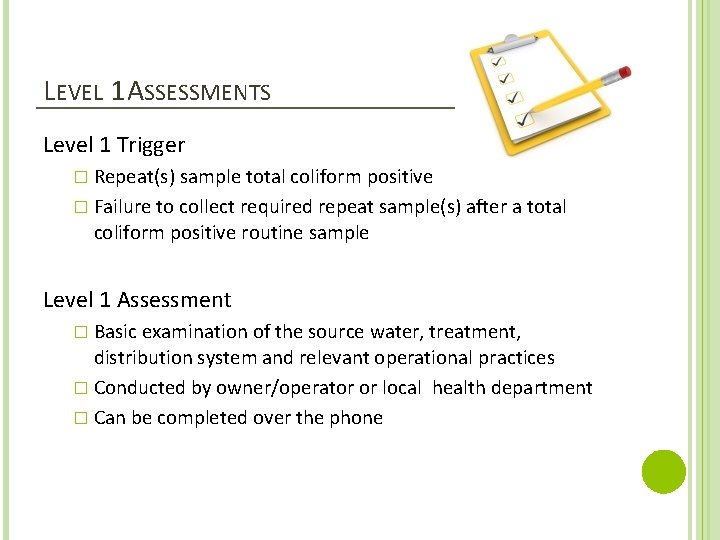
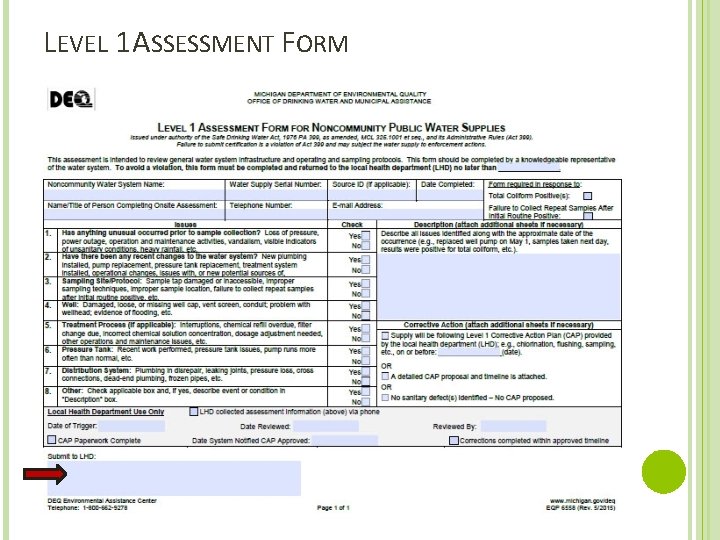
LEVEL 1 ASSESSMENTS Level 1 Trigger � Repeat(s) sample total coliform positive � Failure to collect required repeat sample(s) after a coliform positive routine sample total Level 1 Assessment � Basic examination of the source water, treatment, distribution system and relevant operational practices � Conducted by owner/operator or local health department � Can be completed over the phone
LEVEL 1 ASSESSMENT FORM
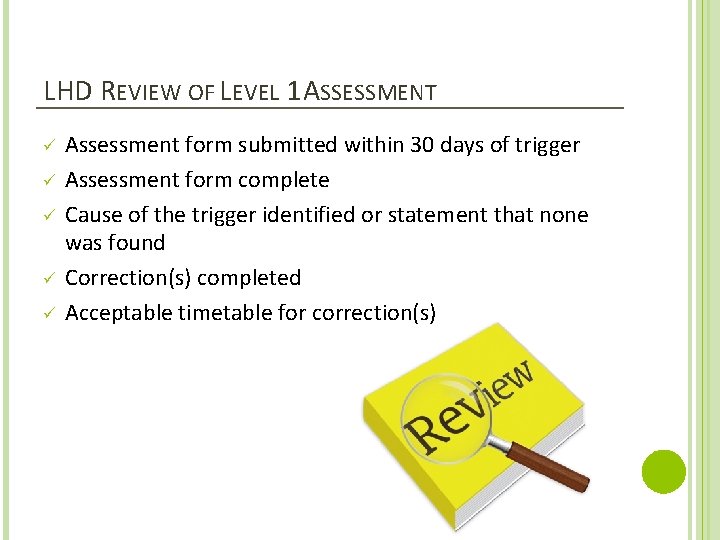
LHD REVIEW OF LEVEL 1 ASSESSMENT Assessment form submitted within 30 days of trigger Assessment form complete Cause of the trigger identified or statement that none was found Correction(s) completed Acceptable timetable for correction(s)
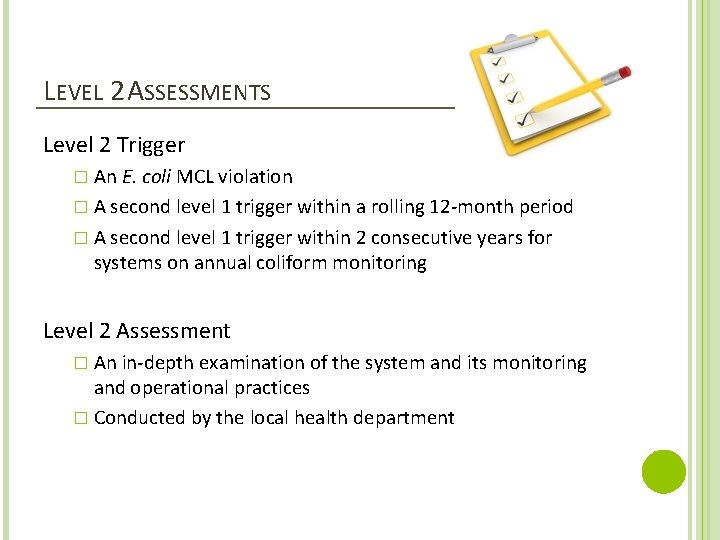
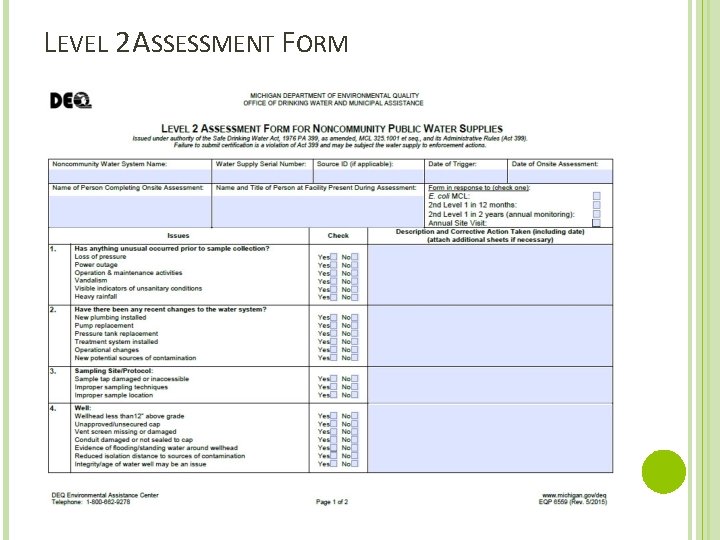
LEVEL 2 ASSESSMENTS Level 2 Trigger � An E. coli MCL violation � A second level 1 trigger within a rolling 12 -month period � A second level 1 trigger within 2 consecutive years for systems on annual coliform monitoring Level 2 Assessment � An in-depth examination of the system and its monitoring and operational practices � Conducted by the local health department
LEVEL 2 ASSESSMENT FORM
LHD AND THE LEVEL 2 ASSESSMENT Assessment completed by LHD as “soon as practical” (within 30 days of trigger) Cause of the trigger identified or statement that none was found Correction(s) completed Acceptable timetable for correction(s)
TREATMENT TECHNIQUE VIOLATIONS Fails to conduct a level 1 or level 2 Assessment within 30 days Fails to correct all sanitary defects from a level 1 or level 2 assessment within 30 days or within the approved corrective action plan timeframe Fails to complete the approved seasonal system start-up procedure
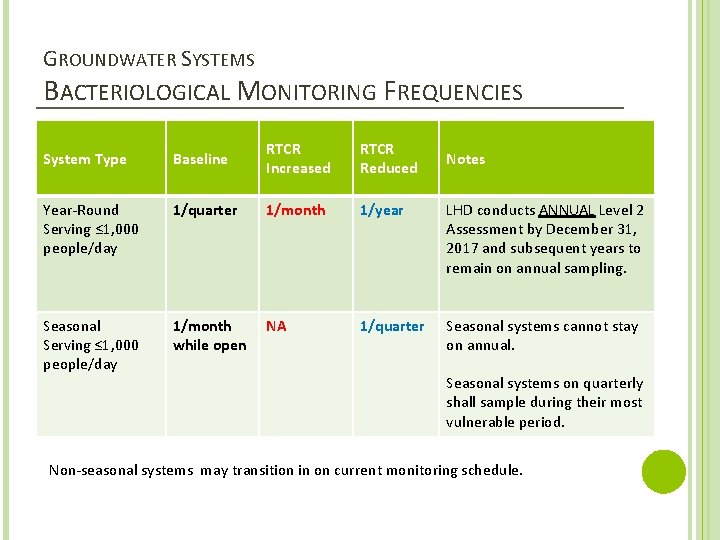
GROUNDWATER SYSTEMS BACTERIOLOGICAL MONITORING FREQUENCIES System Type Baseline RTCR Increased RTCR Reduced Year-Round Serving ≤ 1, 000 people/day 1/quarter 1/month 1/year LHD conducts ANNUAL Level 2 Assessment by December 31, 2017 and subsequent years to remain on annual sampling. Seasonal Serving ≤ 1, 000 people/day 1/month while open NA 1/quarter Seasonal systems cannot stay on annual. Notes Seasonal systems on quarterly shall sample during their most vulnerable period. Non-seasonal systems may transition in on current monitoring schedule.
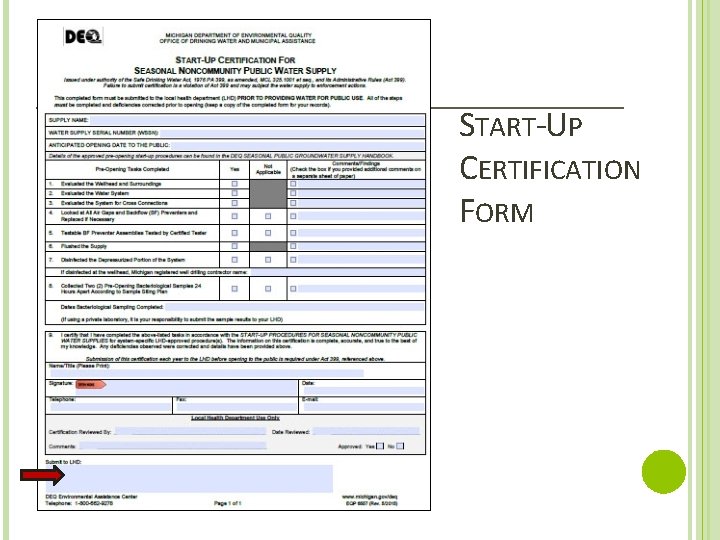
SEASONAL SYSTEM REQUIREMENTS Perform approved start-up procedures Submit start-up certification form Transition in on quarterly monitoring when open (annual monitoring not allowed) Sample collection during high vulnerability periods All systems serving greater than 1, 000 people/day must sample monthly.
START-UP CERTIFICATION FORM
YEAR-ROUND SYSTEMS WITH SEASONAL NATURE Rule 1110 � If the supply depressurizes distribution, they must: Ø Flush distribution Ø Disinfect distribution Ø Collect 2 special purpose samples 24 hours apart Special purpose samples DO NOT qualify as routine samples.
WHAT HAS DEQ DONE TO PREPARE FOR RTCR? FORM Development: Level 1 assessment form Level 2 assessment form Seasonal system start up certification form
WHAT HAS DEQ DONE TO PREPARE FOR RTCR? Document Development: RTCR Fact Sheet Seasonal system start up procedure Seasonal system handbook
WHAT HAS DEQ DONE TO PREPARE FOR RTCR? GUIDANCE and TRACKING : Assessment tracking spreadsheet Seasonal system definition & determination Coliform positive flowchart E. Coli MCL flowchart Google Docs storage https: //drive. google. com/folderview? id=0 B 2 Hvw 92 llr 4 p fn. Fi. Y 1 Jae. TJy. Q 3 h. VV 2 U 2 b. EZBUEx. VVXBzb. Wh 4 S 0 h. LOGp. Eb Wg 3 b. HZx. T 1 Bf. Qm 8&usp=sharing
WHAT HAS DEQ DONE TO PREPARE FOR RTCR? Training to LHDs and NCWS owners/operators: 12 public presentations throughout the state Presentations to MDARD, DNR, MARVAC, etc. Licensed campgrounds notified with license renewal LHD webinar in April 2 day training in Bay City in April Routine emails sent to LHD coordinators Gov. Delivery service started
WHAT IS DEQ DOING NEXT TO PREPARE FOR RTCR? Current projects “in the works”: Notification letter to all NCWSs in July Seasonal system webinar for LHDs “Protected Source” definition Update policy on “Population Served” Update NC evaluation worksheet/summary Update all template letters and enforcement procedures Explore additional funding SDWIS Prime training when available (2017? ) Send suggestions our way!
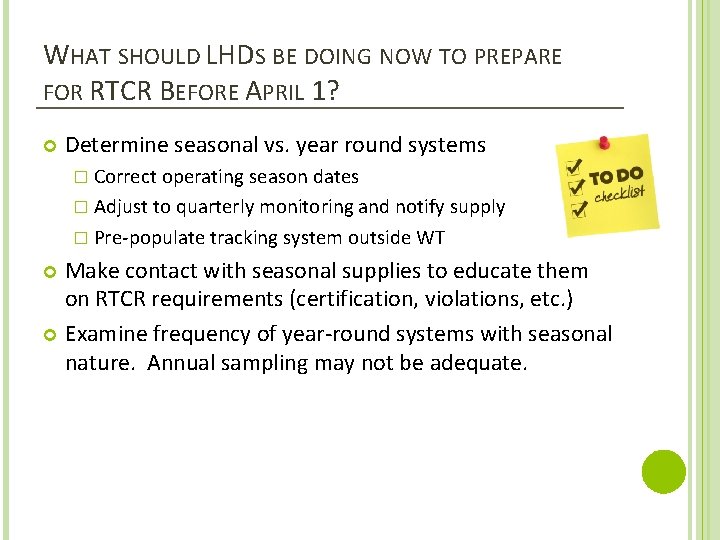
WHAT SHOULD LHDS BE DOING NOW TO PREPARE FOR RTCR BEFORE APRIL 1? Determine seasonal vs. year round systems � Correct operating season dates � Adjust to quarterly monitoring and notify supply � Pre-populate tracking system outside WT Make contact with seasonal supplies to educate them on RTCR requirements (certification, violations, etc. ) Examine frequency of year-round systems with seasonal nature. Annual sampling may not be adequate.
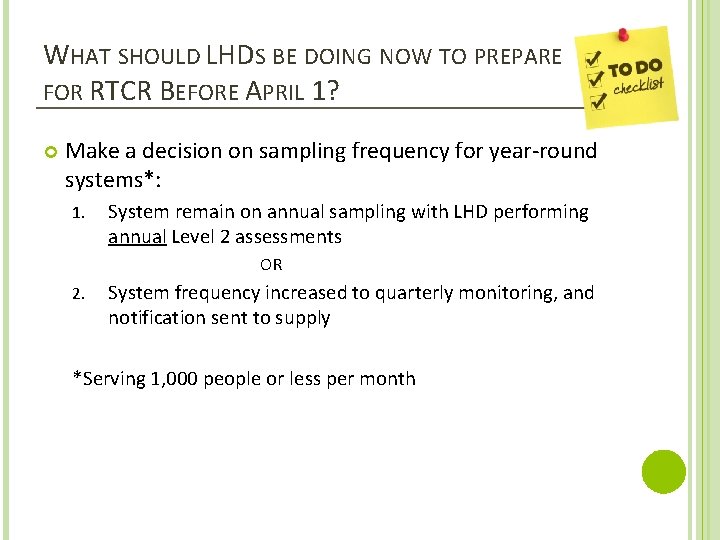
WHAT SHOULD LHDS BE DOING NOW TO PREPARE FOR RTCR BEFORE APRIL 1? Make a decision on sampling frequency for year-round systems*: 1. System remain on annual sampling with LHD performing annual Level 2 assessments OR 2. System frequency increased to quarterly monitoring, and notification sent to supply *Serving 1, 000 people or less per month
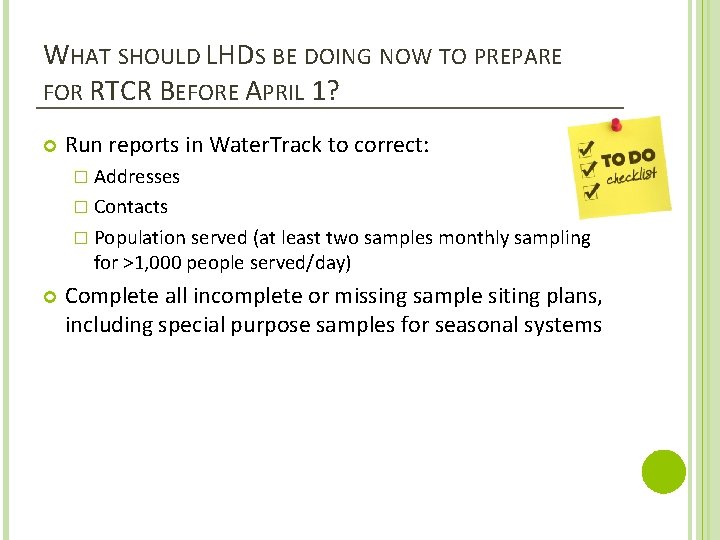
WHAT SHOULD LHDS BE DOING NOW TO PREPARE FOR RTCR BEFORE APRIL 1? Run reports in Water. Track to correct: � Addresses � Contacts � Population served (at least two samples monthly sampling for >1, 000 people served/day) Complete all incomplete or missing sample siting plans, including special purpose samples for seasonal systems
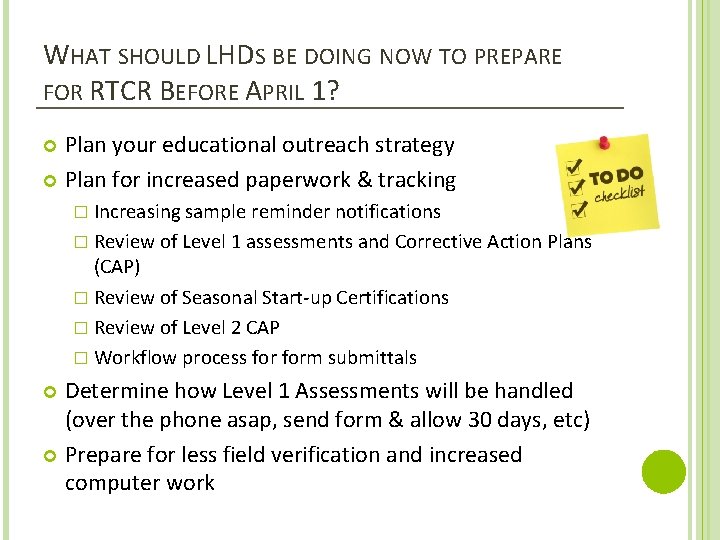
WHAT SHOULD LHDS BE DOING NOW TO PREPARE FOR RTCR BEFORE APRIL 1? Plan your educational outreach strategy Plan for increased paperwork & tracking � Increasing sample reminder notifications � Review of Level 1 assessments and Corrective Action Plans (CAP) � Review of Seasonal Start-up Certifications � Review of Level 2 CAP � Workflow process form submittals Determine how Level 1 Assessments will be handled (over the phone asap, send form & allow 30 days, etc) Prepare for less field verification and increased computer work
IN SUMMARY April 1, 2016 implementation Attend seasonal system webinar Water. Track cleanup of data critical Reach out to seasonal systems Use DEQ’s Noncommunity Website www. michigan. gov/deqnoncommunity Give us specifics on what we can do to help