
Revised Theory of the Slug Calorimeter Method for
- Slides: 15
Revised Theory of the Slug Calorimeter Method for Accurate Thermal Conductivity and Thermal Diffusivity Measurements Akhan Tleoubaev, Andrzej Brzezinski Presented at the 30 th International Thermal Conductivity Conference and the 18 th International Thermal Expansion Symposium September, 2009, Pittsburgh, Pennsylvania, USA
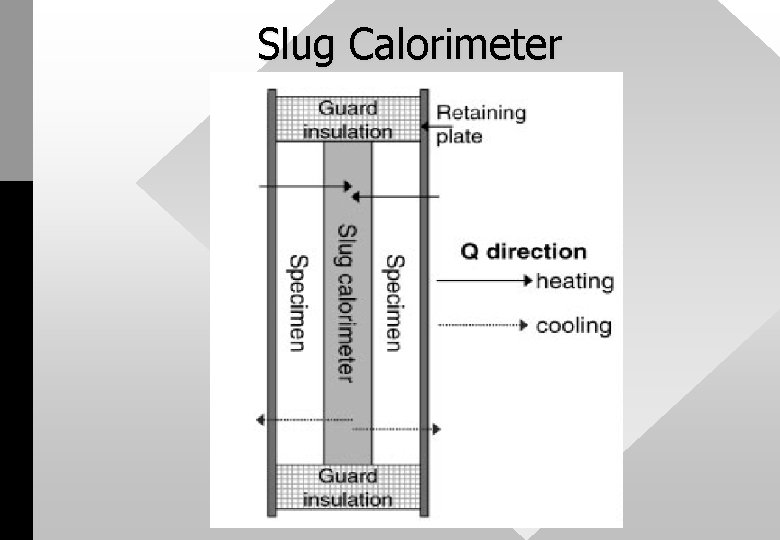
Slug Calorimeter
The Slug Calorimeter Method for thermal conductivity measurements of the fire resistive materials (FRM) at temperatures up to 1100 K (~827 C) • ASTM E 2584 -07 “Standard Practice for Thermal Conductivity of Materials Using a Thermal Capacitance (Slug) Calorimeter” Committee E 37 on Thermal Measurements
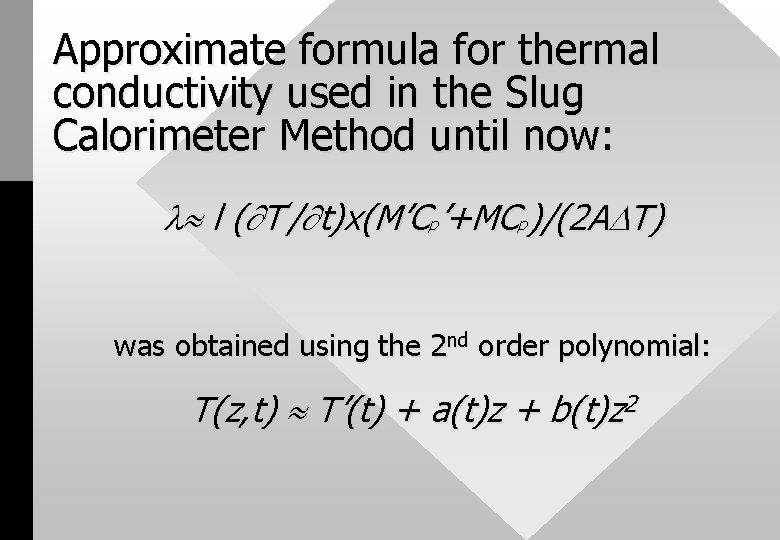
Approximate formula for thermal conductivity used in the Slug Calorimeter Method until now: l ( T’/ t)x(M’Cp’+MCp)/(2 A T) was obtained using the 2 nd order polynomial: T(z, t) T’(t) + a(t)z + b(t)z 2
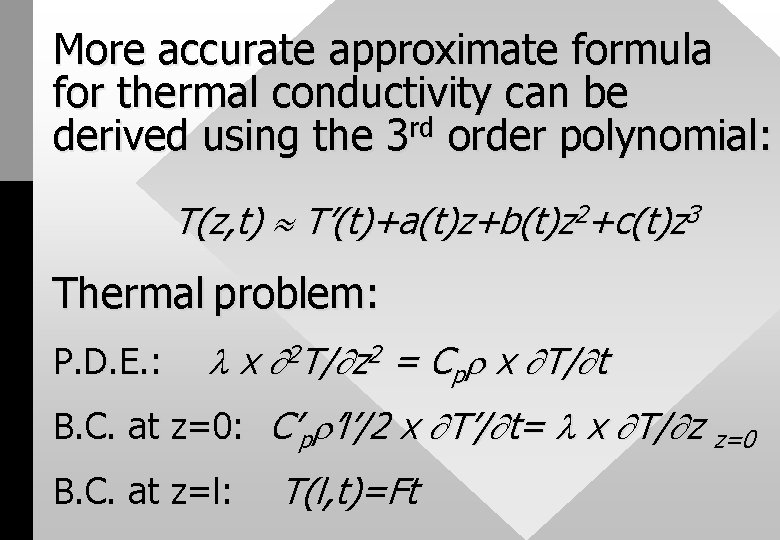
More accurate approximate formula for thermal conductivity can be derived using the 3 rd order polynomial: T(z, t) T’(t)+a(t)z+b(t)z 2+c(t)z 3 Thermal problem: P. D. E. : x 2 T/ z 2 = Cp x T/ t B. C. at z=0: C’p ’l’/2 x T’/ t= x T/ z z=0 B. C. at z=l: T(l, t)=Ft
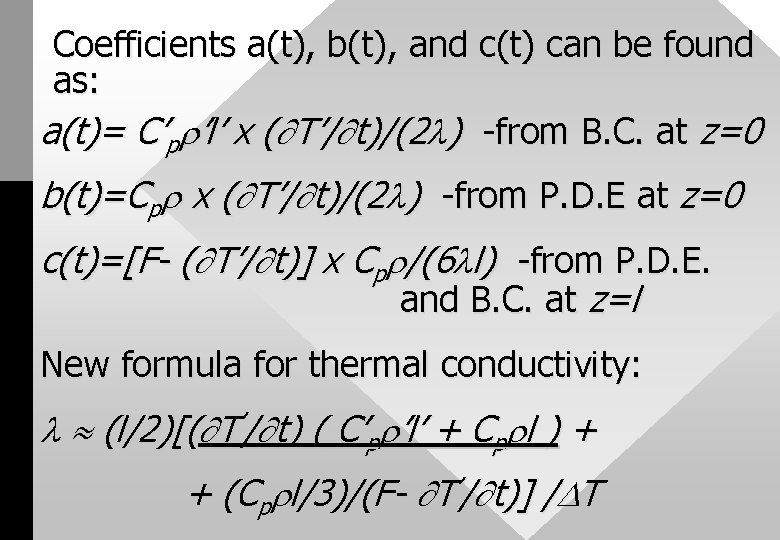
Coefficients a(t), b(t), and c(t) can be found as: a(t)= C’p ’l’ x ( T’/ t)/(2 ) -from B. C. at z=0 b(t)=Cp x ( T’/ t)/(2 ) -from P. D. E at z=0 c(t)=[F- ( T’/ t)] x Cp /(6 l) -from P. D. E. and B. C. at z=l New formula for thermal conductivity: (l/2)[( T’/ t) ( C’p ’l’ + Cp l ) + + (Cp l/3)/(F- T’/ t)] / T
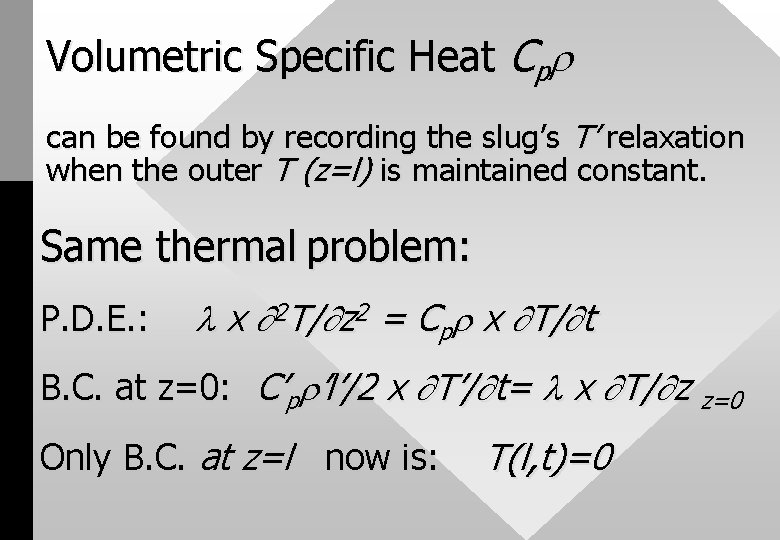
Volumetric Specific Heat Cp can be found by recording the slug’s T’ relaxation when the outer T (z=l) is maintained constant. Same thermal problem: P. D. E. : x 2 T/ z 2 = Cp x T/ t B. C. at z=0: C’p ’l’/2 x T’/ t= x T/ z z=0 Only B. C. at z=l now is: T(l, t)=0
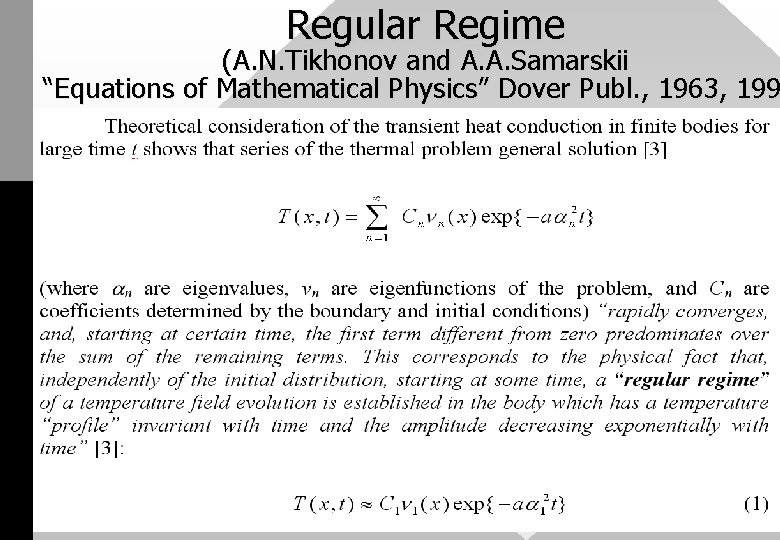
Regular Regime (A. N. Tikhonov and A. A. Samarskii “Equations of Mathematical Physics” Dover Publ. , 1963, 199
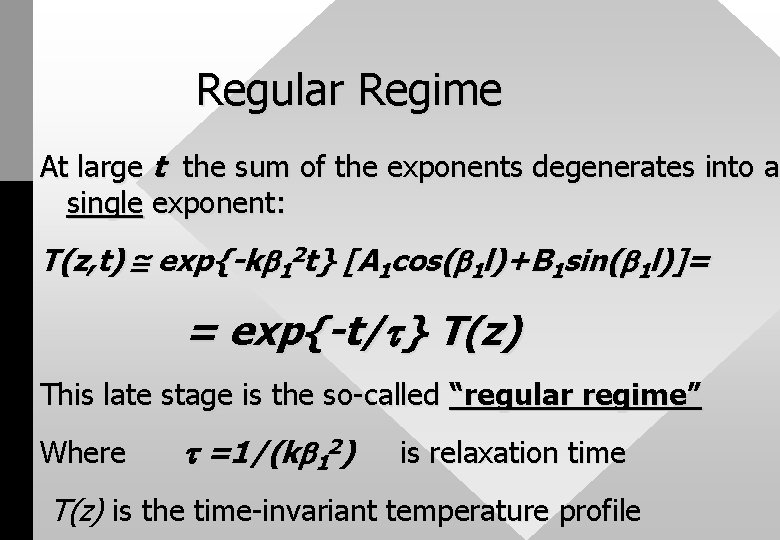
Regular Regime At large t the sum of the exponents degenerates into a single exponent: T(z, t) exp{-k 12 t} [A 1 cos( 1 l)+B 1 sin( 1 l)]= = exp{-t/ } T(z) This late stage is the so-called “regular regime” Where =1/(k 12) is relaxation time T(z) is the time-invariant temperature profile
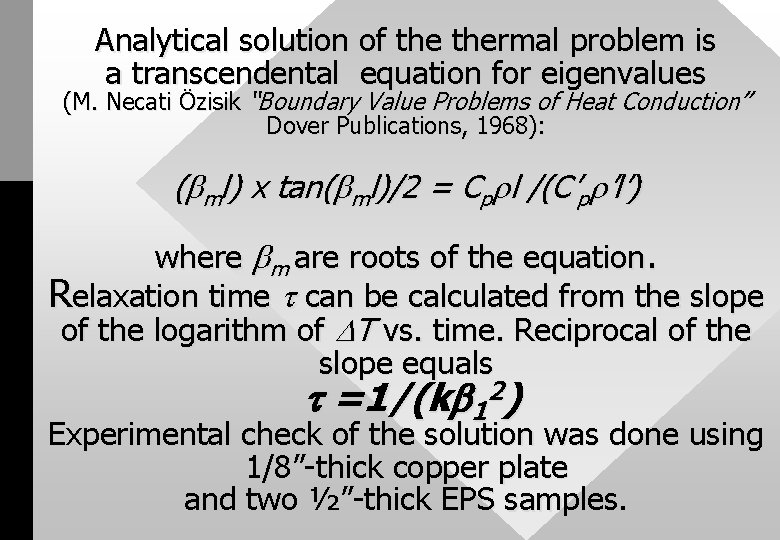
Analytical solution of thermal problem is a transcendental equation for eigenvalues (M. Necati Özisik “Boundary Value Problems of Heat Conduction” Dover Publications, 1968): ( ml) x tan( ml)/2 = Cp l /(C’p ’l’) where m are roots of the equation. Relaxation time can be calculated from the slope of the logarithm of T vs. time. Reciprocal of the slope equals =1/(k 12) Experimental check of the solution was done using 1/8”-thick copper plate and two ½”-thick EPS samples.
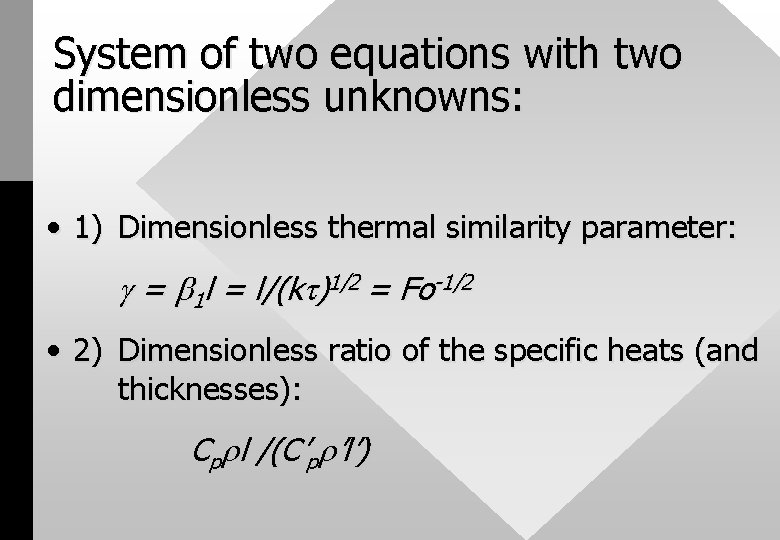
System of two equations with two dimensionless unknowns: • 1) Dimensionless thermal similarity parameter: = 1 l = l/(k )1/2 = Fo-1/2 • 2) Dimensionless ratio of the specific heats (and thicknesses): Cp l /(C’p ’l’)
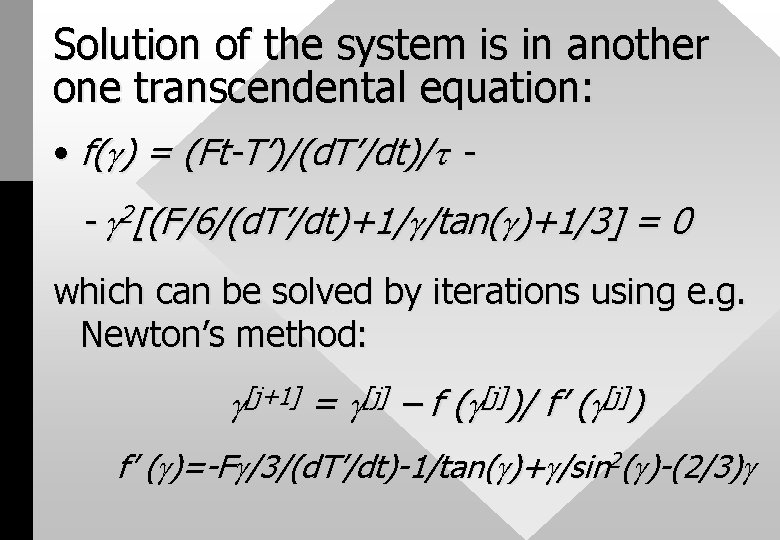
Solution of the system is in another one transcendental equation: • f( ) = (Ft-T’)/(d. T’/dt)/ - - 2[(F/6/(d. T’/dt)+1/ /tan( )+1/3] = 0 which can be solved by iterations using e. g. Newton’s method: [j+1] = [j] – f ( [j])/ f’ ( [j]) f’ ( )=-F /3/(d. T’/dt)-1/tan( )+ /sin 2( )-(2/3)
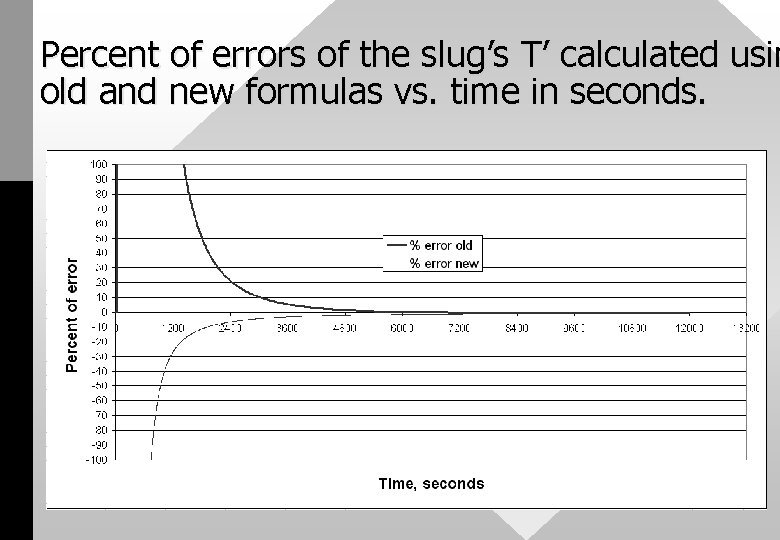
Percent of errors of the slug’s T’ calculated usin old and new formulas vs. time in seconds.
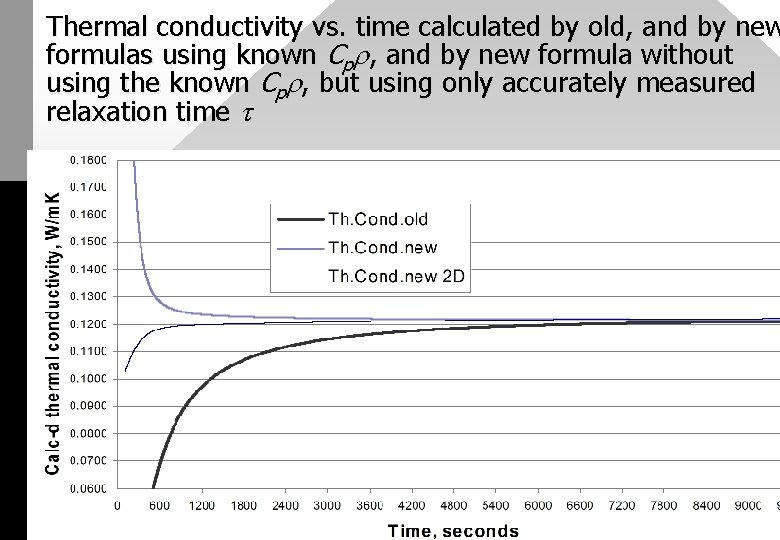
Thermal conductivity vs. time calculated by old, and by new formulas using known Cp , and by new formula without using the known Cp , but using only accurately measured relaxation time
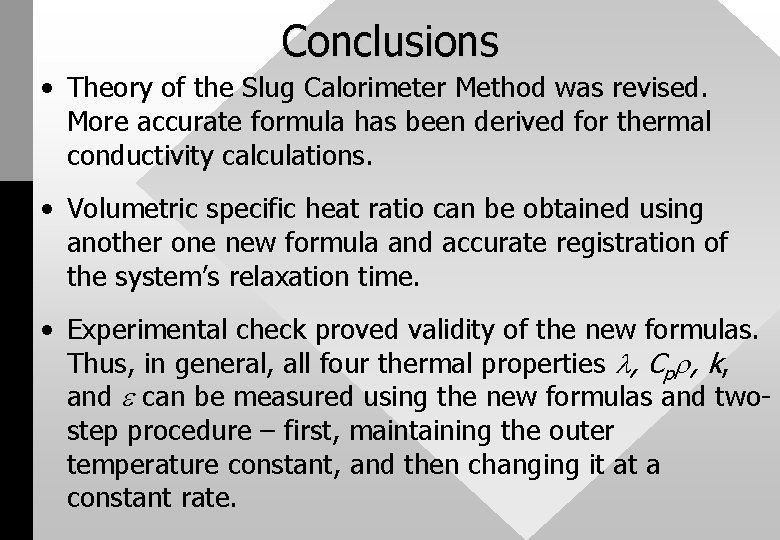
Conclusions • Theory of the Slug Calorimeter Method was revised. More accurate formula has been derived for thermal conductivity calculations. • Volumetric specific heat ratio can be obtained using another one new formula and accurate registration of the system’s relaxation time. • Experimental check proved validity of the new formulas. Thus, in general, all four thermal properties , Cp , k, and can be measured using the new formulas and twostep procedure – first, maintaining the outer temperature constant, and then changing it at a constant rate.