
Revised National Tuberculosis Control Programme Overview Key Priorities
Revised National Tuberculosis Control Programme Overview - Key Priorities Dr K S Sachdeva Deputy Director General, Central TB Division Revised National Tuberculosis Control Programme Ministry of Health and Family Welfare

What is Tuberculosis? Tuberculosis (TB) is an infectious disease caused by the bacterium Mycobacterium tuberculosis (MTB) Tuberculosis generally affects the lungs, but can also affect other parts of the body One patient with infectious pulmonary TB if untreated can infect 10 -15 persons in a year
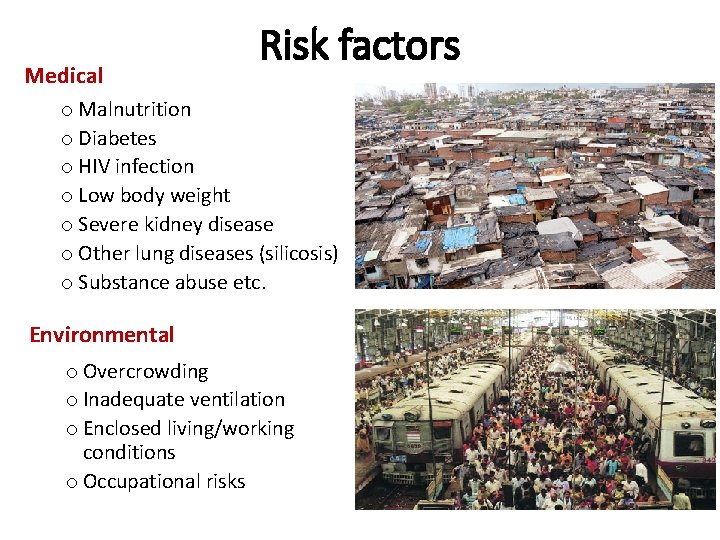
Medical Risk factors o Malnutrition o Diabetes o HIV infection o Low body weight o Severe kidney disease o Other lung diseases (silicosis) o Substance abuse etc. Environmental o Overcrowding o Inadequate ventilation o Enclosed living/working conditions o Occupational risks

The TB threat is REAL in India 28 Lakh people fell ill from TB Missing million TB patients 4. 2 Lakh 1. 4 Lakh people died from TB people had drugresistant TB 1 patient dies every minute Less than 50% treated successfully WHO Global TB Report 2017

In India……. 40 crore infected 35 lakh estimated TB patients annually 4. 2 lakh deaths Due to TB annually 5
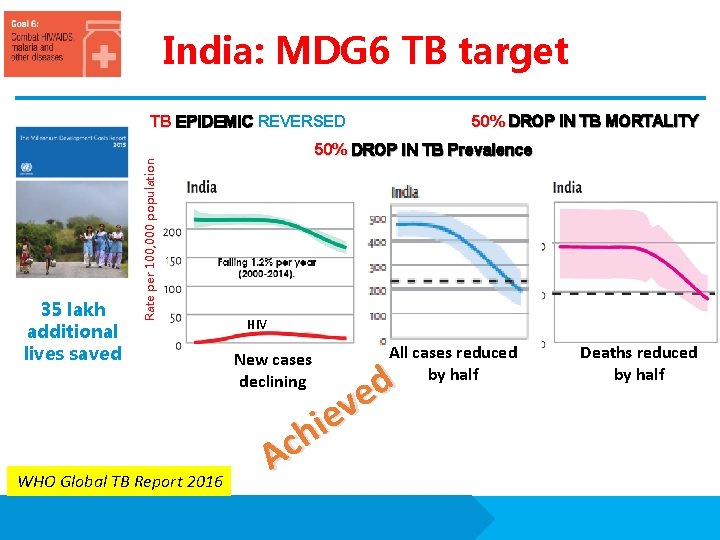
India: MDG 6 TB target 50% DROP IN TB MORTALITY TB EPIDEMIC REVERSED Rate per 100, 000 population 35 lakh additional lives saved 50% DROP IN TB Prevalence HIV New cases declining d e v e i h Ac 216 167 per lakh pop (23% reduction) WHO Global TB Report 2016 All cases reduced by half 465 195 per lakh pop (58% reduction) Deaths reduced by half 38 17 per lakh pop (55% reduction)
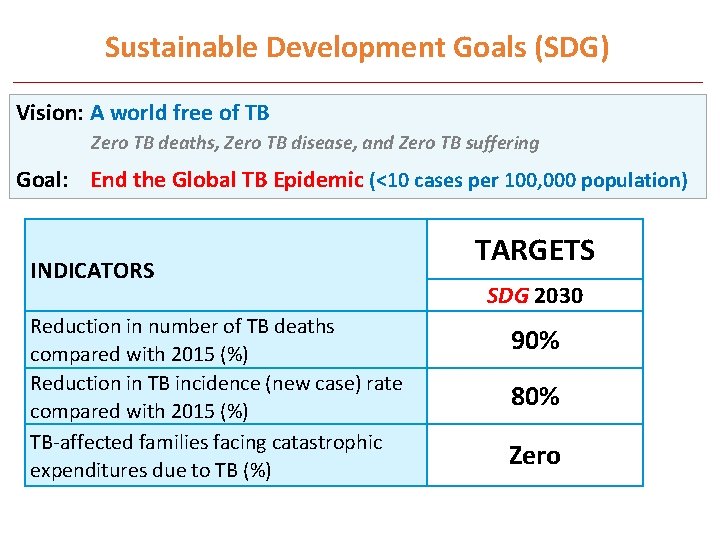
Sustainable Development Goals (SDG) Vision: A world free of TB Zero TB deaths, Zero TB disease, and Zero TB suffering Goal: End the Global TB Epidemic (<10 cases per 100, 000 population) INDICATORS Reduction in number of TB deaths compared with 2015 (%) Reduction in TB incidence (new case) rate compared with 2015 (%) TB-affected families facing catastrophic expenditures due to TB (%) TARGETS SDG 2030 90% 80% Zero

TB Free India • India has committed to End TB by 2025, 5 years ahead of the global SDG target • Prime Minister of India launched TB Free India campaign at ‘Delhi End TB Summit’ on 13 th March, 2018 • The campaign calls for a social movement focused on patient-centric and holistic care driven by integrated actions for TB Free India

National Strategic Plan (2017 -25) Community Engagement Preventive Measures Multisectoral response Active Case Finding Strategies ICT Tools for adherence and monitoring TB Comorbidities Private sector engagement Drug Resistant TB 9
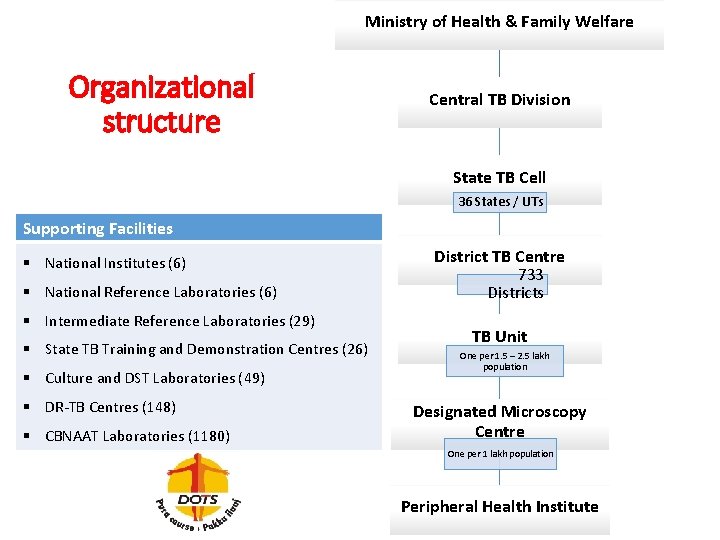
Ministry of Health & Family Welfare Organizational structure Central TB Division State TB Cell 36 States / UTs Supporting Facilities § National Institutes (6) § National Reference Laboratories (6) § Intermediate Reference Laboratories (29) § State TB Training and Demonstration Centres (26) § Culture and DST Laboratories (49) § DR-TB Centres (148) § CBNAAT Laboratories (1180) District TB Centre 733 Districts TB Unit One per 1. 5 – 2. 5 lakh population Designated Microscopy Centre One per 1 lakh population Peripheral Health Institute
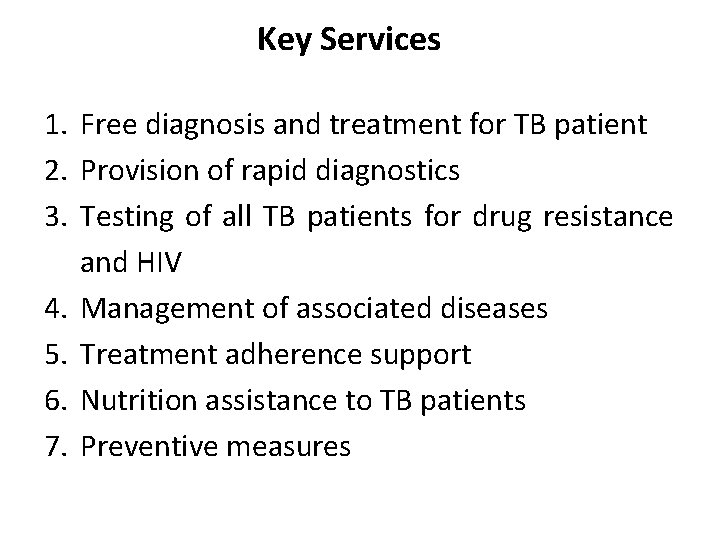
Key Services 1. Free diagnosis and treatment for TB patient 2. Provision of rapid diagnostics 3. Testing of all TB patients for drug resistance and HIV 4. Management of associated diseases 5. Treatment adherence support 6. Nutrition assistance to TB patients 7. Preventive measures

Strategy to find Active TB Case Finding Reaching patients seeking care in Private Sector High Sensitive Diagnostic tool
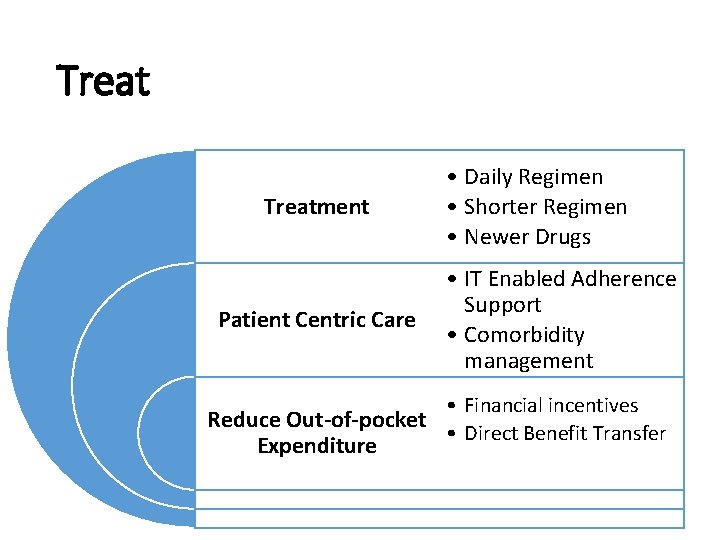
Treatment Patient Centric Care • Daily Regimen • Shorter Regimen • Newer Drugs • IT Enabled Adherence Support • Comorbidity management • Financial incentives Reduce Out-of-pocket • Direct Benefit Transfer Expenditure
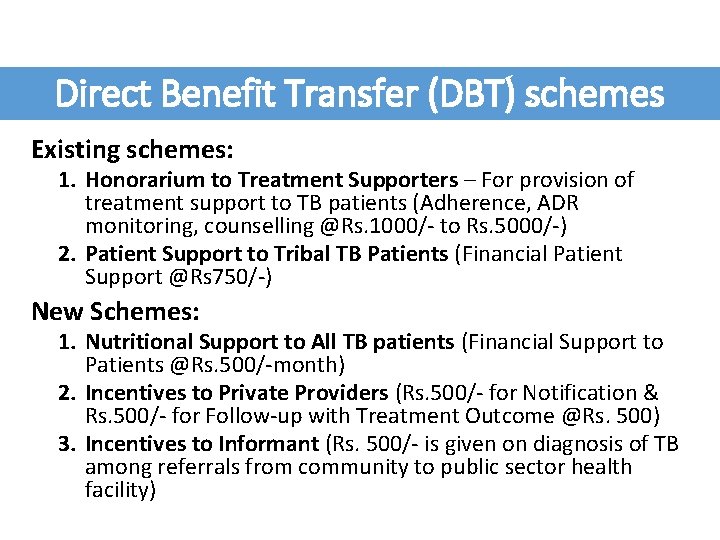
Direct Benefit Transfer (DBT) schemes Existing schemes: 1. Honorarium to Treatment Supporters – For provision of treatment support to TB patients (Adherence, ADR monitoring, counselling @Rs. 1000/- to Rs. 5000/-) 2. Patient Support to Tribal TB Patients (Financial Patient Support @Rs 750/-) New Schemes: 1. Nutritional Support to All TB patients (Financial Support to Patients @Rs. 500/-month) 2. Incentives to Private Providers (Rs. 500/- for Notification & Rs. 500/- for Follow-up with Treatment Outcome @Rs. 500) 3. Incentives to Informant (Rs. 500/- is given on diagnosis of TB among referrals from community to public sector health facility)

Prevent • Air borne infection control measures • Strengthen Contact Investigation • Preventive treatment in high risk groups • Manage Latent TB Infection • Address determinants of disease

Increased Access to Diagnostic Services è Expansion of microscopy centres to improve access § Phase 1 - PHCs where a Laboratory Technician (LT) is available § Phase 2 – Other PHCs èCurrent Status – Microscopy Centres in 2018 Microscopy Centres in 2017 16, 758 14, 576 16. 1 lakh TB patients notified in public sector ( 12% in 2018) 1 microscopy centre at ~75, 000 population Policy Update in RNTCP, 2018
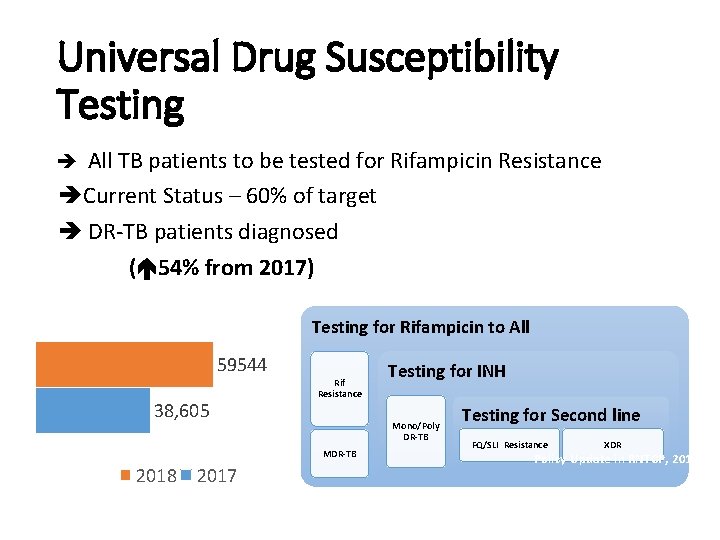
Universal Drug Susceptibility Testing è All TB patients to be tested for Rifampicin Resistance èCurrent Status – 60% of target è DR-TB patients diagnosed ( 54% from 2017) Testing for Rifampicin to All 59544 38, 605 Rif Resistance Mono/Poly DR-TB MDR-TB 2018 2017 Testing for INH Testing for Second line FQ/SLI Resistance XDR Policy Update in RNTCP, 2018
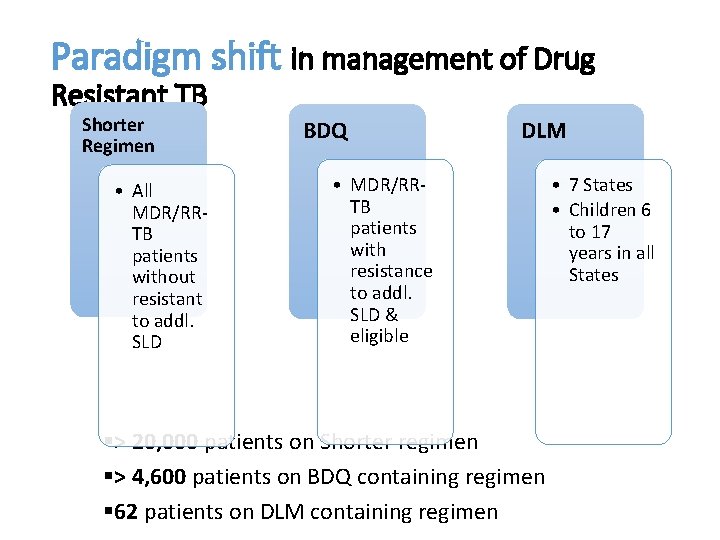
Paradigm shift in management of Drug Resistant TB Shorter Regimen • All MDR/RRTB patients without resistant to addl. SLD BDQ • MDR/RRTB patients with resistance to addl. SLD & eligible DLM • 7 States • Children 6 to 17 years in all States §> 20, 000 patients on Shorter regimen Policy Update in RNTCP, 2018 §> 4, 600 patients on BDQ containing regimen § 62 patients on DLM containing regimen
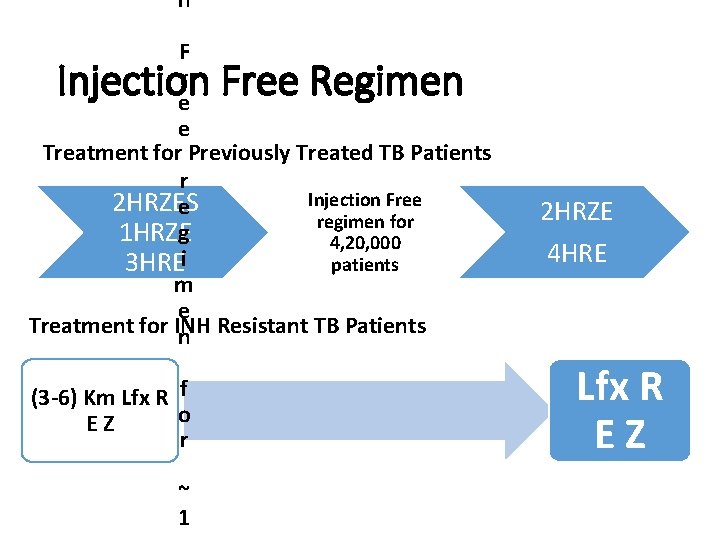
n F r e e Treatment for Previously Treated TB Patients r Injection Free 2 HRZES e regimen for 1 HRZEg 4, 20, 000 patients 3 HREi m e Treatment for INH Resistant TB Patients n (3 -6) Km Lfx R f o E Z r ~ 1 Injection Free Regimen 2 HRZE 4 HRE Lfx R E Z Policy Update in RNTCP, 2018
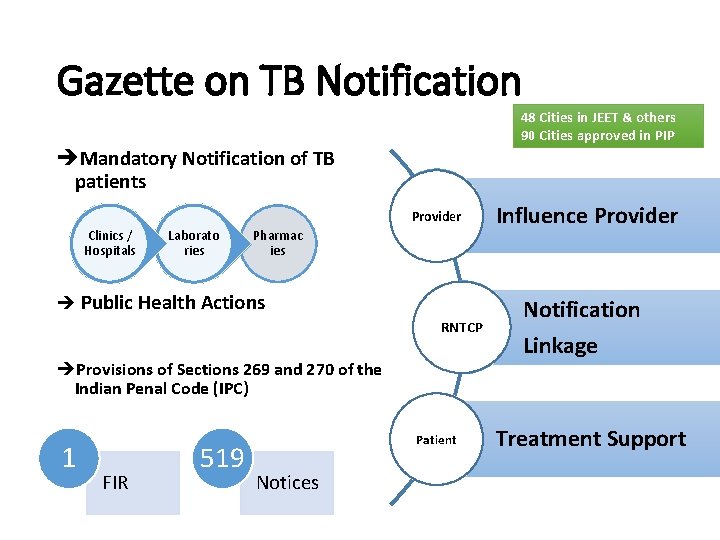
Gazette on TB Notification 48 Cities in JEET & others 90 Cities approved in PIP èMandatory Notification of TB patients Provider Clinics / Hospitals Laborato ries Pharmac ies è Public Health Actions RNTCP èProvisions of Sections 269 and 270 of the Indian Penal Code (IPC) 1 FIR 519 Patient Influence Provider Notification Linkage Treatment Support Policy Update in RNTCP, 2018 Notices
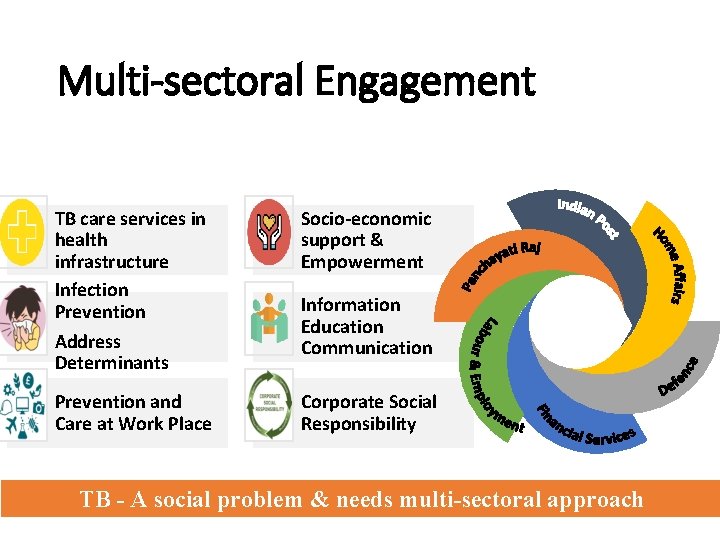
Multi-sectoral Engagement TB care services in health infrastructure Infection Prevention Address Determinants Socio-economic support & Empowerment Prevention and Care at Work Place Corporate Social Responsibility Information Education Communication Policy Update in RNTCP, 2018 TB - A social problem & needs multi-sectoral approach

Community Engagement National 22 States 351 Districts TB Patients | Community 4 lakh Treatment supporters ØTransformation of TB survivors to TB champions ØCapacity building and mentoring programme ØEngagement of existing community groups like PRI, SHG, VHSNC, MAS, Youth Club ØGrievance redressal mechanism ØInvolvement of community representatives in different forums

Call Centre § 1800 -11 -6666 § § § Nikshay Poshan Yojana Counselli ng Outbound & Inbound Time – 7 to 11 Languages – 14 Informat 100 call centre agents ion Pan-India coverage TB Citizen – Patient - Providers Notificati Policy Update in RNTCP, 2018 on Treatme nt Adheren ce Grievance Redressal Follow Up
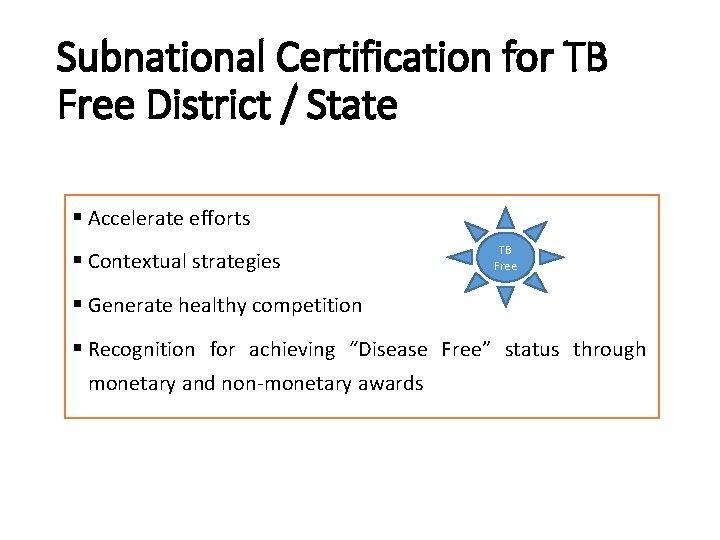
Subnational Certification for TB Free District / State § Accelerate efforts § Contextual strategies TB Free § Generate healthy competition § Recognition for achieving “Disease Free” status through monetary and non-monetary awards Policy Update in RNTCP, 2018
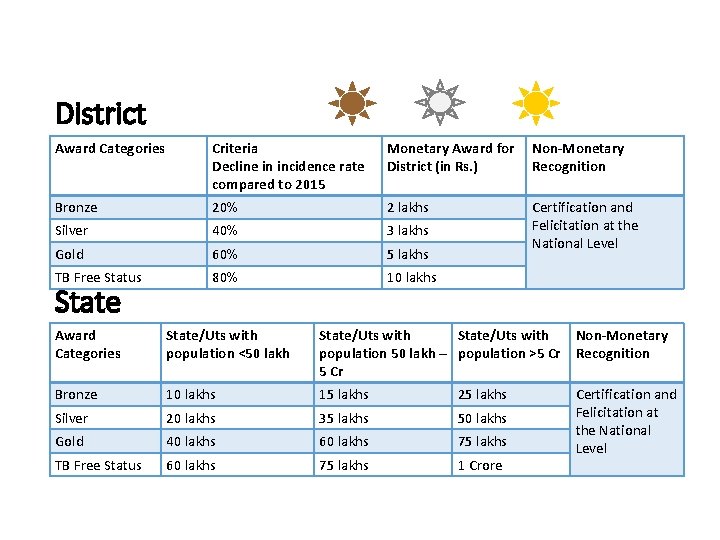
District Award Categories Criteria Decline in incidence rate compared to 2015 Monetary Award for Non-Monetary District (in Rs. ) Recognition Bronze 20% 2 lakhs Silver 40% 3 lakhs Gold 60% 5 lakhs TB Free Status 80% 10 lakhs State Certification and Felicitation at the National Level Award Categories State/Uts with population <50 lakh State/Uts with Non-Monetary population 50 lakh – population >5 Cr Recognition 5 Cr Bronze 10 lakhs 15 lakhs 25 lakhs Silver 20 lakhs 35 lakhs 50 lakhs Gold 40 lakhs 60 lakhs 75 lakhs TB Free Status 60 lakhs 75 lakhs 1 Crore Certification and Felicitation at the National Level
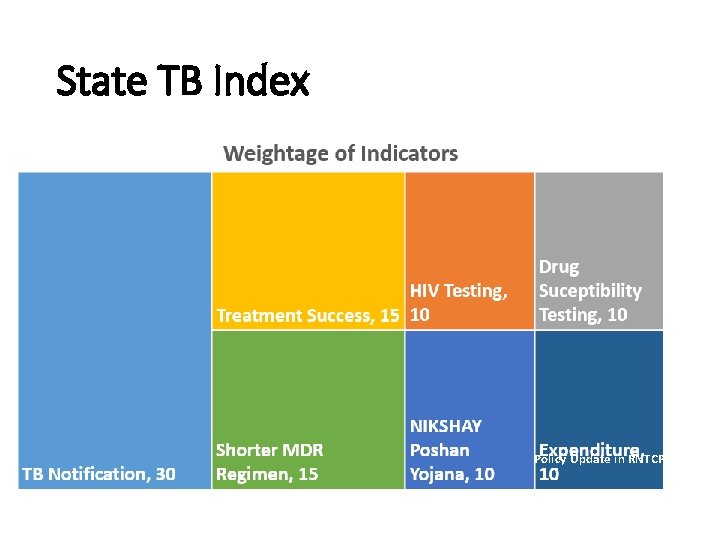
State TB Index Policy Update in RNTCP, 2018

Key Challenges 1. Under reporting and uncertain care of TB patients in private sector 2. Reaching the unreached – Slums, Tribal, vulnerable 3. Drug Resistant TB 4. Co-morbidities – HIV, Diabetes 5. Undernutrition, overcrowding 6. Lack of awareness and poor health seeking behaviour lead to delay in diagnosis

Key Take Away • Improve TB notification rate Ensure mandatory TB notification from private sector • Active TB Case Finding to reach the unreached • Optimum utilization of CBNAAT machines • Expand Universal Drug Susceptibility Testing coverage • Expansion of newer treatment regimens (daily regimen, bedaquiline, delamanid, shorter MDR TB regimen) • NIKSHAY Poshan Yojana to every TB patients • 100% reporting through NIKSHAY • Collaboration with Line Ministries to tackle social determinants of TB • Community participation for TB Elimination
Bending the Curve Accelerating towards a TB free India Thank You
- Slides: 29