
Revised Blooms Taxonomy Blooms Taxonomy 1956 Evaluati on
Revised Bloom's Taxonomy
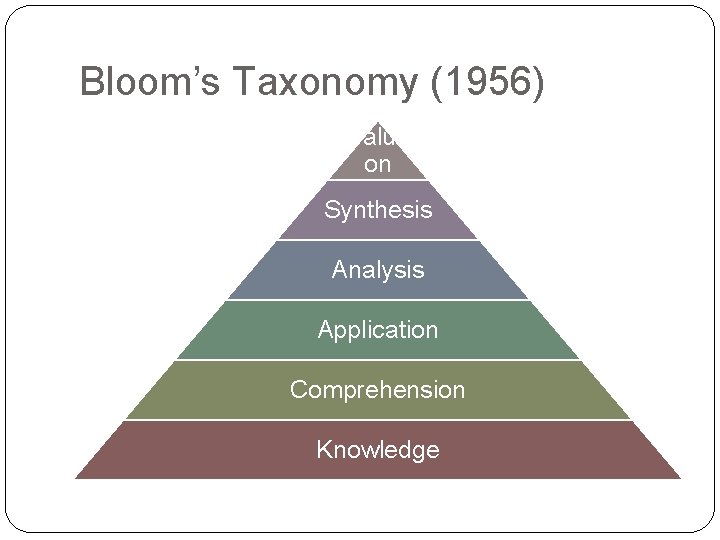
Bloom’s Taxonomy (1956) Evaluati on Synthesis Analysis Application Comprehension Knowledge
Revised Bloom’s Taxonomy (2001) Developed by Lorin Anderson (former student of Bloom) and David Krathwohl Revised to be more powerful and relevant tool to today’s teachers Changes: Categories changed from nouns to verbs Knowledge renamed to Remembering Comprehension renamed to Understanding Synthesis renamed to Creating Synthesis and Evaluation have swapped places in the hierarchy
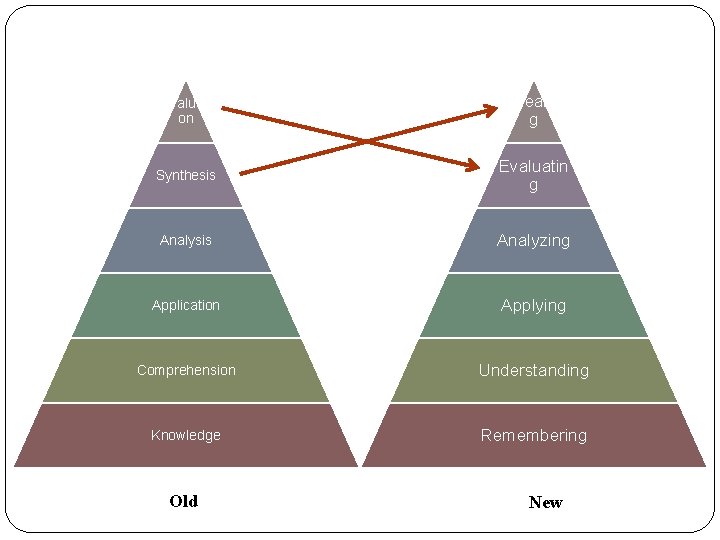
Evaluati on Creatin g Synthesis Evaluatin g Analysis Analyzing Application Applying Comprehension Understanding Knowledge Remembering Old New
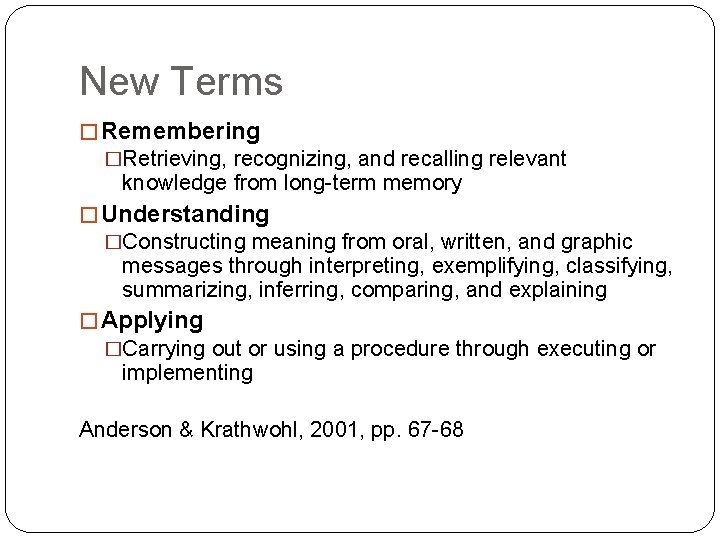
New Terms � Remembering �Retrieving, recognizing, and recalling relevant knowledge from long-term memory � Understanding �Constructing meaning from oral, written, and graphic messages through interpreting, exemplifying, classifying, summarizing, inferring, comparing, and explaining � Applying �Carrying out or using a procedure through executing or implementing Anderson & Krathwohl, 2001, pp. 67 -68
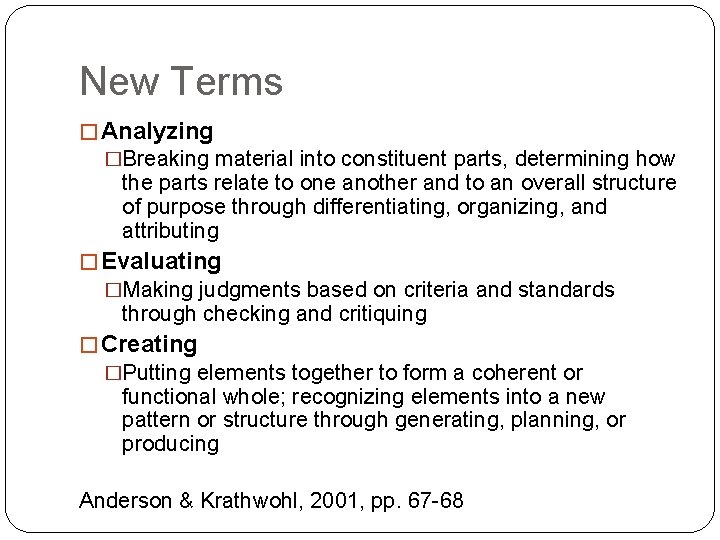
New Terms � Analyzing �Breaking material into constituent parts, determining how the parts relate to one another and to an overall structure of purpose through differentiating, organizing, and attributing � Evaluating �Making judgments based on criteria and standards through checking and critiquing � Creating �Putting elements together to form a coherent or functional whole; recognizing elements into a new pattern or structure through generating, planning, or producing Anderson & Krathwohl, 2001, pp. 67 -68
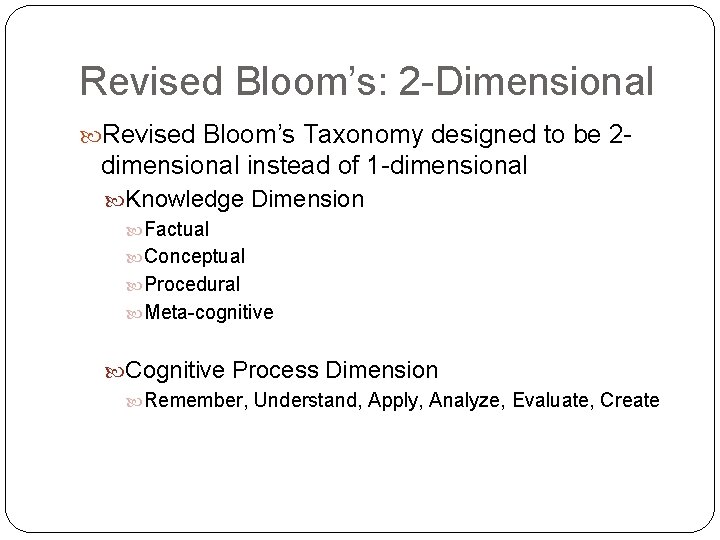
Revised Bloom’s: 2 -Dimensional Revised Bloom’s Taxonomy designed to be 2 - dimensional instead of 1 -dimensional Knowledge Dimension Factual Conceptual Procedural Meta-cognitive Cognitive Process Dimension Remember, Understand, Apply, Analyze, Evaluate, Create
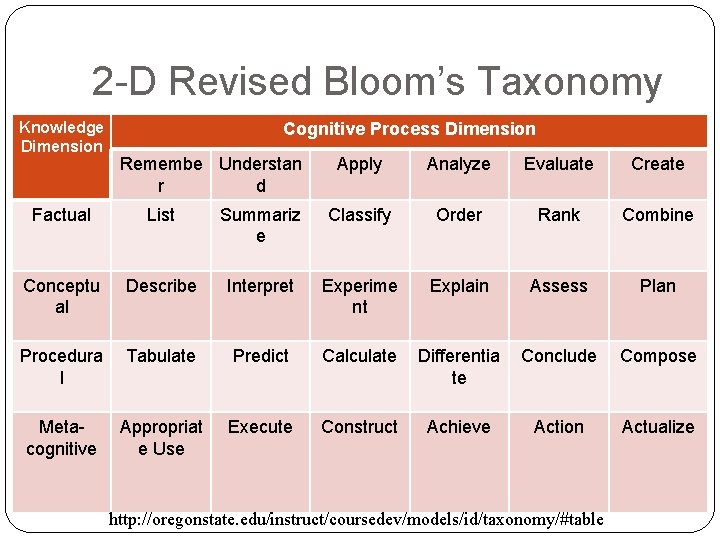
2 -D Revised Bloom’s Taxonomy Knowledge Dimension Cognitive Process Dimension Remembe Understan r d Apply Analyze Evaluate Create Factual List Summariz e Classify Order Rank Combine Conceptu al Describe Interpret Experime nt Explain Assess Plan Procedura l Tabulate Predict Calculate Differentia te Conclude Compose Metacognitive Appropriat e Use Execute Construct Achieve Action Actualize http: //oregonstate. edu/instruct/coursedev/models/id/taxonomy/#table
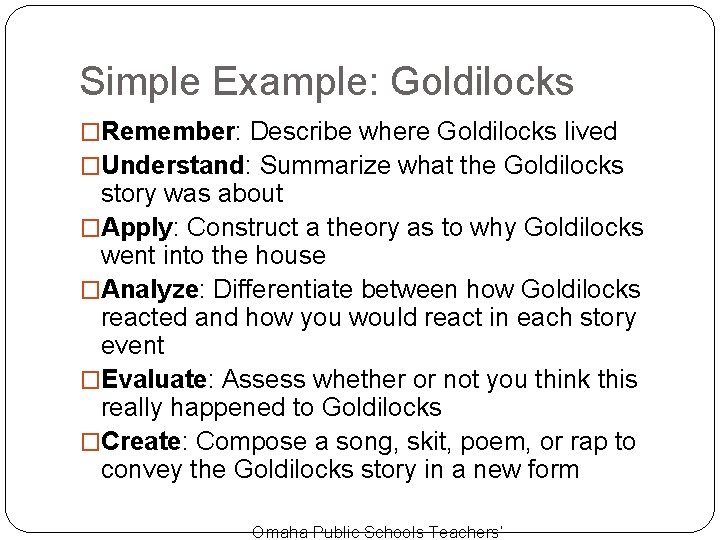
Simple Example: Goldilocks �Remember: Describe where Goldilocks lived �Understand: Summarize what the Goldilocks story was about �Apply: Construct a theory as to why Goldilocks went into the house �Analyze: Differentiate between how Goldilocks reacted and how you would react in each story event �Evaluate: Assess whether or not you think this really happened to Goldilocks �Create: Compose a song, skit, poem, or rap to convey the Goldilocks story in a new form Omaha Public Schools Teachers’
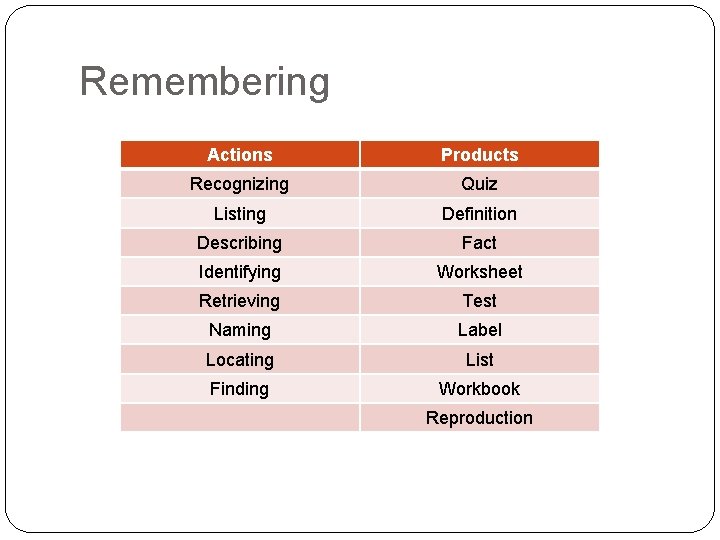
Remembering Actions Products Recognizing Quiz Listing Definition Describing Fact Identifying Worksheet Retrieving Test Naming Label Locating List Finding Workbook Reproduction
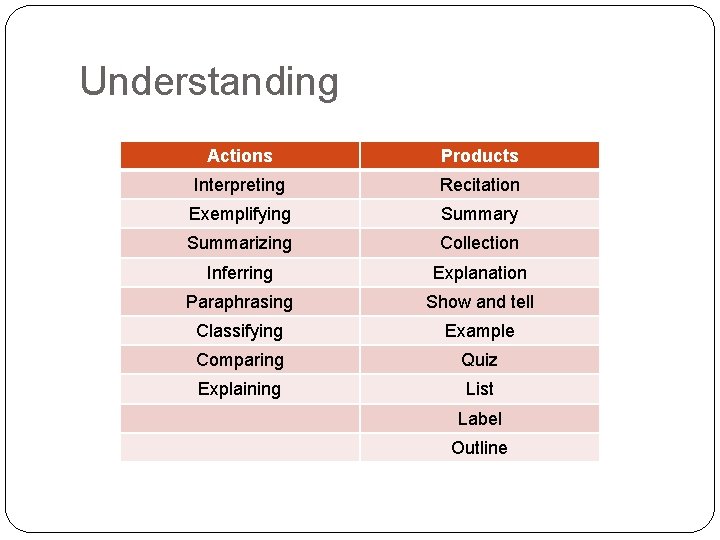
Understanding Actions Products Interpreting Recitation Exemplifying Summary Summarizing Collection Inferring Explanation Paraphrasing Show and tell Classifying Example Comparing Quiz Explaining List Label Outline
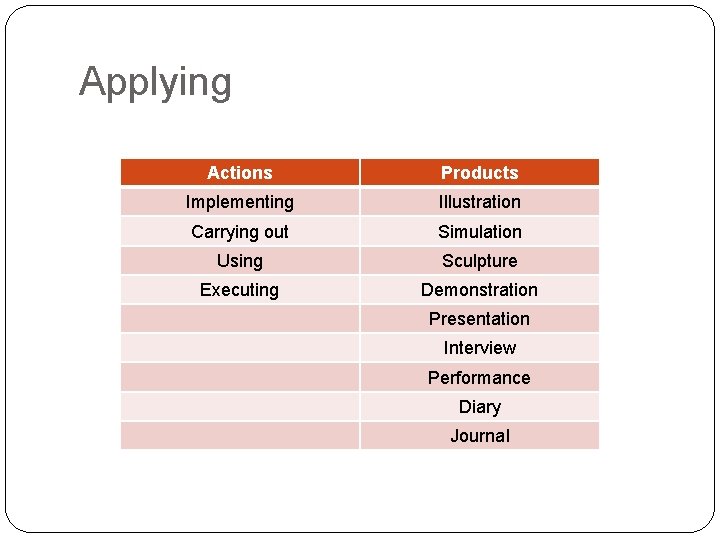
Applying Actions Products Implementing Illustration Carrying out Simulation Using Sculpture Executing Demonstration Presentation Interview Performance Diary Journal
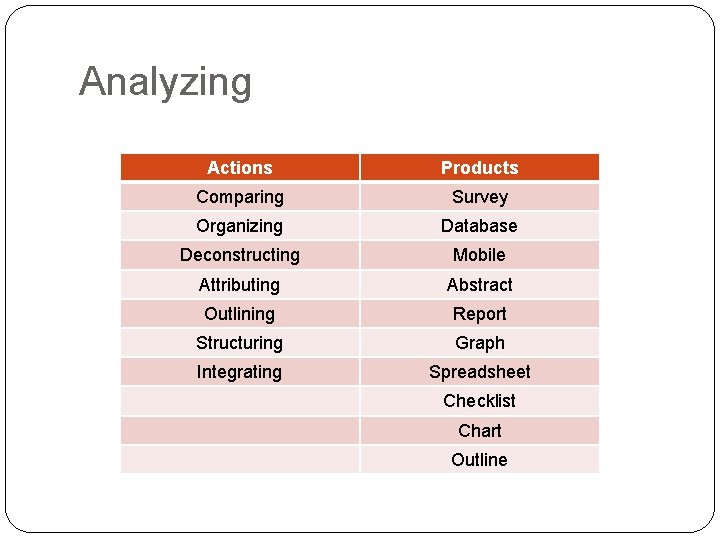
Analyzing Actions Products Comparing Survey Organizing Database Deconstructing Mobile Attributing Abstract Outlining Report Structuring Graph Integrating Spreadsheet Checklist Chart Outline
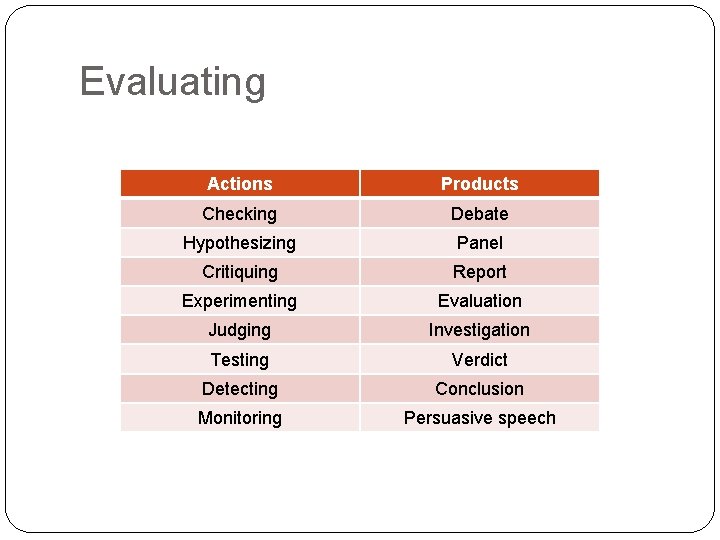
Evaluating Actions Products Checking Debate Hypothesizing Panel Critiquing Report Experimenting Evaluation Judging Investigation Testing Verdict Detecting Conclusion Monitoring Persuasive speech
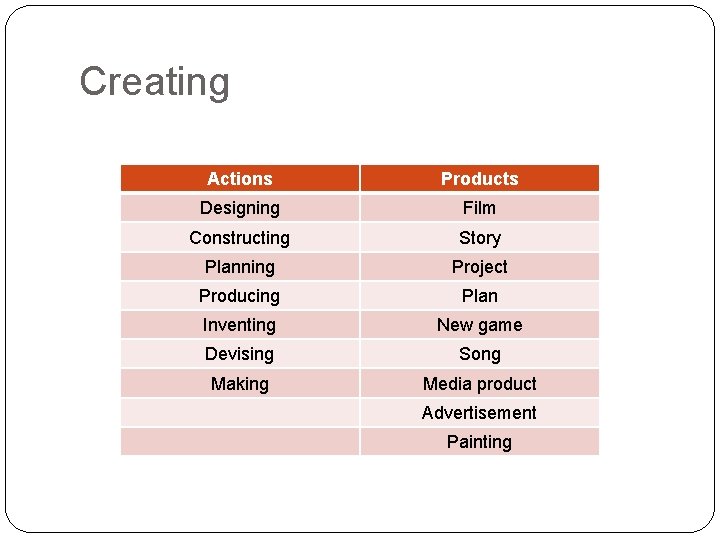
Creating Actions Products Designing Film Constructing Story Planning Project Producing Plan Inventing New game Devising Song Making Media product Advertisement Painting
- Slides: 15