
ReviewLevel AspectBased Sentiment Analysis Using an Ontology Flavius
Review-Level Aspect-Based Sentiment Analysis Using an Ontology Flavius Frasincar* frasincar@ese. eur. nl * Joint work with Sophie de Kok, Linda Punt, Rosita van den Puttelaar, Karoliina Ranta, and Kim Schouten 1
Contents • • Motivation Related Work Data Methodology Evaluation Conclusion Future Work 2
Motivation • Due to the convenience of shopping online there is an increasing number of Web shops • Web shops often provide a platform for consumers to share their experiences, which lead to an increasing number of product reviews: – In 2014: the number of reviews on Amazon exceeded 10 million • Product reviews used for decision making: – Consumers: decide or confirm which products to buy – Producers: improve or develop new products, marketing campaigns, etc. 3
Motivation • Reading all reviews is time consuming, therefore the need for automation • Sentiment mining is defined as the automatic assessment of the sentiment expressed in text (in our case by consumers in product reviews) • Several granularities of sentiment mining: – Review-level – Sentence-level – Aspect-level (product aspects are sometimes referred to as product features): Aspect-Based Sentiment Analysis (ABSA): • Review-level [our focus here] • Sentence-level 4
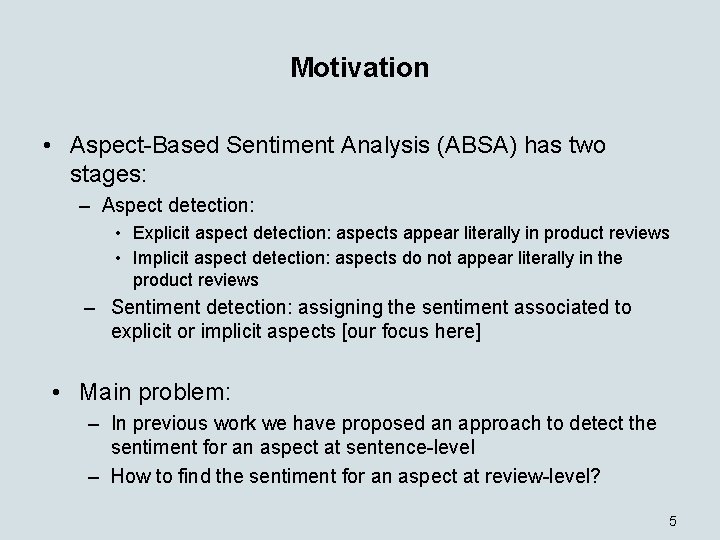
Motivation • Aspect-Based Sentiment Analysis (ABSA) has two stages: – Aspect detection: • Explicit aspect detection: aspects appear literally in product reviews • Implicit aspect detection: aspects do not appear literally in the product reviews – Sentiment detection: assigning the sentiment associated to explicit or implicit aspects [our focus here] • Main problem: – In previous work we have proposed an approach to detect the sentiment for an aspect at sentence-level – How to find the sentiment for an aspect at review-level? 5
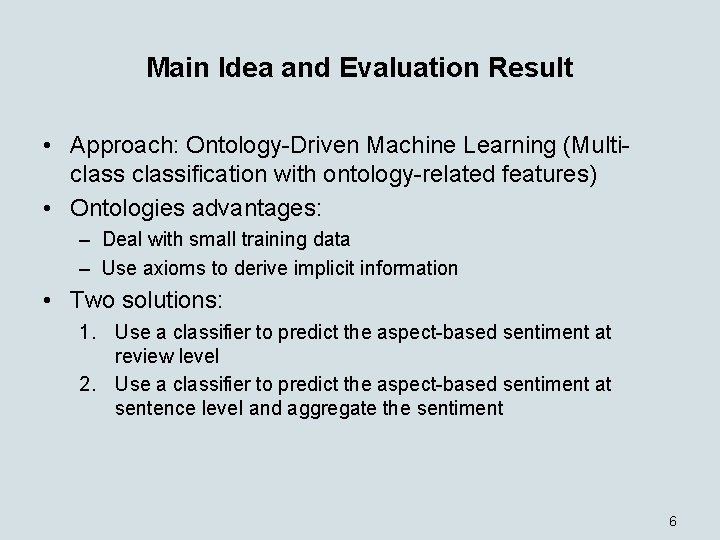
Main Idea and Evaluation Result • Approach: Ontology-Driven Machine Learning (Multiclassification with ontology-related features) • Ontologies advantages: – Deal with small training data – Use axioms to derive implicit information • Two solutions: 1. Use a classifier to predict the aspect-based sentiment at review level 2. Use a classifier to predict the aspect-based sentiment at sentence level and aggregate the sentiment 6
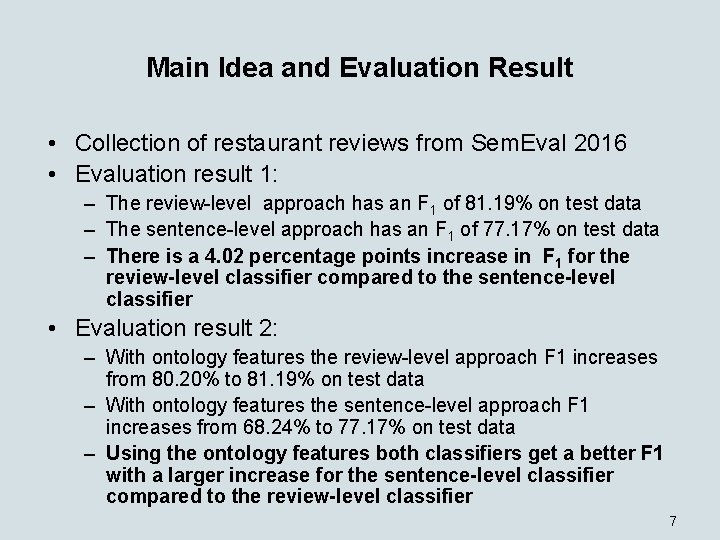
Main Idea and Evaluation Result • Collection of restaurant reviews from Sem. Eval 2016 • Evaluation result 1: – The review-level approach has an F 1 of 81. 19% on test data – The sentence-level approach has an F 1 of 77. 17% on test data – There is a 4. 02 percentage points increase in F 1 for the review-level classifier compared to the sentence-level classifier • Evaluation result 2: – With ontology features the review-level approach F 1 increases from 80. 20% to 81. 19% on test data – With ontology features the sentence-level approach F 1 increases from 68. 24% to 77. 17% on test data – Using the ontology features both classifiers get a better F 1 with a larger increase for the sentence-level classifier compared to the review-level classifier 7
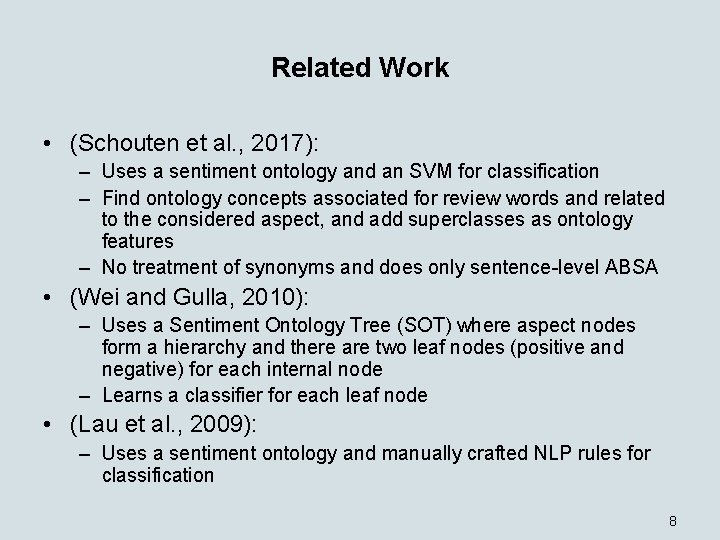
Related Work • (Schouten et al. , 2017): – Uses a sentiment ontology and an SVM for classification – Find ontology concepts associated for review words and related to the considered aspect, and add superclasses as ontology features – No treatment of synonyms and does only sentence-level ABSA • (Wei and Gulla, 2010): – Uses a Sentiment Ontology Tree (SOT) where aspect nodes form a hierarchy and there are two leaf nodes (positive and negative) for each internal node – Learns a classifier for each leaf node • (Lau et al. , 2009): – Uses a sentiment ontology and manually crafted NLP rules for classification 8
Data • Sem. Eval 2014 dataset: restaurants reviews – Training set: • 335 reviews: – 1435 review-aspect pairs – 2455 sentence-aspect pairs – Test set: • 90 reviews: – 404 review-aspect pairs – 859 sentence-aspect pairs • Each review-aspect pair is annotated with sentiment: positive, negative, neutral, or conflict • Each review-aspect pair is annotated with sentiment: positive, negative, or neutral • A sentence or review can contain multiple aspects • Task: detect the aspect-based sentiment at review-level 9
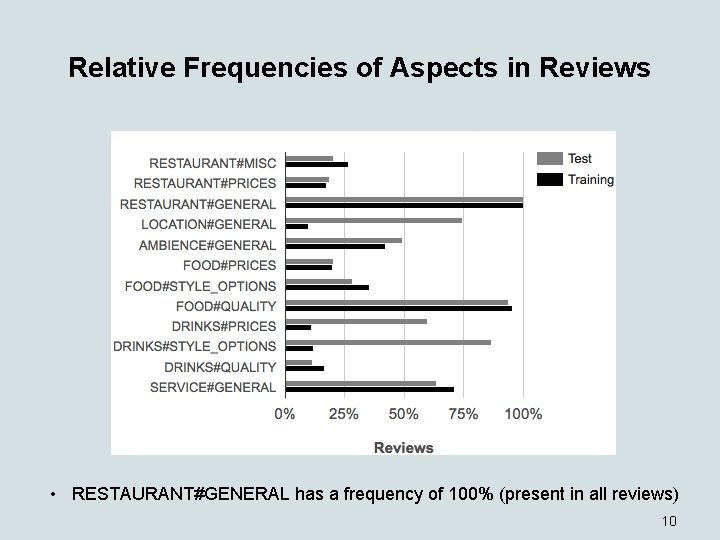
Relative Frequencies of Aspects in Reviews • RESTAURANT#GENERAL has a frequency of 100% (present in all reviews) 10
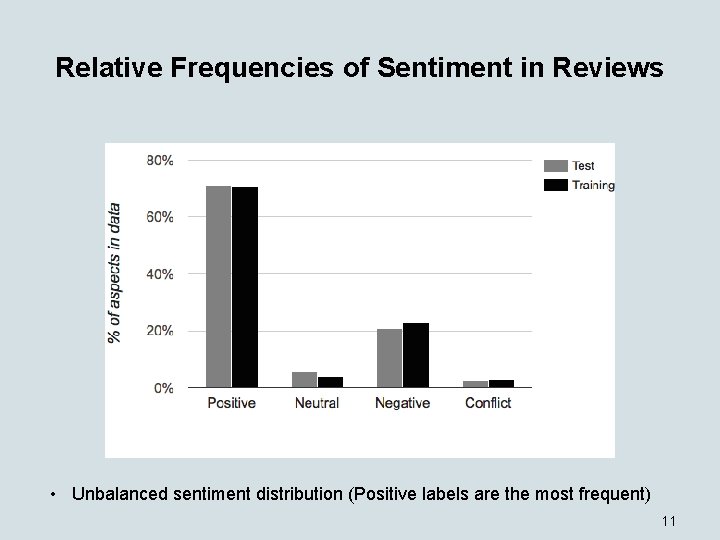
Relative Frequencies of Sentiment in Reviews • Unbalanced sentiment distribution (Positive labels are the most frequent) 11
Methodology • Multi-classifier: linear SVM (shown to give good results for sentiment analysis in literature) – Review-level: 4 classes (positive, negative, neutral, and conflict) – Sentence-level: 3 classes (positive, negative, and neutral) • SVM implementation: Weka, one-versus-one • Data processing: Stanford Core. NLP Toolkit – – – Tokenization Part-of-Speech Lemmatization Grammatical dependencies Ontology gazeteering 12
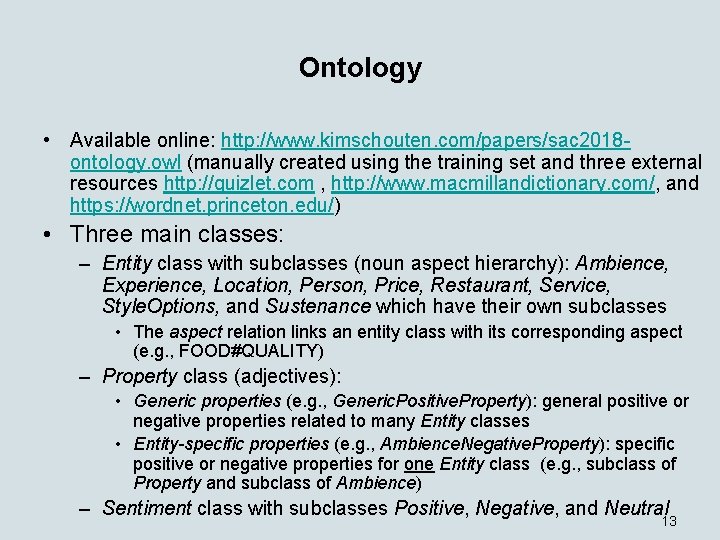
Ontology • Available online: http: //www. kimschouten. com/papers/sac 2018 ontology. owl (manually created using the training set and three external resources http: //quizlet. com , http: //www. macmillandictionary. com/, and https: //wordnet. princeton. edu/) • Three main classes: – Entity class with subclasses (noun aspect hierarchy): Ambience, Experience, Location, Person, Price, Restaurant, Service, Style. Options, and Sustenance which have their own subclasses • The aspect relation links an entity class with its corresponding aspect (e. g. , FOOD#QUALITY) – Property class (adjectives): • Generic properties (e. g. , Generic. Positive. Property): general positive or negative properties related to many Entity classes • Entity-specific properties (e. g. , Ambience. Negative. Property): specific positive or negative properties for one Entity class (e. g. , subclass of Property and subclass of Ambience) – Sentiment class with subclasses Positive, Negative, and Neutral 13
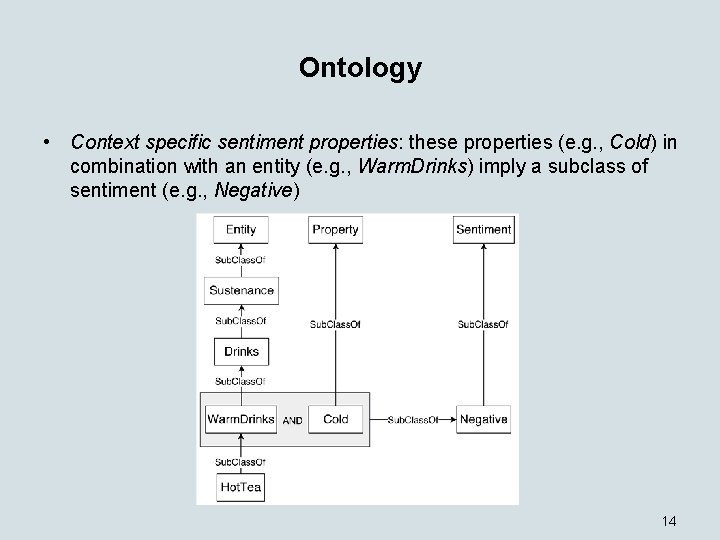
Ontology • Context specific sentiment properties: these properties (e. g. , Cold) in combination with an entity (e. g. , Warm. Drinks) imply a subclass of sentiment (e. g. , Negative) 14
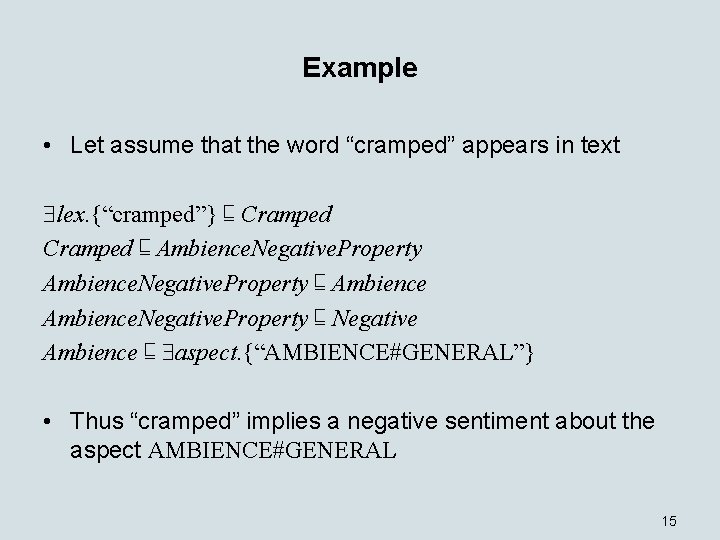
Example • Let assume that the word “cramped” appears in text lex. {“cramped”} ⊑ Cramped ⊑ Ambience. Negative. Property ⊑ Negative Ambience ⊑ aspect. {“AMBIENCE#GENERAL”} • Thus “cramped” implies a negative sentiment about the aspect AMBIENCE#GENERAL 15
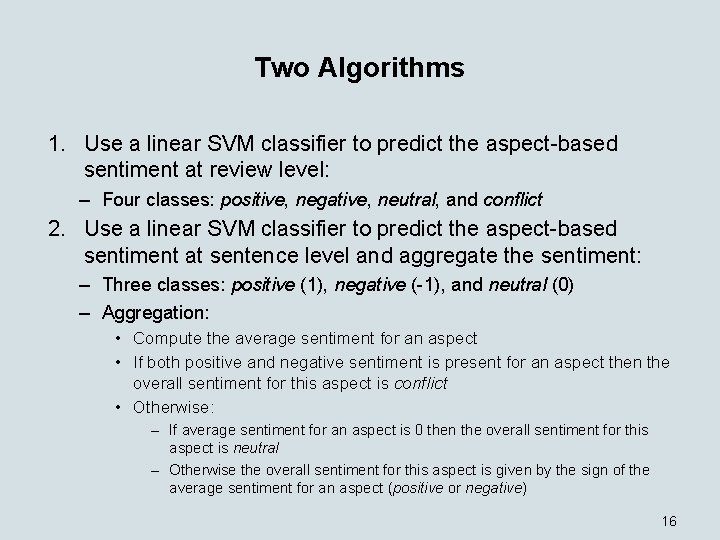
Two Algorithms 1. Use a linear SVM classifier to predict the aspect-based sentiment at review level: – Four classes: positive, negative, neutral, and conflict 2. Use a linear SVM classifier to predict the aspect-based sentiment at sentence level and aggregate the sentiment: – Three classes: positive (1), negative (-1), and neutral (0) – Aggregation: • Compute the average sentiment for an aspect • If both positive and negative sentiment is present for an aspect then the overall sentiment for this aspect is conflict • Otherwise: – If average sentiment for an aspect is 0 then the overall sentiment for this aspect is neutral – Otherwise the overall sentiment for this aspect is given by the sign of the average sentiment for an aspect (positive or negative) 16
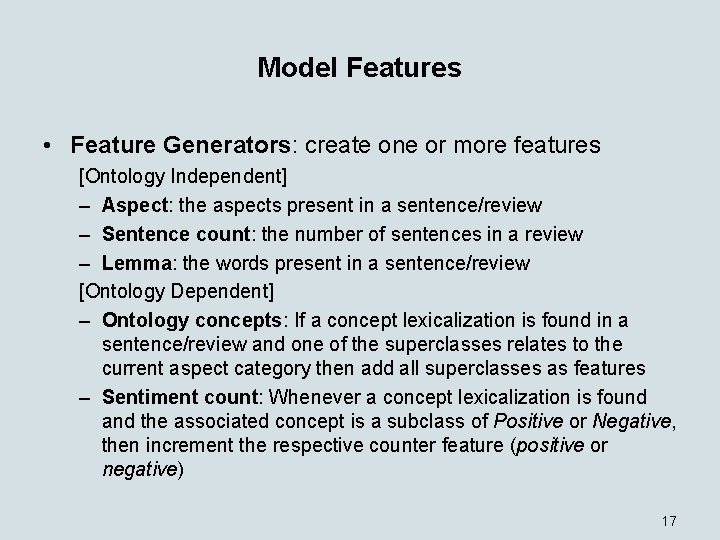
Model Features • Feature Generators: create one or more features [Ontology Independent] – Aspect: the aspects present in a sentence/review – Sentence count: the number of sentences in a review – Lemma: the words present in a sentence/review [Ontology Dependent] – Ontology concepts: If a concept lexicalization is found in a sentence/review and one of the superclasses relates to the current aspect category then add all superclasses as features – Sentiment count: Whenever a concept lexicalization is found and the associated concept is a subclass of Positive or Negative, then increment the respective counter feature (positive or negative) 17
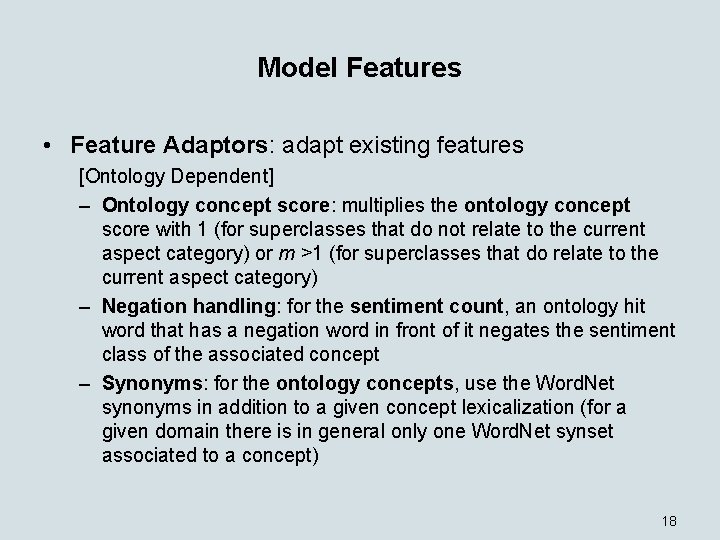
Model Features • Feature Adaptors: adapt existing features [Ontology Dependent] – Ontology concept score: multiplies the ontology concept score with 1 (for superclasses that do not relate to the current aspect category) or m >1 (for superclasses that do relate to the current aspect category) – Negation handling: for the sentiment count, an ontology hit word that has a negation word in front of it negates the sentiment class of the associated concept – Synonyms: for the ontology concepts, use the Word. Net synonyms in addition to a given concept lexicalization (for a given domain there is in general only one Word. Net synset associated to a concept) 18
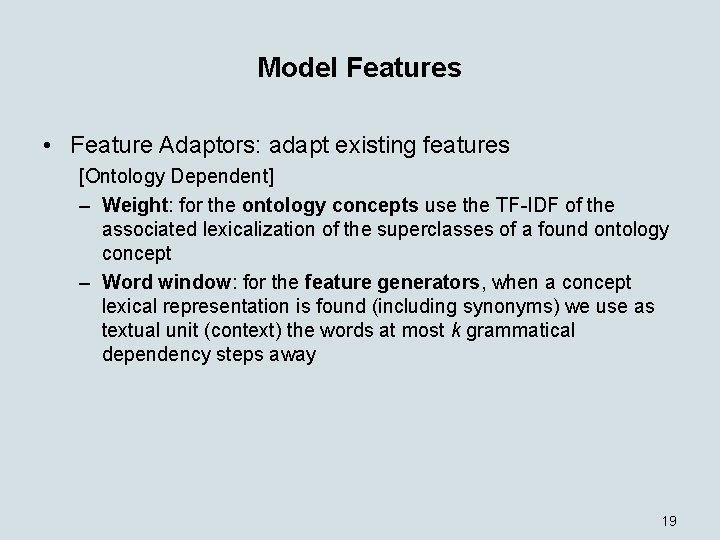
Model Features • Feature Adaptors: adapt existing features [Ontology Dependent] – Weight: for the ontology concepts use the TF-IDF of the associated lexicalization of the superclasses of a found ontology concept – Word window: for the feature generators, when a concept lexical representation is found (including synonyms) we use as textual unit (context) the words at most k grammatical dependency steps away 19
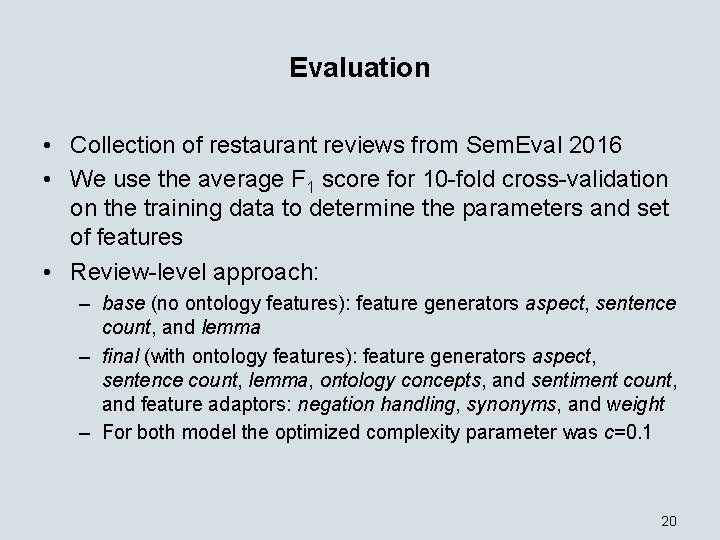
Evaluation • Collection of restaurant reviews from Sem. Eval 2016 • We use the average F 1 score for 10 -fold cross-validation on the training data to determine the parameters and set of features • Review-level approach: – base (no ontology features): feature generators aspect, sentence count, and lemma – final (with ontology features): feature generators aspect, sentence count, lemma, ontology concepts, and sentiment count, and feature adaptors: negation handling, synonyms, and weight – For both model the optimized complexity parameter was c=0. 1 20
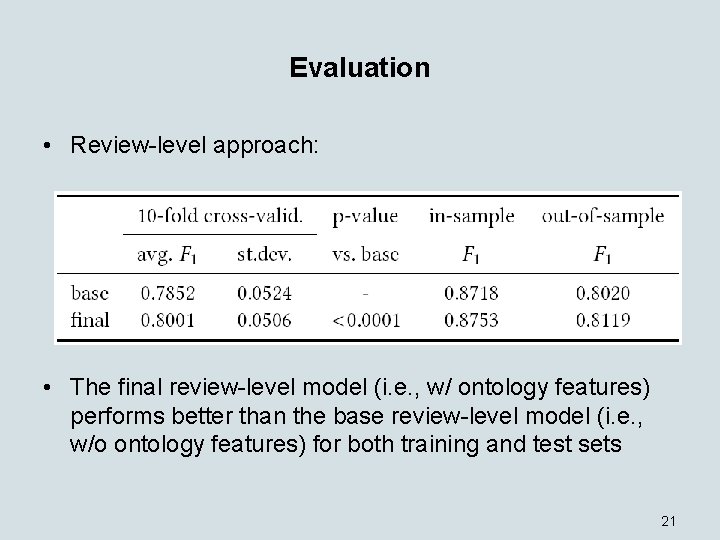
Evaluation • Review-level approach: • The final review-level model (i. e. , w/ ontology features) performs better than the base review-level model (i. e. , w/o ontology features) for both training and test sets 21
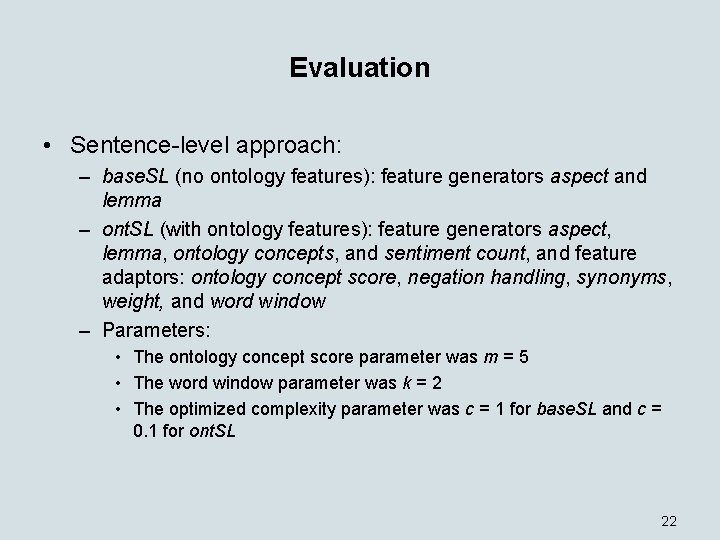
Evaluation • Sentence-level approach: – base. SL (no ontology features): feature generators aspect and lemma – ont. SL (with ontology features): feature generators aspect, lemma, ontology concepts, and sentiment count, and feature adaptors: ontology concept score, negation handling, synonyms, weight, and word window – Parameters: • The ontology concept score parameter was m = 5 • The word window parameter was k = 2 • The optimized complexity parameter was c = 1 for base. SL and c = 0. 1 for ont. SL 22
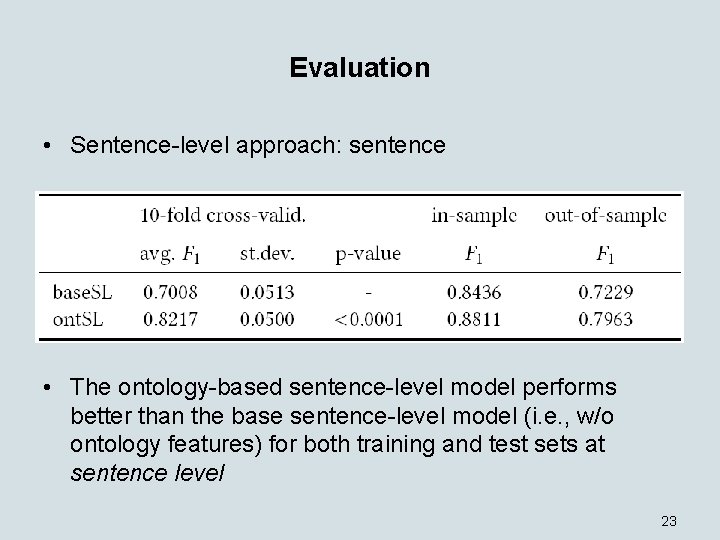
Evaluation • Sentence-level approach: sentence • The ontology-based sentence-level model performs better than the base sentence-level model (i. e. , w/o ontology features) for both training and test sets at sentence level 23
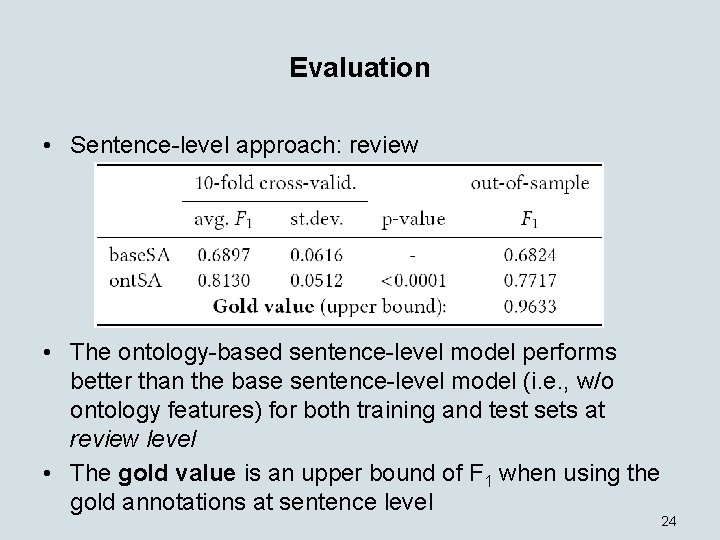
Evaluation • Sentence-level approach: review • The ontology-based sentence-level model performs better than the base sentence-level model (i. e. , w/o ontology features) for both training and test sets at review level • The gold value is an upper bound of F 1 when using the gold annotations at sentence level 24
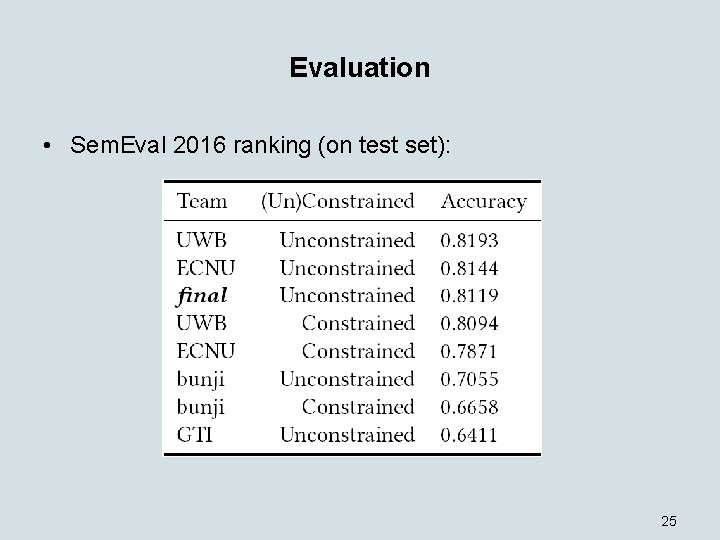
Evaluation • Sem. Eval 2016 ranking (on test set): 25
Evaluation • There is a 4. 02 percentage points increase in F 1 for the review-level classifier compared to the sentencelevel classifier • Using the ontology features both classifiers get a better F 1 with a larger increase for the sentence-level classifier compared to the review-level classifier • The accuracy difference of the review-level classifier to the best performing Sem. Eval 2016 classifier is less than 1 percentage points 26
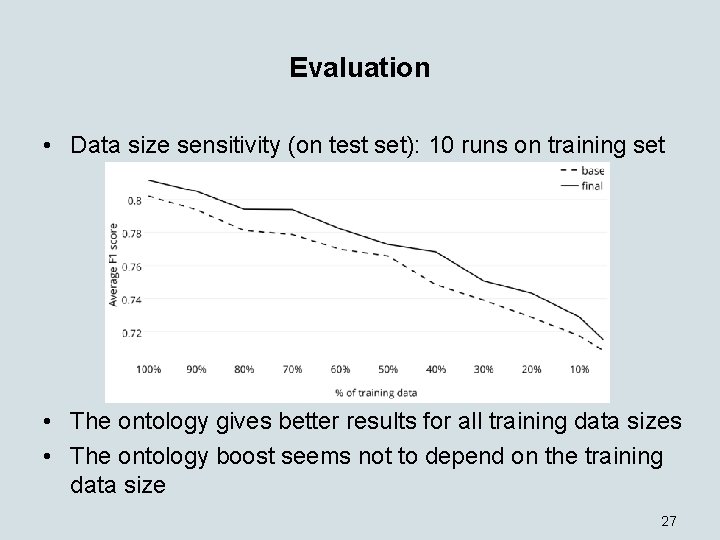
Evaluation • Data size sensitivity (on test set): 10 runs on training set • The ontology gives better results for all training data sizes • The ontology boost seems not to depend on the training data size 27
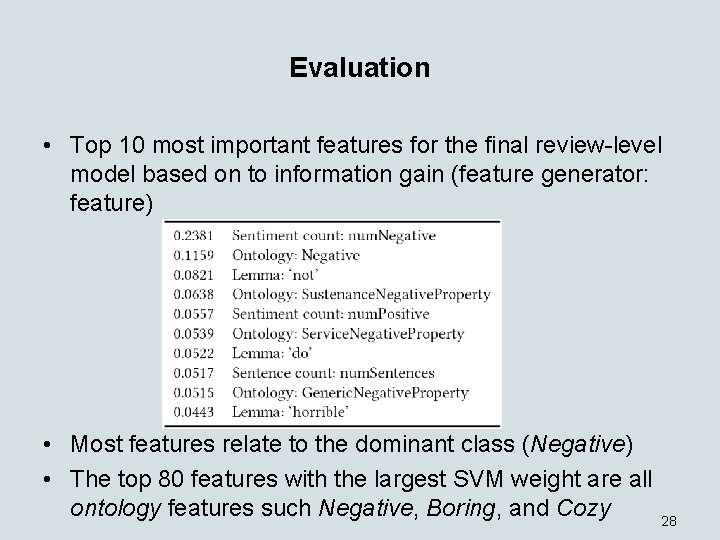
Evaluation • Top 10 most important features for the final review-level model based on to information gain (feature generator: feature) • Most features relate to the dominant class (Negative) • The top 80 features with the largest SVM weight are all ontology features such Negative, Boring, and Cozy 28
Conclusion • We proposed two algorithms for review-level aspectbased sentiment analysis: – Review-based algorithm – Sentence-based algorithm • The review-based algorithm performs better than the sentence-based algorithm • The use of ontology features boosts the performance of both algorithms • The ontology performance boost seem not to depend on the size of the training data 29
Future Work • Apply a two step approach: – Use ontology reasoning first – If ontology inconclusive, apply SVM without ontology features (worked well for sentence-based sentiment analysis, results to be presented at ESWC 2018) • Automatic creation of the ontology from text – Extend the ontology coverage using word embeddings • Extract the strength of a sentiment instead of just the polarity: positive, negative, neutral, and conflict • Replace the SVM classifier with a deep learning solution 30
- Slides: 30