
Reviewing the Literature on Identity Development Models Reconciling
- Slides: 1
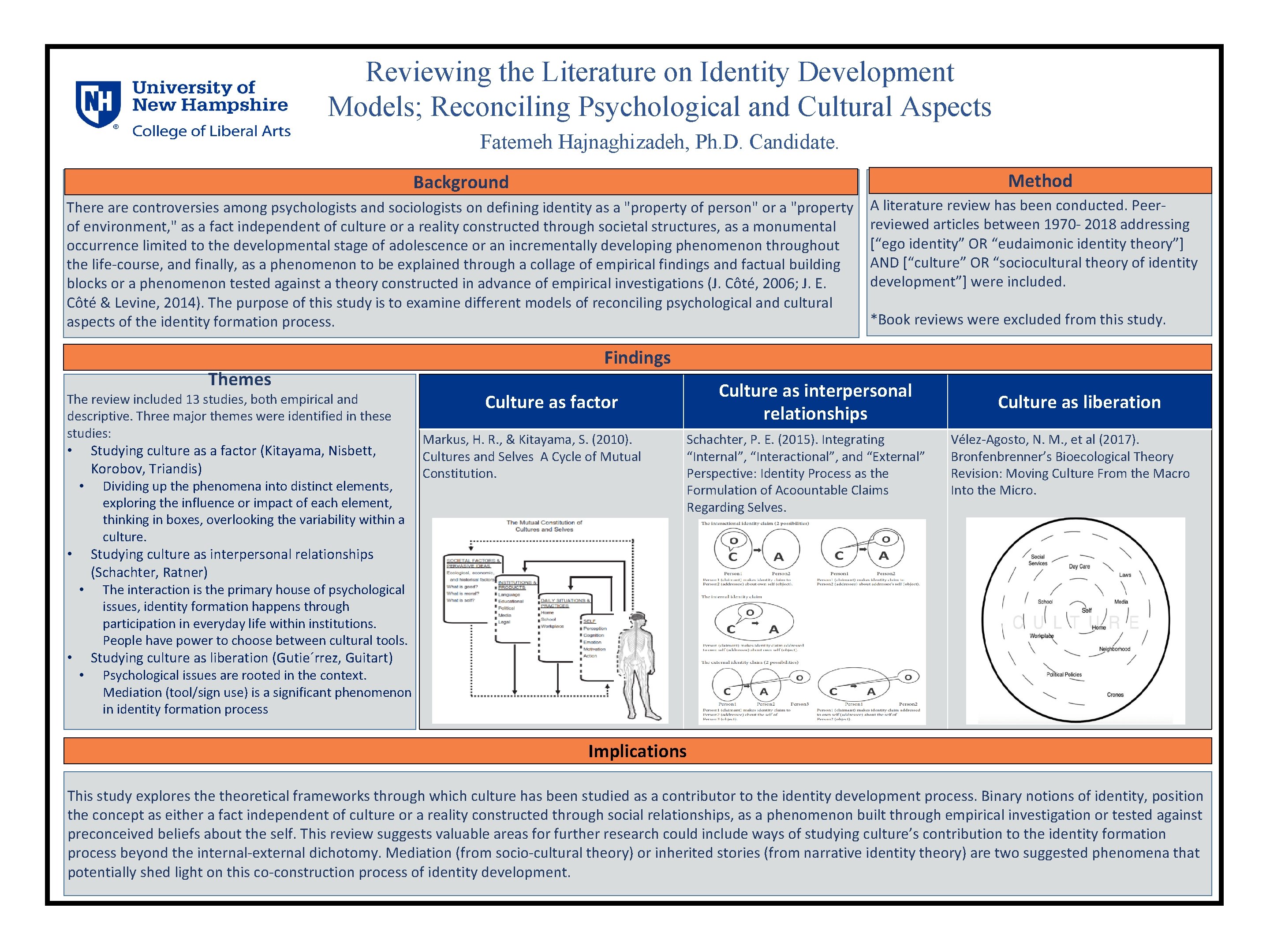
Reviewing the Literature on Identity Development Models; Reconciling Psychological and Cultural Aspects Fatemeh Hajnaghizadeh, Ph. D. Candidate. Method Background Introduction There are controversies among psychologists and sociologists on defining identity as a "property of person" or a "property of environment, " as a fact independent of culture or a reality constructed through societal structures, as a monumental occurrence limited to the developmental stage of adolescence or an incrementally developing phenomenon throughout the life-course, and finally, as a phenomenon to be explained through a collage of empirical findings and factual building blocks or a phenomenon tested against a theory constructed in advance of empirical investigations (J. Côté, 2006; J. E. Côté & Levine, 2014). The purpose of this study is to examine different models of reconciling psychological and cultural aspects of the identity formation process. Themes . The review included 13 studies, both empirical and descriptive. Three major themes were identified in these studies: Studying culture as a factor (Kitayama, Nisbett, Korobov, Triandis) • • Dividing up the phenomena into distinct elements, exploring the influence or impact of each element, thinking in boxes, overlooking the variability within a culture. A literature review has been conducted. Peerreviewed articles between 1970 - 2018 addressing [“ego identity” OR “eudaimonic identity theory”] AND [“culture” OR “sociocultural theory of identity development”] were included. *Book reviews were excluded from this study. Findings Culture as interpersonal relationships Culture as factor Markus, H. R. , & Kitayama, S. (2010). Cultures and Selves A Cycle of Mutual Constitution. Schachter, P. E. (2015). Integrating “Internal”, “Interactional”, and “External” Perspective: Identity Process as the Formulation of Acoountable Claims Regarding Selves. Culture as liberation Vélez-Agosto, N. M. , et al (2017). Bronfenbrenner’s Bioecological Theory Revision: Moving Culture From the Macro Into the Micro. Studying culture as interpersonal relationships (Schachter, Ratner) • • The interaction is the primary house of psychological issues, identity formation happens through participation in everyday life within institutions. People have power to choose between cultural tools. Studying culture as liberation (Gutie´rrez, Guitart) • • Psychological issues are rooted in the context. Mediation (tool/sign use) is a significant phenomenon in identity formation process Implications This study explores theoretical frameworks through which culture has been studied as a contributor to the identity development process. Binary notions of identity, position the concept as either a fact independent of culture or a reality constructed through social relationships, as a phenomenon built through empirical investigation or tested against preconceived beliefs about the self. This review suggests valuable areas for further research could include ways of studying culture’s contribution to the identity formation process beyond the internal-external dichotomy. Mediation (from socio-cultural theory) or inherited stories (from narrative identity theory) are two suggested phenomena that potentially shed light on this co-construction process of identity development.