
Reviewed by Mr Gireesh Associate Professor Dept of

Reviewed by: Mr. Gireesh Associate Professor Dept. of MSN Presented by: Mrs. Prashma Lecturer Dept. of MSN

Learning objectives • To define report • To list out the and explain the types of reports • To explain the purposes of report.
Introduction At the end of each shift nurses report information about their assigned clients to nurses working on the next shift. A handover report is usually given orally in person or during rounds at the bedside Reports given in person or during rounds in hospital permit nurses to obtain immediate feedback when questions are raised about a client’s care
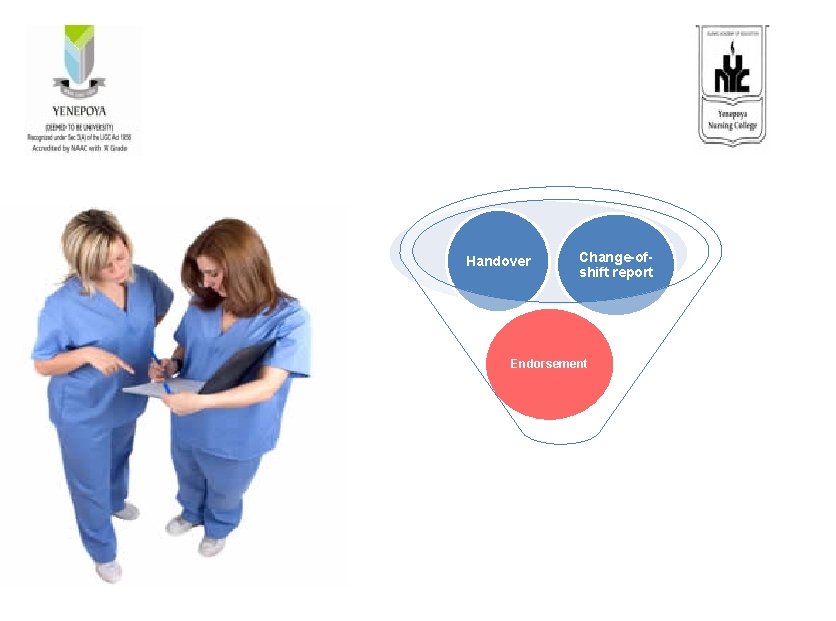
Handover Change-ofshift report Endorsement
Report • A report is oral, written, or computer-based communication intended to convey information to others. • The purpose of reporting is to communicate specific information to a person or group of people. • A report, whether oral or written, should be concise, including pertinent information but no extraneous detail
Types of reports: Reports commonly used by nurses include • Hand off report A. Change of shift report B. Transfer report • Telephone reports • Incident reports
Hand off reports • Hand-off reports happen any time one health care provider transfers care of a patient to another health care provider. • The hand off report may be change of shift report or transfer report • Hand off report can be given face-to-face, in writing, or verbally such as over the telephone or via audio recording
Purposes • To improve patient care • To provide continuity of care among nurses who are caring for a patient For example, if you find that a patient breathes better in a certain position, you relay that information to the next nurse caring for the patient • To encourage a more consistent exchange of information • To increase the efficiency of handover.

Change-of-shift report is given to all nurses on the next shift • It includes up-to date information about a patient’s condition, required care, treatments, medications, and any recent or anticipated changes.
Patients handover consist • Client name, age, marital status, religious preferences, physician and family contact • Medical diagnosis • Nursing diagnosis • Allergies • Medical orders: diet, medications, intravenous (IV) therapy, treatments, diagnostic tests and procedures(including dates and results), consultations.
Patients handover consist • Activities permitted: functional limitations, assistance needed in activities of daily living and safety precautions
Transfer report is given whenever the patient is transferred to other health care unit. It can happen between: • Nursing unit-to-nursing unit transfer • Nursing unit to diagnostic area. • Special settings (operating room, emergency department). • Discharge and inter-facility transfer
Telephone Reports • Health professionals frequently report about a client by telephone. • A registered nurse makes a telephone report when significant events or changes in a patient’s condition have occurred. • Nurses inform primary care providers about a change in a client’s condition; a radiologist reports the results of an x-ray study
Telephone Reports • The nurse receiving a telephone report should document the date and time, the name of the person giving the information, and the subject of the information received, and sign the notation. • For example 16/6/15 10. 35 am Mr. Sahoo, laboratory technician, reported by telephone that Mrs. Anjali’s hemoglobin is 6 gm/dl. Sign at the end
• The person receiving the information should repeat it back to the sender to ensure accuracy. • It is important that the nurse be concise and accurate. • Telephone reports usually include the client’s name and medical diagnosis, changes in nursing assessment, vital signs , significant laboratory data, and related nursing interventions. • The nurse should have the client’s chart ready to give the primary care provider any further Information • After reporting, the nurse should document the date, time, and content of the call
Telephone Orders & Verbal Orders: • A Telephone Order (TO) occurs when a health care provider gives an order over the phone to a registered nurse. • A Verbal Order (VO) involves the health care provider giving orders to a nurse while they are standing near each other. • TOs and VOs usually occur at night or during emergencies and frequently cause medical errors
• Th. E NURSE reads the order back to the health care provider, called read back, and receives confirmation from the person who gave the order that it is correct • The health care provider later verifies the TO or VO legally by signing it within a set time (e. g. , 24 hours) as set by hospital policy.
Guidelines for telephone and verbal orders: • Clearly determine the patient’s name, room number, and diagnosis. • Repeat any prescribed orders back to the physician or health care provider. • Use clarification questions to avoid misunderstandings. • Write TO (telephone order) or VO (verbal order), including date and time, name of patient, the complete order; And sign at the end. • Follow agency policies; some institutions require telephone orders to be reviewed and signed by two nurses. • The health care provider must co-sign the order within the time frame required by the institution (usually 24 hours).
Incident or Occurrence Reports • An incident or occurrence is any event that is not consistent with the routine operation of a health care unit or routine care of a patient. • Examples of incidents include • Patient falls, • Needlestick injuries, • A visitor having symptoms of illness, • Medication administration errors, • Accidental omission of ordered therapies, and • Circumstances that lead to injury or a risk for patient injury.
Incident Report • Incident (or occurrence) reports are an important part of the quality improvement program of a unit. • Always contact the patient’s health care provider whenever an incident happens • In the incident report form document an objective description of what happened, what you observed, and the follow-up actions taken.
Do’s and Don'ts Do ‘s Don’t s Provide only essential background information about client(i. e. name, sex, age, physician’s diagnosis and medical history Identify client’s nursing diagnosis or health care problems and their related causes Don ‘t review all routine care procedures or tasks Don ‘t review all biological information already available in written form
Do’s and Don'ts Do ‘s Don’t s Describe objective measurements or observations about clients condition and response to health problem: emphasize recent changes Don’t use critical comments about client’s behavior, such as “Mrs. Gill is so demanding”
Do’s and Don'ts Do ‘s Don’t’s Share significant Don’t make assumptions information about family about relationships members as it relates to between family members client’s problems Continuously review ongoing discharge plan( e. g. client’s level of preparation to go home)

Summary Today we discussed about purposes of hair washing, equipments required and procedure of hair washing.
Conclusion A change of shift report should not simply be reading documented information. Instead significant information about clients are reviewed
Evaluation 1. The health care provider giving orders to a nurse while they are standing near each other is termed as a. Verbal order b. Telephone order c. Emergency order. d. Standing order 2. A report that includes up-to date information about a patient’s condition, required care, treatments is called as a. Telephone report b. Transfer report c. Change-of-shift report d. Occurrence report

BIBLIOGRAPHY 1. Lindeman Carol A, Meathie Marylov, FUNDAMENTALS. OF CONTEMPORARY NURSING PRACTICE, W. B. S a u n ders, 1 9 9 9 , Philadelphia, 2. White Lois, BASIC NURSING: FOUNDATIONS OFSKILLS AND CONCEPTS, Delmar, 2002. 3. WWW. Wikipedia. com.

- Slides: 28