review Why a queue in radix sort Function
- Slides: 53
review § Why a queue in radix sort? § Function (class) templates, a static behavior 1
Standard Template Library: STL
Outline § Motivation § STL containers • Vector • List • Deque § Container adapters • Stack • Queue 3
Motivation: linear data structure § Review of search in an array with different notations • Array-based • Pointer-based § A first STL example § Emergence of three key components, again from a concept of an abstract ‘list’ • Generic class template • Generic function templates • Abstract ‘pointer’ 4
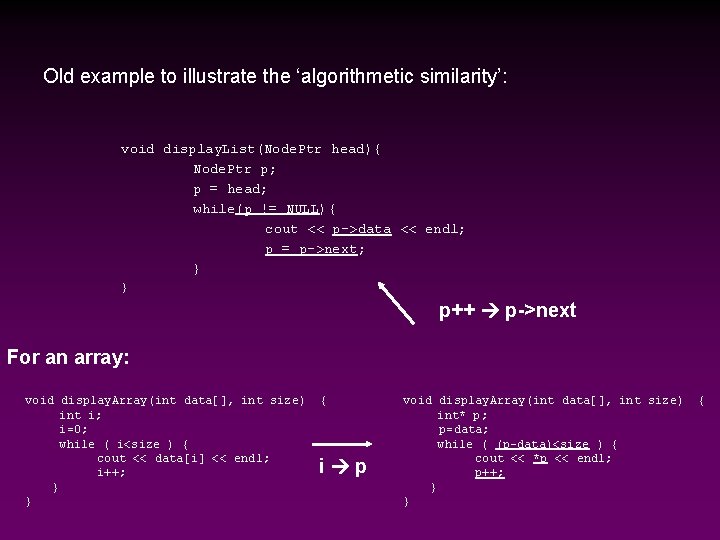
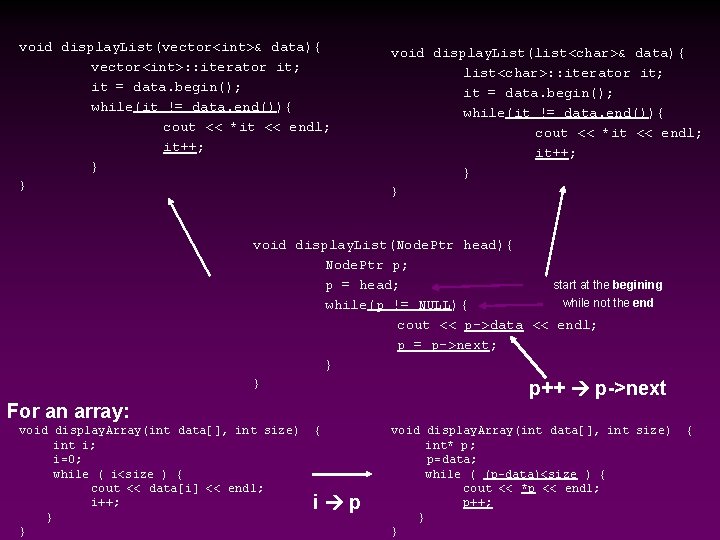
Old example to illustrate the ‘algorithmetic similarity’: void display. List(Node. Ptr head){ Node. Ptr p; p = head; while(p != NULL){ cout << p->data << endl; p = p->next; } } p++ p->next For an array: void display. Array(int data[], int size) int i; i=0; while ( i<size ) { cout << data[i] << endl; i++; } } { i p void display. Array(int data[], int size) int* p; p=data; while ( (p-data)<size ) { cout << *p << endl; p++; } } {
void display. List(vector<int>& data){ vector<int>: : iterator it; it = data. begin(); while(it != data. end()){ cout << *it << endl; it++; } } void display. List(list<char>& data){ list<char>: : iterator it; it = data. begin(); while(it != data. end()){ cout << *it << endl; it++; } } void display. List(Node. Ptr head){ Node. Ptr p; p = head; start at the begining while not the end while(p != NULL){ cout << p->data << endl; p = p->next; } p++ p->next } For an array: void display. Array(int data[], int size) int i; i=0; while ( i<size ) { cout << data[i] << endl; i++; } } { i p void display. Array(int data[], int size) int* p; p=data; while ( (p-data)<size ) { cout << *p << endl; p++; } } {
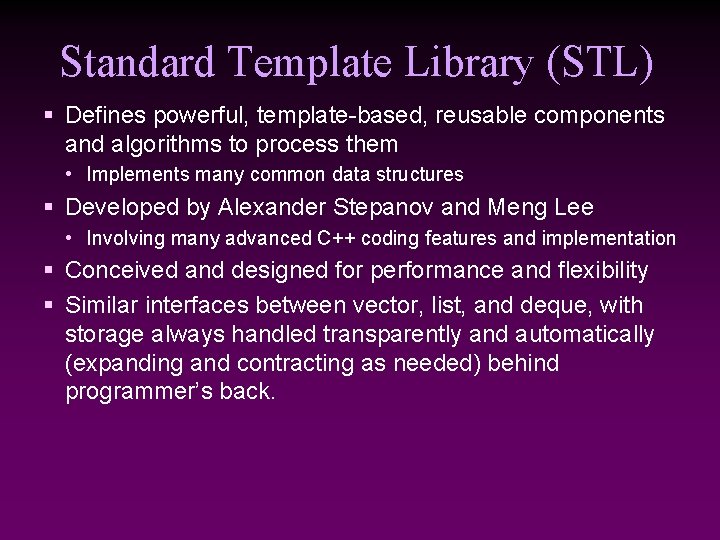
Standard Template Library (STL) § Defines powerful, template-based, reusable components and algorithms to process them • Implements many common data structures § Developed by Alexander Stepanov and Meng Lee • Involving many advanced C++ coding features and implementation § Conceived and designed for performance and flexibility § Similar interfaces between vector, list, and deque, with storage always handled transparently and automatically (expanding and contracting as needed) behind programmer’s back.
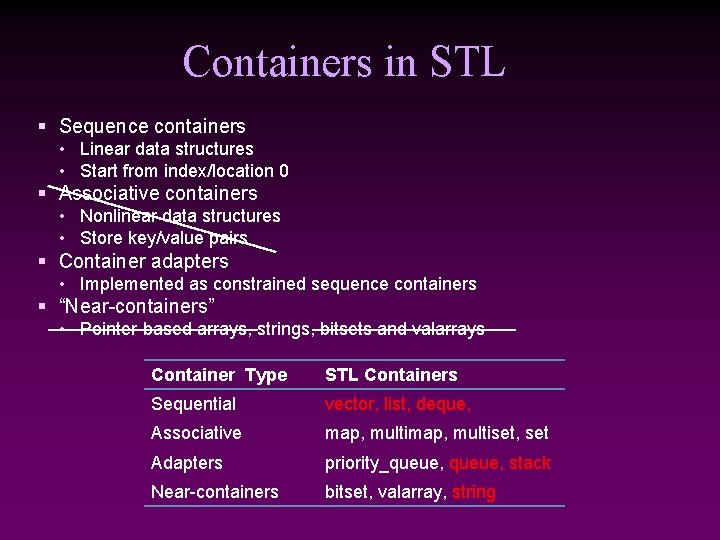
Containers in STL § Sequence containers • Linear data structures • Start from index/location 0 § Associative containers • Nonlinear data structures • Store key/value pairs § Container adapters • Implemented as constrained sequence containers § “Near-containers” • Pointer-based arrays, strings, bitsets and valarrays Container Type STL Containers Sequential vector, list, deque, Associative map, multiset, set Adapters priority_queue, stack Near-containers bitset, valarray, string
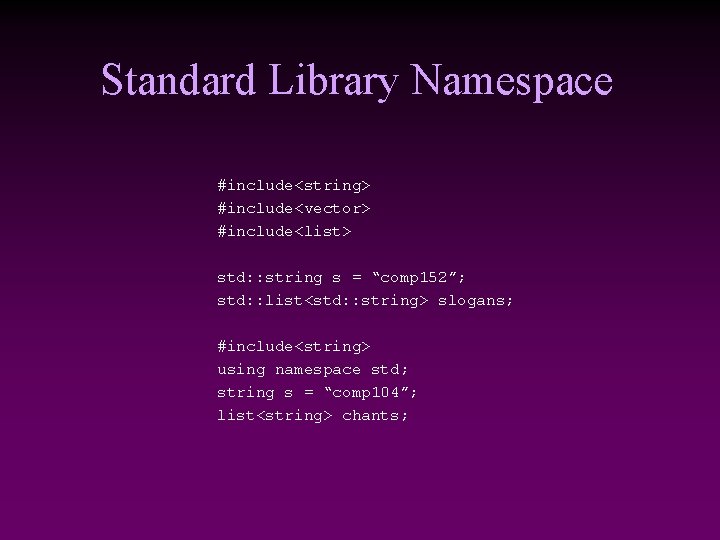
Standard Library Namespace #include<string> #include<vector> #include<list> std: : string s = “comp 152”; std: : list<std: : string> slogans; #include<string> using namespace std; string s = “comp 104”; list<string> chants;
Sequence containers (basic containters): - vector (a dynamic array), - list (a doubly linked list), - deque (a mixture of …) But ‘implementation’ is not standard, only gurantee the efficiency!
Three Components § Containers: • Generic class templates § Iterators: • Generalized pointers that allow algorithms to operate on almost any container § Algorithms: • Generic function templates for operating on containers
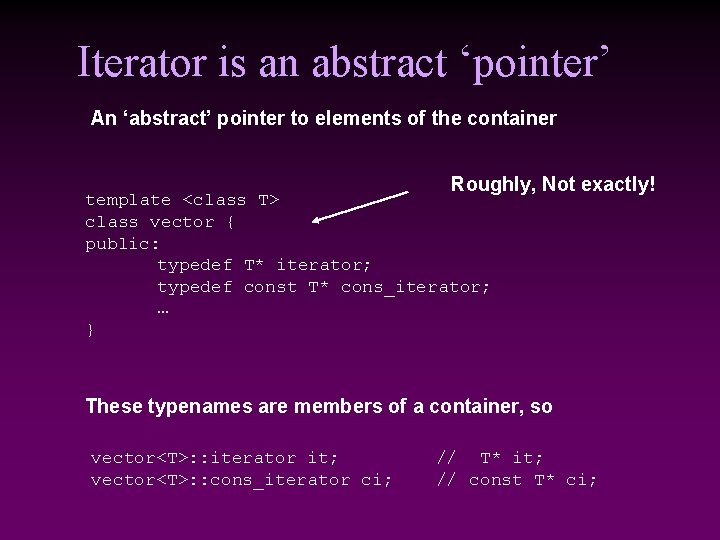
Iterator is an abstract ‘pointer’ An ‘abstract’ pointer to elements of the container Roughly, Not exactly! template <class T> class vector { public: typedef T* iterator; typedef const T* cons_iterator; … } These typenames are members of a container, so vector<T>: : iterator it; vector<T>: : cons_iterator ci; // T* it; // const T* ci;
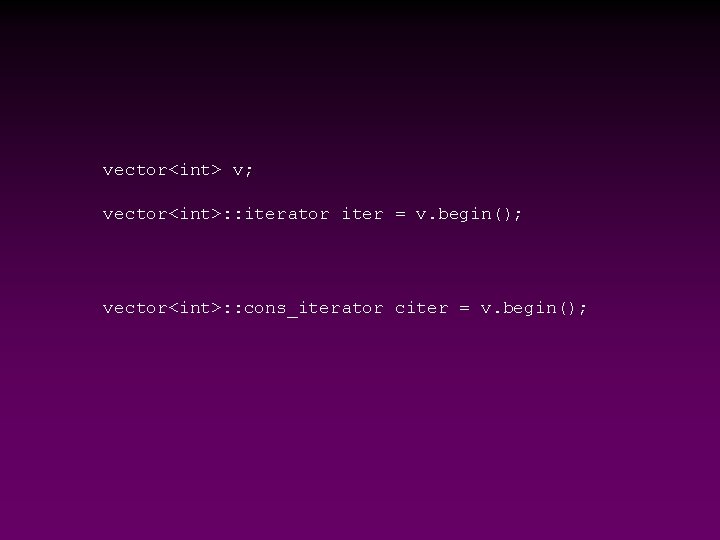
vector<int> v; vector<int>: : iterator iter = v. begin(); vector<int>: : cons_iterator citer = v. begin();
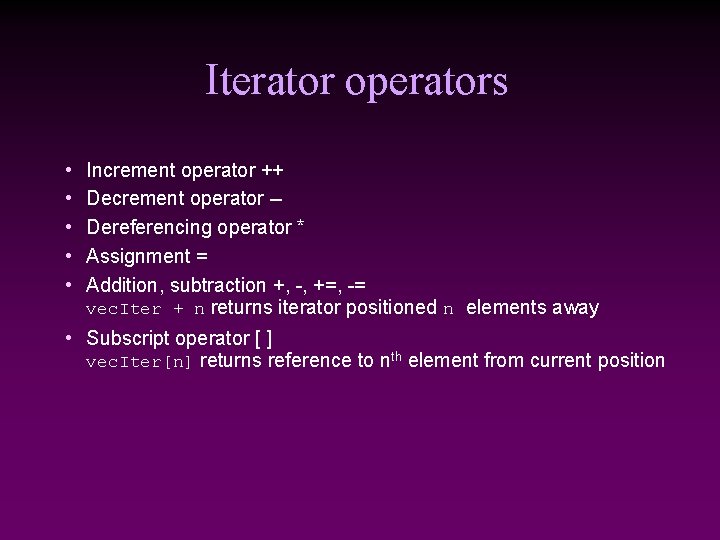
Iterator operators • • • Increment operator ++ Decrement operator -Dereferencing operator * Assignment = Addition, subtraction +, -, +=, -= vec. Iter + n returns iterator positioned n elements away • Subscript operator [ ] vec. Iter[n] returns reference to nth element from current position
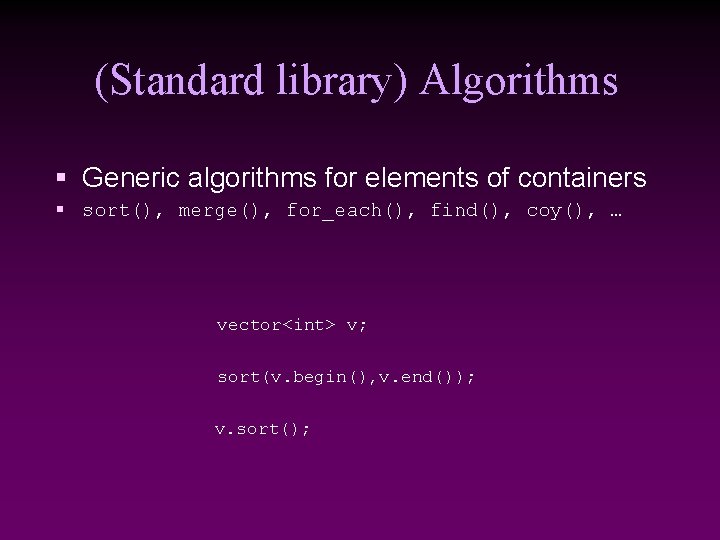
(Standard library) Algorithms § Generic algorithms for elements of containers § sort(), merge(), for_each(), find(), coy(), … vector<int> v; sort(v. begin(), v. end()); v. sort();
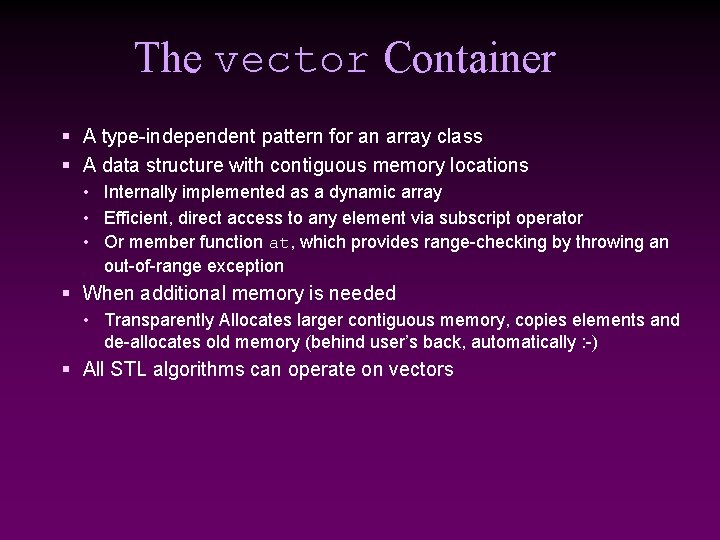
The vector Container § A type-independent pattern for an array class § A data structure with contiguous memory locations • Internally implemented as a dynamic array • Efficient, direct access to any element via subscript operator • Or member function at, which provides range-checking by throwing an out-of-range exception § When additional memory is needed • Transparently Allocates larger contiguous memory, copies elements and de-allocates old memory (behind user’s back, automatically : -) § All STL algorithms can operate on vectors
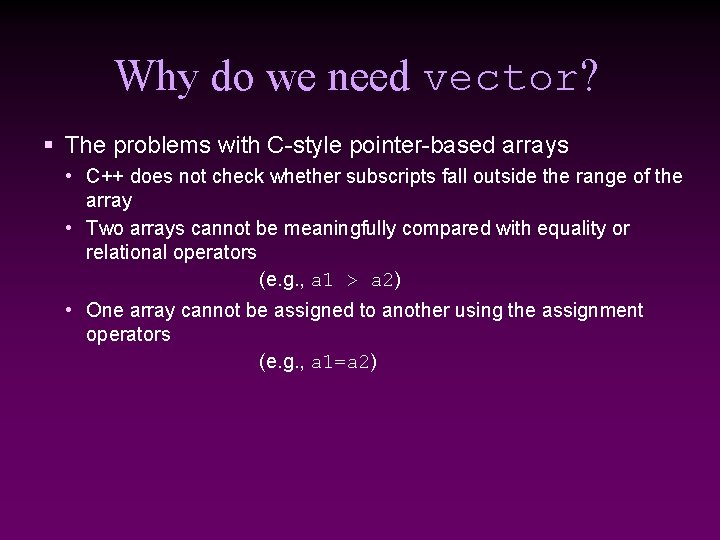
Why do we need vector? § The problems with C-style pointer-based arrays • C++ does not check whether subscripts fall outside the range of the array • Two arrays cannot be meaningfully compared with equality or relational operators (e. g. , a 1 > a 2) • One array cannot be assigned to another using the assignment operators (e. g. , a 1=a 2)
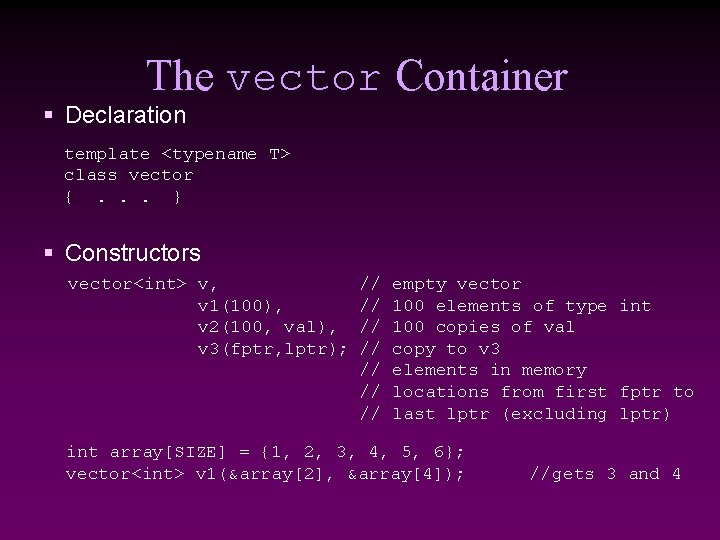
The vector Container § Declaration template <typename T> class vector {. . . } § Constructors vector<int> v, v 1(100), v 2(100, val), v 3(fptr, lptr); // // empty vector 100 elements of type int 100 copies of val copy to v 3 elements in memory locations from first fptr to last lptr (excluding lptr) int array[SIZE] = {1, 2, 3, 4, 5, 6}; vector<int> v 1(&array[2], &array[4]); //gets 3 and 4
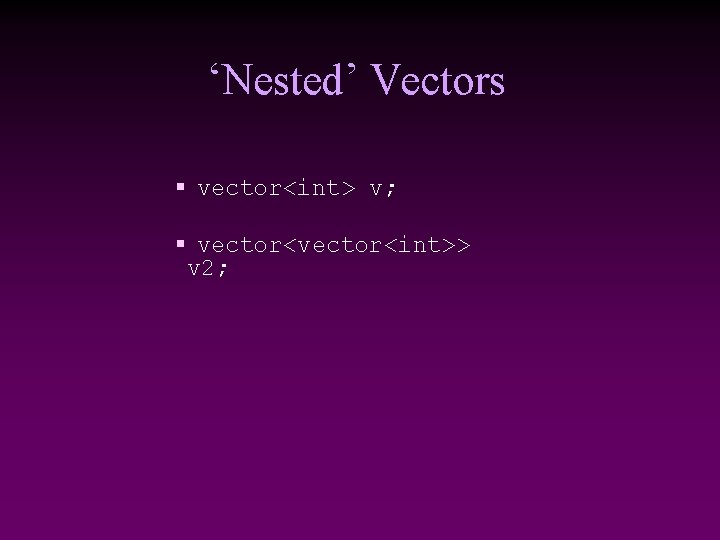
‘Nested’ Vectors § vector<int> v; § vector<int>> v 2;
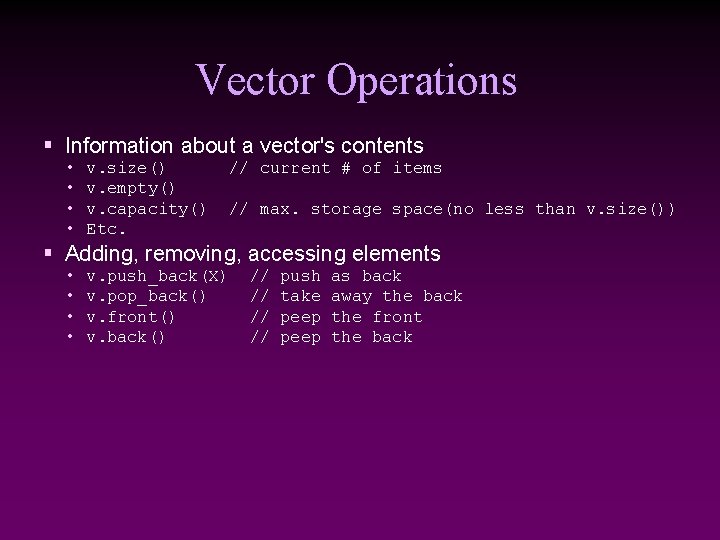
Vector Operations § Information about a vector's contents • • v. size() v. empty() v. capacity() Etc. // current # of items // max. storage space(no less than v. size()) § Adding, removing, accessing elements • • v. push_back(X) v. pop_back() v. front() v. back() // // push take peep as back away the back the front the back
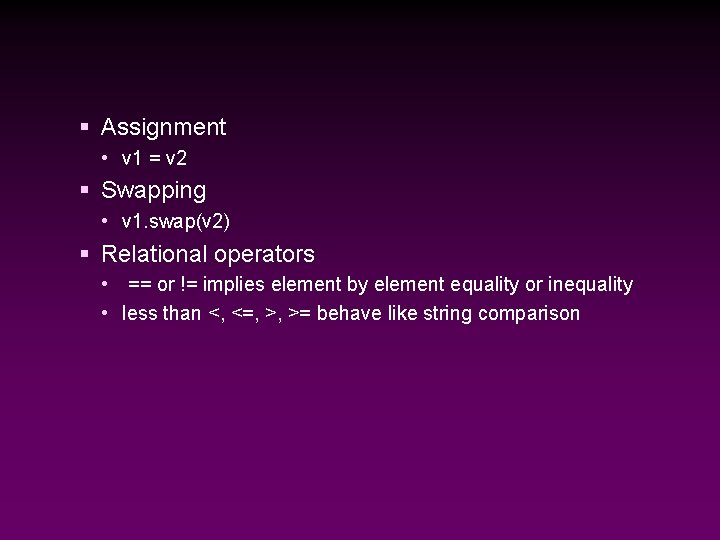
§ Assignment • v 1 = v 2 § Swapping • v 1. swap(v 2) § Relational operators • == or != implies element by element equality or inequality • less than <, <=, >, >= behave like string comparison
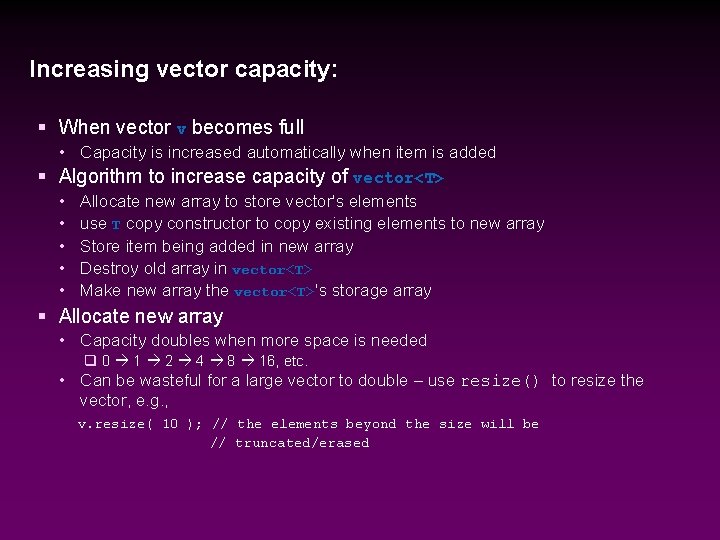
Increasing vector capacity: § When vector v becomes full • Capacity is increased automatically when item is added § Algorithm to increase capacity of vector<T> • Allocate new array to store vector's elements • use T copy constructor to copy existing elements to new array • Store item being added in new array • Destroy old array in vector<T> • Make new array the vector<T>'s storage array § Allocate new array • Capacity doubles when more space is needed q 0 1 2 4 8 16, etc. • Can be wasteful for a large vector to double – use resize() to resize the vector, e. g. , v. resize( 10 ); // the elements beyond the size will be // truncated/erased
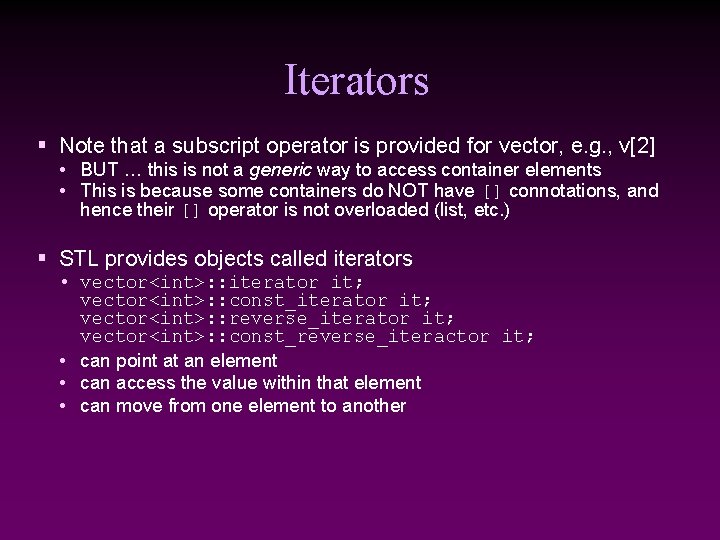
Iterators § Note that a subscript operator is provided for vector, e. g. , v[2] • BUT … this is not a generic way to access container elements • This is because some containers do NOT have [] connotations, and hence their [] operator is not overloaded (list, etc. ) § STL provides objects called iterators • vector<int>: : iterator it; vector<int>: : const_iterator it; vector<int>: : reverse_iterator it; vector<int>: : const_reverse_iteractor it; • can point at an element • can access the value within that element • can move from one element to another
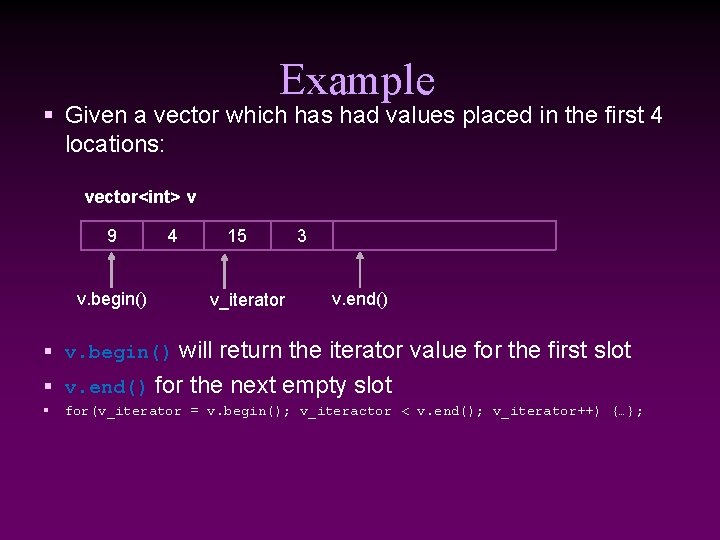
Example § Given a vector which has had values placed in the first 4 locations: vector<int> v 9 v. begin() 4 15 v_iterator 3 v. end() § v. begin() will return the iterator value for the first slot § v. end() for the next empty slot § for(v_iterator = v. begin(); v_iteractor < v. end(); v_iterator++) {…};
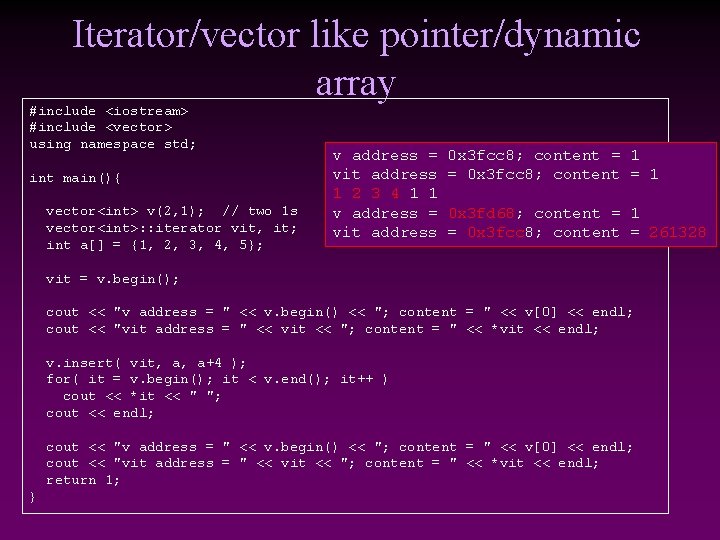
Iterator/vector like pointer/dynamic array #include <iostream> #include <vector> using namespace std; int main(){ vector<int> v(2, 1); // two 1 s vector<int>: : iterator vit, it; int a[] = {1, 2, 3, 4, 5}; v address = vit address 1 2 3 4 1 1 v address = vit address 0 x 3 fcc 8; content = 1 = 0 x 3 fcc 8; content = 1 0 x 3 fd 68; content = 1 = 0 x 3 fcc 8; content = 261328 vit = v. begin(); cout << "v address = " << v. begin() << "; content = " << v[0] << endl; cout << "vit address = " << vit << "; content = " << *vit << endl; v. insert( vit, a, a+4 ); for( it = v. begin(); it < v. end(); it++ ) cout << *it << " "; cout << endl; cout << "v address = " << v. begin() << "; content = " << v[0] << endl; cout << "vit address = " << vit << "; content = " << *vit << endl; return 1; }
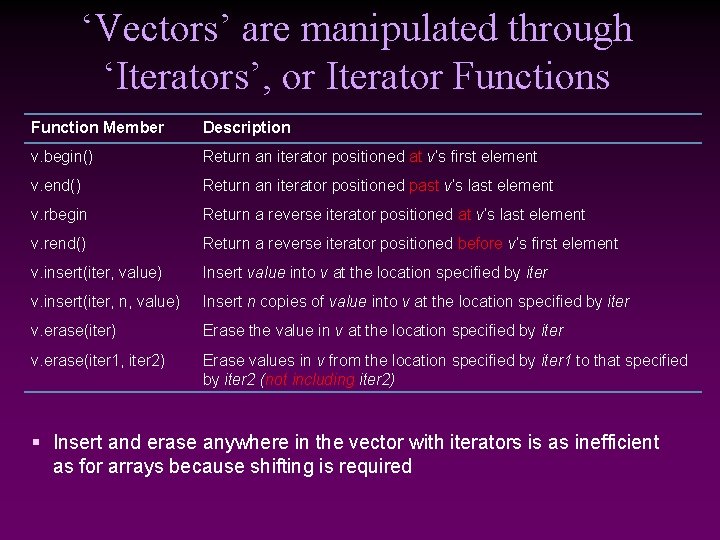
‘Vectors’ are manipulated through ‘Iterators’, or Iterator Functions Function Member Description v. begin() Return an iterator positioned at v’s first element v. end() Return an iterator positioned past v’s last element v. rbegin Return a reverse iterator positioned at v’s last element v. rend() Return a reverse iterator positioned before v’s first element v. insert(iter, value) Insert value into v at the location specified by iter v. insert(iter, n, value) Insert n copies of value into v at the location specified by iter v. erase(iter) Erase the value in v at the location specified by iter v. erase(iter 1, iter 2) Erase values in v from the location specified by iter 1 to that specified by iter 2 (not including iter 2) § Insert and erase anywhere in the vector with iterators is as inefficient as for arrays because shifting is required
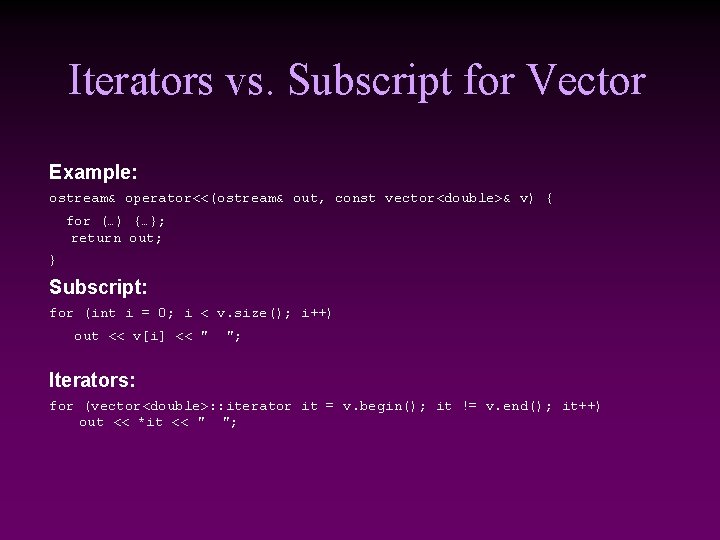
Iterators vs. Subscript for Vector Example: ostream& operator<<(ostream& out, const vector<double>& v) { for (…) {…}; return out; } Subscript: for (int i = 0; i < v. size(); i++) out << v[i] << " "; Iterators: for (vector<double>: : iterator it = v. begin(); it != v. end(); it++) out << *it << " ";
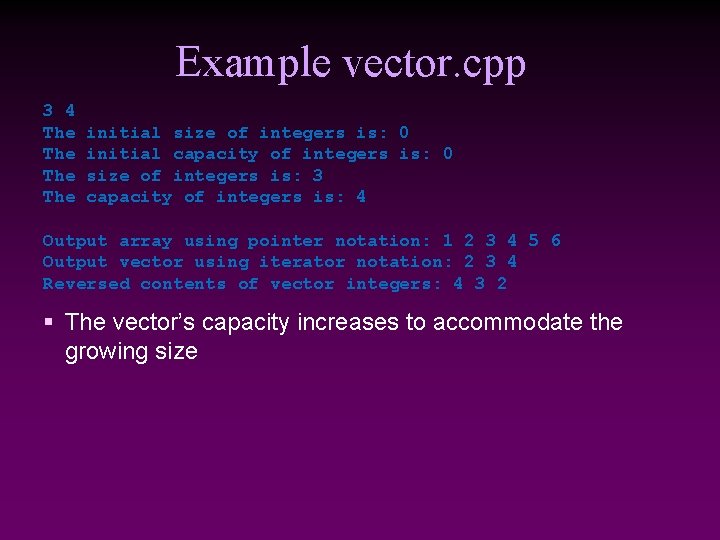
Example vector. cpp 3 4 The The initial size of integers is: 0 initial capacity of integers is: 0 size of integers is: 3 capacity of integers is: 4 Output array using pointer notation: 1 2 3 4 5 6 Output vector using iterator notation: 2 3 4 Reversed contents of vector integers: 4 3 2 § The vector’s capacity increases to accommodate the growing size
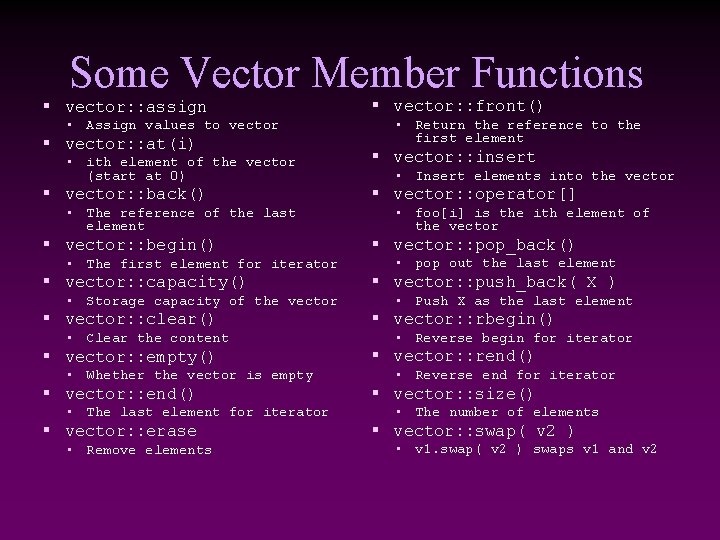
Some Vector Member Functions § vector: : assign • Assign values to vector § vector: : at(i) • ith element of the vector (start at 0) § vector: : back() • The reference of the last element § vector: : begin() • The first element for iterator § vector: : capacity() • Storage capacity of the vector § vector: : clear() • Clear the content § vector: : empty() • Whether the vector is empty § vector: : end() • The last element for iterator § vector: : erase • Remove elements § vector: : front() • Return the reference to the first element § vector: : insert • Insert elements into the vector § vector: : operator[] • foo[i] is the ith element of the vector § vector: : pop_back() • pop out the last element § vector: : push_back( X ) • Push X as the last element § vector: : rbegin() • Reverse begin for iterator § vector: : rend() • Reverse end for iterator § vector: : size() • The number of elements § vector: : swap( v 2 ) • v 1. swap( v 2 ) swaps v 1 and v 2
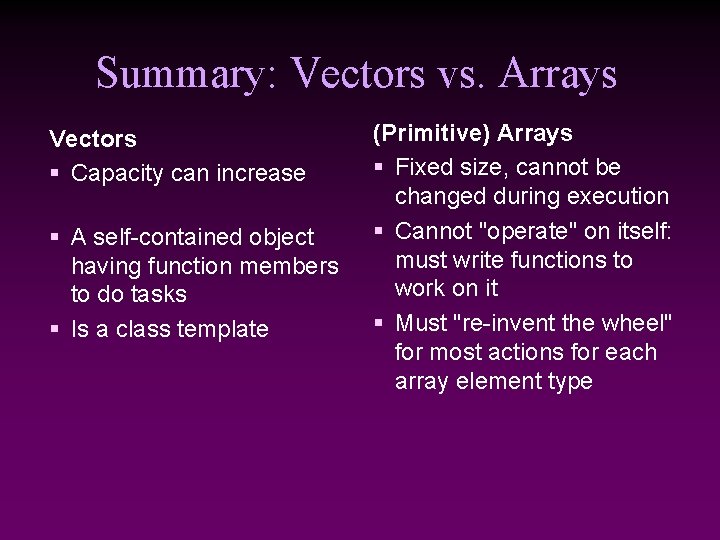
Summary: Vectors vs. Arrays Vectors § Capacity can increase § A self-contained object having function members to do tasks § Is a class template (Primitive) Arrays § Fixed size, cannot be changed during execution § Cannot "operate" on itself: must write functions to work on it § Must "re-invent the wheel" for most actions for each array element type
The list Container § Implemented internally as a doubly-linked list • efficient insertion and deletion operations at any location § Supports bidirectional iterators • traversed forward and backward
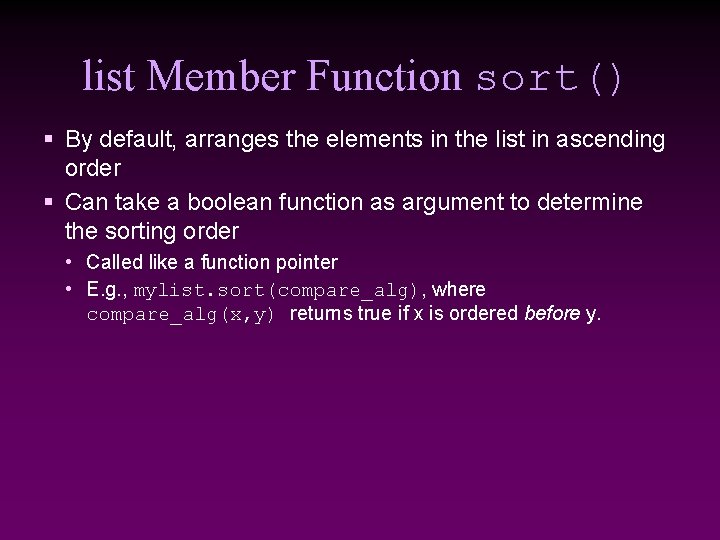
list Member Function sort() § By default, arranges the elements in the list in ascending order § Can take a boolean function as argument to determine the sorting order • Called like a function pointer • E. g. , mylist. sort(compare_alg), where compare_alg(x, y) returns true if x is ordered before y.
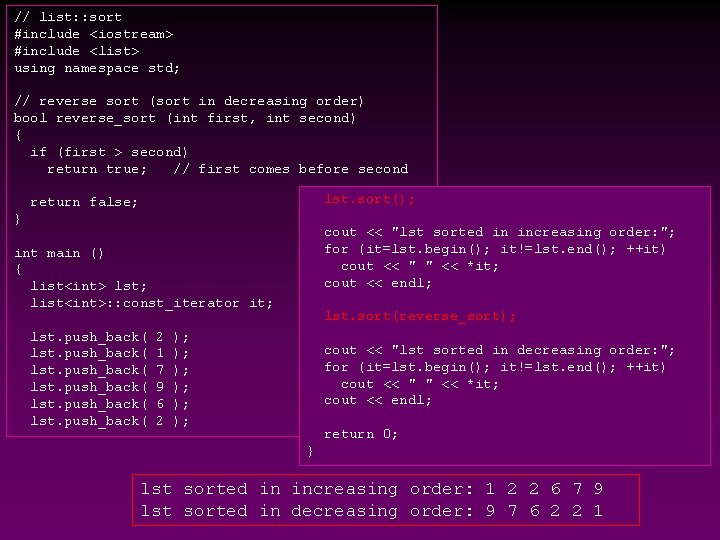
// list: : sort #include <iostream> #include <list> using namespace std; // reverse sort (sort in decreasing order) bool reverse_sort (int first, int second) { if (first > second) return true; // first comes before second lst. sort(); return false; } cout << "lst sorted in increasing order: "; for (it=lst. begin(); it!=lst. end(); ++it) cout << " " << *it; cout << endl; int main () { list<int> lst; list<int>: : const_iterator it; lst. push_back( 2 1 7 9 6 2 lst. sort(reverse_sort); ); ); ); cout << "lst sorted in decreasing order: "; for (it=lst. begin(); it!=lst. end(); ++it) cout << " " << *it; cout << endl; return 0; } lst sorted in increasing order: 1 2 2 6 7 9 lst sorted in decreasing order: 9 7 6 2 2 1
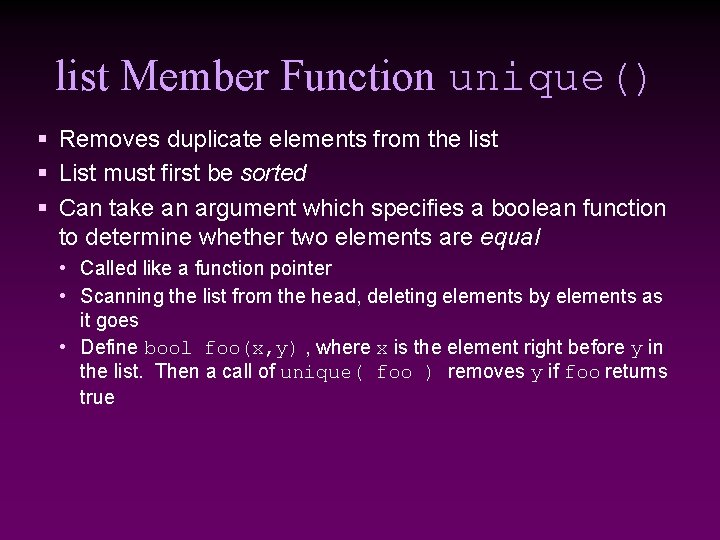
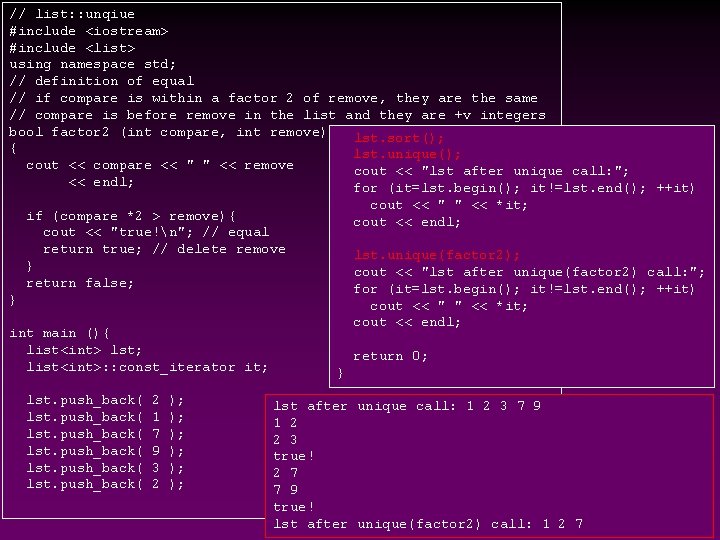
list Member Function unique() § Removes duplicate elements from the list § List must first be sorted § Can take an argument which specifies a boolean function to determine whether two elements are equal • Called like a function pointer • Scanning the list from the head, deleting elements by elements as it goes • Define bool foo(x, y) , where x is the element right before y in the list. Then a call of unique( foo ) removes y if foo returns true
// list: : unqiue #include <iostream> #include <list> using namespace std; // definition of equal // if compare is within a factor 2 of remove, they are the same // compare is before remove in the list and they are +v integers bool factor 2 (int compare, int remove) lst. sort(); { lst. unique(); cout << compare << " " << remove cout << "lst after unique call: "; << endl; for (it=lst. begin(); it!=lst. end(); ++it) cout << " " << *it; if (compare *2 > remove){ cout << endl; cout << "true!n"; // equal return true; // delete remove lst. unique(factor 2); } cout << "lst after unique(factor 2) call: "; return false; for (it=lst. begin(); it!=lst. end(); ++it) } cout << " " << *it; int main (){ list<int> lst; list<int>: : const_iterator it; lst. push_back( 2 1 7 9 3 2 ); ); ); cout << endl; return 0; } lst after unique call: 1 2 3 7 9 1 2 2 3 true! 2 7 7 9 true! lst after unique(factor 2) call: 1 2 7 35
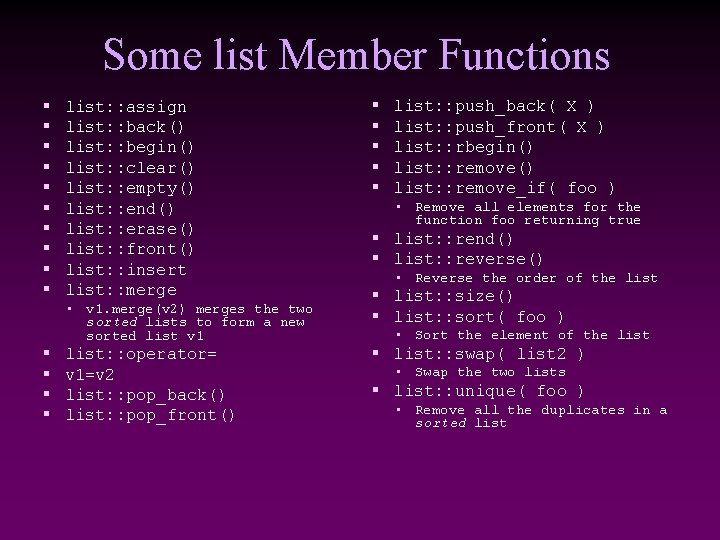
Some list Member Functions § § § § list: : assign list: : back() list: : begin() list: : clear() list: : empty() list: : end() list: : erase() list: : front() list: : insert list: : merge • v 1. merge(v 2) merges the two sorted lists to form a new sorted list v 1 list: : operator= v 1=v 2 list: : pop_back() list: : pop_front() § § § list: : push_back( X ) list: : push_front( X ) list: : rbegin() list: : remove_if( foo ) • Remove all elements for the function foo returning true § list: : rend() § list: : reverse() • Reverse the order of the list § list: : size() § list: : sort( foo ) • Sort the element of the list § list: : swap( list 2 ) • Swap the two lists § list: : unique( foo ) • Remove all the duplicates in a sorted list
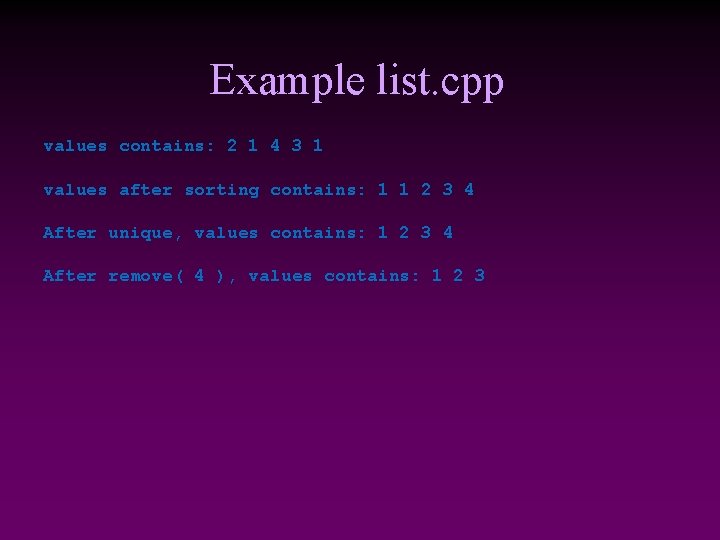
Example list. cpp values contains: 2 1 4 3 1 values after sorting contains: 1 1 2 3 4 After unique, values contains: 1 2 3 4 After remove( 4 ), values contains: 1 2 3
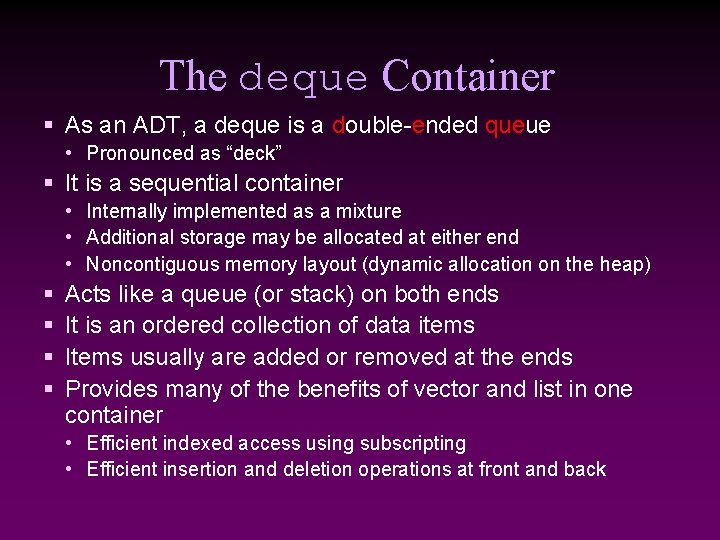
The deque Container § As an ADT, a deque is a double-ended queue • Pronounced as “deck” § It is a sequential container • Internally implemented as a mixture • Additional storage may be allocated at either end • Noncontiguous memory layout (dynamic allocation on the heap) § § Acts like a queue (or stack) on both ends It is an ordered collection of data items Items usually are added or removed at the ends Provides many of the benefits of vector and list in one container • Efficient indexed access using subscripting • Efficient insertion and deletion operations at front and back
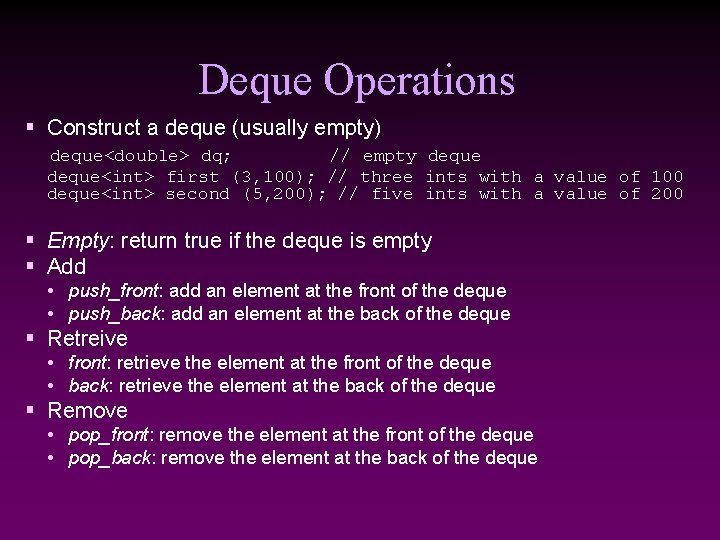
Deque Operations § Construct a deque (usually empty) deque<double> dq; // empty deque<int> first (3, 100); // three ints with a value of 100 deque<int> second (5, 200); // five ints with a value of 200 § Empty: return true if the deque is empty § Add • push_front: add an element at the front of the deque • push_back: add an element at the back of the deque § Retreive • front: retrieve the element at the front of the deque • back: retrieve the element at the back of the deque § Remove • pop_front: remove the element at the front of the deque • pop_back: remove the element at the back of the deque
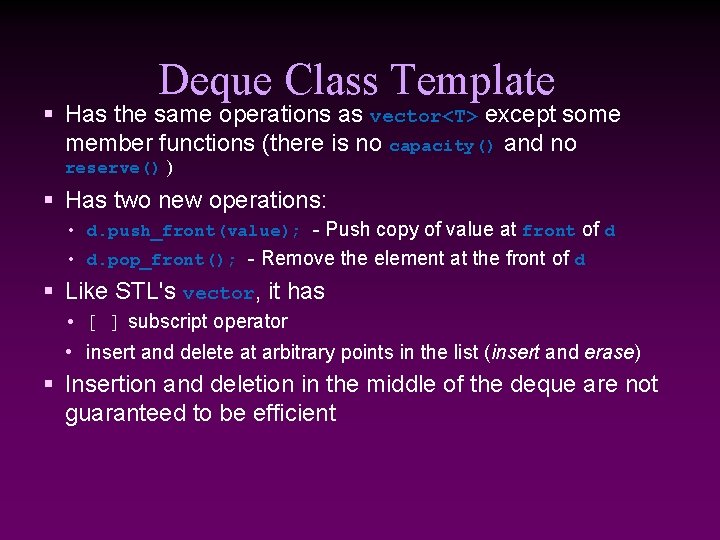
Deque Class Template § Has the same operations as vector<T> except some member functions (there is no capacity() and no reserve() ) § Has two new operations: • d. push_front(value); - Push copy of value at front of d • d. pop_front(); - Remove the element at the front of d § Like STL's vector, it has • [ ] subscript operator • insert and delete at arbitrary points in the list (insert and erase) § Insertion and deletion in the middle of the deque are not guaranteed to be efficient
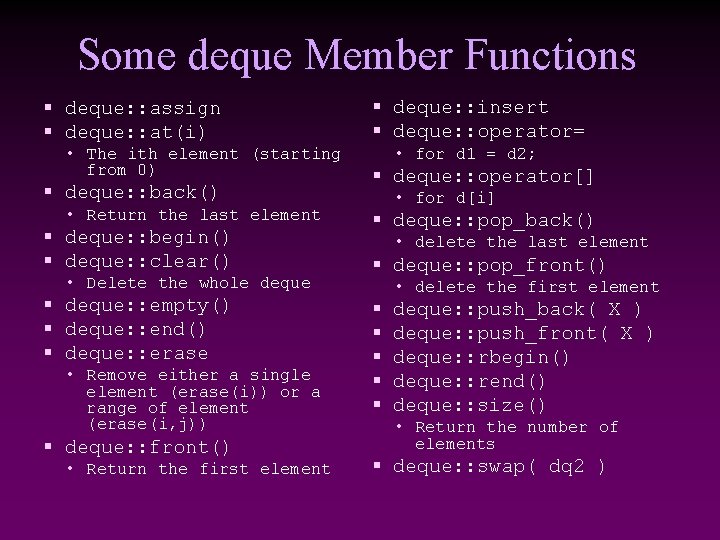
Some deque Member Functions § deque: : assign § deque: : at(i) • The ith element (starting from 0) § deque: : back() • Return the last element § deque: : begin() § deque: : clear() • Delete the whole deque § deque: : empty() § deque: : end() § deque: : erase • Remove either a single element (erase(i)) or a range of element (erase(i, j)) § deque: : front() • Return the first element § deque: : insert § deque: : operator= • for d 1 = d 2; § deque: : operator[] • for d[i] § deque: : pop_back() • delete the last element § deque: : pop_front() § § § • delete the first element deque: : push_back( X ) deque: : push_front( X ) deque: : rbegin() deque: : rend() deque: : size() • Return the number of elements § deque: : swap( dq 2 )
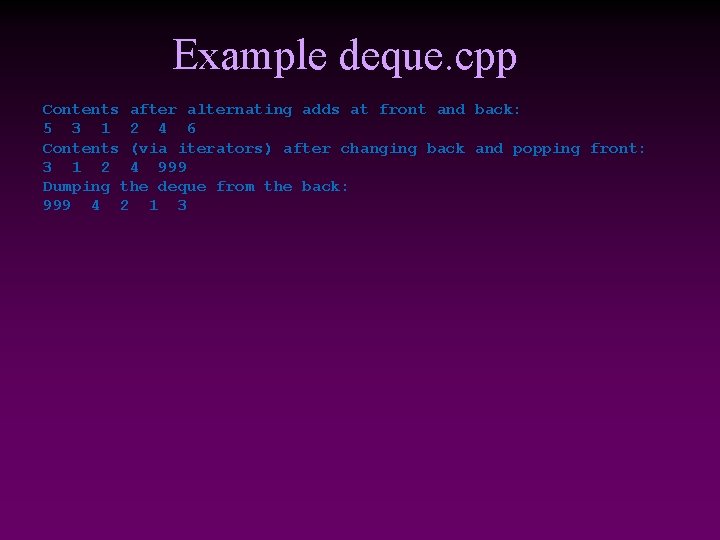
Example deque. cpp Contents after alternating adds at front and back: 5 3 1 2 4 6 Contents (via iterators) after changing back and popping front: 3 1 2 4 999 Dumping the deque from the back: 999 4 2 1 3
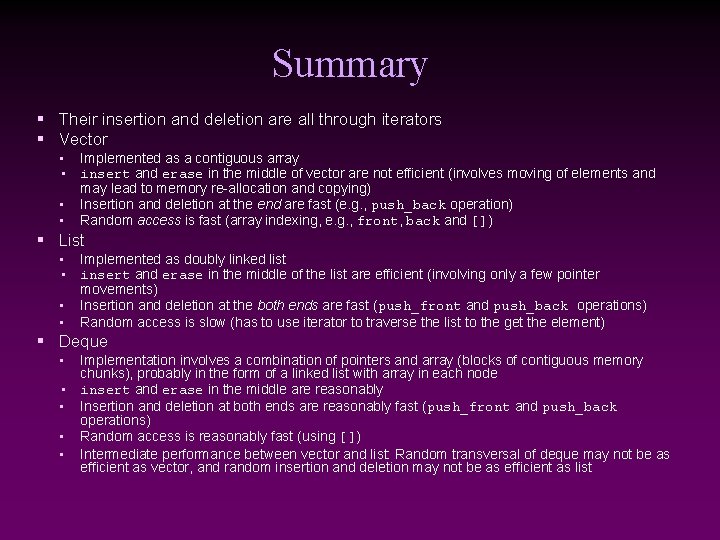
Summary § Their insertion and deletion are all through iterators § Vector • Implemented as a contiguous array • insert and erase in the middle of vector are not efficient (involves moving of elements and may lead to memory re-allocation and copying) • Insertion and deletion at the end are fast (e. g. , push_back operation) • Random access is fast (array indexing, e. g. , front, back and []) § List • Implemented as doubly linked list • insert and erase in the middle of the list are efficient (involving only a few pointer movements) • Insertion and deletion at the both ends are fast (push_front and push_back operations) • Random access is slow (has to use iterator to traverse the list to the get the element) § Deque • Implementation involves a combination of pointers and array (blocks of contiguous memory chunks), probably in the form of a linked list with array in each node • insert and erase in the middle are reasonably • Insertion and deletion at both ends are reasonably fast (push_front and push_back operations) • Random access is reasonably fast (using []) • Intermediate performance between vector and list: Random transversal of deque may not be as efficient as vector, and random insertion and deletion may not be as efficient as list
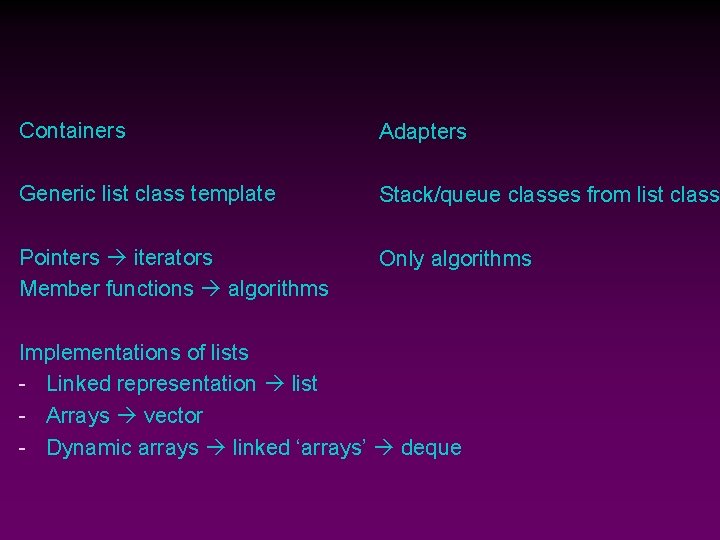
Containers Adapters Generic list class template Stack/queue classes from list class Pointers iterators Member functions algorithms Only algorithms Implementations of lists - Linked representation list - Arrays vector - Dynamic arrays linked ‘arrays’ deque
Container Adapters
Container Adapters § Each basic container has its own data structure (representation): vector, list, deque § A containter adapter is a ‘container’ built on top of a basic container • A basic container is ‘adapted’ to another (not separate) container • You choose a basic container (data structure) § The interfaces of an adaptor are restricted and specialized • No iterators!!! • Use only ‘push’ and ‘pop’ q Push: properly insert an element into data structure q Pop: properly remove an element from data structure
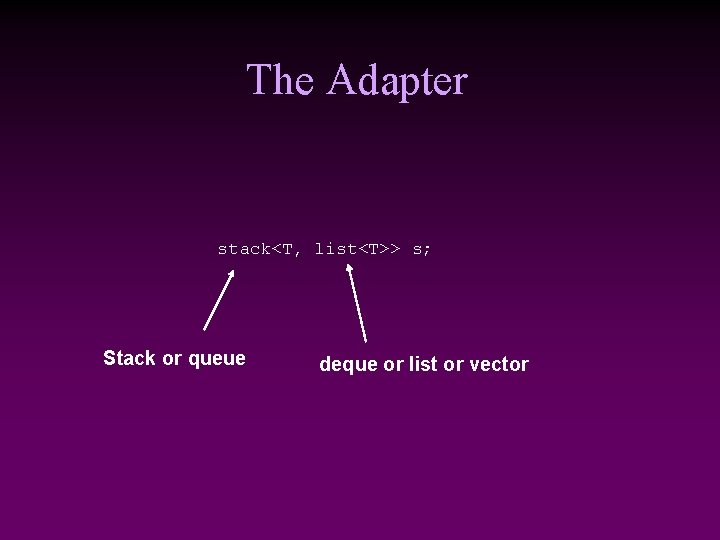
The Adapter stack<T, list<T>> s; Stack or queue deque or list or vector
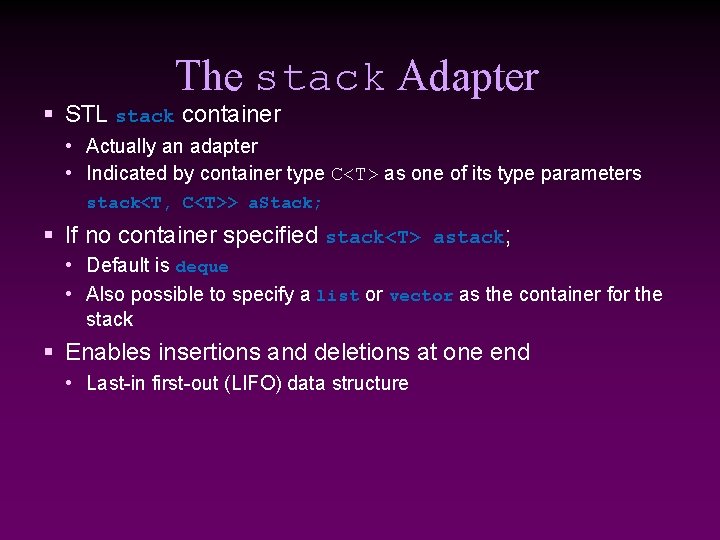
The stack Adapter § STL stack container • Actually an adapter • Indicated by container type C<T> as one of its type parameters stack<T, C<T>> a. Stack; § If no container specified stack<T> astack; • Default is deque • Also possible to specify a list or vector as the container for the stack § Enables insertions and deletions at one end • Last-in first-out (LIFO) data structure
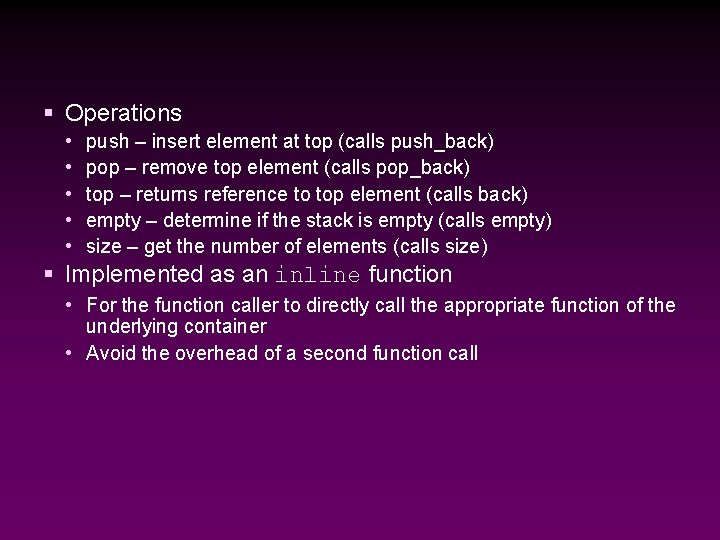
§ Operations • • • push – insert element at top (calls push_back) pop – remove top element (calls pop_back) top – returns reference to top element (calls back) empty – determine if the stack is empty (calls empty) size – get the number of elements (calls size) § Implemented as an inline function • For the function caller to directly call the appropriate function of the underlying container • Avoid the overhead of a second function call
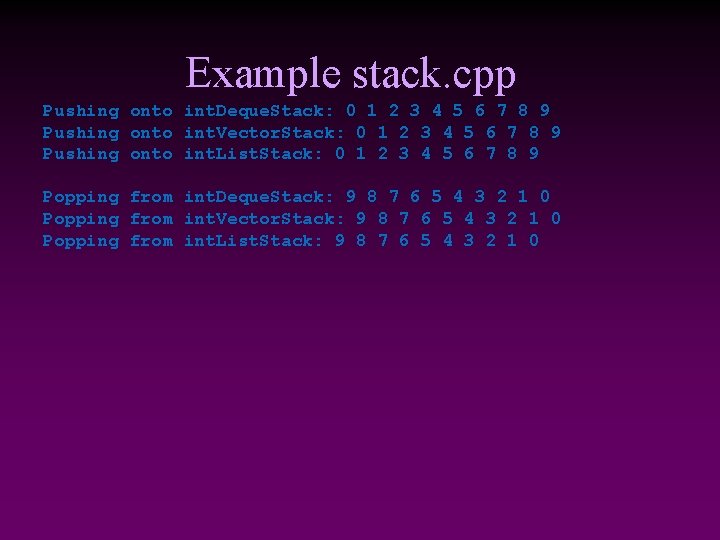
Example stack. cpp Pushing onto int. Deque. Stack: 0 1 2 3 4 5 6 7 8 9 Pushing onto int. Vector. Stack: 0 1 2 3 4 5 6 7 8 9 Pushing onto int. List. Stack: 0 1 2 3 4 5 6 7 8 9 Popping from int. Deque. Stack: 9 8 7 6 5 4 3 2 1 0 Popping from int. Vector. Stack: 9 8 7 6 5 4 3 2 1 0 Popping from int. List. Stack: 9 8 7 6 5 4 3 2 1 0
The queue Adapter § A queue can be specified queue<T, C<T> > a. Queue; • C<T> may be any container supporting push_back() and pop_front() § The default container is deque • Could also use queue<T, list<T> > a. Queue; • For the best performance, use class deque as the underlying container § Enables insertions at back and deletions from front • First-in first-out (FIFO) data structure
§ Operations • • • push – insert element at back (calls push_back) pop – remove element from front (calls pop_front) front – returns reference to first element (calls front) empty – determine if the queue is empty (calls empty) size – get the number of elements (calls size) § Again, implemented as an inline function
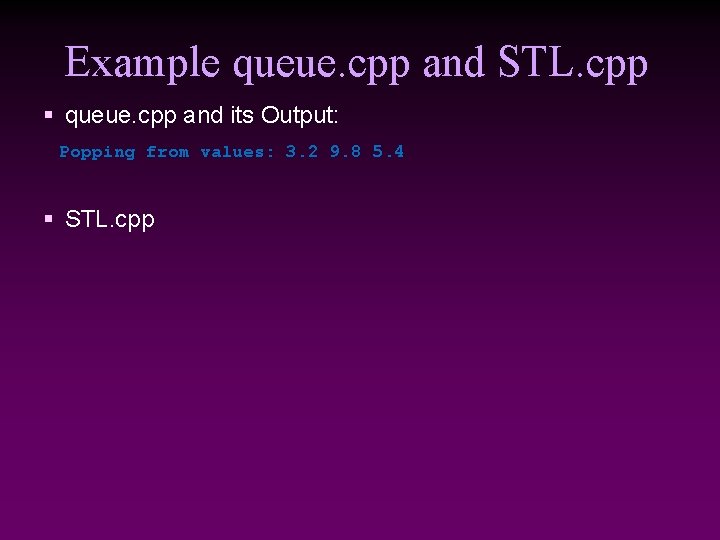
Example queue. cpp and STL. cpp § queue. cpp and its Output: Popping from values: 3. 2 9. 8 5. 4 § STL. cpp