
Review What monomers make up protein polymers What

- Slides: 37
Review • What monomers make up protein polymers? • What type of chemical bond is formed between these monomers? • What are the four levels of structure in proteins?
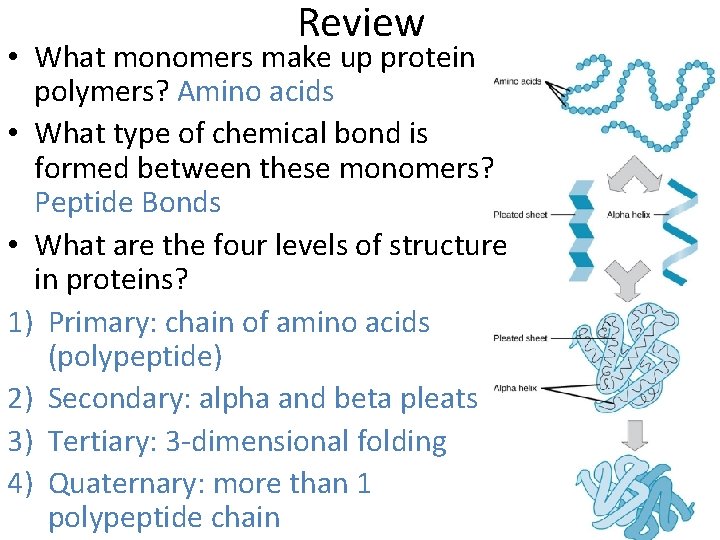
Review • What monomers make up protein polymers? Amino acids • What type of chemical bond is formed between these monomers? Peptide Bonds • What are the four levels of structure in proteins? 1) Primary: chain of amino acids (polypeptide) 2) Secondary: alpha and beta pleats 3) Tertiary: 3 -dimensional folding 4) Quaternary: more than 1 polypeptide chain
• What are traits? http: //learn. genetics. utah. edu/content/basics /traits/ • What are DNA and genes? http: //learn. genetics. utah. edu/content/basics /dna
What makes a firefly glow? • http: //learn. genetics. utah. edu/content/basics /firefly/
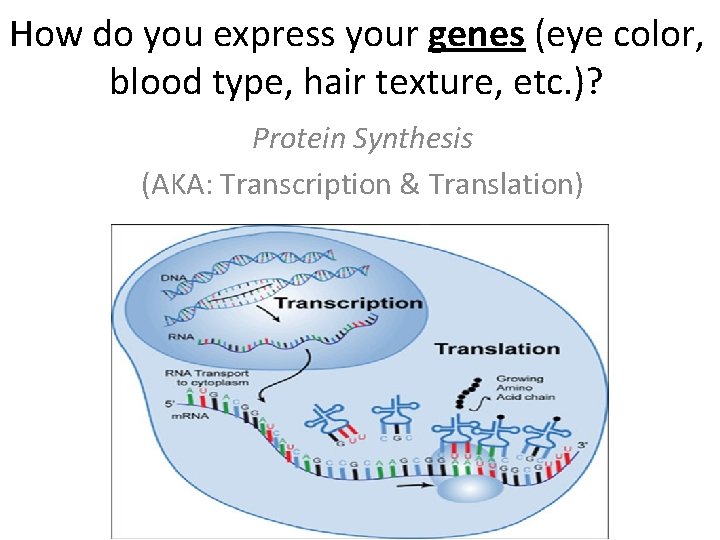
How do you express your genes (eye color, blood type, hair texture, etc. )? Protein Synthesis (AKA: Transcription & Translation)
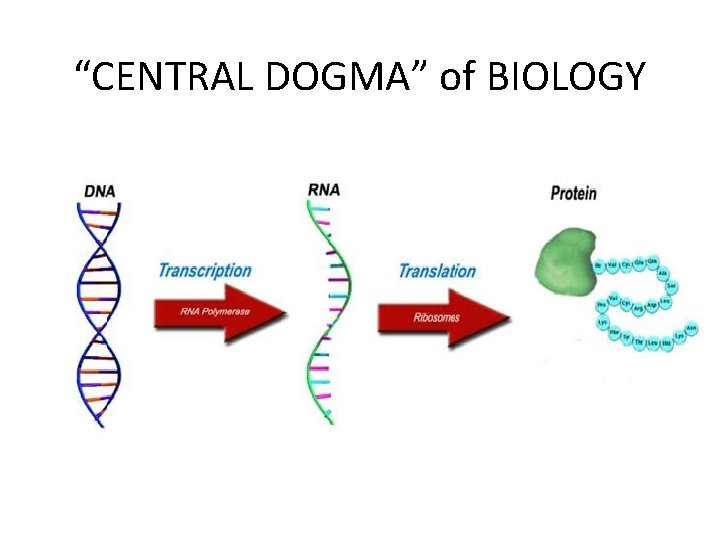
“CENTRAL DOGMA” of BIOLOGY
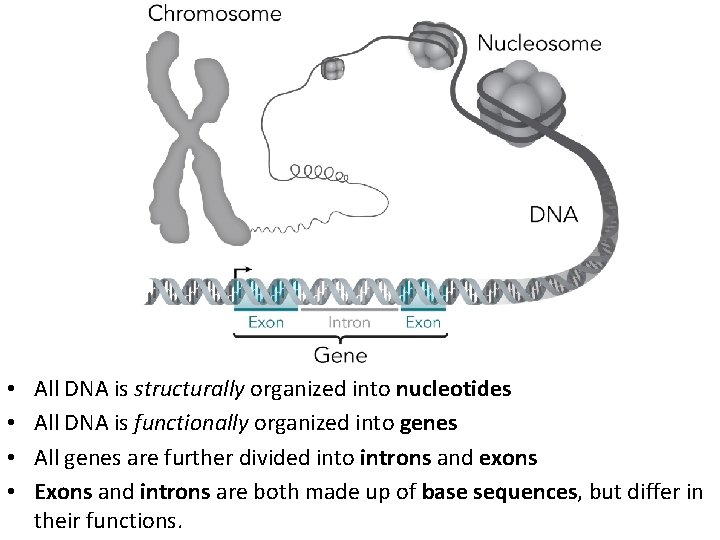
• • All DNA is structurally organized into nucleotides All DNA is functionally organized into genes All genes are further divided into introns and exons Exons and introns are both made up of base sequences, but differ in their functions.
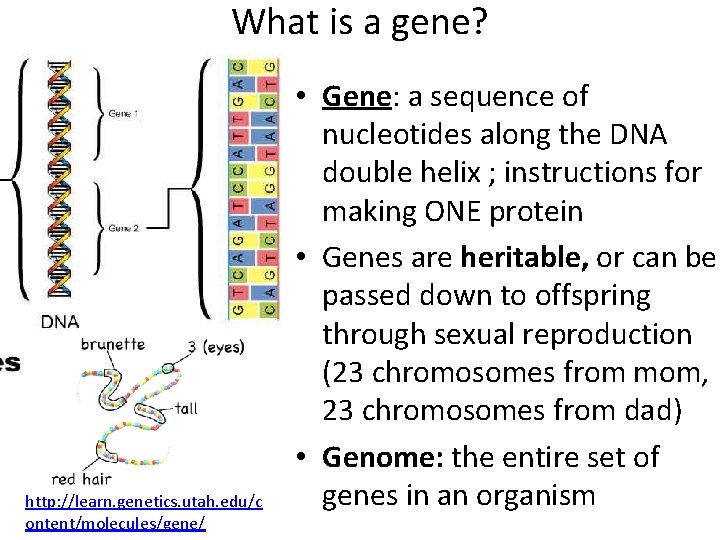
What is a gene? http: //learn. genetics. utah. edu/c ontent/molecules/gene/ • Gene: a sequence of nucleotides along the DNA double helix ; instructions for making ONE protein • Genes are heritable, or can be passed down to offspring through sexual reproduction (23 chromosomes from mom, 23 chromosomes from dad) • Genome: the entire set of genes in an organism
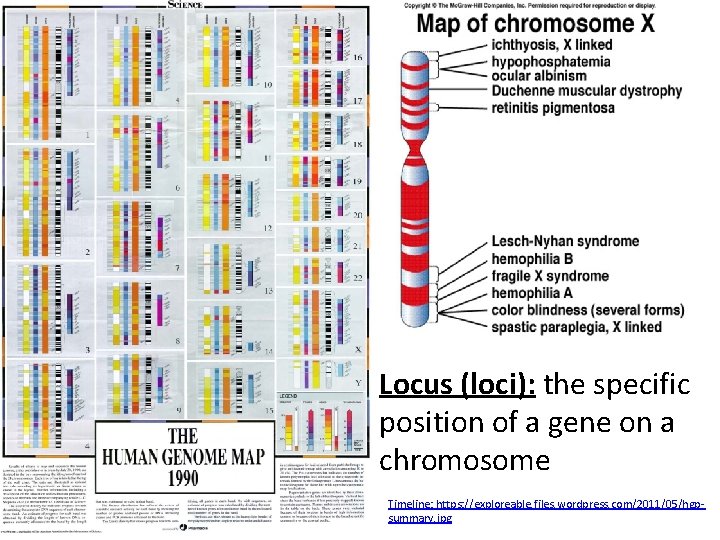
Locus (loci): the specific position of a gene on a chromosome • Timeline: https: //exploreable. files. wordpress. com/2011/05/hgpsummary. jpg
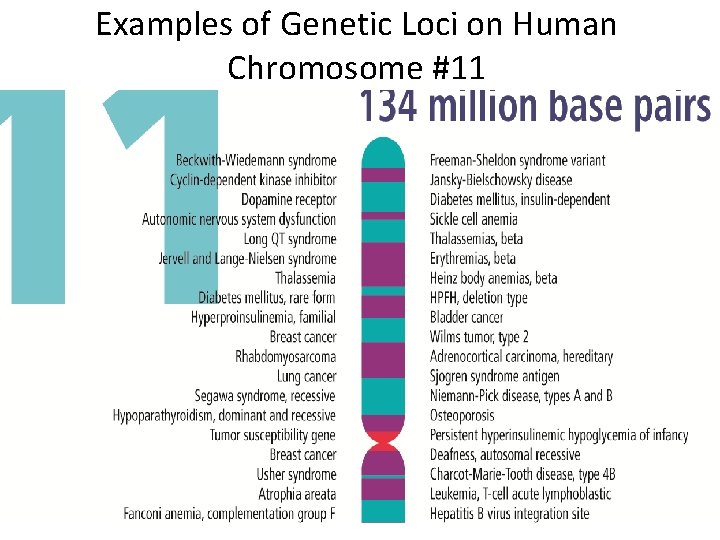
Examples of Genetic Loci on Human Chromosome #11
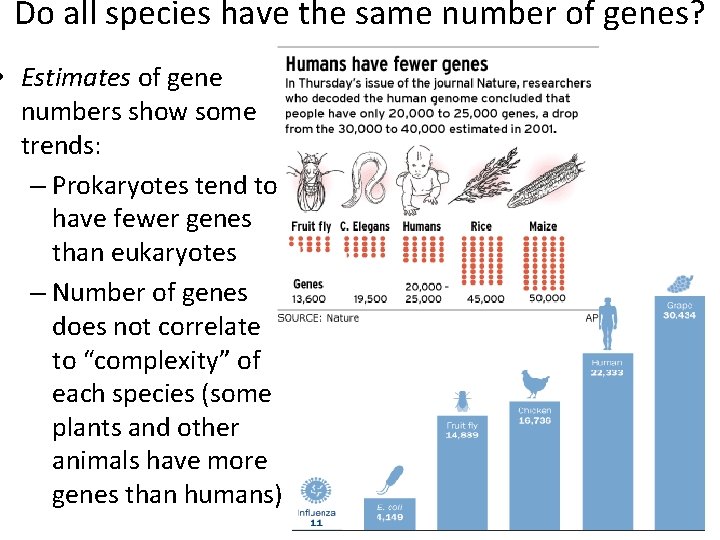
Do all species have the same number of genes? • Estimates of gene numbers show some trends: – Prokaryotes tend to have fewer genes than eukaryotes – Number of genes does not correlate to “complexity” of each species (some plants and other animals have more genes than humans)
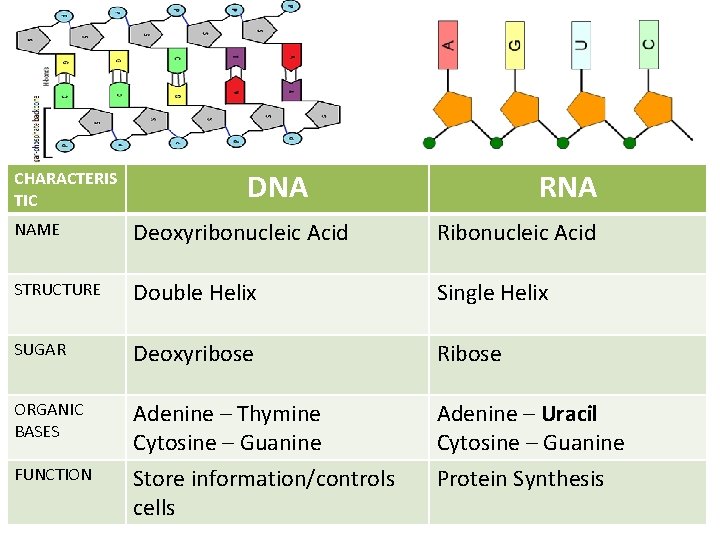
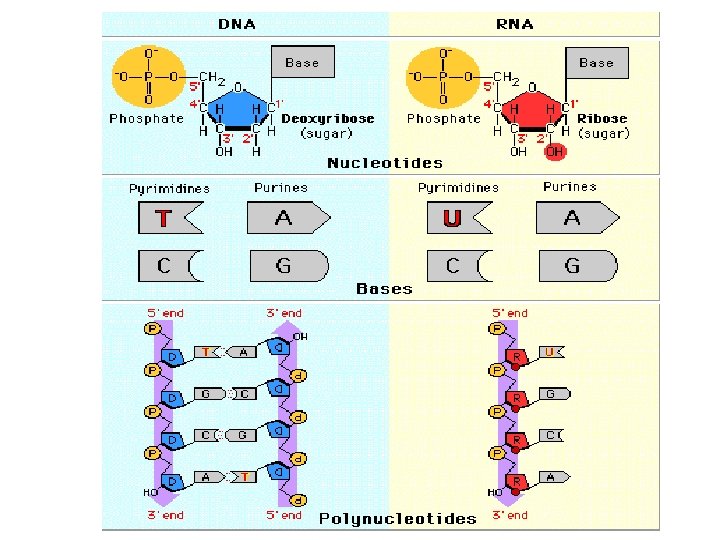
CHARACTERIS TIC DNA RNA NAME Deoxyribonucleic Acid Ribonucleic Acid STRUCTURE Double Helix Single Helix SUGAR Deoxyribose Ribose ORGANIC BASES Adenine – Thymine Cytosine – Guanine Adenine – Uracil Cytosine – Guanine FUNCTION Store information/controls cells Protein Synthesis
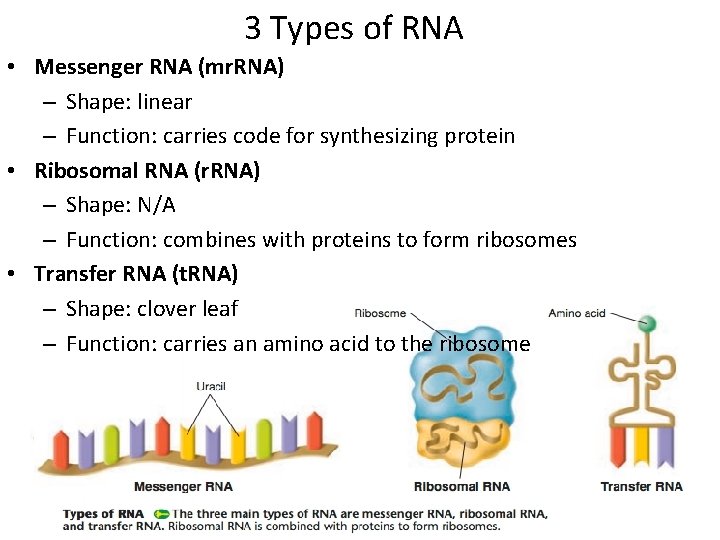
3 Types of RNA • Messenger RNA (mr. RNA) – Shape: linear – Function: carries code for synthesizing protein • Ribosomal RNA (r. RNA) – Shape: N/A – Function: combines with proteins to form ribosomes • Transfer RNA (t. RNA) – Shape: clover leaf – Function: carries an amino acid to the ribosome
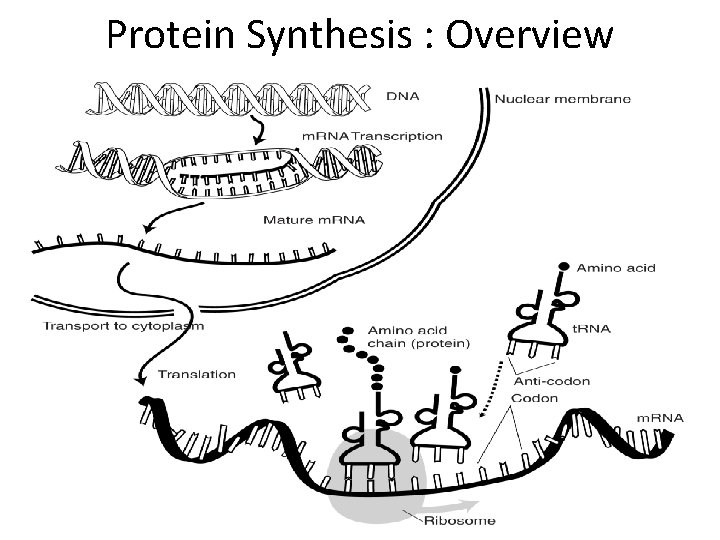
Protein Synthesis : Overview
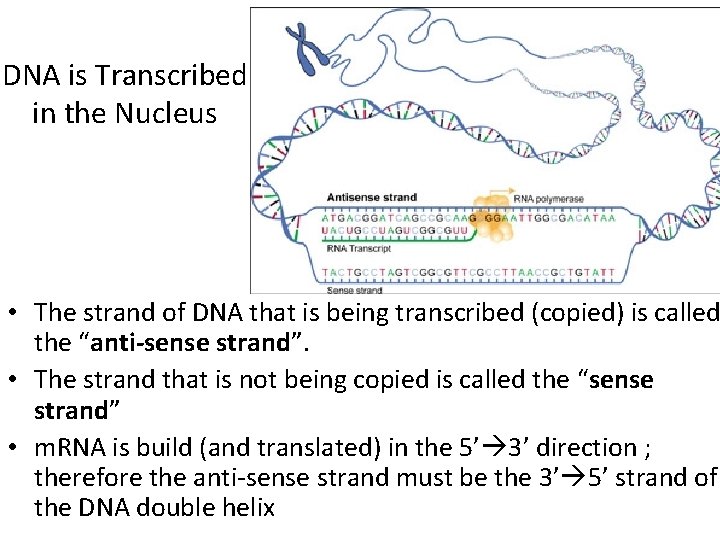
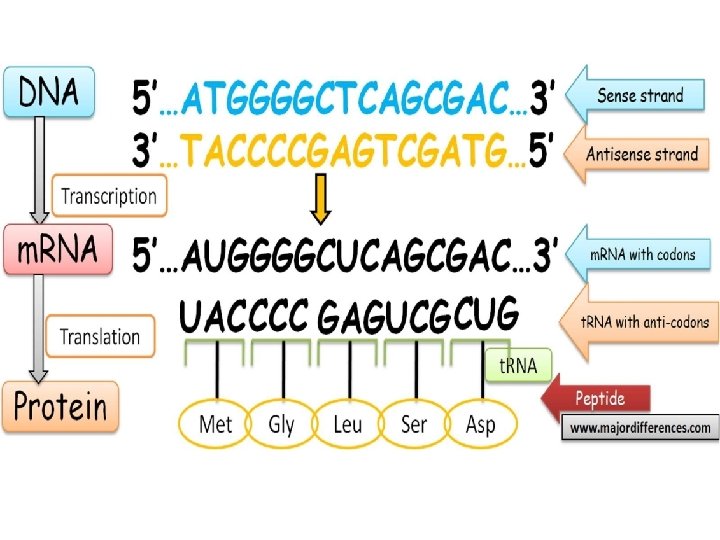
DNA is Transcribed in the Nucleus • The strand of DNA that is being transcribed (copied) is called the “anti-sense strand”. • The strand that is not being copied is called the “sense strand” • m. RNA is build (and translated) in the 5’ 3’ direction ; therefore the anti-sense strand must be the 3’ 5’ strand of the DNA double helix
PROTEIN SYNTHESIS: http: //www. biologieenflash. net/sommaire. html • 1) Transcription Animation: http: //www. biologieenflash. net/animation. ph p? ref=bio-0025 -2 • 2) Translation Animation 1: http: //www. biologieenflash. net/animation. ph p? ref=bio-0026 -2
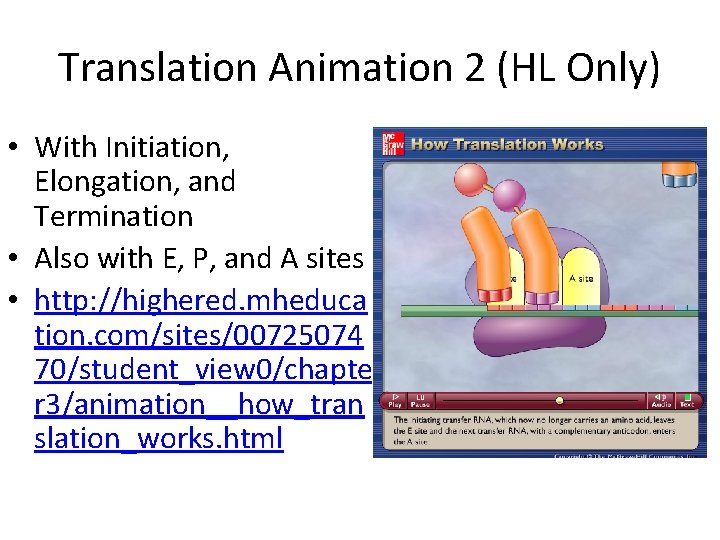
Translation Animation 2 (HL Only) • With Initiation, Elongation, and Termination • Also with E, P, and A sites • http: //highered. mheduca tion. com/sites/00725074 70/student_view 0/chapte r 3/animation__how_tran slation_works. html
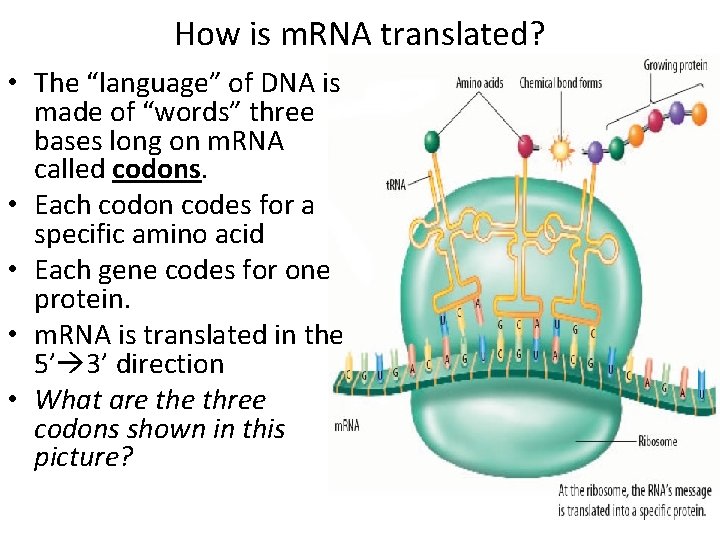
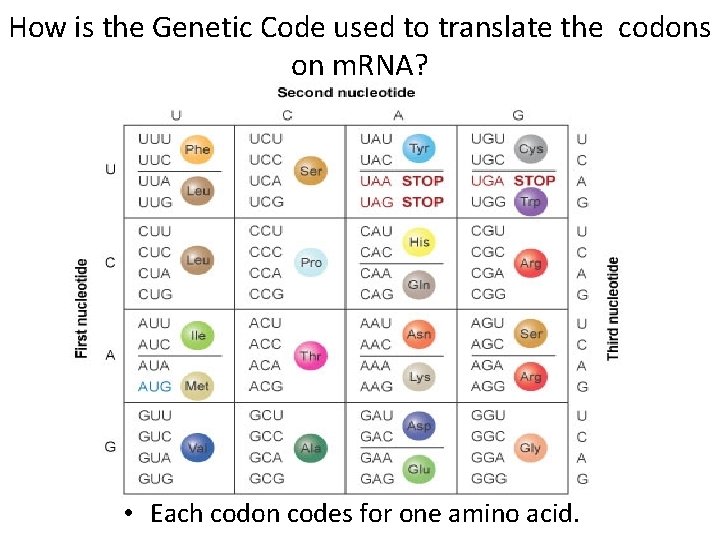
How is m. RNA translated? • The “language” of DNA is made of “words” three bases long on m. RNA called codons. • Each codon codes for a specific amino acid • Each gene codes for one protein. • m. RNA is translated in the 5’ 3’ direction • What are three codons shown in this picture?
How is the Genetic Code used to translate the codons on m. RNA? • Each codon codes for one amino acid.
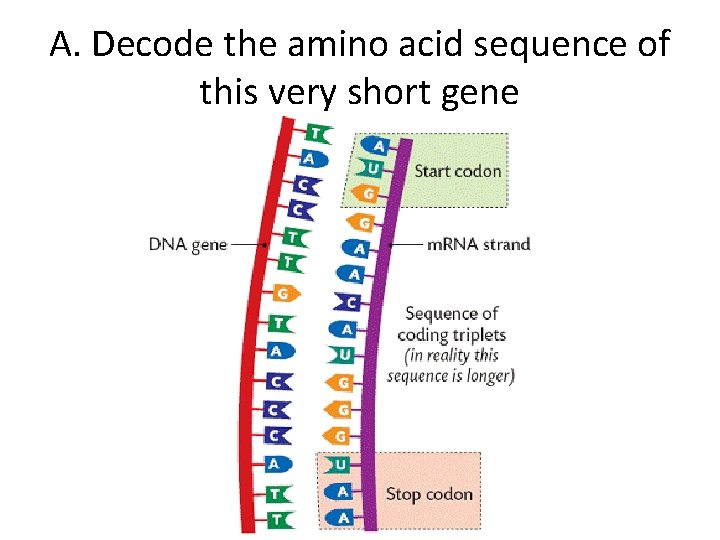
A. Decode the amino acid sequence of this very short gene
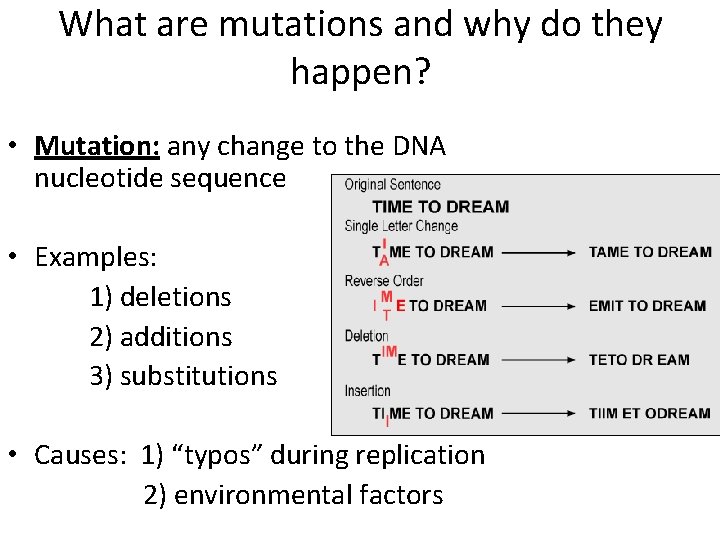
What are mutations and why do they happen? • Mutation: any change to the DNA nucleotide sequence • Examples: 1) deletions 2) additions 3) substitutions • Causes: 1) “typos” during replication 2) environmental factors
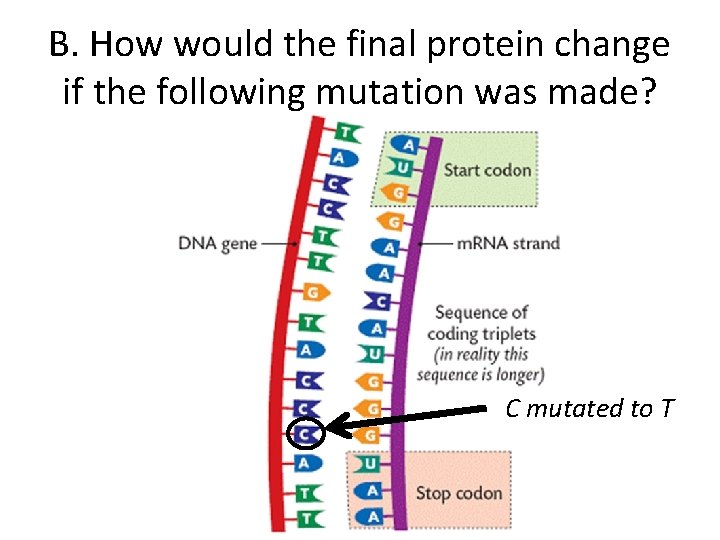
B. How would the final protein change if the following mutation was made? C mutated to T
• http: //learn. genetics. utah. edu/content/basics /transcribe/
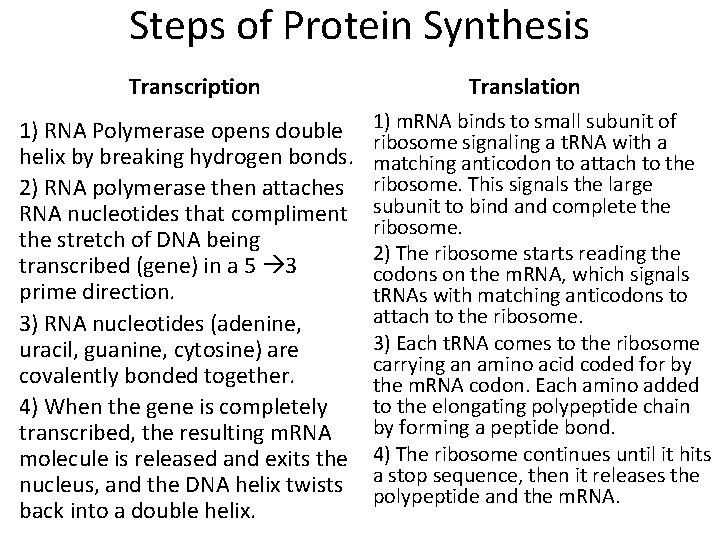
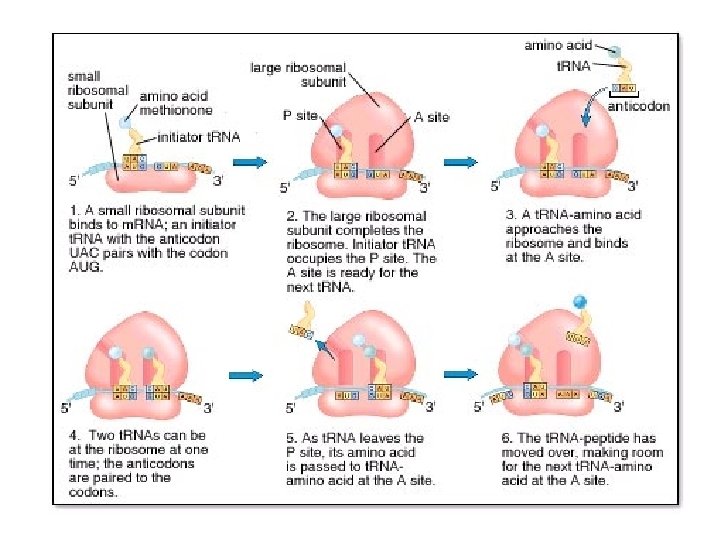
Steps of Protein Synthesis Transcription 1) RNA Polymerase opens double helix by breaking hydrogen bonds. 2) RNA polymerase then attaches RNA nucleotides that compliment the stretch of DNA being transcribed (gene) in a 5 3 prime direction. 3) RNA nucleotides (adenine, uracil, guanine, cytosine) are covalently bonded together. 4) When the gene is completely transcribed, the resulting m. RNA molecule is released and exits the nucleus, and the DNA helix twists back into a double helix. Translation 1) m. RNA binds to small subunit of ribosome signaling a t. RNA with a matching anticodon to attach to the ribosome. This signals the large subunit to bind and complete the ribosome. 2) The ribosome starts reading the codons on the m. RNA, which signals t. RNAs with matching anticodons to attach to the ribosome. 3) Each t. RNA comes to the ribosome carrying an amino acid coded for by the m. RNA codon. Each amino added to the elongating polypeptide chain by forming a peptide bond. 4) The ribosome continues until it hits a stop sequence, then it releases the polypeptide and the m. RNA.
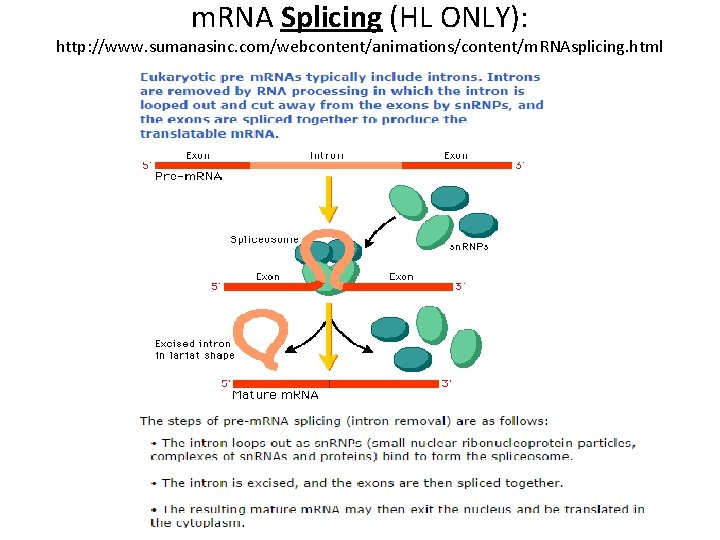
m. RNA Splicing (HL ONLY): http: //www. sumanasinc. com/webcontent/animations/content/m. RNAsplicing. html
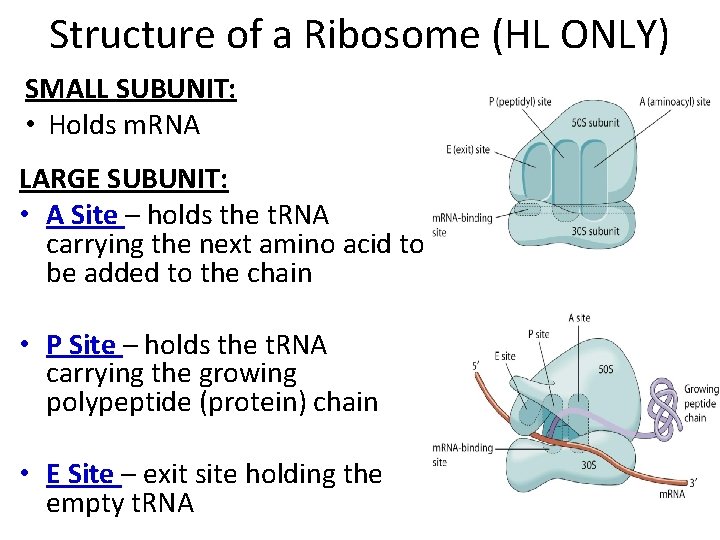
Structure of a Ribosome (HL ONLY) SMALL SUBUNIT: • Holds m. RNA LARGE SUBUNIT: • A Site – holds the t. RNA carrying the next amino acid to be added to the chain • P Site – holds the t. RNA carrying the growing polypeptide (protein) chain • E Site – exit site holding the empty t. RNA
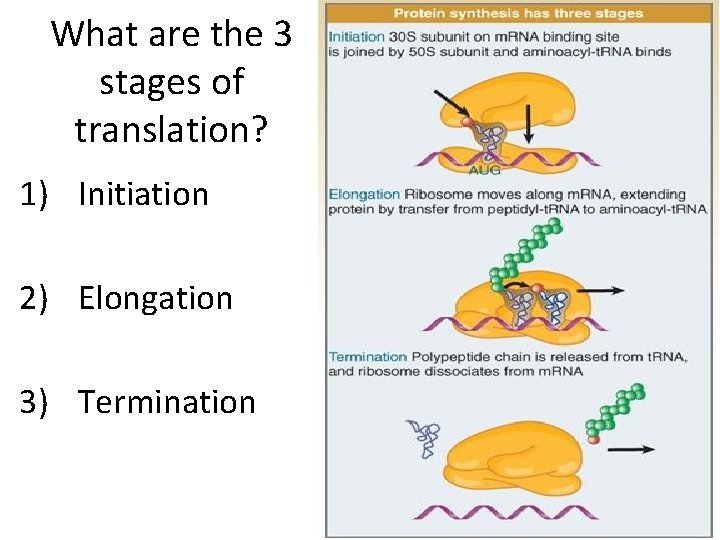
What are the 3 stages of translation? 1) Initiation 2) Elongation 3) Termination
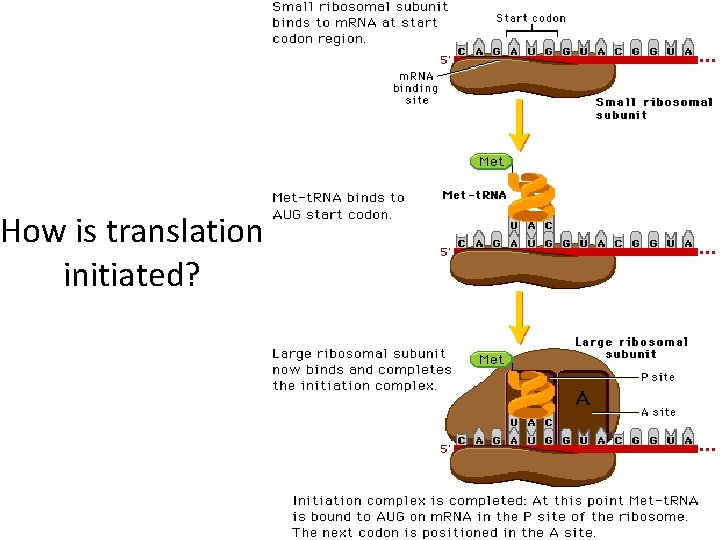
How is translation initiated?
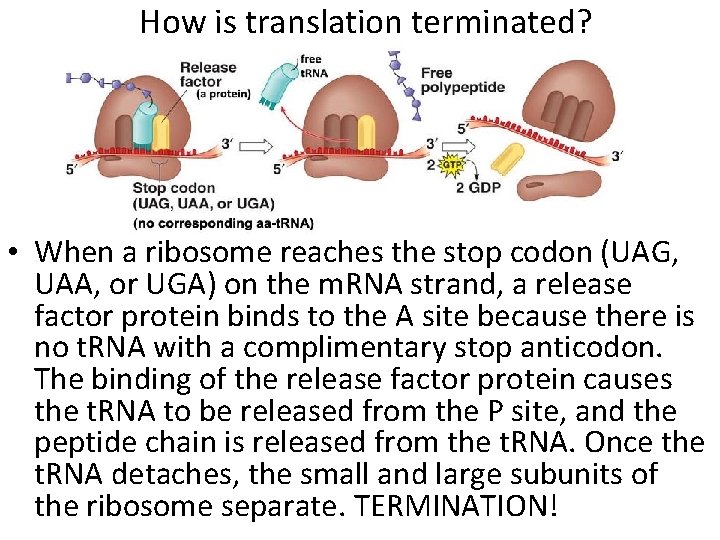
How is translation terminated? • When a ribosome reaches the stop codon (UAG, UAA, or UGA) on the m. RNA strand, a release factor protein binds to the A site because there is no t. RNA with a complimentary stop anticodon. The binding of the release factor protein causes the t. RNA to be released from the P site, and the peptide chain is released from the t. RNA. Once the t. RNA detaches, the small and large subunits of the ribosome separate. TERMINATION!
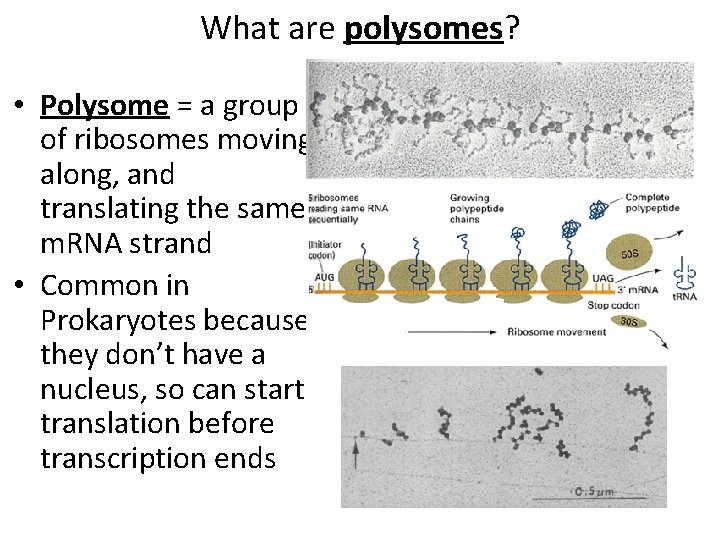
What are polysomes? • Polysome = a group of ribosomes moving along, and translating the same m. RNA strand • Common in Prokaryotes because they don’t have a nucleus, so can start translation before transcription ends
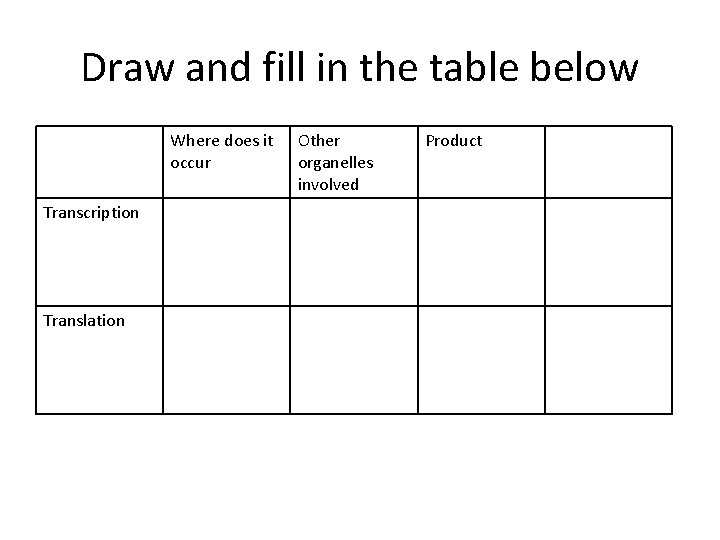
Draw and fill in the table below Where does it occur Transcription Translation Other organelles involved Product
Homework for 9/16 – DUE MONDAY SL Only: 1) Complete Data Based Questions on Page 109, & 118 -119. (2 questions total) 2) Complete Review Questions 1 -3 (Page 120 – Purple Box) HL Only: 1) Read Protein Synthesis PPT Slides 21 -25 PPT & Take notes. Let me know if you have any questions! 2) Complete SL Data Questions AND Data Based Questions on Page 356 & 371 (4 Questions Total) – Try them and use answer keys!! Will clarify questions on Monday.
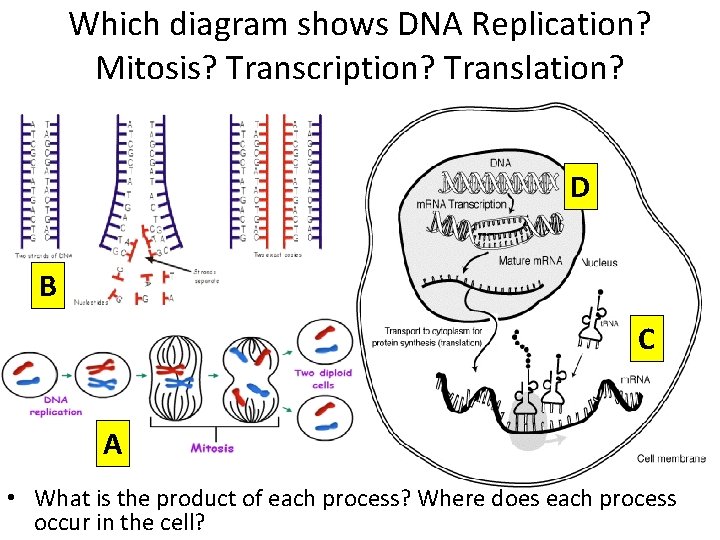
Which diagram shows DNA Replication? Mitosis? Transcription? Translation? D B C A • What is the product of each process? Where does each process occur in the cell?