
Review What might you find in a Victorian
- Slides: 9
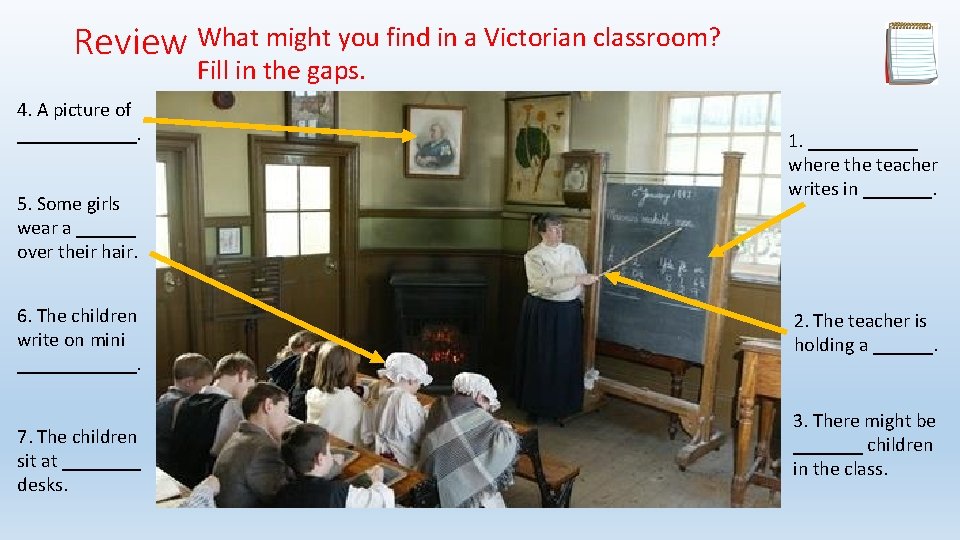
Review What might you find in a Victorian classroom? Fill in the gaps. 4. A picture of ______. 5. Some girls wear a ______ over their hair. 6. The children write on mini ______. 7. The children sit at ____ desks. 1. ______ where the teacher writes in _______. 2. The teacher is holding a ______. 3. There might be _______ children in the class.
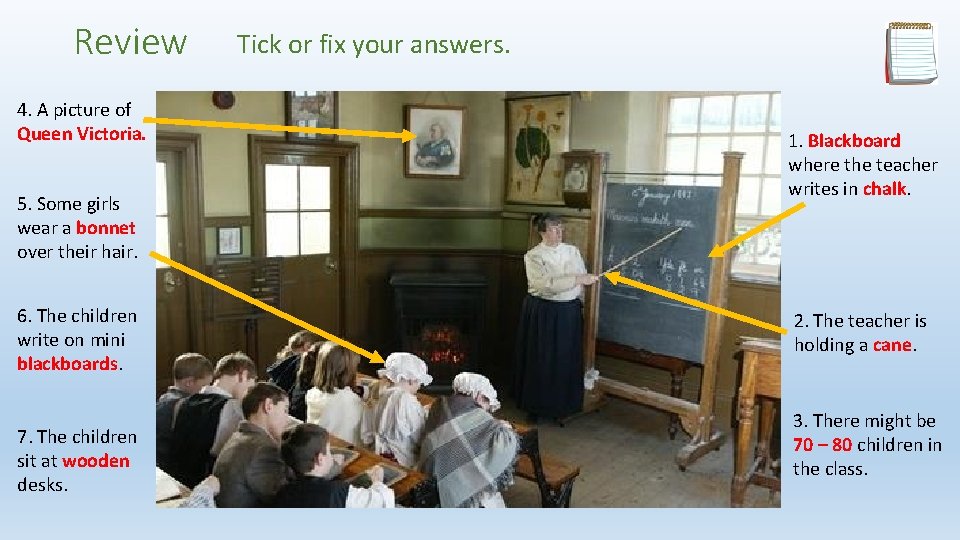
Review 4. A picture of Queen Victoria. 5. Some girls wear a bonnet over their hair. 6. The children write on mini blackboards. 7. The children sit at wooden desks. Tick or fix your answers. 1. Blackboard where the teacher writes in chalk. 2. The teacher is holding a cane. 3. There might be 70 – 80 children in the class.
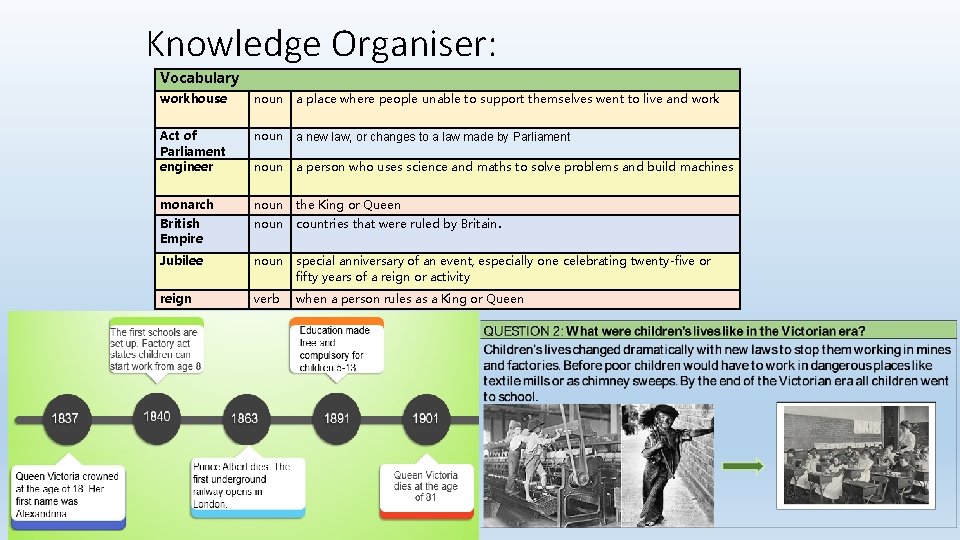
Knowledge Organiser: Vocabulary workhouse noun a place where people unable to support themselves went to live and work Act of Parliament engineer noun a new law, or changes to a law made by Parliament noun a person who uses science and maths to solve problems and build machines monarch noun the King or Queen British Empire noun countries that were ruled by Britain. Jubilee noun special anniversary of an event, especially one celebrating twenty-five or fifty years of a reign or activity reign verb when a person rules as a King or Queen
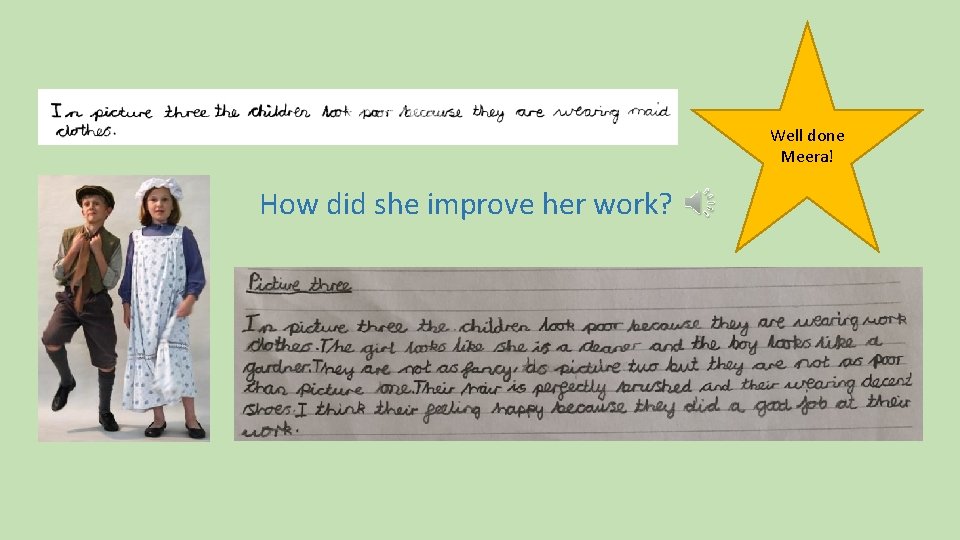
Well done Meera! How did she improve her work?
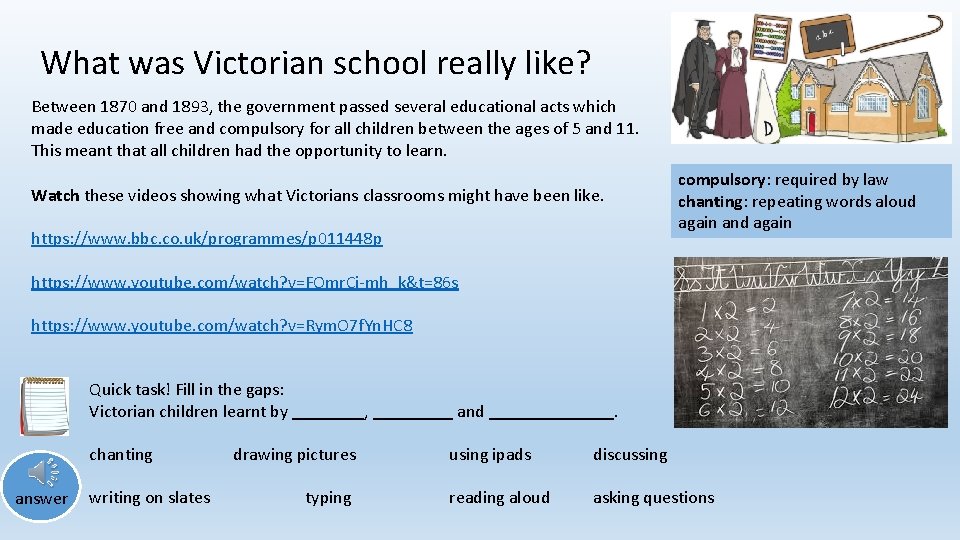
What was Victorian school really like? Between 1870 and 1893, the government passed several educational acts which made education free and compulsory for all children between the ages of 5 and 11. This meant that all children had the opportunity to learn. Watch these videos showing what Victorians classrooms might have been like. https: //www. bbc. co. uk/programmes/p 011448 p compulsory: required by law chanting: repeating words aloud again and again https: //www. youtube. com/watch? v=FOmr. Ci-mh_k&t=86 s https: //www. youtube. com/watch? v=Rym. O 7 f. Yn. HC 8 Quick task! Fill in the gaps: Victorian children learnt by ____, _____ and _______. chanting answer writing on slates drawing pictures typing using ipads discussing reading aloud asking questions
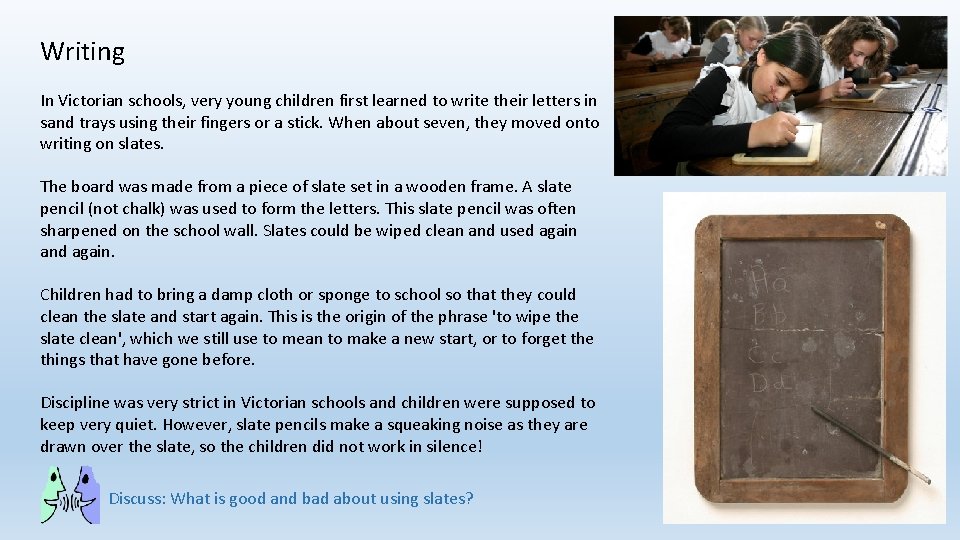
Writing In Victorian schools, very young children first learned to write their letters in sand trays using their fingers or a stick. When about seven, they moved onto writing on slates. The board was made from a piece of slate set in a wooden frame. A slate pencil (not chalk) was used to form the letters. This slate pencil was often sharpened on the school wall. Slates could be wiped clean and used again and again. Children had to bring a damp cloth or sponge to school so that they could clean the slate and start again. This is the origin of the phrase 'to wipe the slate clean', which we still use to mean to make a new start, or to forget the things that have gone before. Discipline was very strict in Victorian schools and children were supposed to keep very quiet. However, slate pencils make a squeaking noise as they are drawn over the slate, so the children did not work in silence! Discuss: What is good and bad about using slates?
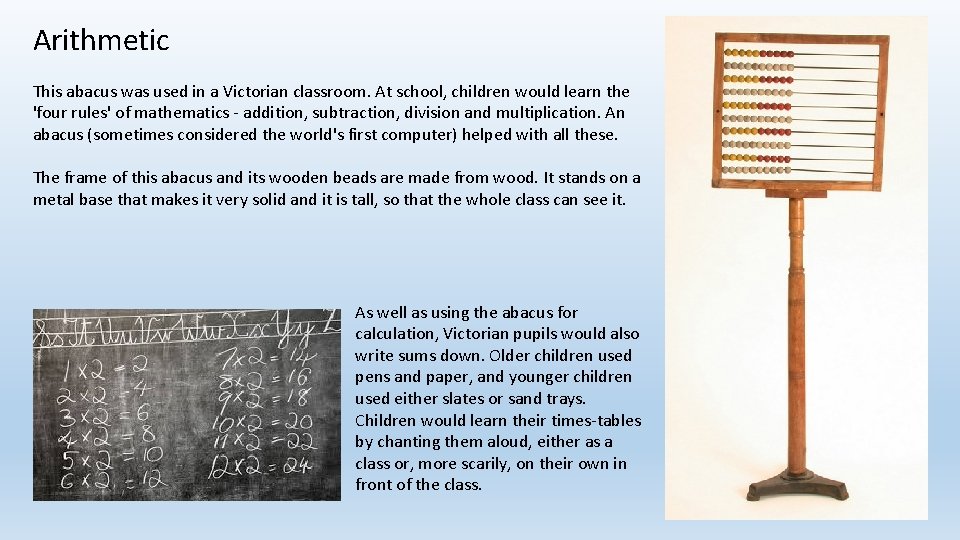
Arithmetic This abacus was used in a Victorian classroom. At school, children would learn the 'four rules' of mathematics - addition, subtraction, division and multiplication. An abacus (sometimes considered the world's first computer) helped with all these. The frame of this abacus and its wooden beads are made from wood. It stands on a metal base that makes it very solid and it is tall, so that the whole class can see it. As well as using the abacus for calculation, Victorian pupils would also write sums down. Older children used pens and paper, and younger children used either slates or sand trays. Children would learn their times-tables by chanting them aloud, either as a class or, more scarily, on their own in front of the class.
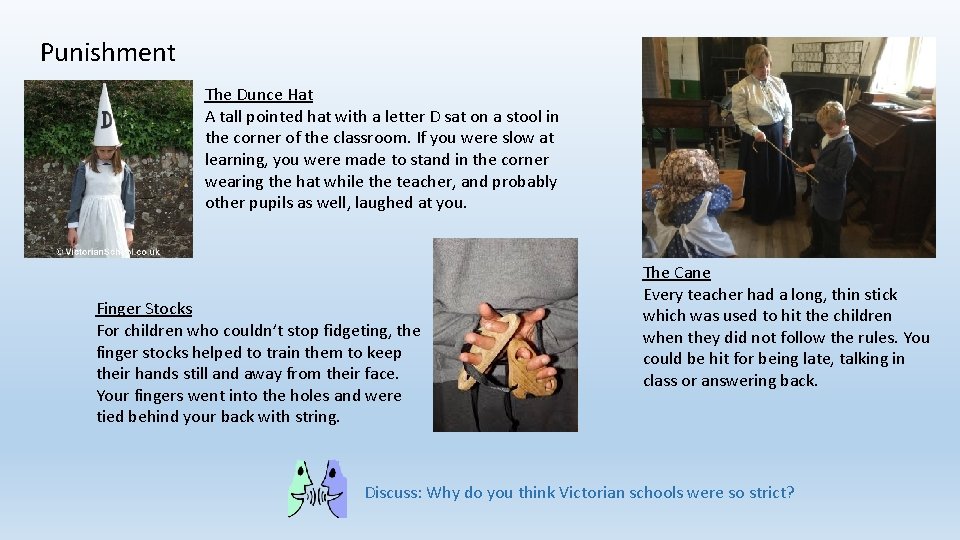
Punishment The Dunce Hat A tall pointed hat with a letter D sat on a stool in the corner of the classroom. If you were slow at learning, you were made to stand in the corner wearing the hat while the teacher, and probably other pupils as well, laughed at you. Finger Stocks For children who couldn’t stop fidgeting, the finger stocks helped to train them to keep their hands still and away from their face. Your fingers went into the holes and were tied behind your back with string. The Cane Every teacher had a long, thin stick which was used to hit the children when they did not follow the rules. You could be hit for being late, talking in class or answering back. Discuss: Why do you think Victorian schools were so strict?
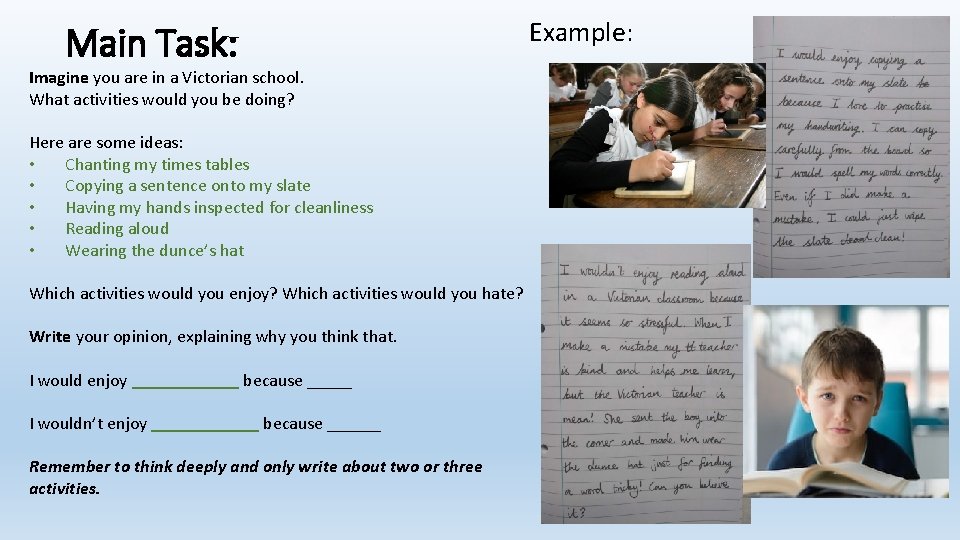
Main Task: Imagine you are in a Victorian school. What activities would you be doing? Here are some ideas: • Chanting my times tables • Copying a sentence onto my slate • Having my hands inspected for cleanliness • Reading aloud • Wearing the dunce’s hat Which activities would you enjoy? Which activities would you hate? Write your opinion, explaining why you think that. I would enjoy ______ because _____ I wouldn’t enjoy ______ because ______ Remember to think deeply and only write about two or three activities. Example: