
Review What is security history and definition Security
![Substitution-Permutation Ciphers • Substitution-permutation (S-P) networks [Shannon, 1949] – modern substitution-transposition product cipher •](https://slidetodoc.com/presentation_image/1b7bf3a9a70657e7c76e596ca645ca68/image-29.jpg "Substitution-Permutation Ciphers • Substitution-permutation (S-P) networks [Shannon, 1949] – modern substitution-transposition product cipher •")
- Slides: 44
Review • What is security: history and definition • Security policy, mechanisms and services • Security models
Outline • Overview of Cryptography • Classical Symmetric Cipher • Modern Symmetric Ciphers (DES)
Basic Terminology • plaintext - the original message • ciphertext - the coded message • cipher - algorithm for transforming plaintext to ciphertext • key - info used in cipher known only to sender/receiver • encipher (encrypt) - converting plaintext to ciphertext • decipher (decrypt) - recovering ciphertext from plaintext • cryptography - study of encryption principles/methods • cryptanalysis (codebreaking) - the study of principles/ methods of deciphering ciphertext without knowing key • cryptology - the field of both cryptography and cryptanalysis
Classification of Cryptography • Number of keys used – Hash functions: no key – Secret key cryptography: one key – Public key cryptography: two keys - public, private • Type of encryption operations used – substitution / transposition / product • Way in which plaintext is processed – block / stream
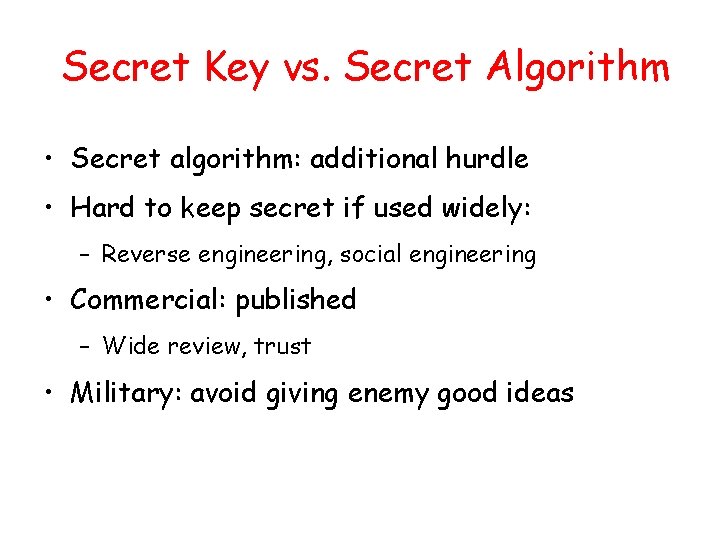
Secret Key vs. Secret Algorithm • Secret algorithm: additional hurdle • Hard to keep secret if used widely: – Reverse engineering, social engineering • Commercial: published – Wide review, trust • Military: avoid giving enemy good ideas
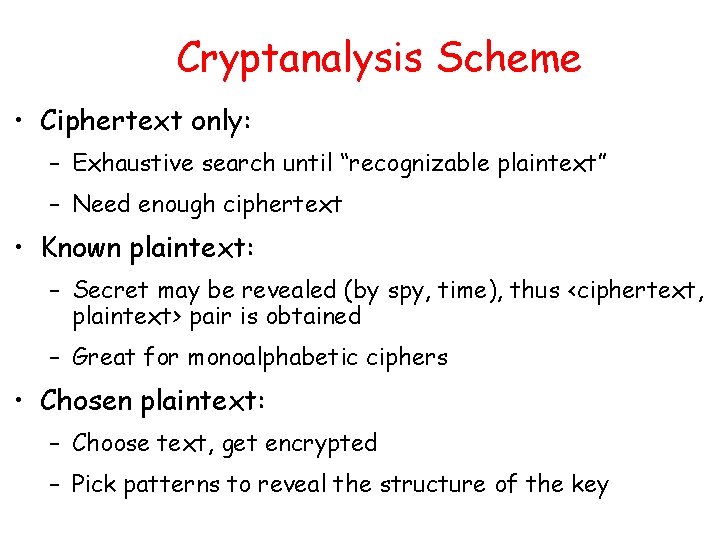
Cryptanalysis Scheme • Ciphertext only: – Exhaustive search until “recognizable plaintext” – Need enough ciphertext • Known plaintext: – Secret may be revealed (by spy, time), thus <ciphertext, plaintext> pair is obtained – Great for monoalphabetic ciphers • Chosen plaintext: – Choose text, get encrypted – Pick patterns to reveal the structure of the key
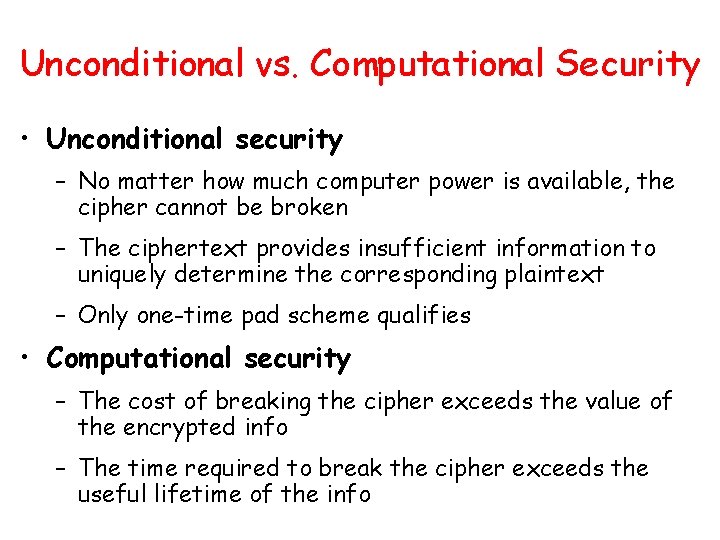
Unconditional vs. Computational Security • Unconditional security – No matter how much computer power is available, the cipher cannot be broken – The ciphertext provides insufficient information to uniquely determine the corresponding plaintext – Only one-time pad scheme qualifies • Computational security – The cost of breaking the cipher exceeds the value of the encrypted info – The time required to break the cipher exceeds the useful lifetime of the info
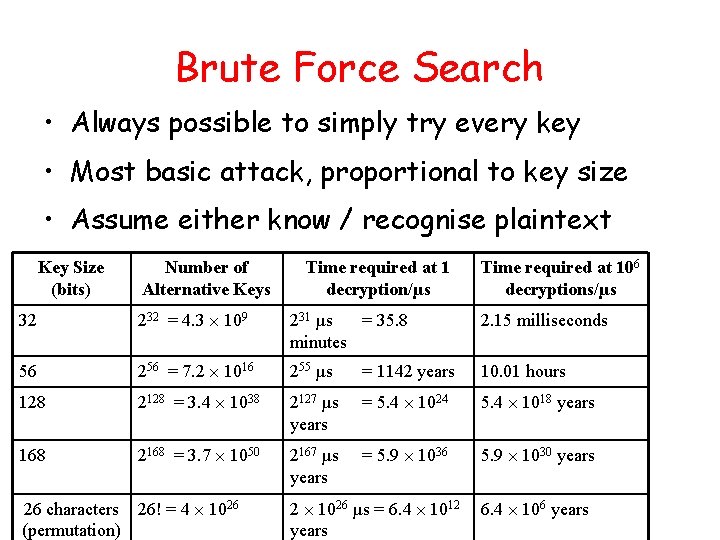
Brute Force Search • Always possible to simply try every key • Most basic attack, proportional to key size • Assume either know / recognise plaintext Key Size (bits) Number of Alternative Keys Time required at 1 decryption/µs Time required at 106 decryptions/µs 32 232 = 4. 3 109 231 µs = 35. 8 minutes 2. 15 milliseconds 56 256 = 7. 2 1016 255 µs = 1142 years 10. 01 hours 128 2128 = 3. 4 1038 2127 µs years = 5. 4 1024 5. 4 1018 years 168 2168 = 3. 7 1050 2167 µs years = 5. 9 1036 5. 9 1030 years 26 characters 26! = 4 1026 (permutation) 2 1026 µs = 6. 4 1012 years 6. 4 106 years
Outline • Overview of Cryptography • Classical Symmetric Cipher – Substitution Cipher – Transposition Cipher • Modern Symmetric Ciphers (DES)
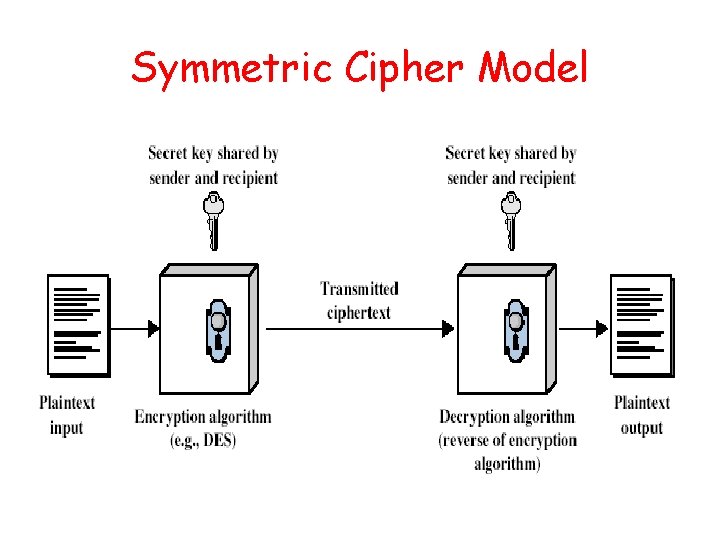
Symmetric Cipher Model
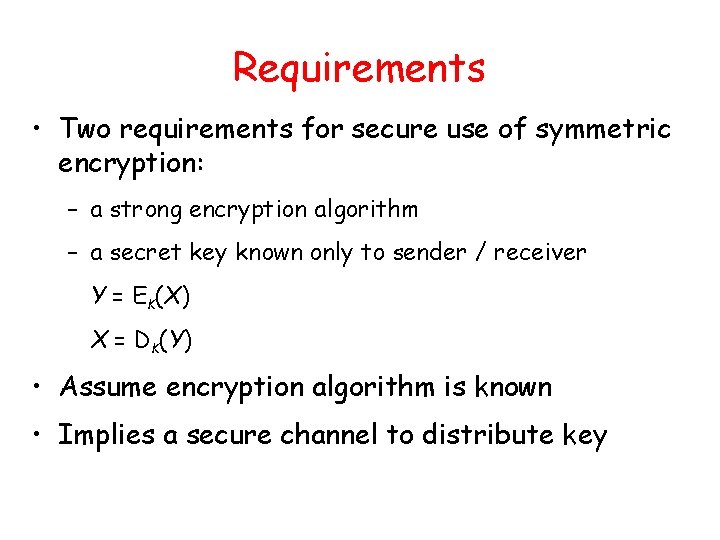
Requirements • Two requirements for secure use of symmetric encryption: – a strong encryption algorithm – a secret key known only to sender / receiver Y = EK(X) X = DK(Y) • Assume encryption algorithm is known • Implies a secure channel to distribute key
Classical Substitution Ciphers • Letters of plaintext are replaced by other letters or by numbers or symbols • Plaintext is viewed as a sequence of bits, then substitution replaces plaintext bit patterns with ciphertext bit patterns
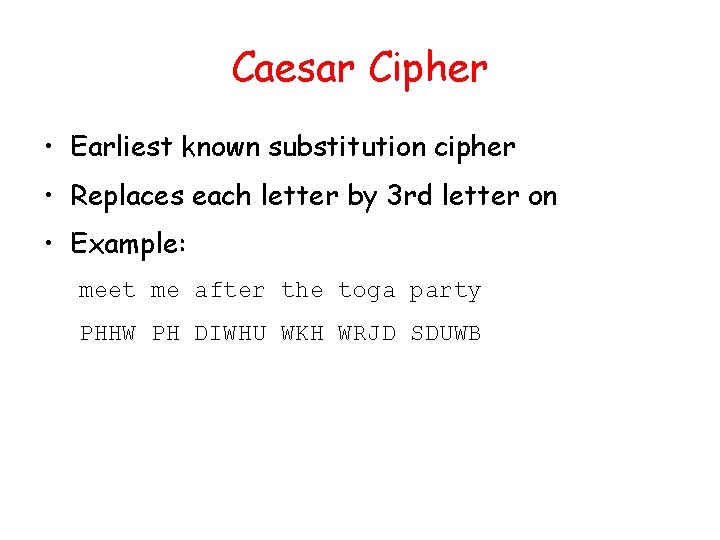
Caesar Cipher • Earliest known substitution cipher • Replaces each letter by 3 rd letter on • Example: meet me after the toga party PHHW PH DIWHU WKH WRJD SDUWB
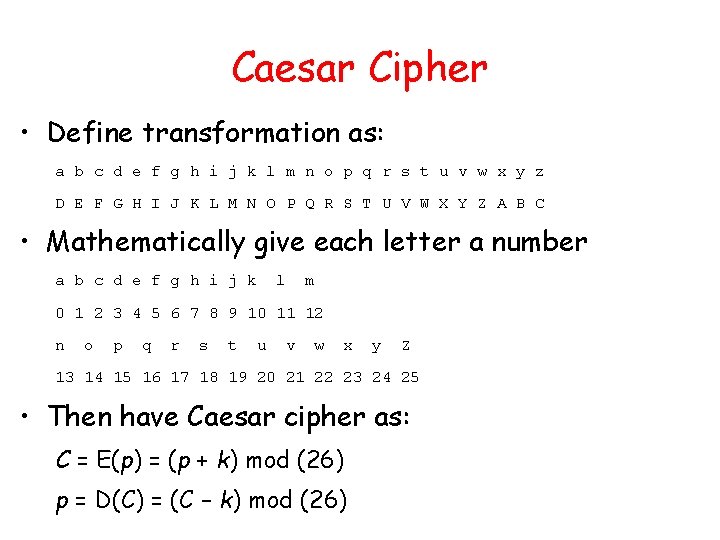
Caesar Cipher • Define transformation as: a b c d e f g h i j k l m n o p q r s t u v w x y z D E F G H I J K L M N O P Q R S T U V W X Y Z A B C • Mathematically give each letter a number a b c d e f g h i j k l m 0 1 2 3 4 5 6 7 8 9 10 11 12 n o p q r s t u v w x y Z 13 14 15 16 17 18 19 20 21 22 23 24 25 • Then have Caesar cipher as: C = E(p) = (p + k) mod (26) p = D(C) = (C – k) mod (26)
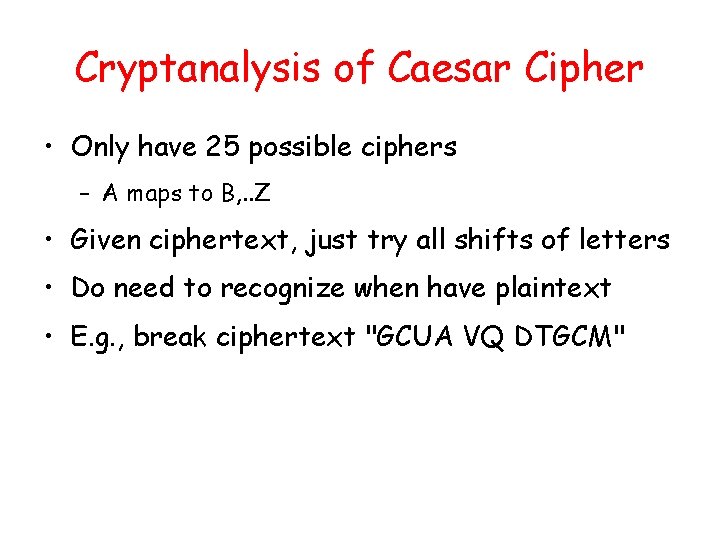
Cryptanalysis of Caesar Cipher • Only have 25 possible ciphers – A maps to B, . . Z • Given ciphertext, just try all shifts of letters • Do need to recognize when have plaintext • E. g. , break ciphertext "GCUA VQ DTGCM"
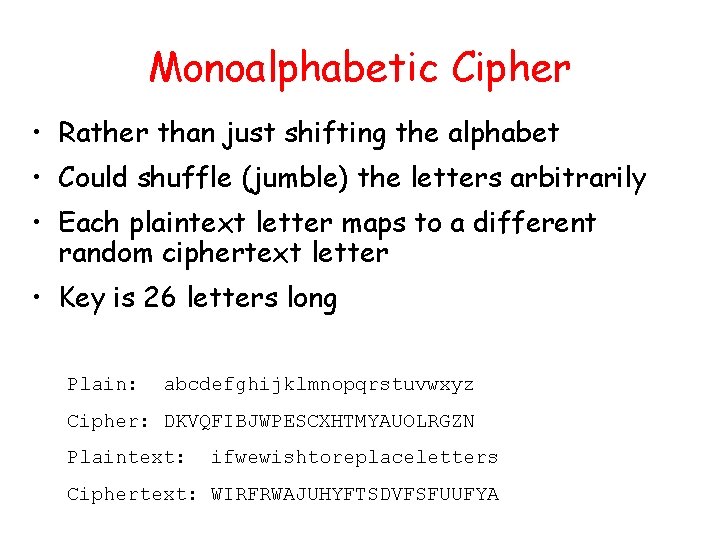
Monoalphabetic Cipher • Rather than just shifting the alphabet • Could shuffle (jumble) the letters arbitrarily • Each plaintext letter maps to a different random ciphertext letter • Key is 26 letters long Plain: abcdefghijklmnopqrstuvwxyz Cipher: DKVQFIBJWPESCXHTMYAUOLRGZN Plaintext: ifwewishtoreplaceletters Ciphertext: WIRFRWAJUHYFTSDVFSFUUFYA
Monoalphabetic Cipher Security • Now have a total of 26! = 4 x 1026 keys • Is that secure? • Problem is language characteristics – Human languages are redundant – Letters are not equally commonly used
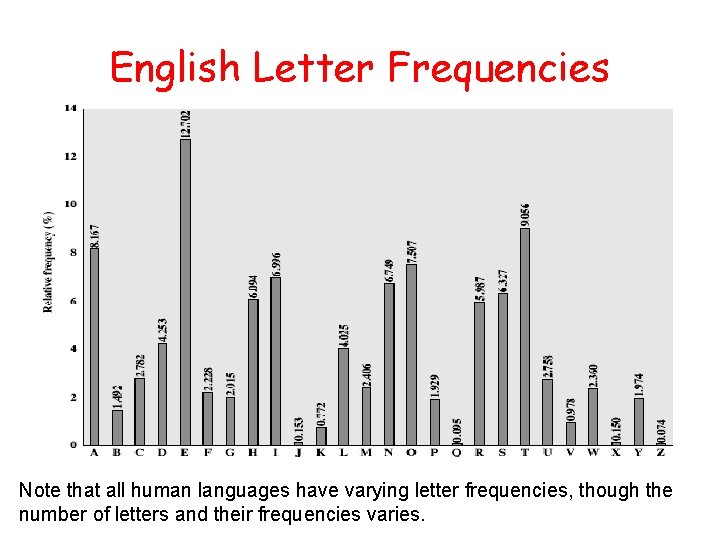
English Letter Frequencies Note that all human languages have varying letter frequencies, though the number of letters and their frequencies varies.
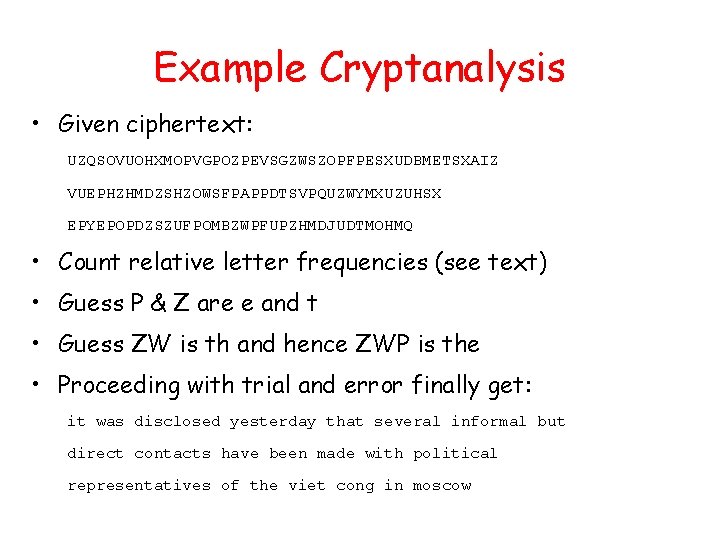
Example Cryptanalysis • Given ciphertext: UZQSOVUOHXMOPVGPOZPEVSGZWSZOPFPESXUDBMETSXAIZ VUEPHZHMDZSHZOWSFPAPPDTSVPQUZWYMXUZUHSX EPYEPOPDZSZUFPOMBZWPFUPZHMDJUDTMOHMQ • Count relative letter frequencies (see text) • Guess P & Z are e and t • Guess ZW is th and hence ZWP is the • Proceeding with trial and error finally get: it was disclosed yesterday that several informal but direct contacts have been made with political representatives of the viet cong in moscow
One-Time Pad • If a truly random key as long as the message is used, the cipher will be secure - One-Time pad • E. g. , a random sequence of 0’s and 1’s XORed to plaintext, no repetition of keys • Unbreakable since ciphertext bears no statistical relationship to the plaintext • For any plaintext, it needs a random key of the same length – Hard to generate large amount of keys • Have problem of safe distribution of key
Transposition Ciphers • Now consider classical transposition or permutation ciphers • These hide the message by rearranging the letter order, without altering the actual letters used • Can recognise these since have the same frequency distribution as the original text
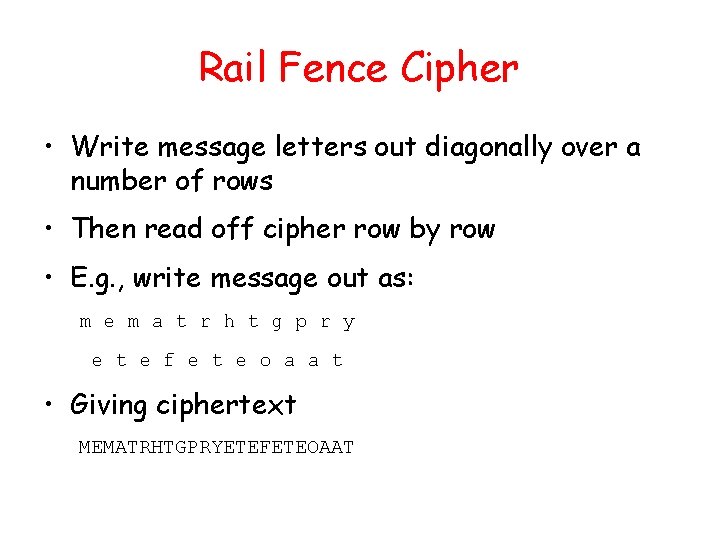
Rail Fence Cipher • Write message letters out diagonally over a number of rows • Then read off cipher row by row • E. g. , write message out as: m e m a t r h t g p r y e t e f e t e o a a t • Giving ciphertext MEMATRHTGPRYETEFETEOAAT
Product Ciphers • Ciphers using substitutions or transpositions are not secure because of language characteristics • Hence consider using several ciphers in succession to make harder, but: – Two substitutions make another substitution – Two transpositions make a more complex transposition – But a substitution followed by a transposition makes a new much harder cipher • This is bridge from classical to modern ciphers
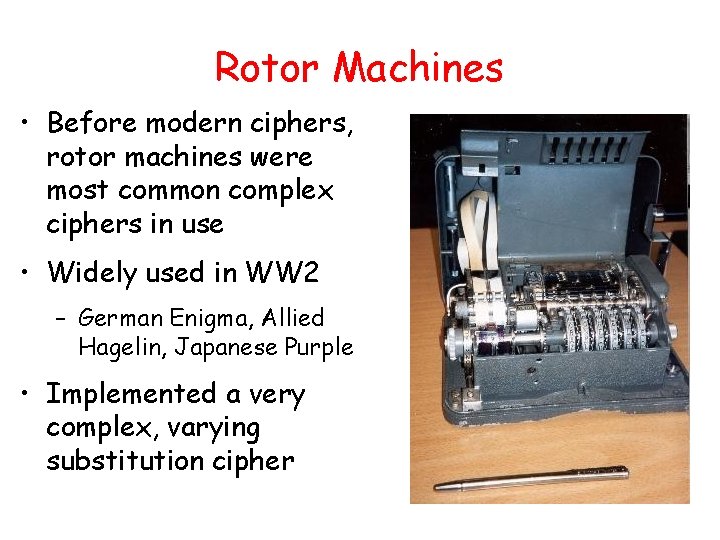
Rotor Machines • Before modern ciphers, rotor machines were most common complex ciphers in use • Widely used in WW 2 – German Enigma, Allied Hagelin, Japanese Purple • Implemented a very complex, varying substitution cipher
Outline • Overview of Cryptography • Classical Symmetric Cipher • Modern Symmetric Ciphers (DES)
Block vs Stream Ciphers • Block ciphers process messages in into blocks, each of which is then en/decrypted • Like a substitution on very big characters – 64 -bits or more • Stream ciphers process messages a bit or byte at a time when en/decrypting • Many current ciphers are block ciphers, one of the most widely used types of cryptographic algorithms
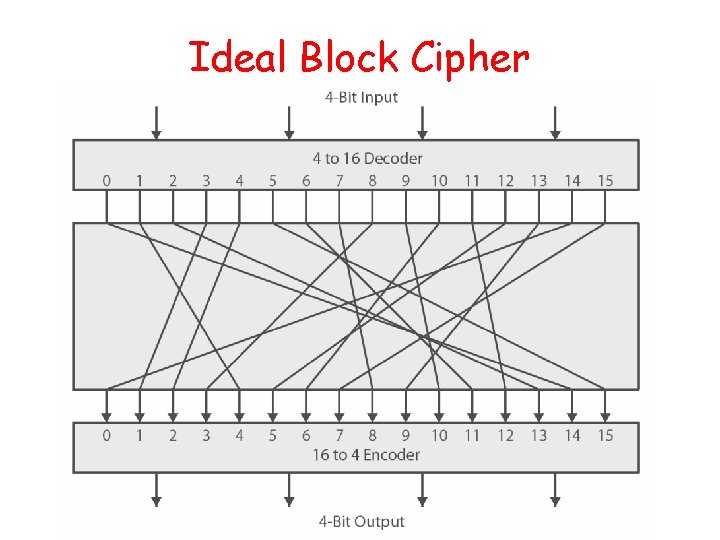
Block Cipher Principles • Most symmetric block ciphers are based on a Feistel Cipher Structure • Block ciphers look like an extremely large substitution • Would need table of 264 entries for a 64 -bit block • Instead create from smaller building blocks • Using idea of a product cipher
Ideal Block Cipher
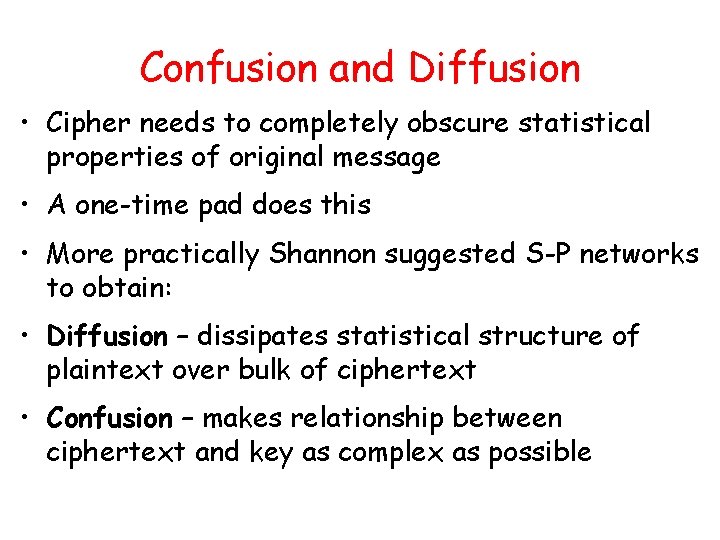
Substitution-Permutation Ciphers • Substitution-permutation (S-P) networks [Shannon, 1949] – modern substitution-transposition product cipher • These form the basis of modern block ciphers • S-P networks are based on the two primitive cryptographic operations – substitution (S-box) – permutation (P-box) • provide confusion and diffusion of message
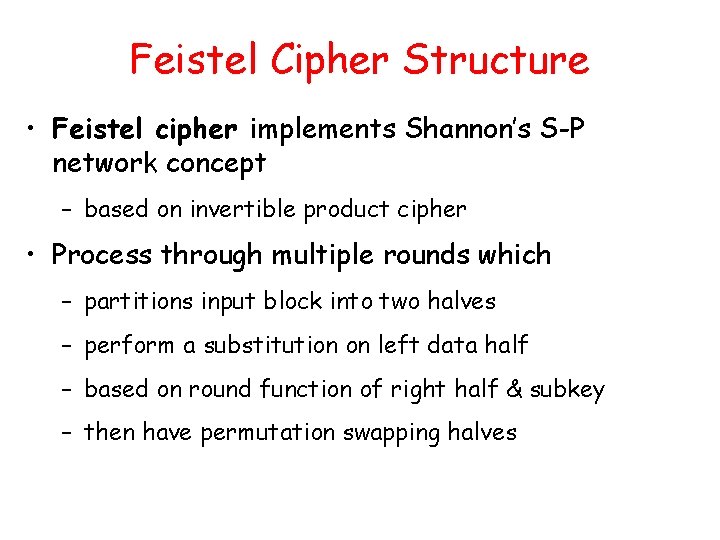
Confusion and Diffusion • Cipher needs to completely obscure statistical properties of original message • A one-time pad does this • More practically Shannon suggested S-P networks to obtain: • Diffusion – dissipates statistical structure of plaintext over bulk of ciphertext • Confusion – makes relationship between ciphertext and key as complex as possible
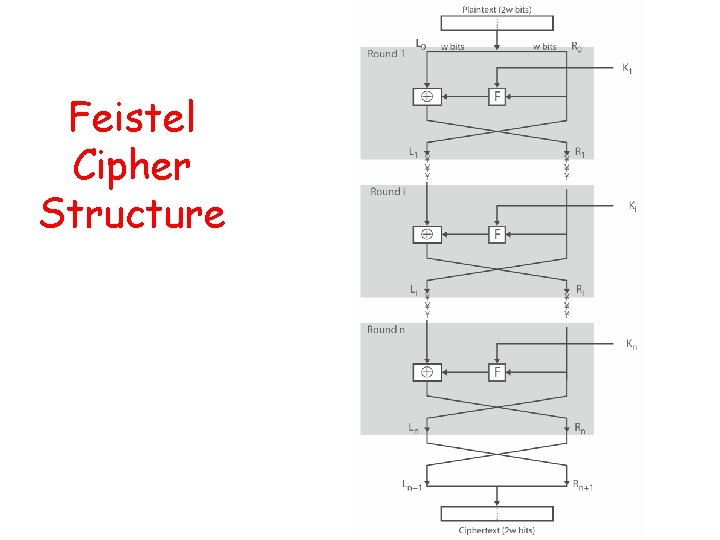
Feistel Cipher Structure • Feistel cipher implements Shannon’s S-P network concept – based on invertible product cipher • Process through multiple rounds which – partitions input block into two halves – perform a substitution on left data half – based on round function of right half & subkey – then have permutation swapping halves
Feistel Cipher Structure
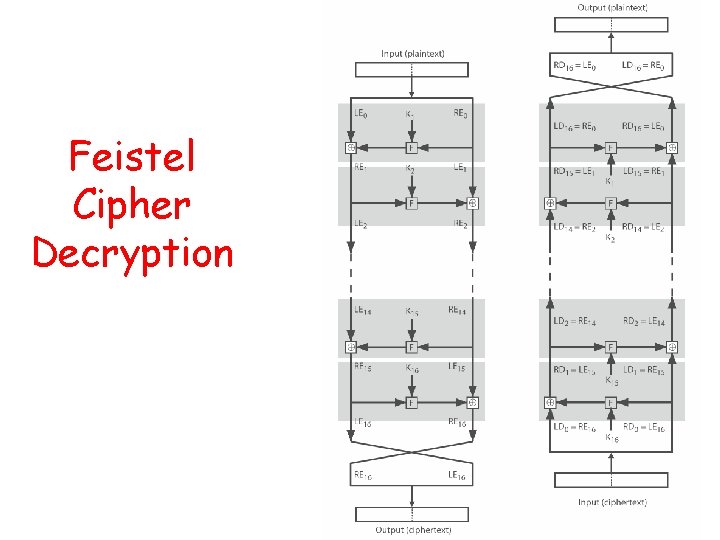
Feistel Cipher Decryption
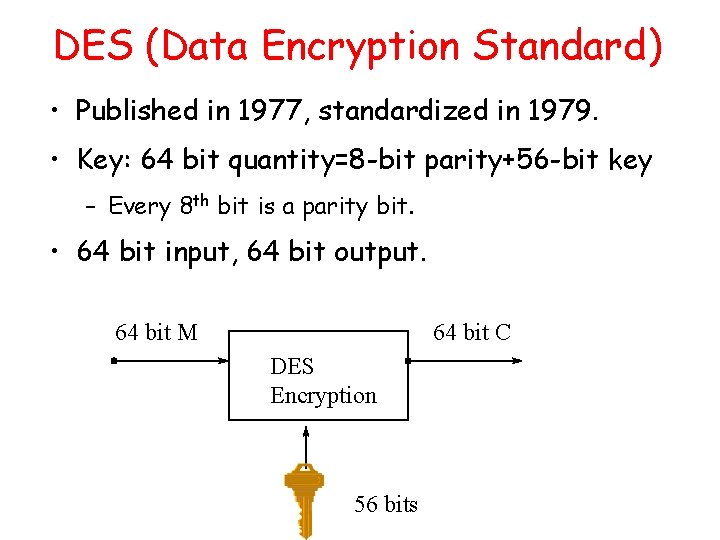
DES (Data Encryption Standard) • Published in 1977, standardized in 1979. • Key: 64 bit quantity=8 -bit parity+56 -bit key – Every 8 th bit is a parity bit. • 64 bit input, 64 bit output. 64 bit M 64 bit C DES Encryption 56 bits
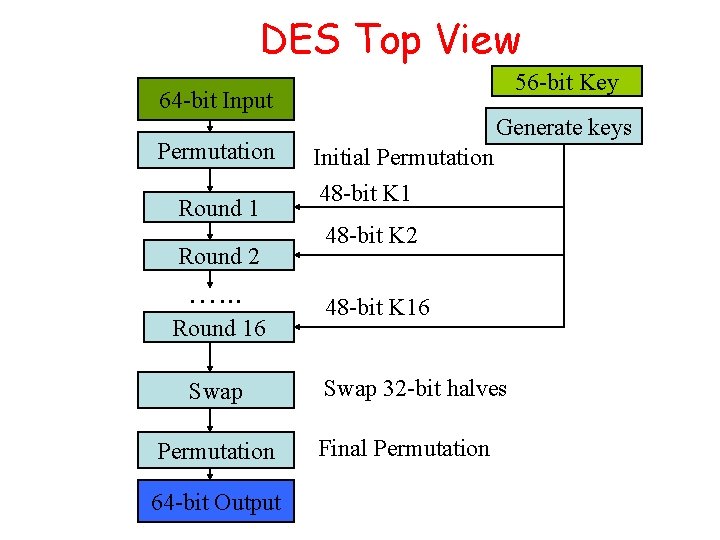
DES Top View 56 -bit Key 64 -bit 48 -bit. Input K 1 Permutation Round 1 Round 2 …. . . Round 16 Swap Permutation 64 -bit Output Generate keys Initial Permutation 48 -bit K 1 48 -bit K 2 48 -bit K 16 Swap 32 -bit halves Final Permutation
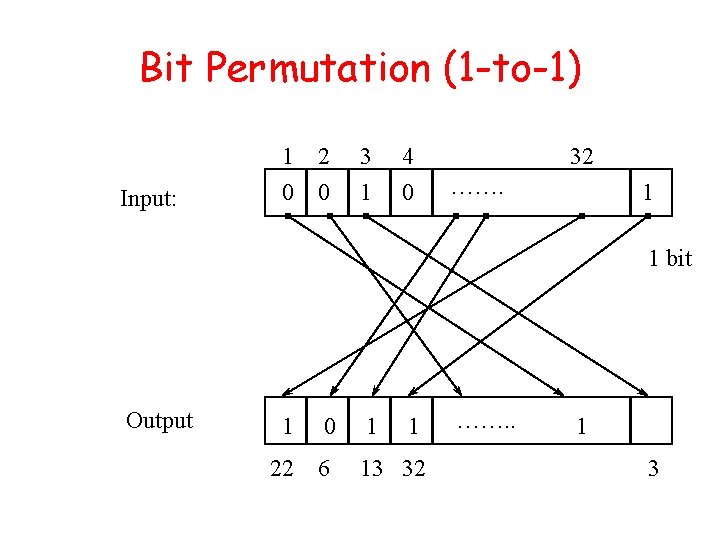
Bit Permutation (1 -to-1) Input: 1 2 0 0 3 1 4 0 32 ……. 1 1 bit Output 1 0 1 1 22 6 13 32 ……. . 1 3
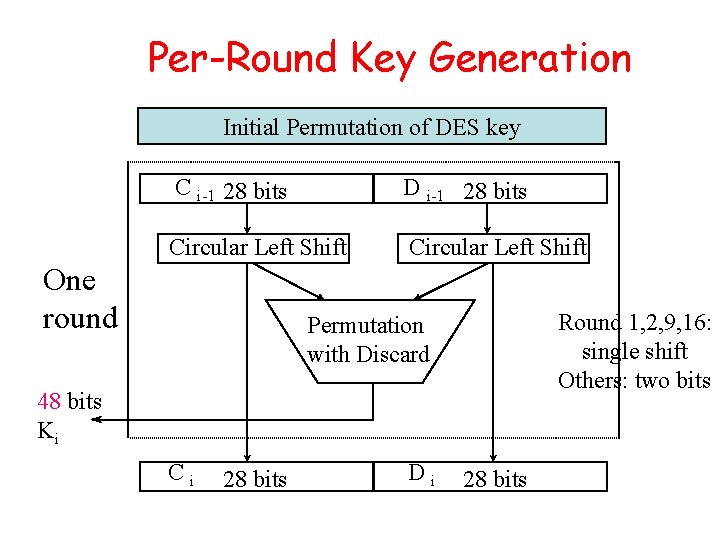
Per-Round Key Generation Initial Permutation of DES key C i-1 28 bits D i-1 28 bits Circular Left Shift One round Round 1, 2, 9, 16: single shift Others: two bits Permutation with Discard 48 bits Ki Ci 28 bits Di 28 bits
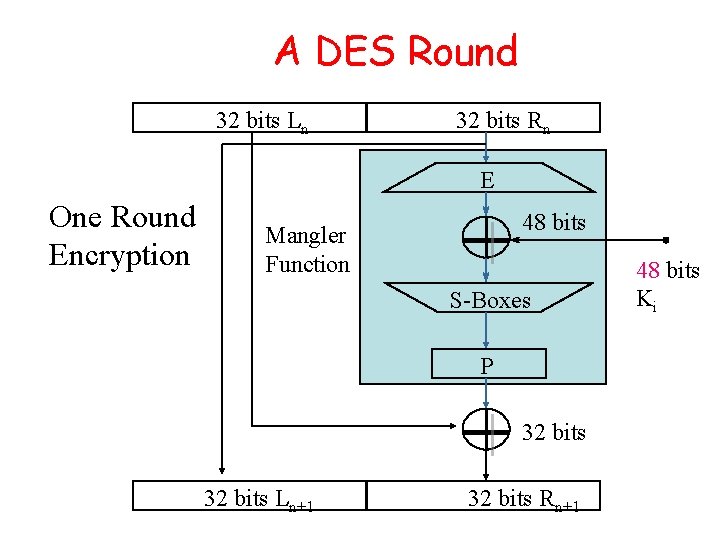
A DES Round 32 bits Ln 32 bits Rn E One Round Encryption 48 bits Mangler Function S-Boxes P 32 bits Ln+1 32 bits Rn+1 48 bits Ki
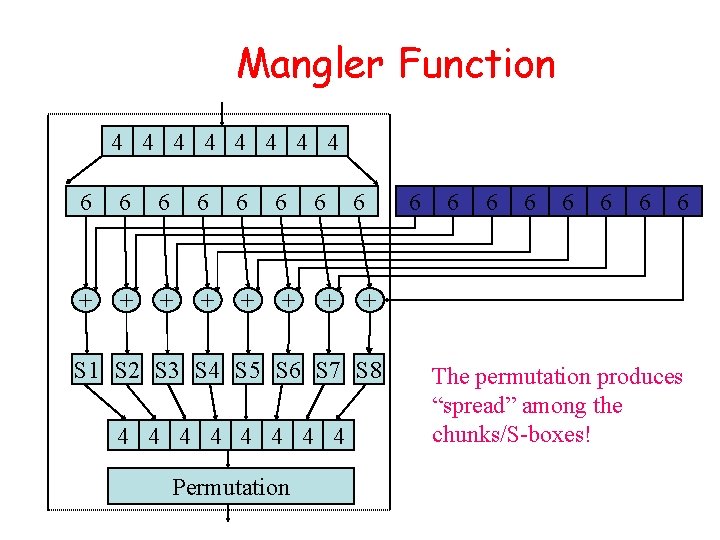
Mangler Function 4 4 4 4 6 6 6 + + + 6 + 6 Permutation 6 6 6 6 + S 1 S 2 S 3 S 4 S 5 S 6 S 7 S 8 4 4 4 4 6 The permutation produces “spread” among the chunks/S-boxes!
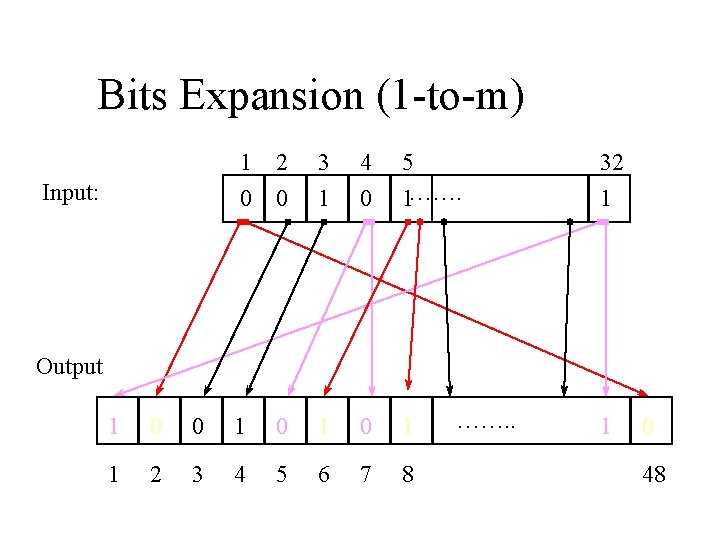
Bits Expansion (1 -to-m) Input: 1 0 2 0 3 1 4 0 5 1……. 32 1 Output 1 0 0 1 0 1 1 2 3 4 5 6 7 8 ……. . 1 0 48
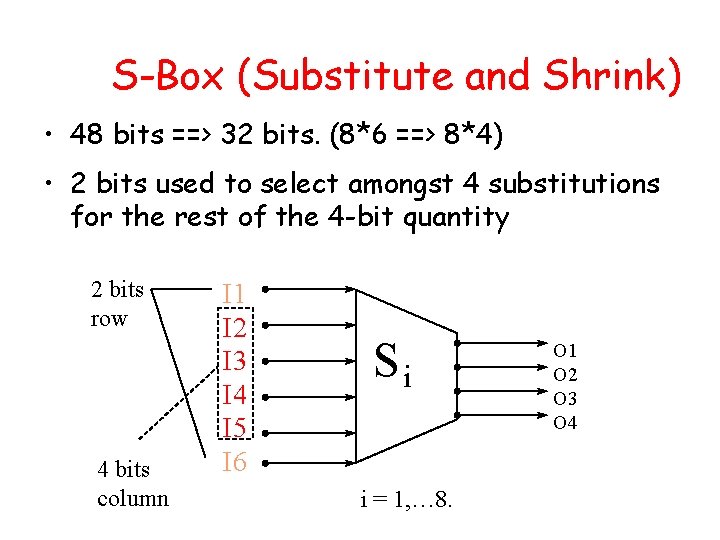
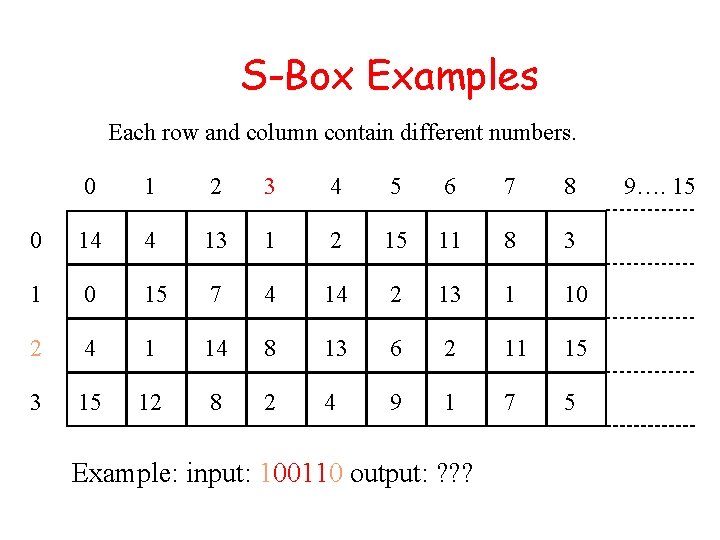
S-Box (Substitute and Shrink) • 48 bits ==> 32 bits. (8*6 ==> 8*4) • 2 bits used to select amongst 4 substitutions for the rest of the 4 -bit quantity 2 bits row 4 bits column I 1 I 2 I 3 I 4 I 5 I 6 Si i = 1, … 8. O 1 O 2 O 3 O 4
S-Box Examples Each row and column contain different numbers. 0 1 2 3 4 5 6 7 8 0 14 4 13 1 2 15 11 8 3 1 0 15 7 4 14 2 13 1 10 2 4 1 14 8 13 6 2 11 15 3 15 12 8 2 4 9 1 7 5 Example: input: 100110 output: ? ? ? 9…. 15
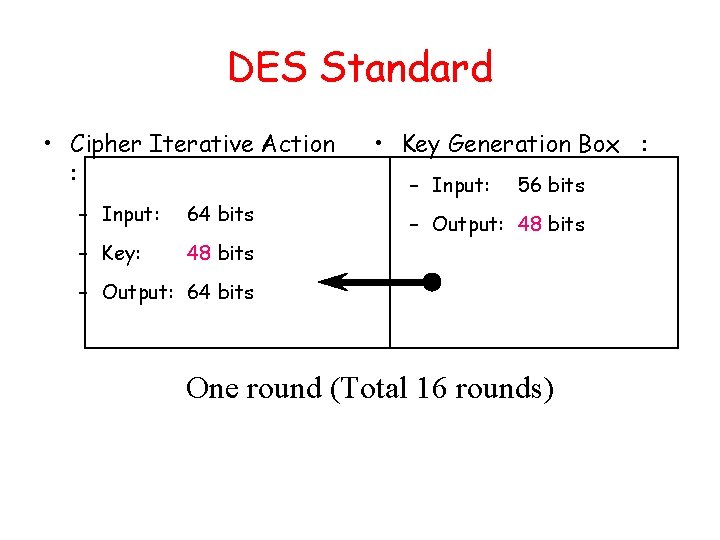
DES Standard • Cipher Iterative Action : – Input: 64 bits – Key: 48 bits • Key Generation Box : – Input: 56 bits – Output: 48 bits – Output: 64 bits One round (Total 16 rounds)
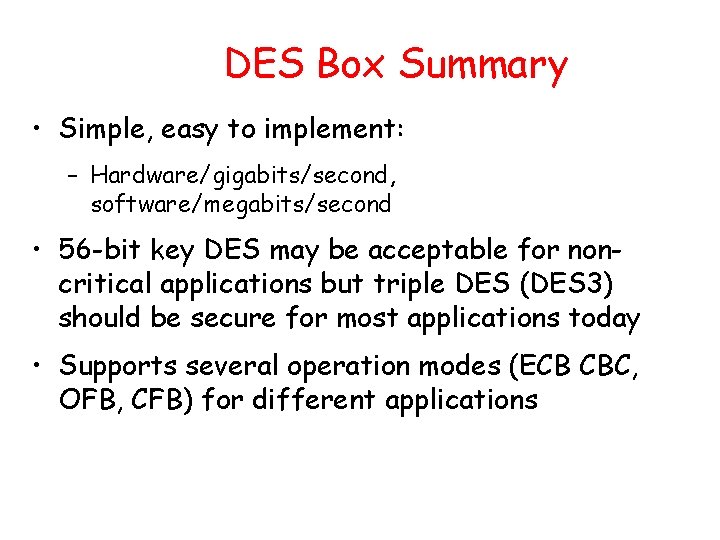
DES Box Summary • Simple, easy to implement: – Hardware/gigabits/second, software/megabits/second • 56 -bit key DES may be acceptable for noncritical applications but triple DES (DES 3) should be secure for most applications today • Supports several operation modes (ECB CBC, OFB, CFB) for different applications