
Review the Problem of Practice Problem of Practice

Review the Problem of Practice
Problem of Practice Data indicates that student tasks are not at the Bloom’s higher level which stimulates a student’s thinking. Tasks are defined as opportunities for students to verbalize, write or demonstrate their thinking through collaboration, answering questions, completing group and independent work, discussions and/or reflections. Higher level thinking is defined as using cognitive processes at the apply, analyze, evaluate, or create level.
Essential Questions Essential Question # 1 - What is the task? • Percentage of engagement time (teacher vs. student) recorded in minutes • Task format (whole group, group work, independent )-frequency of • Bloom’s level of tasks using CISD cognitive rubric
Essential Questions Essential Question # 2 - What questions are teachers asking? • Question levels (procedural versus content) • Cognitive level of content questions • Frequency and length of think time given to students
Essential Questions Essential Question # 3 - What are the students’ responses in relation to the task? Bloom’s level of student responses using CISD student response [discourse] rubric
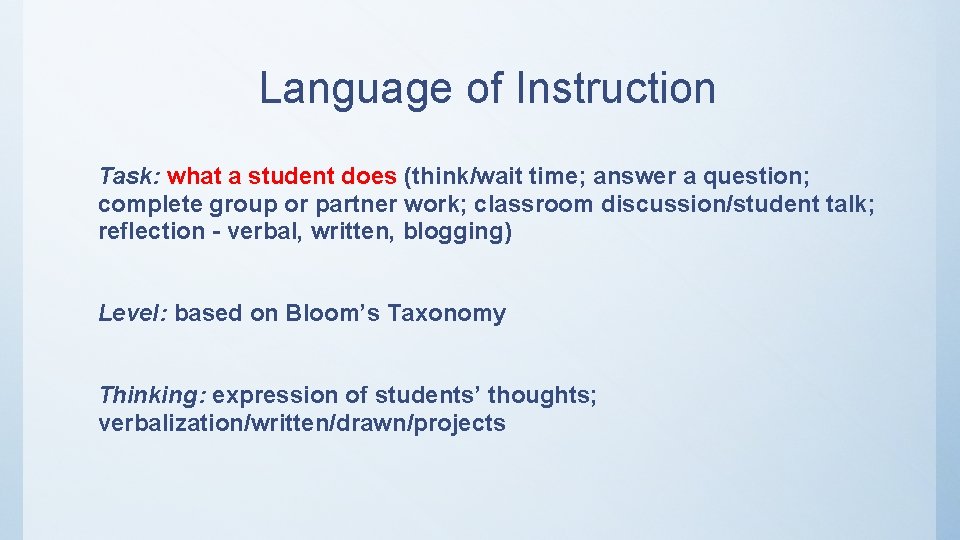
Language of Instruction Task: what a student does (think/wait time; answer a question; complete group or partner work; classroom discussion/student talk; reflection - verbal, written, blogging) Level: based on Bloom’s Taxonomy Thinking: expression of students’ thoughts; verbalization/written/drawn/projects
Instructional Rounds Castleberry High School 2014 -15
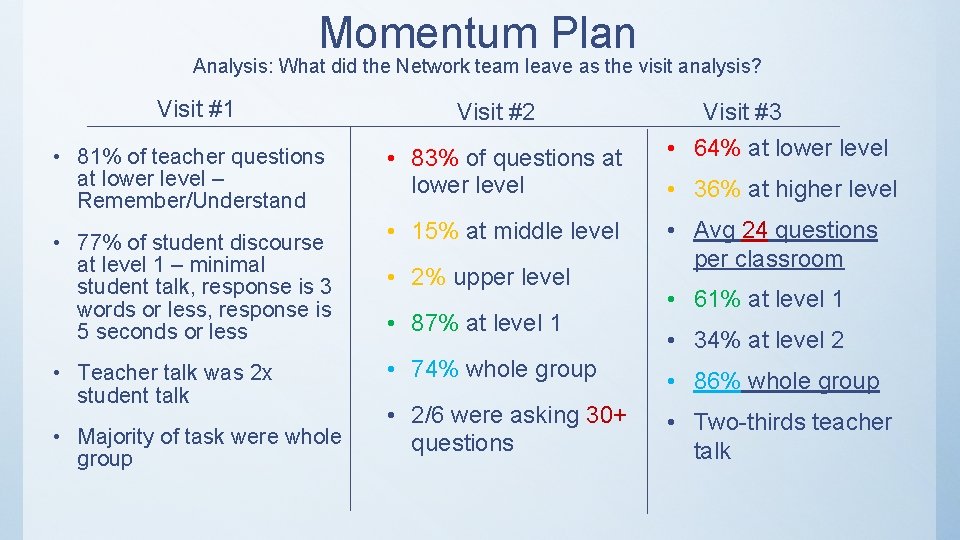
Momentum Plan Analysis: What did the Network team leave as the visit analysis? Visit #1 • 81% of teacher questions at lower level – Remember/Understand • 77% of student discourse at level 1 – minimal student talk, response is 3 words or less, response is 5 seconds or less • Teacher talk was 2 x student talk • Majority of task were whole group Visit #2 Visit #3 • 83% of questions at lower level • 64% at lower level • 15% at middle level • Avg 24 questions per classroom • 2% upper level • 87% at level 1 • 36% at higher level • 61% at level 1 • 34% at level 2 • 74% whole group • 86% whole group • 2/6 were asking 30+ questions • Two-thirds teacher talk
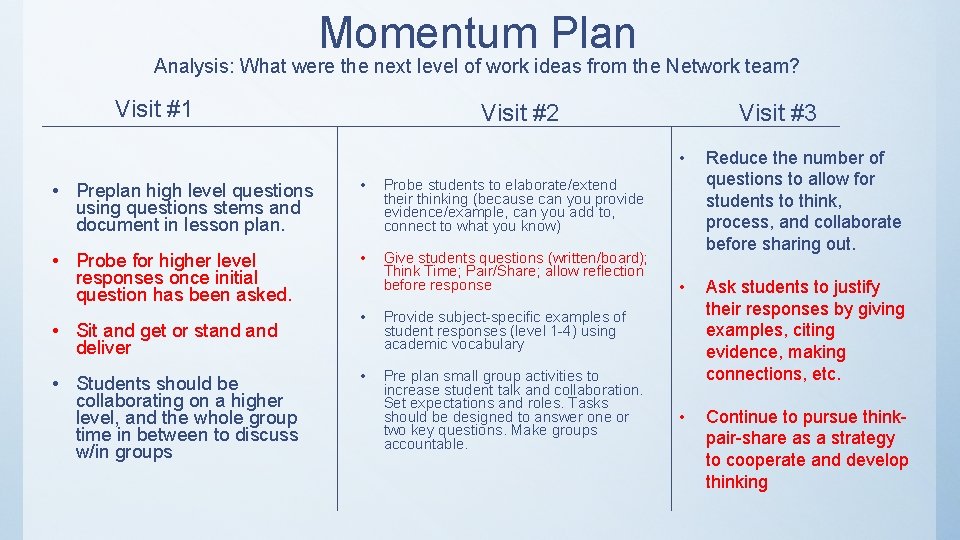
Momentum Plan Analysis: What were the next level of work ideas from the Network team? Visit #1 Visit #2 • Preplan high level questions using questions stems and document in lesson plan. • Probe students to elaborate/extend their thinking (because can you provide evidence/example, can you add to, connect to what you know) • Probe for higher level responses once initial question has been asked. • Give students questions (written/board); Think Time; Pair/Share; allow reflection before response • Sit and get or stand deliver • Students should be collaborating on a higher level, and the whole group time in between to discuss w/in groups • Provide subject-specific examples of student responses (level 1 -4) using academic vocabulary • Pre plan small group activities to increase student talk and collaboration. Set expectations and roles. Tasks should be designed to answer one or two key questions. Make groups accountable. Visit #3 • Reduce the number of questions to allow for students to think, process, and collaborate before sharing out. • Ask students to justify their responses by giving examples, citing evidence, making connections, etc. • Continue to pursue thinkpair-share as a strategy to cooperate and develop thinking
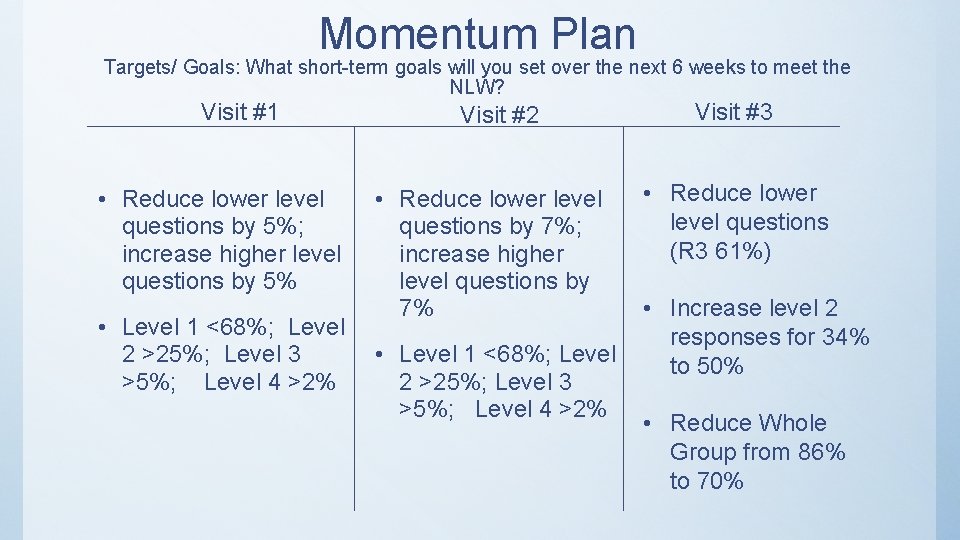
Momentum Plan Targets/ Goals: What short-term goals will you set over the next 6 weeks to meet the NLW? Visit #1 • Reduce lower level questions by 5%; increase higher level questions by 5% • Level 1 <68%; Level 2 >25%; Level 3 >5%; Level 4 >2% Visit #2 • Reduce lower level questions by 7%; increase higher level questions by 7% • Level 1 <68%; Level 2 >25%; Level 3 >5%; Level 4 >2% Visit #3 • Reduce lower level questions (R 3 61%) • Increase level 2 responses for 34% to 50% • Reduce Whole Group from 86% to 70%
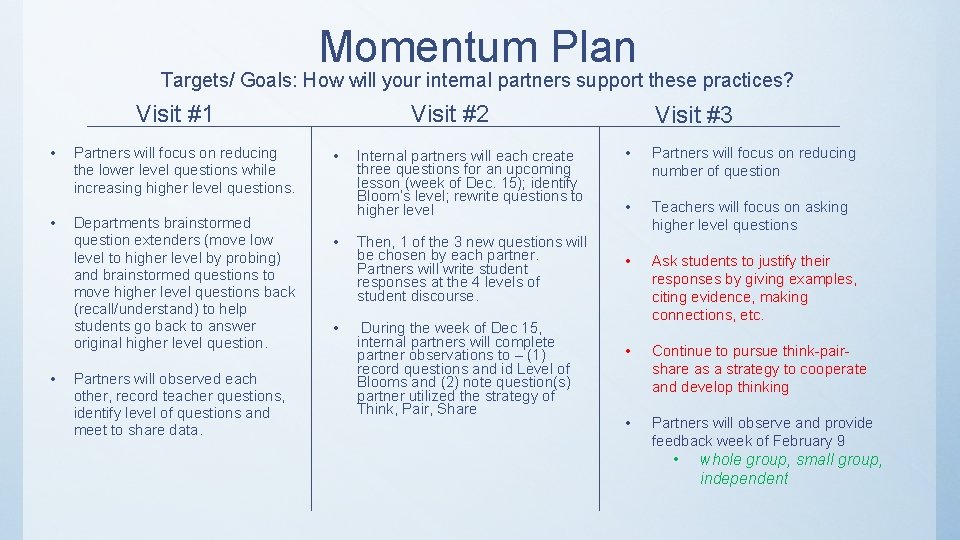
Momentum Plan Targets/ Goals: How will your internal partners support these practices? Visit #2 Visit #1 • • • Partners will focus on reducing the lower level questions while increasing higher level questions. Departments brainstormed question extenders (move low level to higher level by probing) and brainstormed questions to move higher level questions back (recall/understand) to help students go back to answer original higher level question. Partners will observed each other, record teacher questions, identify level of questions and meet to share data. • • • Internal partners will each create three questions for an upcoming lesson (week of Dec. 15); identify Bloom’s level; rewrite questions to higher level Then, 1 of the 3 new questions will be chosen by each partner. Partners will write student responses at the 4 levels of student discourse. During the week of Dec 15, internal partners will complete partner observations to – (1) record questions and id Level of Blooms and (2) note question(s) partner utilized the strategy of Think, Pair, Share Visit #3 • Partners will focus on reducing number of question • Teachers will focus on asking higher level questions • Ask students to justify their responses by giving examples, citing evidence, making connections, etc. • Continue to pursue think-pairshare as a strategy to cooperate and develop thinking • Partners will observe and provide feedback week of February 9 • whole group, small group, independent
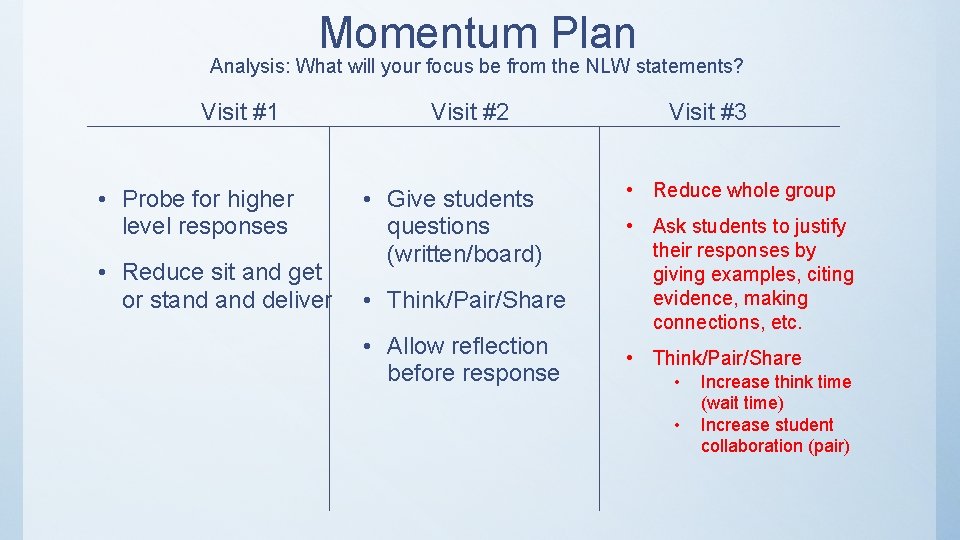
Momentum Plan Analysis: What will your focus be from the NLW statements? Visit #1 • Probe for higher level responses • Reduce sit and get or stand deliver Visit #2 • Give students questions (written/board) • Think/Pair/Share • Allow reflection before response Visit #3 • Reduce whole group • Ask students to justify their responses by giving examples, citing evidence, making connections, etc. • Think/Pair/Share • • Increase think time (wait time) Increase student collaboration (pair)
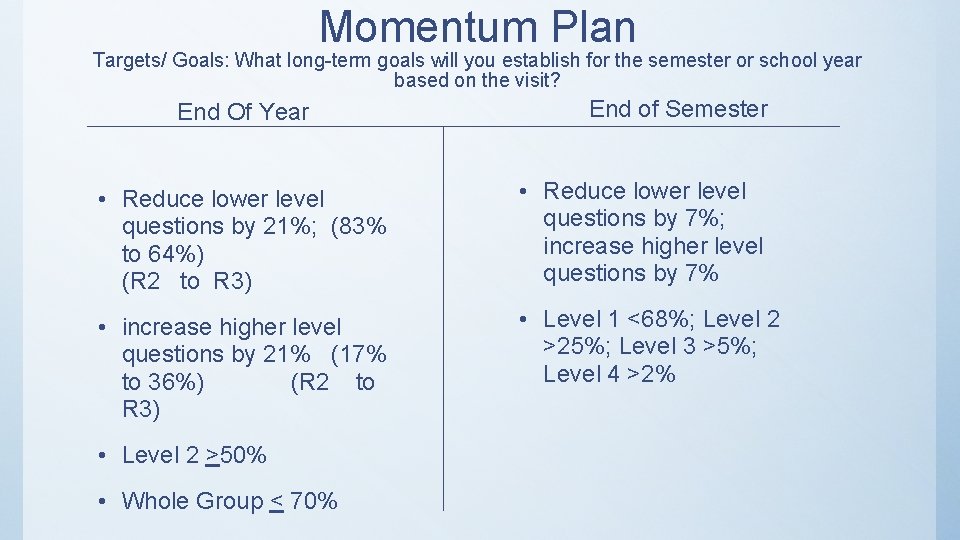
Momentum Plan Targets/ Goals: What long-term goals will you establish for the semester or school year based on the visit? End Of Year End of Semester • Reduce lower level questions by 21%; (83% to 64%) (R 2 to R 3) • Reduce lower level questions by 7%; increase higher level questions by 7% • increase higher level questions by 21% (17% to 36%) (R 2 to R 3) • Level 1 <68%; Level 2 >25%; Level 3 >5%; Level 4 >2% • Level 2 >50% • Whole Group < 70%
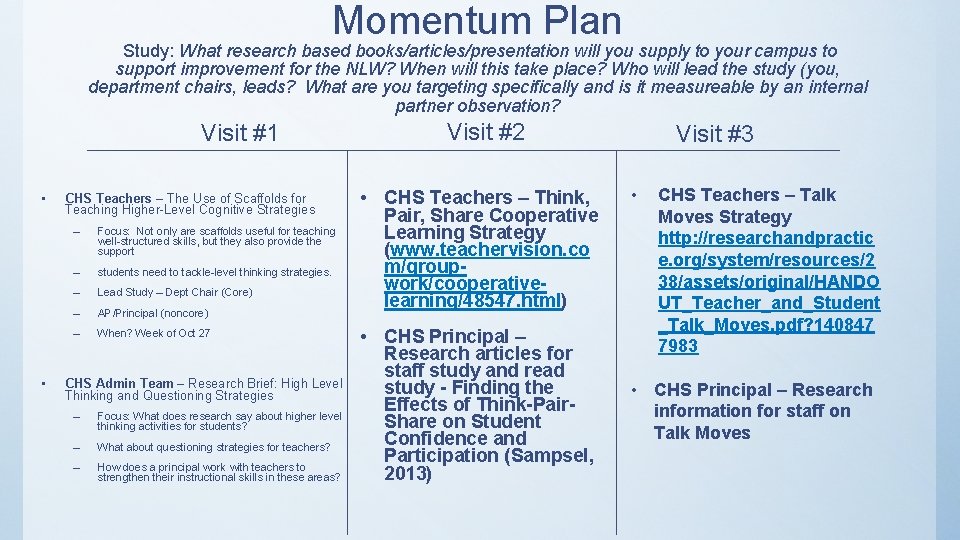
Momentum Plan Study: What research based books/articles/presentation will you supply to your campus to support improvement for the NLW? When will this take place? Who will lead the study (you, department chairs, leads? What are you targeting specifically and is it measureable by an internal partner observation? Visit #1 • • CHS Teachers – The Use of Scaffolds for Teaching Higher-Level Cognitive Strategies – Focus: Not only are scaffolds useful for teaching well-structured skills, but they also provide the support – students need to tackle-level thinking strategies. – Lead Study – Dept Chair (Core) – AP/Principal (noncore) – When? Week of Oct 27 CHS Admin Team – Research Brief: High Level Thinking and Questioning Strategies – Focus: What does research say about higher level thinking activities for students? – What about questioning strategies for teachers? – How does a principal work with teachers to strengthen their instructional skills in these areas? Visit #2 • CHS Teachers – Think, Pair, Share Cooperative Learning Strategy (www. teachervision. co m/groupwork/cooperativelearning/48547. html) • CHS Principal – Research articles for staff study and read study - Finding the Effects of Think-Pair. Share on Student Confidence and Participation (Sampsel, 2013) Visit #3 • CHS Teachers – Talk Moves Strategy http: //researchandpractic e. org/system/resources/2 38/assets/original/HANDO UT_Teacher_and_Student _Talk_Moves. pdf? 140847 7983 • CHS Principal – Research information for staff on Talk Moves
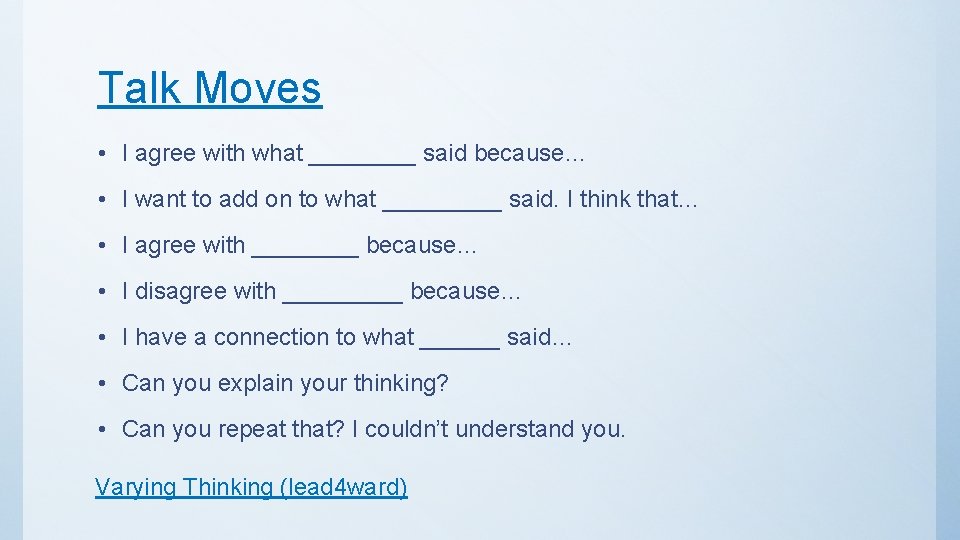
Talk Moves • I agree with what ____ said because… • I want to add on to what _____ said. I think that… • I agree with ____ because… • I disagree with _____ because… • I have a connection to what ______ said… • Can you explain your thinking? • Can you repeat that? I couldn’t understand you. Varying Thinking (lead 4 ward)
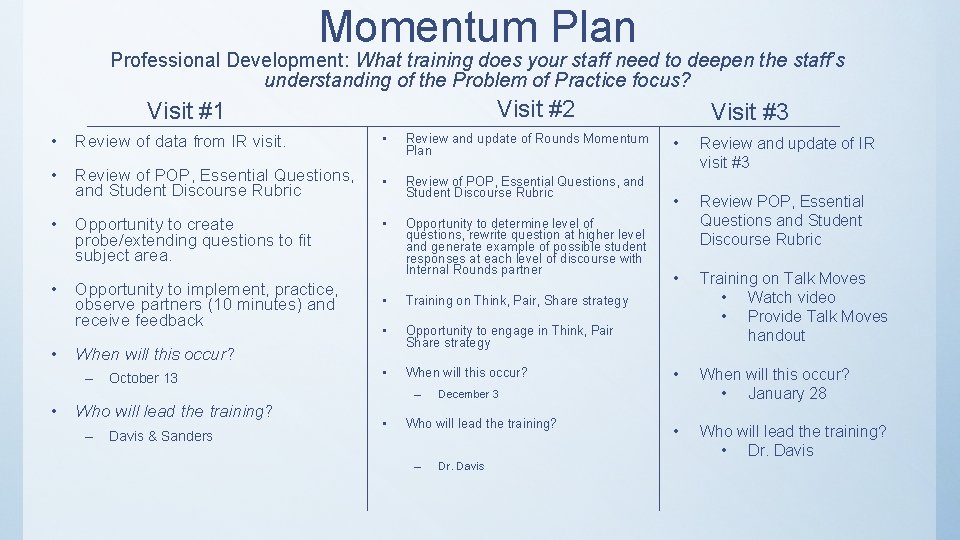
Momentum Plan Professional Development: What training does your staff need to deepen the staff’s understanding of the Problem of Practice focus? Visit #2 Visit #1 • Review of data from IR visit. • Review and update of Rounds Momentum Plan • Review of POP, Essential Questions, and Student Discourse Rubric • Opportunity to create probe/extending questions to fit subject area. • Opportunity to implement, practice, observe partners (10 minutes) and receive feedback • • • Training on Think, Pair, Share strategy • Opportunity to engage in Think, Pair Share strategy • When will this occur? – October 13 Opportunity to determine level of questions, rewrite question at higher level and generate example of possible student responses at each level of discourse with Internal Rounds partner – • Who will lead the training? – Davis & Sanders • • Review and update of IR visit #3 • Review POP, Essential Questions and Student Discourse Rubric • Training on Talk Moves • Watch video • Provide Talk Moves handout • When will this occur? • January 28 • Who will lead the training? • Dr. Davis December 3 Who will lead the training? – Visit #3 Dr. Davis
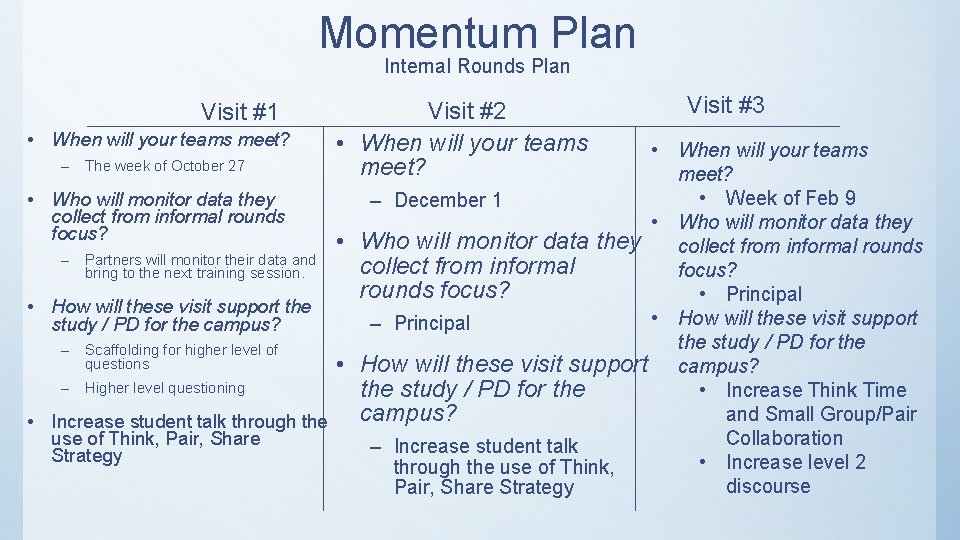
Momentum Plan Internal Rounds Plan Visit #1 • When will your teams meet? Visit #2 • When will your teams meet? Visit #3 • When will your teams meet? • Week of Feb 9 • Who will monitor data they – December 1 collect from informal rounds • Who will monitor data they focus? • Who will monitor data they collect from informal rounds – Partners will monitor their data and collect from informal focus? bring to the next training session. rounds focus? • Principal • How will these visit support the • How will these visit support – Principal study / PD for the campus? the study / PD for the – Scaffolding for higher level of questions • How will these visit support campus? – Higher level questioning the study / PD for the • Increase Think Time and Small Group/Pair campus? • Increase student talk through the Collaboration use of Think, Pair, Share – Increase student talk Strategy • Increase level 2 through the use of Think, discourse Pair, Share Strategy – The week of October 27
Partner Internal Rounds • Observe week of February 9 (minimum of 15 minutes) • Record Task format in time (whole group, group work, independent) • Meet w/ partner on or before February 13 • Provide feedback – Whole group, small group, independent (Think Time) – Suggestions on adjusting activity to increase Think Time and Small Group • Submit Summary February 13
- Slides: 18