
Review the Periodic Table Tuesday September 30 th
Review the Periodic Table Tuesday, September 30 th, 2014
Do Now � What do you remember about the Periodic Table of Elements? ◦ How to read the periodic table? ◦ Who created the table? ◦ What are the groups and what are the properties? ◦ I want you to be writing the whole time and using complete sentences
Objectives � SWBAT review the Periodic Table unit Essential Question � How do we know the properties of the elements based on their location on the Periodic Table?
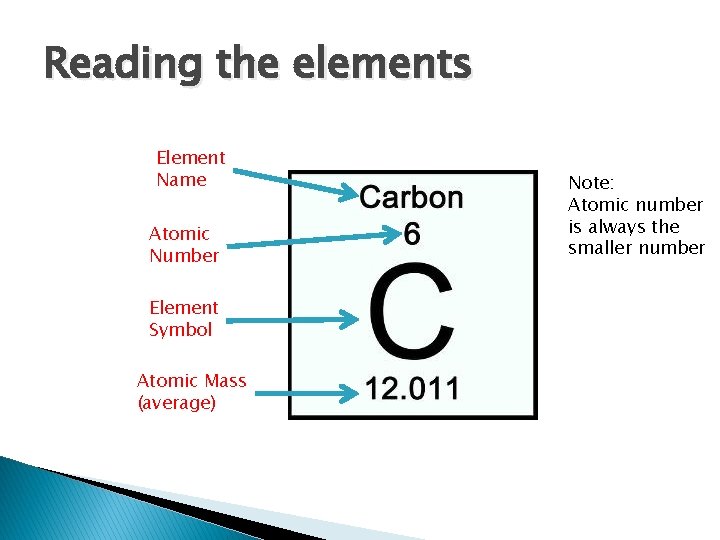
Reading the elements Element Name Atomic Number Element Symbol Atomic Mass (average) Note: Atomic number is always the smaller number
� Number of protons: 6 � (Same as atomic number) � Number of neutrons: 12 -6=6 � (Rounded atomic mass – atomic number) � Number of electrons: 6 � (Same as atomic number)
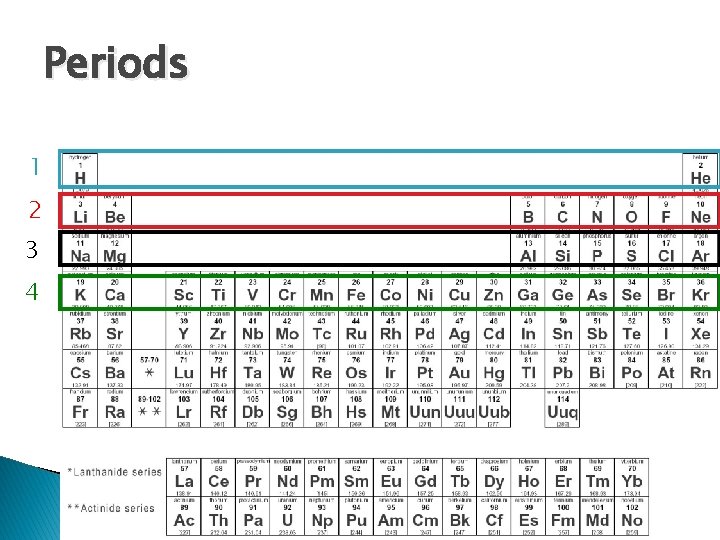
Periods 1 2 3 4

Groups 1 2 17 3 18

Alkali Metals � Alkali group 1 at metals are located in ____ the far left side of the periodic table. Note that ______ is not an alkali Hydrogen metal. All of the Alkali metals have 1 valence electron _________ in their outer shell. This is what gives them similar properties Alkali metals are ____ highly _____. reactive _____ and are not found in their pure form in nature. They are also all ______ solids ______ at room temperature There are 6 Alkali Metals with symbols of ____, Li Na ____, K Rb and Cs ____ Fr ____,

Alkaline Earth Metals � The Alkaline Earth Metals are located group 2 just to the right of the in ____, Alkali Metals. All of the Alkaline Earth 2 valence electrons their Metals have _________in outer shells. Alkaline Earth Metals are reactive but not as reactive as still _____ Alkali Metals the _______. These are sometimes found in their pure form in solids nature as _______. The 5 Alkaline Be ___, Mg ___, Ca ___, Sr ___ Ba Earth Metals are ___, Ra and ___

Transition Metals � The middle transition metals are located in the ____ group 3 to group 12 of the Periodic Table from __________. valence electrons for the The number of _________ varies but stays the same for Transition Metals _______, each _____. Transition Metals are all element solids at room temperature except for _______ Mercury _____.
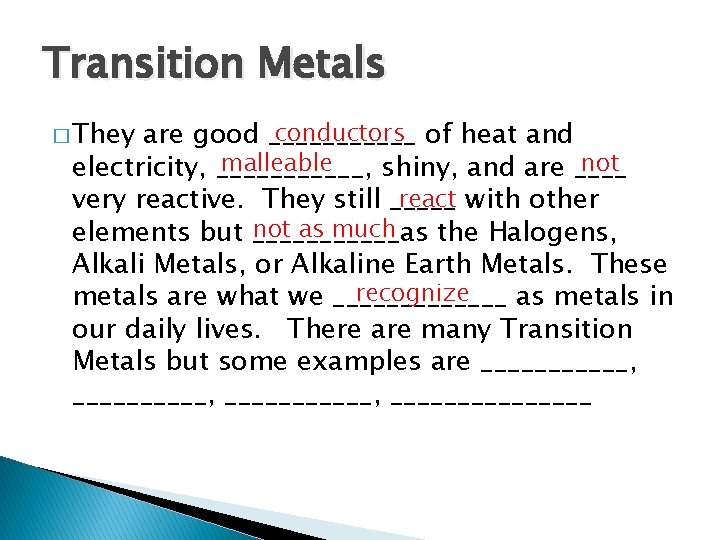
Transition Metals � They conductors of heat and are good ______ malleable not electricity, ______, shiny, and are ____ react with other very reactive. They still _____ not as much elements but ______as the Halogens, Alkali Metals, or Alkaline Earth Metals. These recognize metals are what we _______ as metals in our daily lives. There are many Transition Metals but some examples are ______, ___________, ________
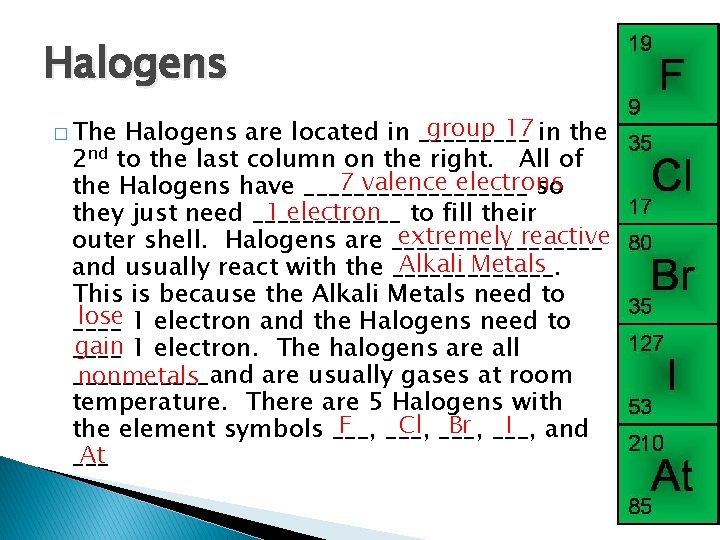
Halogens group 17 in the Halogens are located in _____ 2 nd to the last column on the right. All of 7 valence electrons the Halogens have _________ so 1 electron to fill their they just need ______ extremely reactive outer shell. Halogens are _________ Alkali Metals and usually react with the _______. This is because the Alkali Metals need to lose 1 electron and the Halogens need to ____ gain 1 electron. The halogens are all ___________and are usually gases at room nonmetals temperature. There are 5 Halogens with F ___, Cl ___, Br ___, I and the element symbols ___, At ___ � The

Noble Gases � The Noble Gases are located all the way to group 18 the right of the table in _____. The unique Noble Gases are _____because they are non-reactive _______. The Noble Gases have ______ 8 electrons in their outer shell and don’t lose or gain any electrons. The need to ______ colorless gases and are Noble Gases are all ________ pure form in the commonly found in their ______ atmosphere. There are 6 Noble Gases with He Ne Ar ___, Kr ___, Xe and ___. Rn symbols ___,
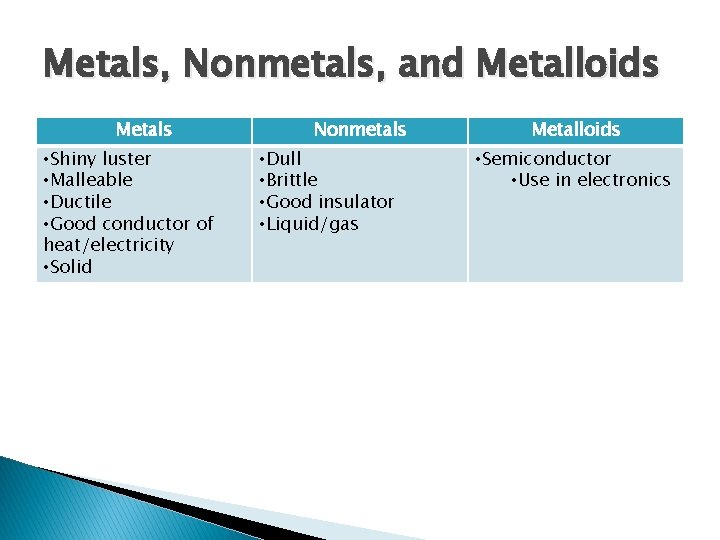
Metals, Nonmetals, and Metalloids Metals • Shiny luster • Malleable • Ductile • Good conductor of heat/electricity • Solid Nonmetals • Dull • Brittle • Good insulator • Liquid/gas Metalloids • Semiconductor • Use in electronics
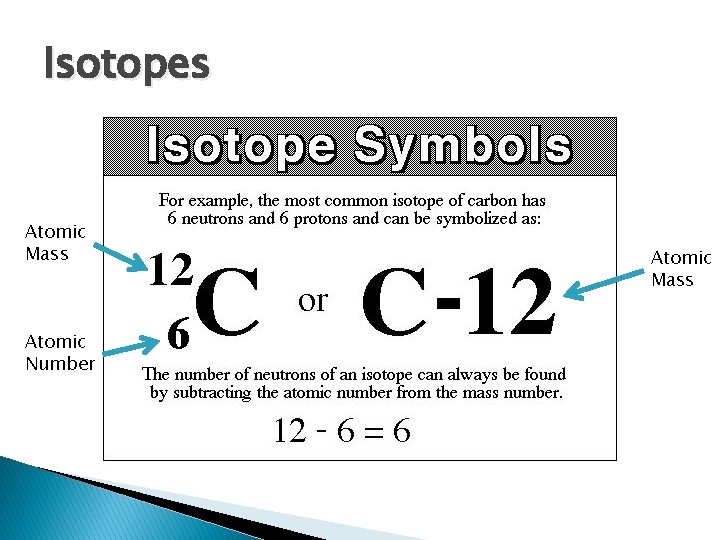
Isotopes Atomic Mass Atomic Number Atomic Mass

TCAP sample questions �I am going to show you 6 questions that relate to the standard about the Periodic Table � SPI 0807. 9. 9 Use the periodic table to determine the properties of an element. ◦ There will be 1 -2 questions on this standard for the TCAP � Please let everyone answer each question by refraining from shouting out the answers and helping each other. � Please explain how you know that it is the right answer and how you know the other answers are incorrect

A group from the Periodic Table is shown � What is the atomic number of Fluorine

Answer � 9 ◦ The atomic number is always the smaller one ◦ The atomic number is the number of protons ◦ Protons + neutrons = atomic mass (the other number)


Answer � Correct answer is C. � Halogens (F) are very reactive ◦ Eliminates A, B, and D
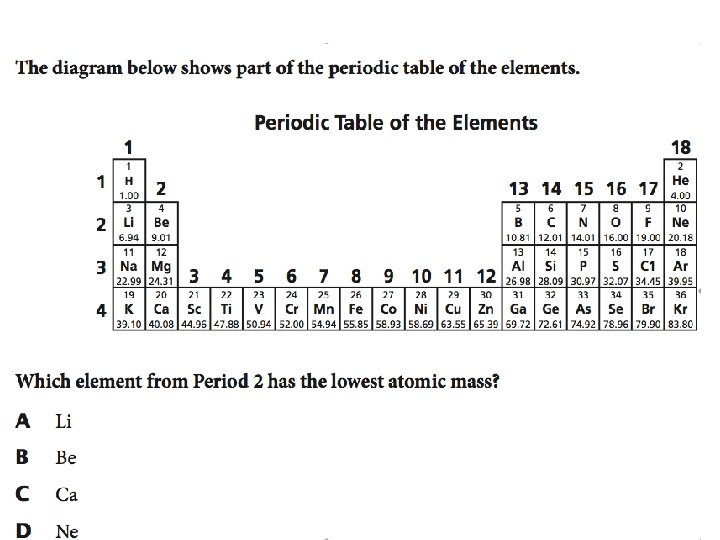
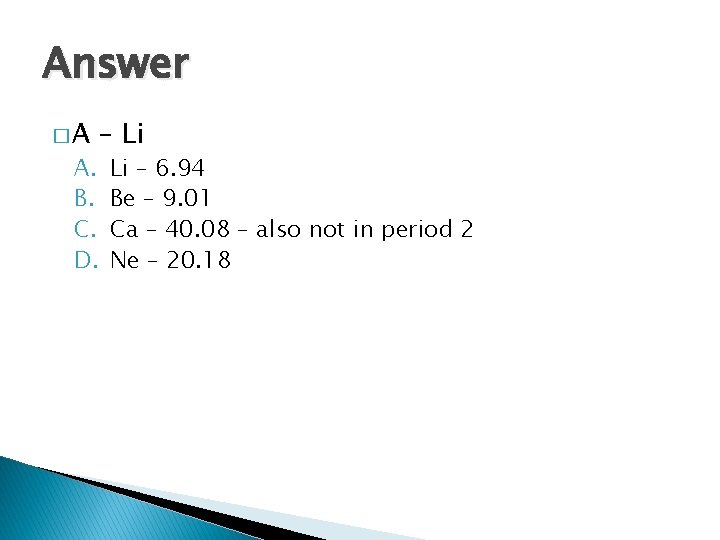
Answer �A – Li A. B. C. D. Li – 6. 94 Be – 9. 01 Ca – 40. 08 – also not in period 2 Ne – 20. 18

� Based on their locations on the periodic table, which two elements share the most similar chemical properties? A. B. C. D. K and Kr Be and Ba S and Sn H and I

Answer �B – Be and Ba ◦ These are both alkaline earth metals � All other answers are not in the same group � Similar groups have similar properties

Answer �D – Krypton (Kr) ◦ Starting from the top left, the elements atomic number and atomic mass (how heavy it is) increases

�A property that the elements Fe, Co, and Ni have in common is that they are all A. B. C. D. Chemically inert Halogens Transition metals Poor electrical conductors
Answer �C – Transition metals ◦ Not A because inert means non-reactive. Transition metals are some of the least reactive elements but they do still react with other elements ◦ Not B because the Halogens are on the right side (F, Cl, Br, I, and At) ◦ Not D because metals are good conductors of electricity
Physical Science Questions � � � � These next questions are from the Physical Science Standards 3202. 1. 9 Distinguish between atomic number and atomic mass. 3202. 1. 10 Define an isotope and describe the use of common isotopes. 3202. 1. 11 Identify the number of protons, neutrons, and electrons in an atom of an isotope based on its atomic number and atomic mass. 3202. 1. 12 Know the chemical symbols for the common elements. 3202. 1. 13 Use the periodic table to determine the number of protons, neutrons, and electrons in an isotope of an element. 3202. 1. 14 Use the periodic table to identify the characteristics and properties of metals, non-metals, and metalloids.

� 9 – Atomic number vs. atomic mass � 10 – What is an isotope and how are they used � 11 – Protons, neutrons, and electrons based on atomic mass and atomic number � 12 – Know the chemical symbols for the common elements � 13 - properties of metals, nonmetals, and metalloids

Identify the atomic number and atomic mass in each element 83. 08 Kr Krypton 36
Answers � Pb ◦ Atomic number – 82 ◦ Atomic mass – 207. 2 � Kr ◦ Atomic number - 36 ◦ Atomic mass – 83. 08 �B ◦ Atomic number – 5 ◦ Atomic mass – 10. 811 � The individual elements on a periodic table will be arranged in various ways � The smaller number is always the atomic number � The larger number is always the atomic mass

An isotope is an atom of the same _____ with a different number of _______. A. B. C. D. State of matter, protons Element, neutrons State of matter, neutrons Element, protons

Answer � C- An isotope is an atom of the same element with a different number of neutrons. � If the number of protons are different the atom is a different element � State of matter is dependent on temperature
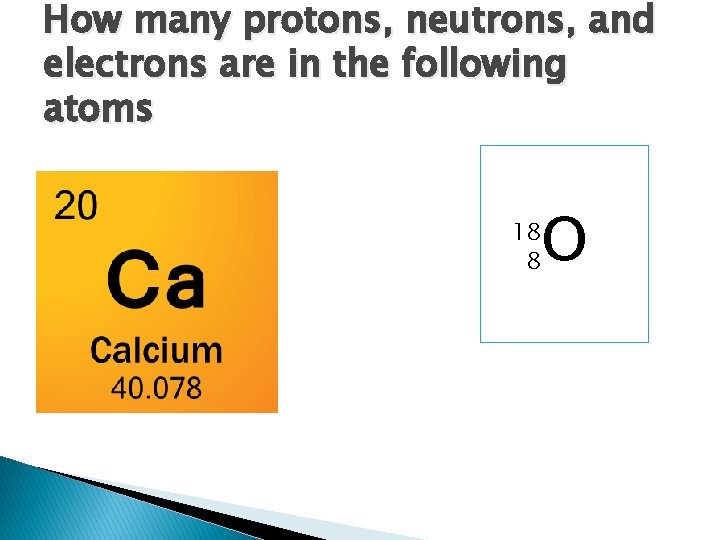
How many protons, neutrons, and electrons are in the following atoms O 18 8
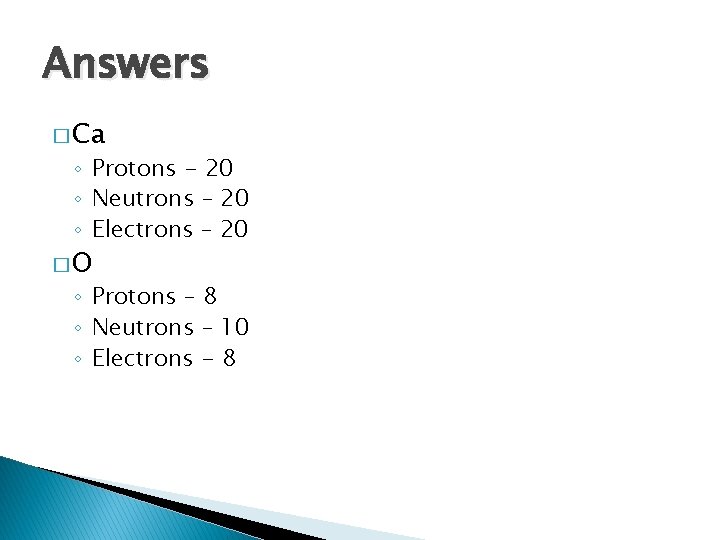
Answers � Ca ◦ Protons - 20 ◦ Neutrons – 20 ◦ Electrons – 20 �O ◦ Protons – 8 ◦ Neutrons – 10 ◦ Electrons - 8
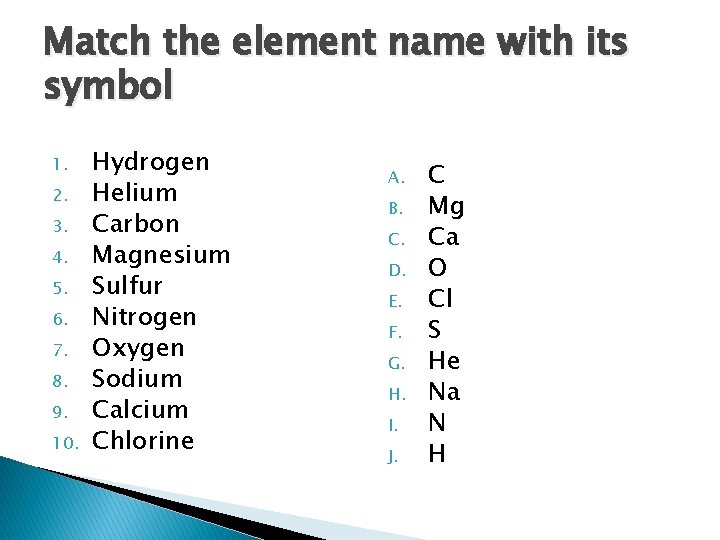
Match the element name with its symbol 1. 2. 3. 4. 5. 6. 7. 8. 9. 10. Hydrogen Helium Carbon Magnesium Sulfur Nitrogen Oxygen Sodium Calcium Chlorine A. B. C. D. E. F. G. H. I. J. C Mg Ca O Cl S He Na N H
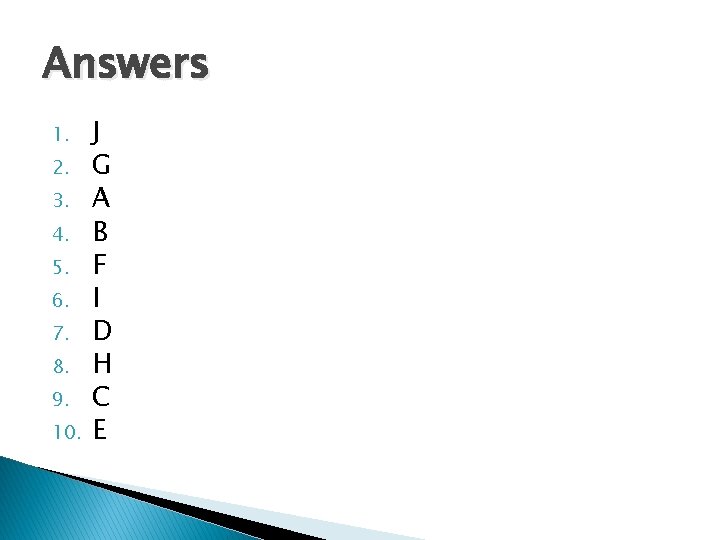
Answers 1. 2. 3. 4. 5. 6. 7. 8. 9. 10. J G A B F I D H C E

I am a solid at room temperature, malleable, very reactive, and is in period 3. Which element am I?
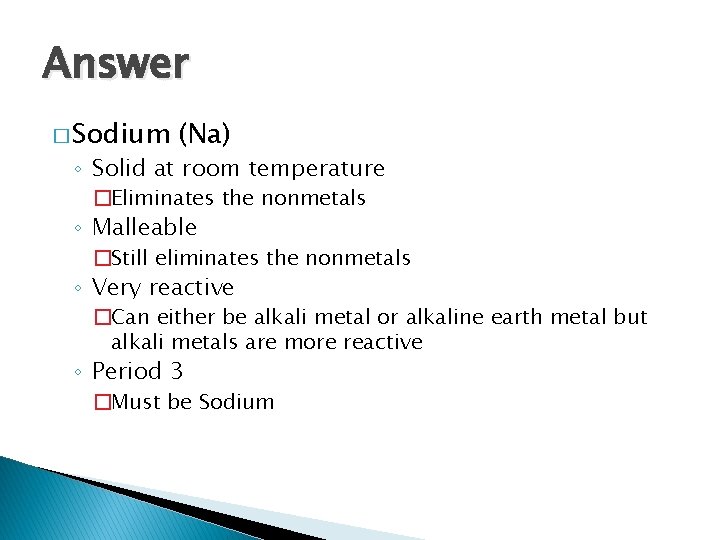
Answer � Sodium (Na) ◦ Solid at room temperature �Eliminates the nonmetals ◦ Malleable �Still eliminates the nonmetals ◦ Very reactive �Can either be alkali metal or alkaline earth metal but alkali metals are more reactive ◦ Period 3 �Must be Sodium
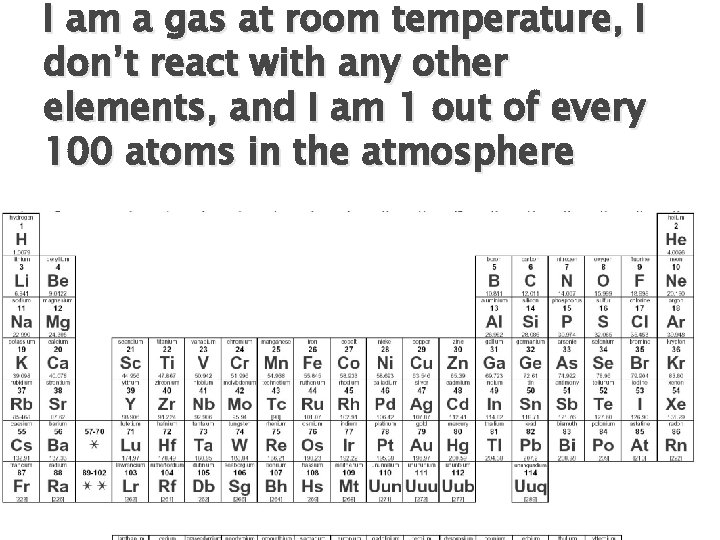
I am a gas at room temperature, I don’t react with any other elements, and I am 1 out of every 100 atoms in the atmosphere
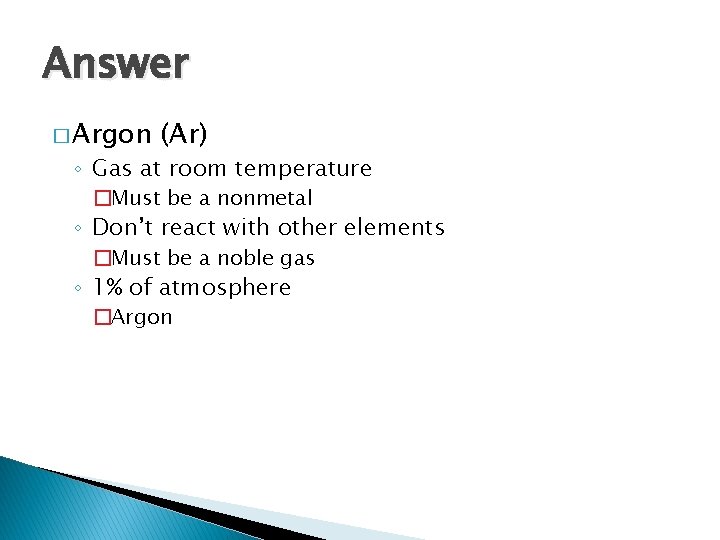
Answer � Argon (Ar) ◦ Gas at room temperature �Must be a nonmetal ◦ Don’t react with other elements �Must be a noble gas ◦ 1% of atmosphere �Argon

Create your own � With an element in mind, give 3 clues of physical properties, chemical properties, and location on the periodic table
Answer the Essential Question � How do we know the properties of the elements based on their location on the Periodic Table? ◦ Group/family ◦ Period ◦ Metal, nonmetal, metalloid
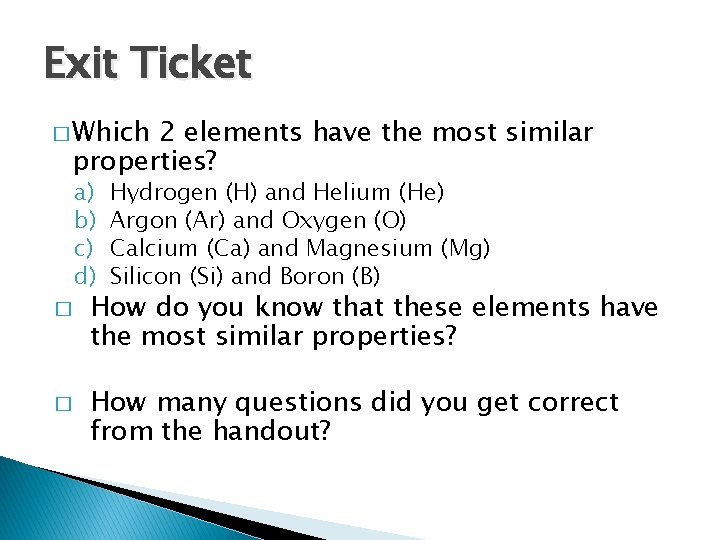
Exit Ticket � Which 2 elements have the most similar properties? a) b) c) d) � � Hydrogen (H) and Helium (He) Argon (Ar) and Oxygen (O) Calcium (Ca) and Magnesium (Mg) Silicon (Si) and Boron (B) How do you know that these elements have the most similar properties? How many questions did you get correct from the handout?
- Slides: 45