
Review The Hall Plot Method Update April 2000


- Slides: 7
Review: The Hall Plot Method Update, April 2000
The Hall Plot Document (Rev. 0) • Review of the first version - an update (Rev. 1) will be soon on the web page • Contents: – The Hall plot theory – Practical applications of the Hall plot method – Early detection of slope changes – Also: The role of Hall plot and other continuous monitoring techniques in the overall well monitoring strategy
The Hall Plot Method • Description of the basic theory • Practical aspects: examples of applications to real field data • Advantages versus disadvantages • Limitations and potential pitfalls, such as the importance of: – reservoir pressure and – correct bottom hole pressure correlation
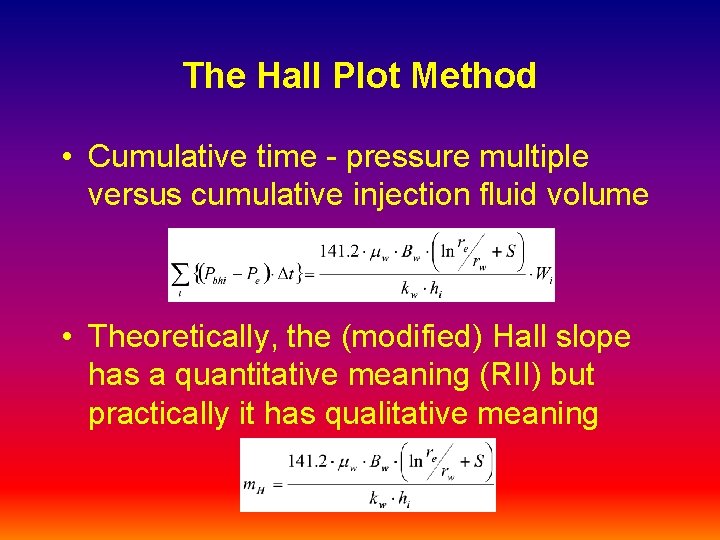
The Hall Plot Method • Cumulative time - pressure multiple versus cumulative injection fluid volume • Theoretically, the (modified) Hall slope has a quantitative meaning (RII) but practically it has qualitative meaning
The Hall Plot Method • The core behind the Hall plot method is that it takes readily available data, and minimises fluctuations due to “noise” • The Hall plot technique is best known for well history overview • Also possible to use for more specific analysis, given that constraints are taken into account, such as steady state etc. – Early detection of slow gradual changes in slope (e. g. plugging, or flow geometry changes)
Continuous Injection Monitoring • These method include: – Pressure and rate versus time – Injectivity and reciprocal injectivity indices – Hall plots, etc. • Analysis of readily available data (pressure and rate) can give a strong early indication of changes in the injection behaviour • However, this analysis of often not exclusive and to explain certain behaviour, specific tests need to be performed
Continuous Injection Monitoring and Well Monitoring Strategy • Guidelines and best practices needed