
Review The First Crusade began with 300 000
Review • The First Crusade began with 300, 000 soldiers gathered at Constantinople lead by an impressive assembly of Western Europe’s greatest French and Norman nobles. • What were the military results of the First Crusade? – The restoration of western Asia Minor to Byzantine rule – The setting up of four independent Latin “Crusader states” in Syria and Palestine. • The creation of these Latin Crusader states did far more than the schism of 1054 to breed real practical division between Eastern Orthodox and Western Catholic Christians. Why? – The Crusaders were brutal in their treatment of the Eastern Christians, forcibly taking over their churches, setting up their own Western Latin bishops and expecting Eastern believers to submit to them.
Review • Who acted as a sort of publicity agent for the Second Crusade? – Bernard of Clairvaux • The Second Crusade ended in disaster - Most of the Crusaders perished in Asia Minor through famine, fever, and Turkish attacks. • Many blamed the collapse of the Second Crusade on the illwill and treachery of the Byzantines. But Bernard of Clairvaux attributed the failure of the Second Crusade to another cause. What was it? – God was judging and punishing them for their ungodly lives. • What did Martin Luther say about Bernard in his commentary on Galatians (written over 250 years later)? – “Bernard, a man so godly, so holy, so pure, that we should commend and prefer him before all theologians of the Church. ”
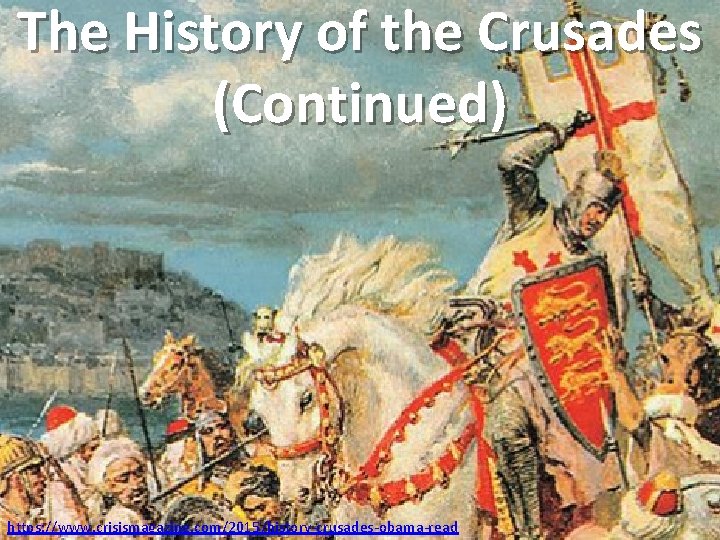
The History of the Crusades (Continued) https: //www. crisismagazine. com/2015/history-crusades-obama-read
The Third Crusade, 1189 -92 • After the failure of the Second Crusade, a brilliant Kurdish general called Saladin (1137 -93) took control of Egypt, and by 1186 his empire surrounded the kingdom of Jerusalem. • He crushed the Latin army in July 1187 and captured Jerusalem. • The West had controlled the city from 1099 to 1187. • Fortunately Saladin was more merciful than the Crusaders had been when they took Jerusalem, and he allowed its conquered Christian inhabitants to leave peacefully. • Saladin was a just and wise ruler whose standards of conduct often put the Crusaders to shame. Needham, Nick. 2, 000 Years of Christ's Power Vol. 2: The Middle Ages
The Third Crusade, 1189 -92 • The whole West was shocked by the fall of Jerusalem. • It is said that Pope Gregory VIII died of grief over the fall of Jerusalem, but not before proclaiming the Third Crusade. • The three greatest kings of Catholic Europe led the Crusade: – King Philip Augustus of France (1180 -1223), – The Holy Roman Emperor Frederick Barbarossa (1152 -90), – And above all, King Richard I of England (1189 -99), known to history as “Richard the Lionheart”. • Various disasters almost wrecked the expedition. Needham, Nick. 2, 000 Years of Christ's Power Vol. 2: The Middle Ages
The Third Crusade, 1189 -92 • The Holy Roman Emperor Frederick drowned near Tarsus in 1190; without his leadership, his German army proved hopelessly ineffective. • Philip Augustus of France and Richard of England quarreled constantly. • However, the Crusaders still managed to capture the great city of Acre near Mount Carmel, north of Jerusalem. • Acre, not Jerusalem, was really the most important Latin city in the Middle East, because it was the center of international trade and commerce. • After the Crusaders had taken Acre, Philip Augustus went back to France. Needham, Nick. 2, 000 Years of Christ's Power Vol. 2: The Middle Ages
The Third Crusade, 1189 -92 • Richard the Lionheart stayed on for another year. He failed to capture Jerusalem, but his amazing exploits in battle won him the admiration even of the Muslims. • For years afterwards, Muslim women used to frighten their children into obedience by telling them that if they did not do as they were told, Richard the Lionheart would get them! • Richard finally made a treaty with Saladin in 1192, which gave the Crusaders a strip of coastland from Acre to Ascalon (south-west of Jerusalem), with Christian right of access to Jerusalem guaranteed. Needham, Nick. 2, 000 Years of Christ's Power Vol. 2: The Middle Ages
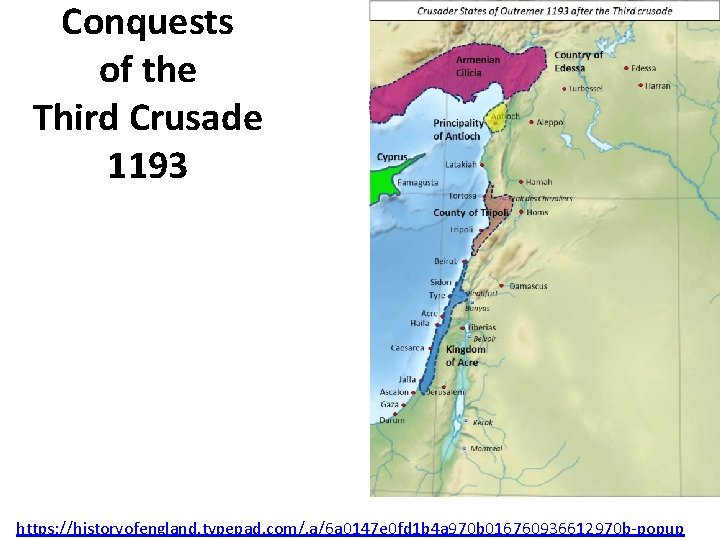
Conquests of the Third Crusade 1193 https: //historyofengland. typepad. com/. a/6 a 0147 e 0 fd 1 b 4 a 970 b 016760936612970 b-popup
The Fourth Crusade, 1202 -1204 • Pope Innocent III (1198 -1216) proclaimed the Fourth Crusade. • This time the Crusading soldiers were entirely French. • They had planned to take Egypt from the Muslims after being ferried there in ships provided by the great Italian trading republic of Venice. • Venice insisted, as part of the payment, that the French had to first conquer for them the city of Zara in Dalmatia (modern Croatia) – Zara had recently seceded from the Venetian empire and joined the Catholic kingdom of Hungary. • So the Fourth Crusade began with the Crusaders shedding the blood of their fellow Catholics as they stormed and captured Zara. Needham, Nick. 2, 000 Years of Christ's Power Vol. 2: The Middle Ages
The Fourth Crusade, 1202 -1204 • After the capture of Zara, Alexius Angelus, the son of a deposed Byzantine Emperor promised the Crusaders large payment, and the submission of the Orthodox Church to the papacy, if they would help him regain the Byzantine throne. • The Venetians saw Alexius’s proposal as an opportunity to secure control of all Eastern trade and so they offered to join the French Crusaders in the taking of Constantinople. • Pope Innocent III forbade the Crusaders to fight the Byzantines, but they ignored him, went to Constantinople, deposed the Byzantine Emperor, and placed Alexius on the throne. • When Alexius was unable to make the large payment he had promised for helping him regain the Byzantine throne, the Crusaders captured Constantinople for themselves in 1204. Needham, Nick. 2, 000 Years of Christ's Power Vol. 2: The Middle Ages
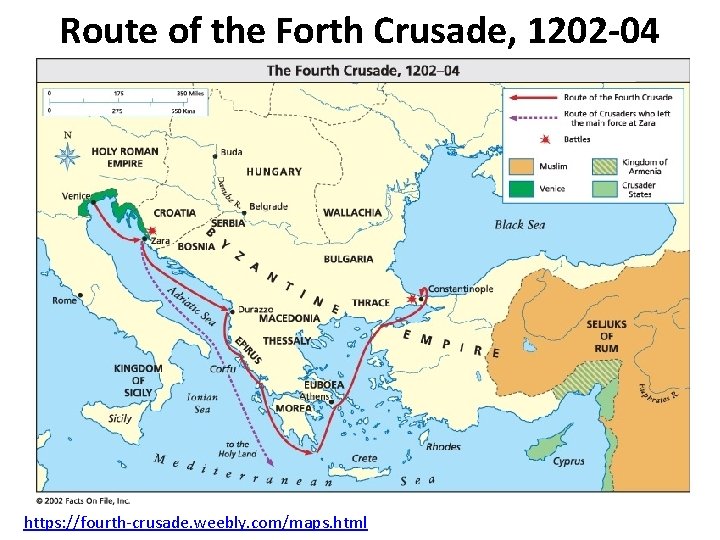
Route of the Forth Crusade, 1202 -04 https: //fourth-crusade. weebly. com/maps. html
The Fourth Crusade, 1202 -1204 • The new Catholic rulers of Byzantium set up a Western Catholic patriarch of Constantinople, and made the Orthodox Church subject to the pope. • But the Orthodox people of Byzantium scorned the papacy and remained loyal to their own Church and their own patriarch. • The Fourth Crusade was one of the darkest episodes in Christian history. • For the first time, a Crusading army fought fellow Christians – Catholics in Zara and Orthodox in Constantinople – simply for material gain. • Although the Byzantines did manage to recapture Constantinople from the Latins in 1261, the Byzantine Empire received a mortal wound from which it never really fully recovered. Needham, Nick. 2, 000 Years of Christ's Power Vol. 2: The Middle Ages
The Children’s Crusade • The Children’s Crusade consisted of a group of boys 18 and under led by Stephen of Cloyes from Northern France and Nicholas of Cologne from Germany. • They felt that the other Crusades had failed due to spiritual impurity, which was probably true. • They thought if they went on a Crusade with “innocent” young people who were spiritually pure, God would let them march into Jerusalem and free it from the infidels. • They marched to Genoa, Italy where Stephen and Nicholas had promised that the Mediterranean would part for them. • That didn’t happen, of course. The Genoese offered them three ships for transport which they got on. • Two of them disappeared and the third one went to Egypt and everyone on it was sold into slavery. James White – 2016 Church History Series #45 – The Crusades
Other Crusades • There were other Crusades, but none to rival the first four. • By the end of the 13 th century, all the Latin territory in the Middle East had fallen to the Muslims; the last to fall was the great Crusading capital of Acre in 1291. • Western Christendom and the papacy continued to talk about further Crusades for several hundred years, but none was ever launched. • When Acre fell, the Crusades against Islam were over. Needham, Nick. 2, 000 Years of Christ's Power Vol. 2: The Middle Ages
The Results of the Crusades • In the end, the Crusades failed to accomplish their original objective – taking back Jerusalem from the Muslims. • They inflicted lasting damage on the relationship between Eastern Orthodox and Western Catholic Christianity because of the religious oppression to which the Crusaders subjected the Orthodox peoples of the East. • The fall of Constantinople to a Crusading army in 1204 hastened the fall of the Byzantine Empire, and Byzantium’s weakness paved the way for the Muslim conquest of Eastern Europe a number of years later. • The Crusades left a lasting legacy of bitterness and hatred between Christians and Muslims. To this day, Arabic and Turkish Muslims think of Christianity in terms of the Crusades, and see the “Christian West” as the present-day representative of the Crusading knights who slaughtered so many Muslim men, women and children in the Holy Land in the Middle Ages. Needham, Nick. 2, 000 Years of Christ's Power Vol. 2: The Middle Ages
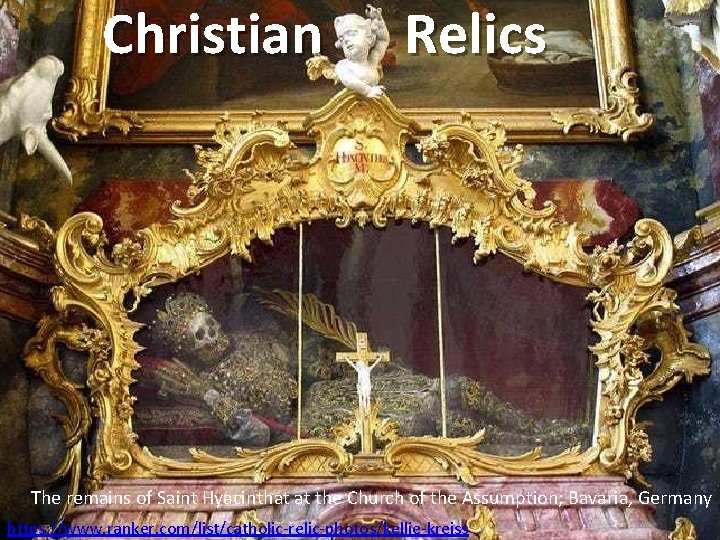
Christian Relics The remains of Saint Hyacinthat at the Church of the Assumption; Bavaria, Germany https: //www. ranker. com/list/catholic-relic-photos/kellie-kreiss
What are Relics? • In Christianity, relics are the material remains of a deceased saint or martyr and/or objects closely associated with those remains. • Relics can be entire skeletons, but more usually they consist of a part such as a bone, hair or tooth. • Pieces of clothing worn by the deceased saint or even an object that has come in contact with a deceased saint is also considered a relic. • Relics have played an important role in Christian ritual since the earliest centuries of the church and were a major part of popular religion in the Middle Ages. • The veneration of relics was rejected by most of the Protestant Reformers and by most Protestants today, but relics continue to play an important part in Catholic and Orthodox Christianity – even in the present day. http: //www. religionfacts. com/christianity/relics
Relics in the Early Church • The earliest surviving mention of relic veneration after the completion of the New Testament occurs in a work called The Martyrdom of Polycarp, dated to about AD 150. • In this account of the death of Polycarp, his admirers in Smyrna wrote: – We took up his bones, which are more valuable than precious stones and finer than refined gold, and laid them in a suitable place, where the Lord will permit us to gather ourselves together, as we are able, in gladness and joy and to celebrate the birthday of his martyrdom. http: //www. religionfacts. com/christianity/relics
Relics in the Early Church • St. Jerome (AD 347 -420) had this to say about the veneration of relics: – We do not worship, we do not adore, for fear that we should bow down to the creature rather than to the creator, but we venerate the relics of the martyrs in order the better to adore him whose martyrs they are. • In AD 787, the Second Council of Nicaea met to consider the iconoclastic controversy. The assembled bishops affirmed the veneration of icons, images and relics: – We accept the image of the honorable and life-giving Cross, and the holy relics of the saints; and we receive the holy and venerable images; we accept them and we embrace them, according to the ancient traditions of the Holy Catholic Church of God, that is to say our holy Fathers, who also received these things and established them in all the most holy Churches of God and in every place of His dominion. http: //www. religionfacts. com/christianity/relics
Biblical Passages Cited • Once while some Israelites were burying a man, suddenly they saw a band of raiders; so they threw the man's body into Elisha's tomb. When the body touched Elisha's bones, the man came to life and stood up on his feet. (2 Kings 13: 21 NIV) • Just then a woman who had been subject to bleeding for twelve years came up behind him and touched the edge of his cloak. She said to herself, "If I only touch his cloak, I will be healed. " Jesus turned and saw her. "Take heart, daughter, " he said, "your faith has healed you. " And the woman was healed from that moment. (Mat 9: 20 -22 NIV) • And God was doing extraordinary miracles by the hands of Paul, so that even handkerchiefs or aprons that had touched his skin were carried away to the sick, and their diseases left them and the evil spirits came out of them. (Act 19: 11 -12) http: //www. religionfacts. com/christianity/relics
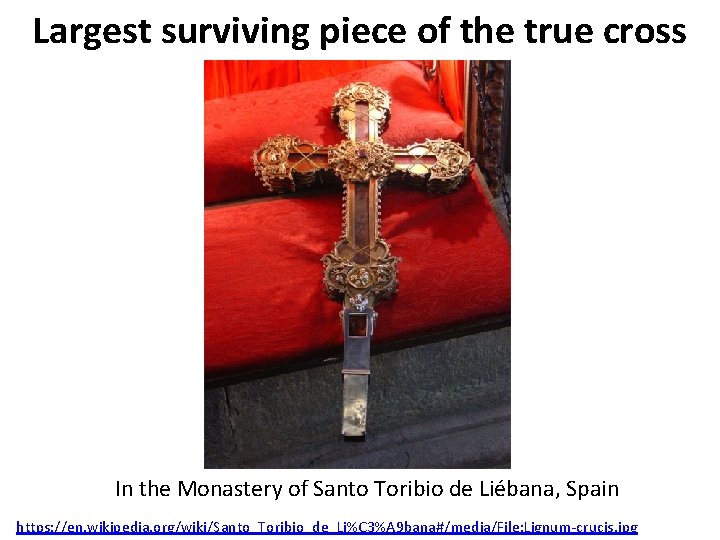
Largest surviving piece of the true cross In the Monastery of Santo Toribio de Liébana, Spain https: //en. wikipedia. org/wiki/Santo_Toribio_de_Li%C 3%A 9 bana#/media/File: Lignum-crucis. jpg
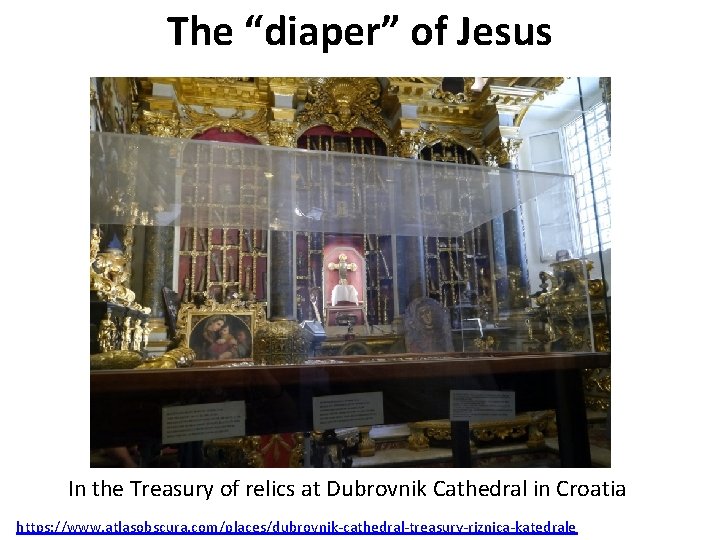
The “diaper” of Jesus In the Treasury of relics at Dubrovnik Cathedral in Croatia https: //www. atlasobscura. com/places/dubrovnik-cathedral-treasury-riznica-katedrale
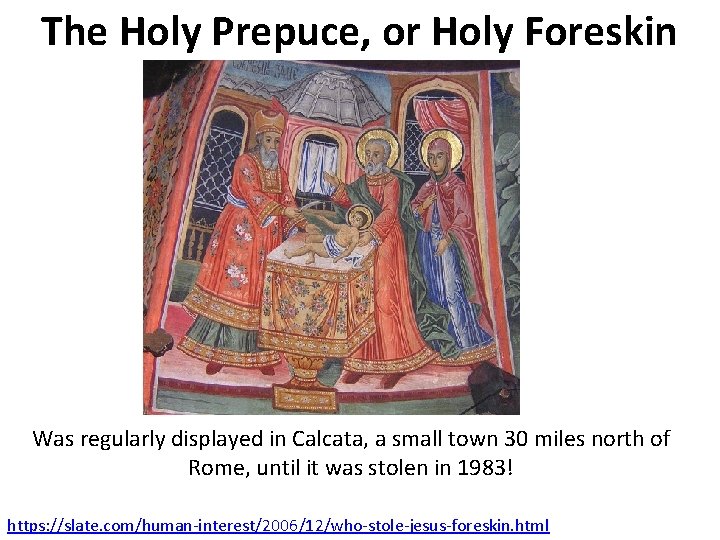
The Holy Prepuce, or Holy Foreskin Was regularly displayed in Calcata, a small town 30 miles north of Rome, until it was stolen in 1983! https: //slate. com/human-interest/2006/12/who-stole-jesus-foreskin. html

Christmas Music in Early Christian History http: //watt-logic. com/2018/12/31/christmas-tree-lights/

https: //www. hopehelps. org/volunteer-appreciation-week-2018/

Class Discussion Time https: //www. weareteachers. com/moving-beyond-classroom-discussions/
*Class Discussion Time • How would you respond to a Muslim who claimed that modern military efforts by the United States in the Middle East were nothing more than a modern day re-enactment of the Medieval Crusades? • How would you respond to someone who claimed that the: – Dead man brought back to life by Elisha’s bones (2 Kings 13: 21) – Woman healed by touching Jesus cloak (Mat. 9: 20 -22) – People healed by handkerchiefs and aprons that had touched the Apostle Paul’s skin (Acts 19: 11 -12) • All provide scriptural support for the veneration of Christian relics? • Do you have a topic or question that you would like to see us to discuss?
- Slides: 28