
Review Terms associated with phylogenetic trees Tips represent

- Slides: 21
Review…
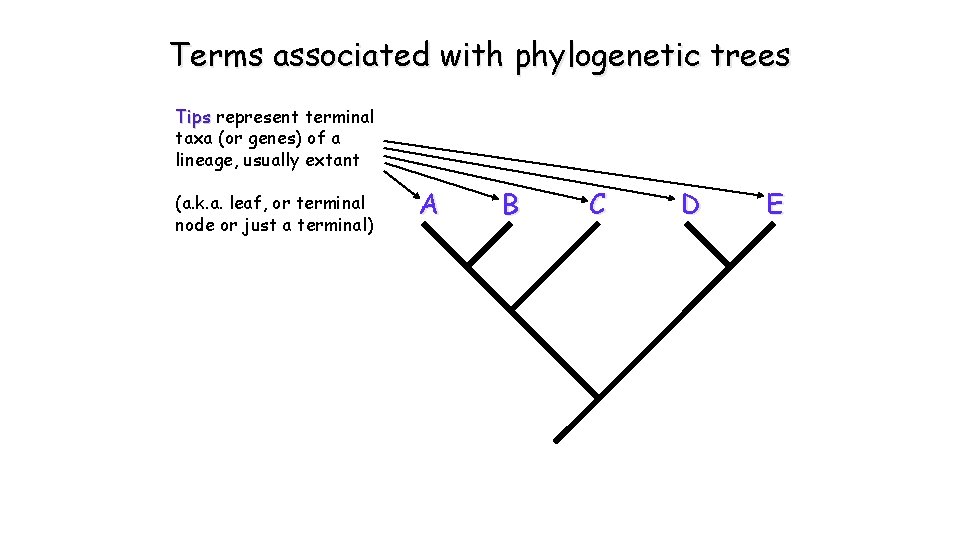
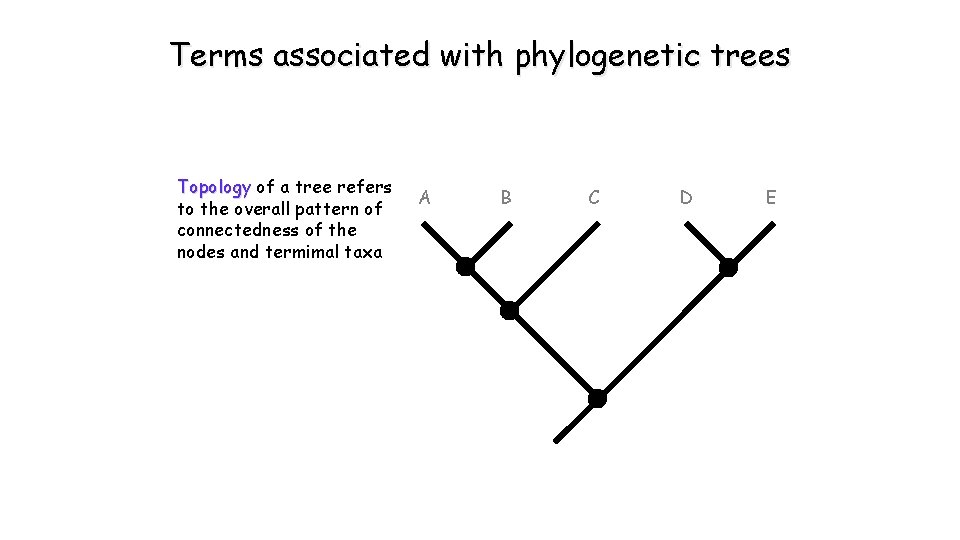
Terms associated with phylogenetic trees Tips represent terminal taxa (or genes) of a lineage, usually extant (a. k. a. leaf, or terminal node or just a terminal) A B C D E
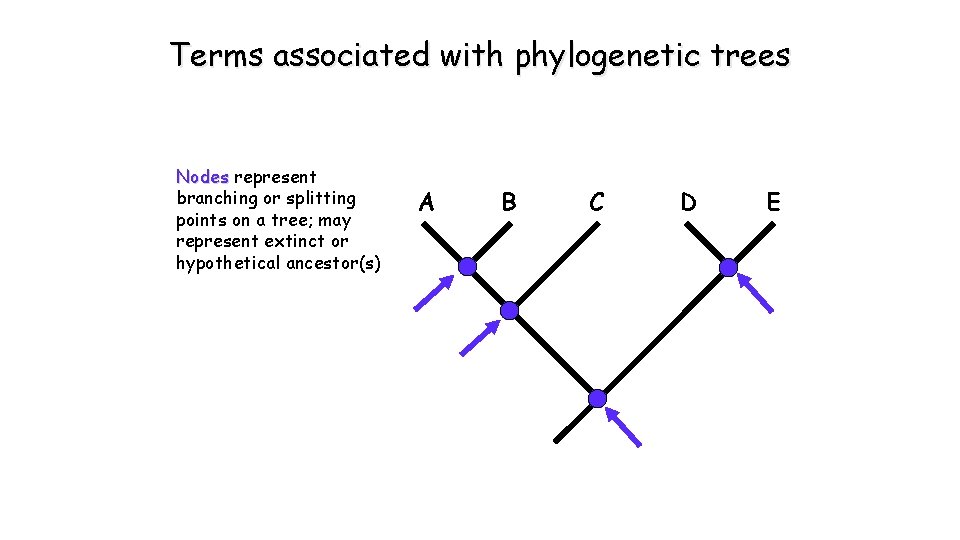
Terms associated with phylogenetic trees Nodes represent branching or splitting points on a tree; may represent extinct or hypothetical ancestor(s) A B C D E
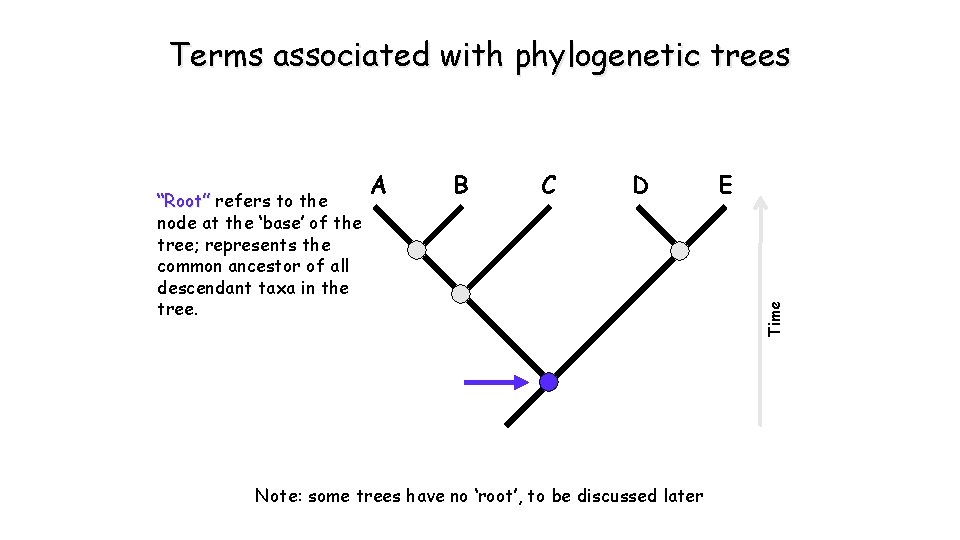
Terms associated with phylogenetic trees A B C D Note: some trees have no ‘root’, to be discussed later E Time “Root” refers to the node at the ‘base’ of the tree; represents the common ancestor of all descendant taxa in the tree.
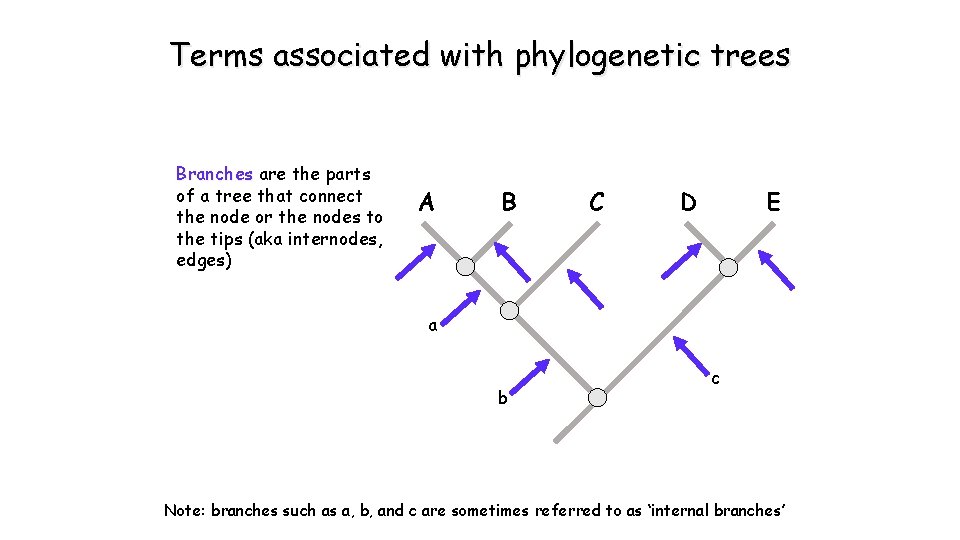
Terms associated with phylogenetic trees Branches are the parts of a tree that connect the node or the nodes to the tips (aka internodes, edges) A B C D E a b c Note: branches such as a, b, and c are sometimes referred to as ‘internal branches’
Terms associated with phylogenetic trees Topology of a tree refers to the overall pattern of connectedness of the nodes and termimal taxa A B C D E
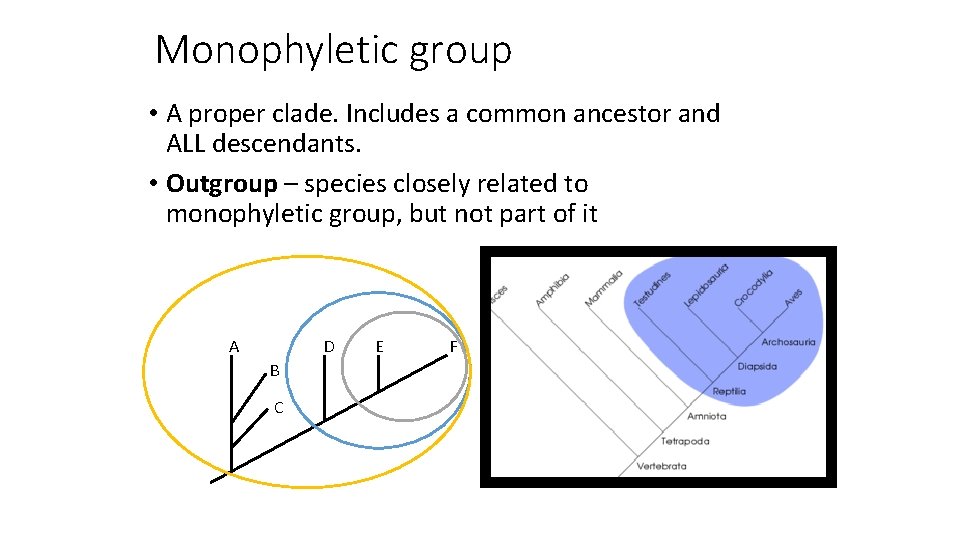
Monophyletic group • A proper clade. Includes a common ancestor and ALL descendants. • Outgroup – species closely related to monophyletic group, but not part of it A D B C E F
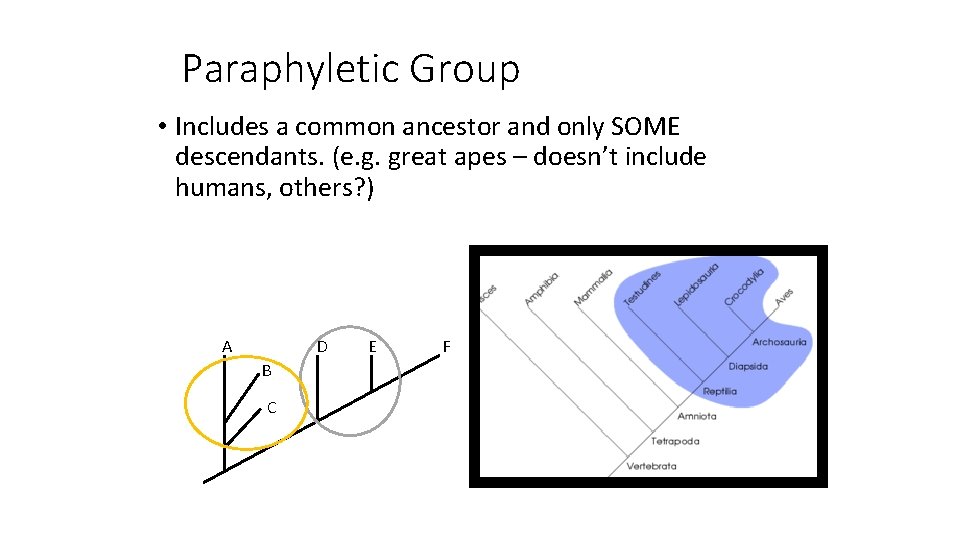
Paraphyletic Group • Includes a common ancestor and only SOME descendants. (e. g. great apes – doesn’t include humans, others? ) A D B C E F
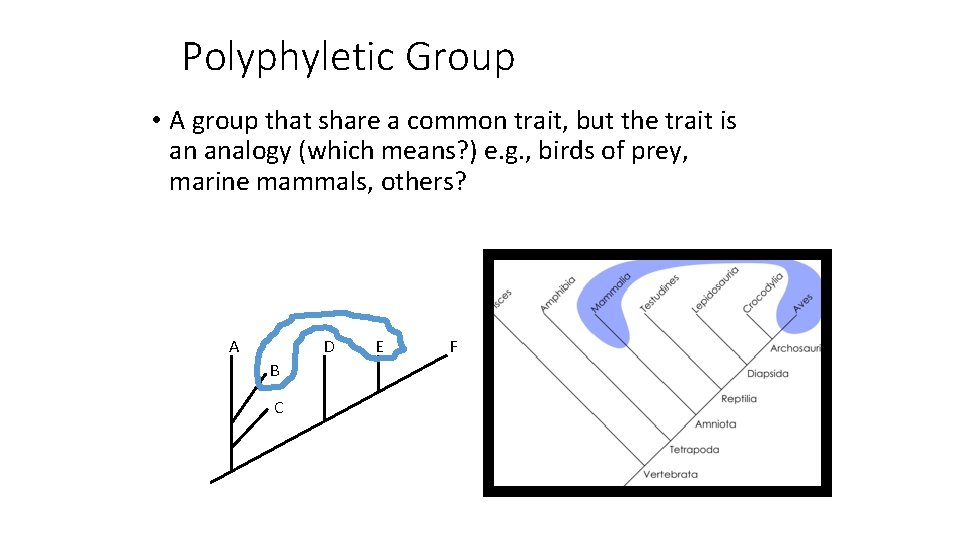
Polyphyletic Group • A group that share a common trait, but the trait is an analogy (which means? ) e. g. , birds of prey, marine mammals, others? A D B C E F
How do we figure out the evolutionary relationships among organisms? • We rely on shared, derived characters • Shared = shared, found in multiple related groups/species • Derived = new, non-ancestral • Characters = heritable traits of an organism (e. g. , morphology, physiology, biochemistry, behavior, developmental pattern, chromosome features, gene sequences, etc. )
Clarification • Ancestral/derived are terms that have to be used relatively. • For example, when comparing reptiles, dinosaurs, birds, and mammals, body hair is a derived feature for mammals. However, when discussing mice, rats, dogs, and people, body hair is ancestral (the most recent common ancestor of all four groups had body hair).
Homology, Analogy, and Cladistics • Homologies are characteristics that are alike because of common descent • Analogies, or homoplasies, are characteristics that are alike in form or function (probably due to similar selective pressures), but do not share a common ancestry (evolved independently). This is known as convergence.
Cladistics • A cladogram is a graphical representation of the relatedness of species (their phylogeny) based on the number of characteristics from common ancestors that they share (can be morphology, behavior, genes, etc. ) • One axis is time, with the top (or right) being the present and the bottom (or left) being earlier. • Nodes are the splitting points. Represent the most recent common ancestor of two or more taxa. • The more homologies, the more closely related.
Parsimony • Parsimony – the fewest number of evolutionary changes is the most likely explanation. For example, you don’t want to have feathers evolve 317 times in your phylogeny if you can help it. The idea that feathers evolved only once is more parsimonious. • However, if you have a whole bunch of traits on which to base your cladogram, it might be simpler for one trait to evolve independently multiple times. This trait is an analogy.
Synapomorphy • Trait found in two or more taxa that is present in their most recent common ancestor but is missing in more distant ancestors. • Allows for biologists to recognize clades (What else is a clade known as? )
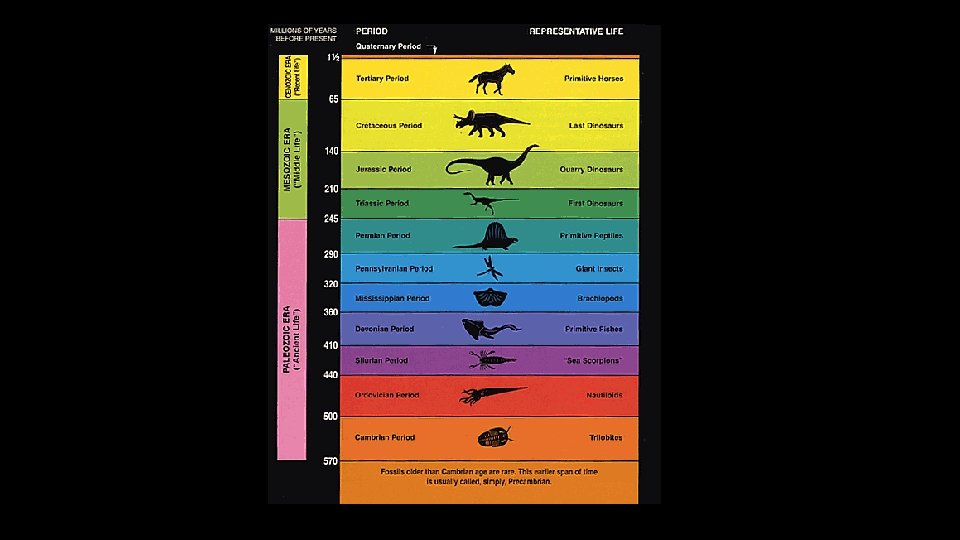
Fossil record • Fossil – physical evidence of organisms that lived in the past • Form when the organism is buried and preserved • Provide information about what the organisms looked like and where they lived • Critical to understanding the history of life, yet biased
Limitations of the fossil record • Habitat bias • Taxonomic and tissue bias • Temporal bias • Abundance bias
Adaptive radiation • Speciation events and morphological change occur rapidly • A single lineage diversifies into a wide variety of ecological roles • Instances when species originate and rapidly diversify • Periods when species go extinct rapidly
Adaptive radiation • When a species produces many descendent species that • live in a wide diversity of habitats and • use a wide array of resources • Adaptive radiations occur through these mechanisms: • Ecological opportunity; e. g. , by the colonization of a new habitat that offers resources and lacks competitors • Morphological innovations; e. g. , feathers, any structure that allows individuals to exploit resources more efficiently or in a new way
Mass Extinctions • Rapid extinction of a large number of lineages scattered throughout the tree of life; e. g. ; at least 60% of the species are wiped out within one million years • Have occurred repeatedly throughout history, at least 5 times • Environmental catastrophes that rapidly eliminate most of the species • ‘Prune’ the tree of life; marked the end of several prominent lineages and the rise of new branches • Can take ecosystems approx. 15 mil years to recover their diversity