
REVIEW SLIDES NOTE Disclaimer students may find typosmistakes









- Slides: 102
REVIEW SLIDES
NOTE: • Disclaimer: students may find typos/mistakes in these reviews. If you spot them, please feel free to make a change and then email the instructor the corrected Power Point. • Disclaimer: these slides are not intended to substitute for exam preparation. Finding a mistake does not exempt students from knowing the material.
Chapter 10 Sensory Physiology
• ________ are pain receptors that depolarize in response to stimuli that accompany tissue damage.
• ___nociceptors_ are pain receptors that depolarize in response to stimuli that accompany tissue damage.
• In many cases, we do not need to be continuously aware of a constant stimulus, and our receptors adjust accordingly. This is called __________ _________.
• In many cases, we do not need to be continuously aware of a constant stimulus, and our receptors adjust accordingly. This is called sensory adaptation.
• Sensory adaptation involves ___________ receptors.
• Sensory adaptation involves phasic_ receptors.
• Tonic receptors respond to _______.
• Tonic receptors respond to __pain___.
• __________ are receptors that respond to mechanical force.
• _mechanoreceptors_ are receptors that respond to mechanical force.
• ___________ are receptors that respond to tissue damage.
• _pain receptors (nociceptors)___ are receptors that respond to tissue damage.
• ____________ are receptors that respond to dissolved chemicals.
• Chemoreceptors are receptors that respond to dissolved chemicals.
• Light _____the photoreceptors from releasing their inhibitory neuorotransmitter, and by this means stimulates the bipolar cells
• Light inhibits the photoreceptors from releasing their inhibitory neuorotransmitter, and by this means stimulates the bipolar cells
Essay question • Discuss the ear, numbering the sentences in your paragraph. 1 -2) Discuss the flow of sound into the inner ear, naming all structures involved. 3 -4) Explain how sound is transduced to an action potential. 5 -6) Describe how your ear discriminates among high pitches and low pitches. 7 -8) How does the ear detect linear acceleration?
Essay question • Discuss the ear, numbering the sentences in your paragraph. 1 -2) Discuss the flow of sound into the inner ear, naming all structures involved. 3 -4) Explain how sound is transduced to an action potential. 5 -6) Describe how your ear discriminates among high pitches and low pitches. 7 -8) How does the ear detect linear acceleration? • 1. Sound waves enter the ear at the acoustic meatus, vibrate the tympanic membrane, the incus, malleus, and stapes and then the oval window. 2)This triggers the vibration of fluid in the cochlea. 3/4 The vibration of the basilar membrane triggers the influx of K+ ions into the hair cells, which causes a depolarization that is sent through the vestibular cochlear nerve to the brain. 5/6. Low pitches vibrate the cochlear membrane nearest the apex; high pitches vibrate the membrane closer to the oval window. 7/8. The utricle and the saccule (otolith organs) provide information about linear acceleration. During linear acceleration (accelerating in a car), the otoliths (calcium crystals) fall against the hair cells, triggering an action potential that is sent to the VC
• Increasing the pressure on the Pacinian corpuscle increases the magnitude of the generator potential until it reaches the threshold depolarization required to produce an action potential. The Pacinian corpuscle is, however, a phasic receptor, and therefore if the pressure is maintained, what happens to the size of the generator potential?
• Increasing the pressure on the Pacinian corpuscle increases the magnitude of the generator potential until it reaches the threshold depolarization required to produce an action potential. The Pacinian corpuscle is, however, a phasic receptor, and therefore if the pressure is maintained, what happens to the size of the generator potential? A phasic receptor no longer reacts to a stimulus that is constantly applied, and therefore the generator potential diminishes. Think: if you put your sunglasses on your head, you may forget they’re there.
• _________ are receptors found in the rods and cones in the retina of the eye, which respond to light.
• Photoreceptors_ are receptors found in the rods and cones in the retina of the eye, which respond to light.
• Distinguish between a tonic and a phasic receptor
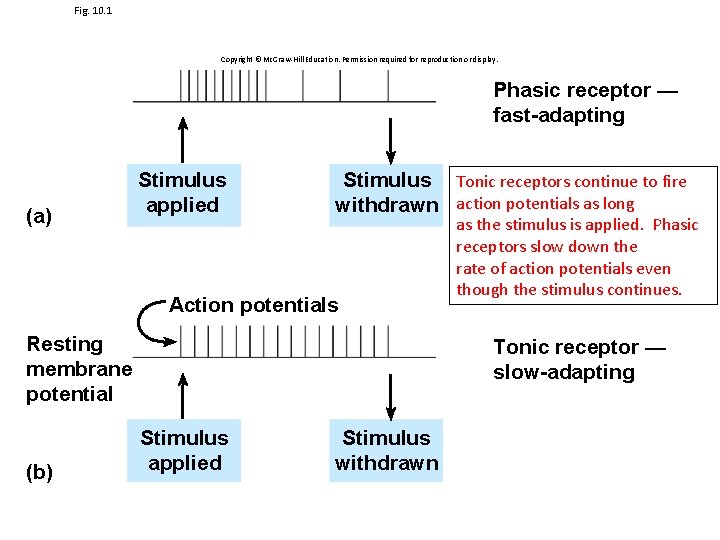
Fig. 10. 1 Copyright © Mc. Graw-Hill Education. Permission required for reproduction or display. Phasic receptor — fast-adapting (a) Stimulus applied Stimulus Tonic receptors continue to fire withdrawn action potentials as long Action potentials Resting membrane potential (b) as the stimulus is applied. Phasic receptors slow down the rate of action potentials even though the stimulus continues. Tonic receptor — slow-adapting Stimulus applied Stimulus withdrawn
• The Law of _________________ states that the sensation characteristic of each sensory neuron is that produced by its normal stimulus, or adequate stimulus.
• The Law of Specific Nerve Energies states that the sensation characteristic of each sensory neuron is that produced by its normal stimulus, or adequate stimulus.
• Which of the following is NOT a type of chemoreceptor? – Olfactory receptor – Cochlea – Gustatory receptor – Carotid body
• Which of the following is NOT a type of chemoreceptor? – Olfactory receptor – Cochlea – Gustatory receptor – Carotid body
• Each rod contains thousands of molecules of a purple pigment known as _________.
• Each rod contains thousands of molecules of a purple pigment known as __rhodopsin_.
• Rhodopsin (pigment) appears purple (a combination of red and blue) because it transmits light in the red and blue regions of the spectrum, while absorbing light energy in the ________ region.
• Rhodopsin (pigment) appears purple (a combination of red and blue) because it transmits light in the red and blue regions of the spectrum, while absorbing light energy in the _green_ region.
• __________ cars (and other green objects) are seen more easily at night because the rods are used at night, and they contain rhodopsin, which responds to this color primarily.
• __Green_ cars (and other green objects) are seen more easily at night because the rods are used at night, and they contain rhodopsin, which responds to this color primarily.
• In response to absorbed light rhodopsin dissociates into its two components: the pigment retinaldehyde (also called retinene or retinal), which is derived from vitamin A, and a protein called opsin. This reaction is known as the _________ reaction.
• In response to absorbed light rhodopsin dissociates into its two components: the pigment retinaldehyde (also called retinene or retinal), which is derived from vitamin A, and a protein called opsin. This reaction is known as the bleaching_ reaction.
• In the presence of light, the dissociation of opsin from retinaldehyde (bleaching reaction) is what causes the ______proteins to dissociate. This leads to the conversion of c. GMP to GMP, and results in the closing of Na+ channels, causing hyperpolarization.
• In the presence of light, the dissociation of opsin from retinaldehyde (bleaching reaction) is what causes the G- proteins to dissociate. This leads to the conversion of c. GMP to GMP, and results in the closing of Na+ channels, causing hyperpolarization.
• The dissociated rhodopsin (separated into transretinaldehyde and opsin) must reassociate in order for vision to occur. For this purpose, the trans-retinaldehyde moves from the photoreceptor cells to the pigmented epithelium where it is converted back into cis-retinaldehyde (and then transported back to the photoreceptors). • This is called the _______ __ _______.
• The dissociated rhodopsin (separated into transretinaldehyde and opsin) must reassociate in order for vision to occur. For this purpose, the trans-retinaldehyde moves from the photoreceptor cells to the pigmented epithelium where it is converted back into cis-retinaldehyde (and then transported back to the photoreceptors). • This is called the visual cycle of retinal.
• The bleaching reaction occurs in both rods and _______.
• The bleaching reaction occurs in both rods and cones_.
• The _______ provide color vision and greater visual acuity.
• The cones provide color vision and greater visual acuity.
• In rods, retinaldehyde is combined with _____, whereas in cones, retinaldehyde is combined with _______.
• In rods, retinaldehyde is combined with opsin, whereas in cones, retinaldehyde is combined with _photopsin.
• Cones have three different types of photopsins that absorb ______, _______, and ______.
• Cones have three different types of photopsins that absorb red, blue and _green.
• Photoreceptors are normally polarized and they send out an inhibitory neurotransmitter that blocks vision. The presence of light removes the inhibitory neurotransmitter, and ________ the cell, which removes the inhibition.
• Photoreceptors are normally polarized and they send out an inhibitory neurotransmitter that blocks vision. The presence of light removes the inhibitory neurotransmitter, and hyperpolarizes the cell, which removes the inhibition.
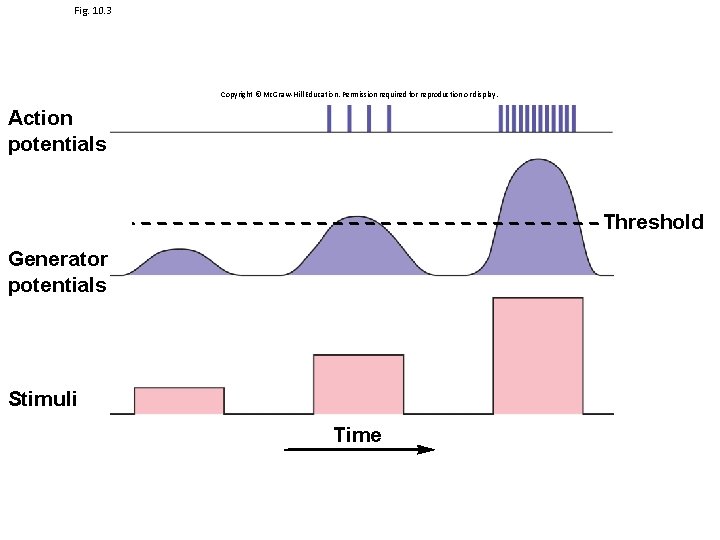
• Increasing frequency of the “generator potential” results in an increased frequency of action potentials in a ________ receptor.
• Increasing frequency of the “generator potential” results in an increased frequency of action potentials in a tonic receptor. • See graph on the next slide (Figure 10. 3)
Fig. 10. 3 Copyright © Mc. Graw-Hill Education. Permission required for reproduction or display. Action potentials Threshold Generator potentials Stimuli Time
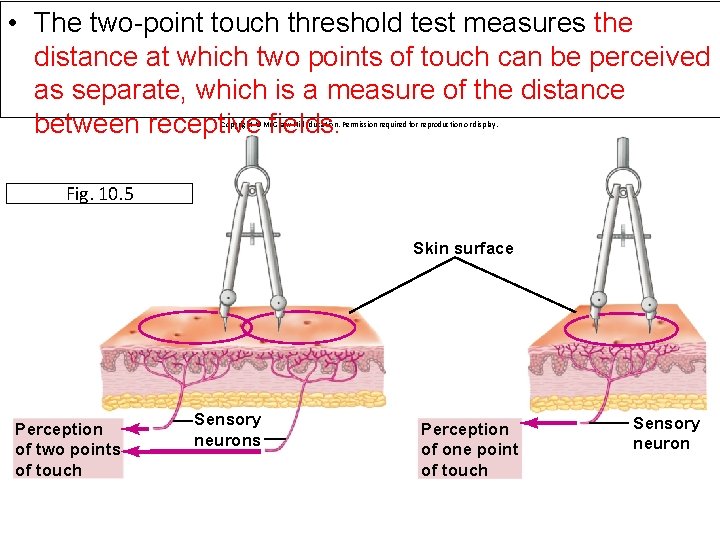
• The two-point touch threshold test measures (? )
• The two-point touch threshold test measures the distance at which two points of touch can be perceived as separate, which is a measure of the distance between receptive fields. Copyright © Mc. Graw-Hill Education. Permission required for reproduction or display. Fig. 10. 5 Skin surface Perception of two points of touch Sensory neurons Perception of one point of touch Sensory neuron
• Hot temperatures activate a nociceptor at temperatures of 43 degrees Celsius or higher. This nociceptor is an ion channel that also binds to the molecule in ___________ _____, called capsaicin.
• Hot temperatures activate a nociceptor at temperatures of 43 degrees Celsius or higher. This nociceptor is an ion channel that also binds to the molecule in hot chili peppers, called capsaicin. • Opening of the ion channel allows Ca 2+ and Na+ to diffuse into the neuron, producing depolarization and resulting in action potentials that are transmitted to the CNS and perceived as heat and pain.
• The two-point touch threshold, a measure of “tactile acuity” is greatest in regions such as the _______s, which allows experienced Braille readers to scan words faster than people whose vision is not impaired.
• The two-point touch threshold, a measure of “tactile acuity” is greatest in regions such as the fingertips, which allows experienced Braille readers to scan words faster than people whose vision is not impaired.
• Smell is also called _________.
• Smell is also called olfaction.
• There approximately _________ different olfactory receptors that each detect different odorant molecules.
• There approximately _____380_____ different olfactory receptors that each detect different odorant molecules.
• Smell receptors are associated with G proteins. When the odorant molecule binds to the receptor, G proteins dissociate. It is thought that the amount of G proteins that dissociate might explain the ___________to small amounts of a molecule (such as a billionth of an ounce of perfume in the air).
• Smell receptors are associated with G proteins. When the odorant molecule binds to the receptor, G proteins dissociate. It is thought that the amount of G proteins that dissociate might explain the extreme sensitivity to small amounts of a molecule (such as a billionth of an ounce of perfume in the air).
• Unlike other sensory modalities that are first sent to the thalamus and from there relayed to the cerebral cortex, the sense of ________ is transmitted directly to the cerebral cortex.
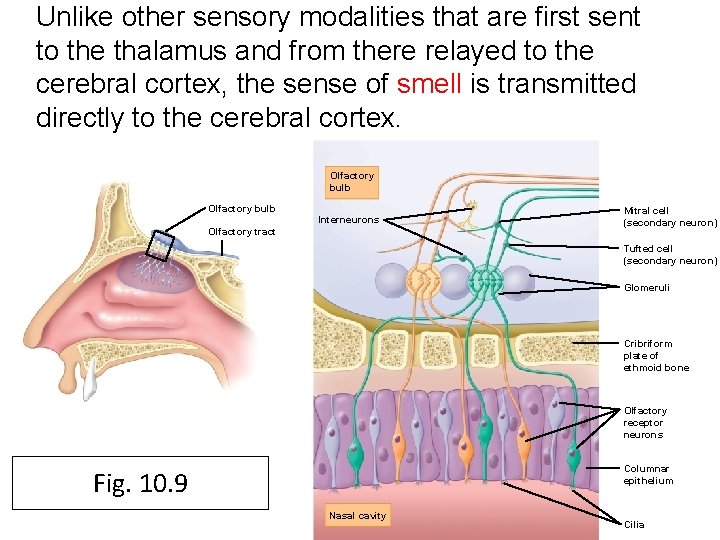
Unlike other sensory modalities that are first sent to the thalamus and from there relayed to the cerebral cortex, the sense of smell is transmitted directly to the cerebral cortex. Olfactory bulb Interneurons Olfactory tract Mitral cell (secondary neuron) Tufted cell (secondary neuron) Glomeruli Cribriform plate of ethmoid bone Olfactory receptor neurons Columnar epithelium Fig. 10. 9 Nasal cavity Cilia
• The part of the ear responsible for equilibrium is the _______________, whereas the __________ is used for hearing.
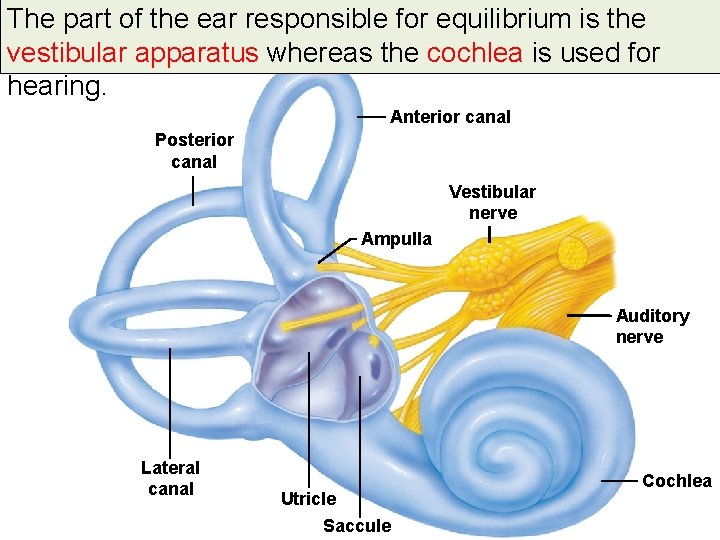
The part of the ear responsible for equilibrium is the vestibular apparatus whereas the cochlea is used for hearing. Anterior canal Posterior canal Vestibular nerve Ampulla Auditory nerve Lateral canal Utricle Saccule Cochlea
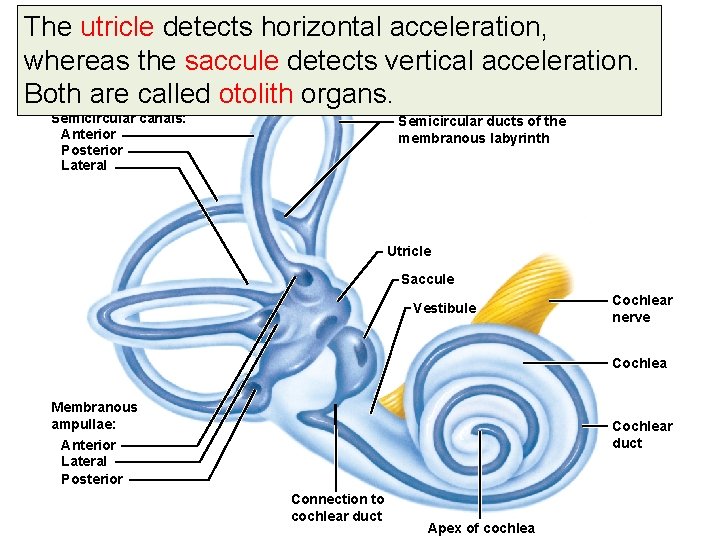
The _______ detects horizontal acceleration, whereas the _______ detects vertical acceleration. Both are called ________ organs.
The utricle detects horizontal acceleration, whereas the saccule detects vertical acceleration. Fig. 10. 13 Both are called otolith organs. Semicircular canals: Anterior Posterior Lateral Semicircular ducts of the membranous labyrinth Utricle Saccule Vestibule Cochlear nerve Cochlea Membranous ampullae: Cochlear duct Anterior Lateral Posterior Connection to cochlear duct Apex of cochlea
• A sense of angular acceleration is provided by the ________ _______.
• A sense of angular acceleration is provided by the semicircular canals.
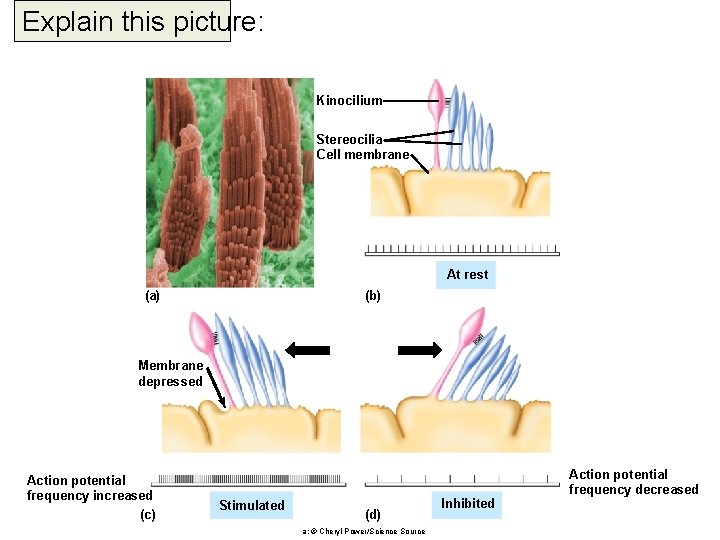
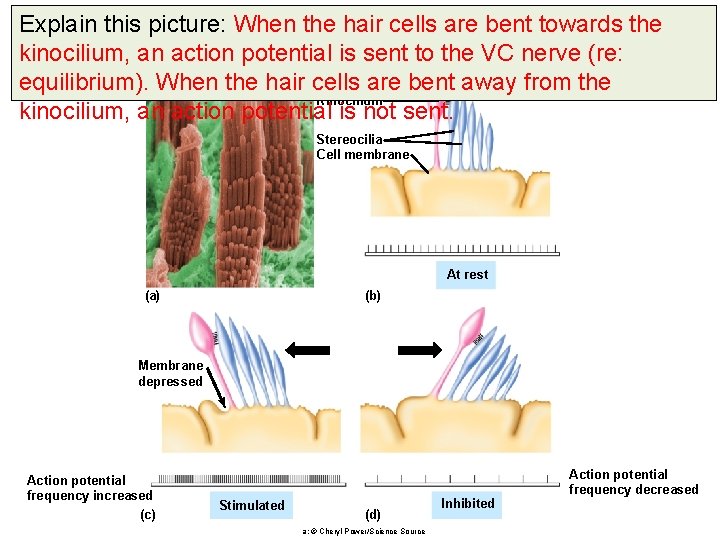
Explain this picture: Kinocilium Stereocilia Cell membrane At rest (a) (b) Membrane depressed Action potential frequency increased (c) Stimulated (d) a: © Cheryl Power/Science Source Inhibited Action potential frequency decreased
Explain this picture: When the hair cells are bent towards the kinocilium, an action potential is sent to the VC nerve (re: equilibrium). When the hair cells are bent away from the Kinocilium kinocilium, an action potential is not sent. Stereocilia Cell membrane At rest (a) (b) Membrane depressed Action potential frequency increased (c) Stimulated (d) a: © Cheryl Power/Science Source Inhibited Action potential frequency decreased
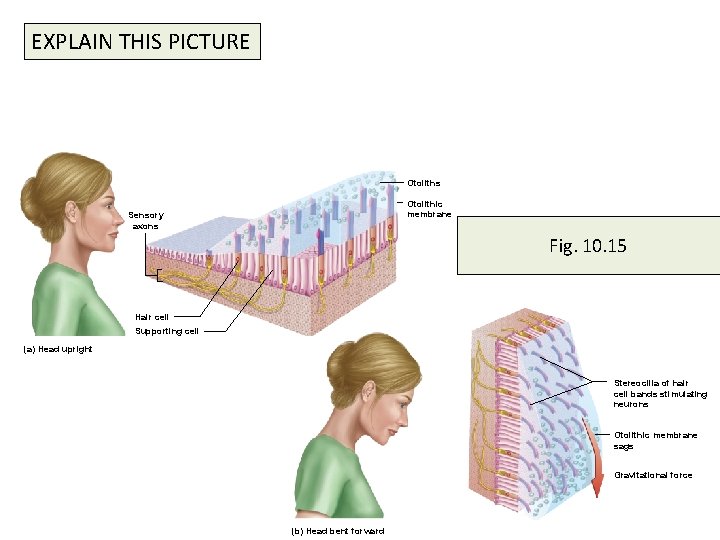
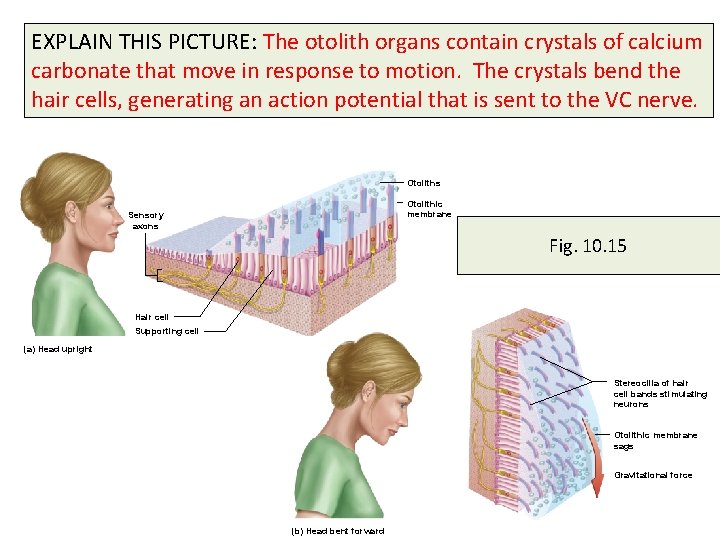
EXPLAIN THIS PICTURE Otoliths Otolithic membrane Sensory axons Fig. 10. 15 Hair cell Supporting cell (a) Head upright Stereocilia of hair cell bands stimulating neurons Otolithic membrane sags Gravitational force (b) Head bent forward
EXPLAIN THIS PICTURE: The otolith organs contain crystals of calcium carbonate that move in response to motion. The crystals bend the hair cells, generating an action potential that is sent to the VC nerve. Otoliths Otolithic membrane Sensory axons Fig. 10. 15 Hair cell Supporting cell (a) Head upright Stereocilia of hair cell bands stimulating neurons Otolithic membrane sags Gravitational force (b) Head bent forward
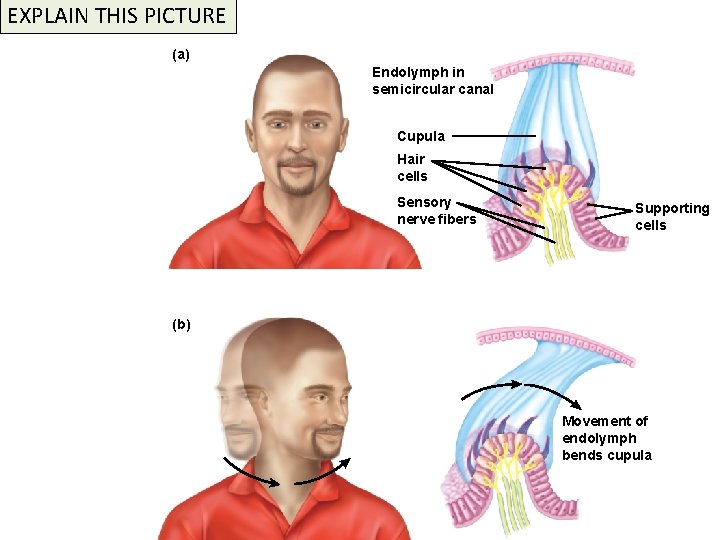
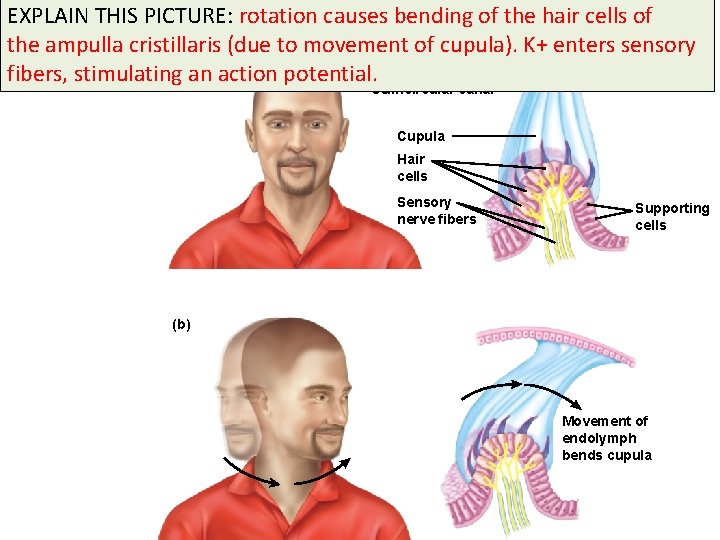
EXPLAIN THIS PICTURE (a) Endolymph in semicircular canal Cupula Hair cells Sensory nerve fibers Supporting cells (b) Movement of endolymph bends cupula
EXPLAIN THIS PICTURE: rotation causes bending of the hair cells of the ampulla cristillaris (due to movement of cupula). K+ enters sensory (a) fibers, stimulating an action potential. Endolymph in semicircular canal Cupula Hair cells Sensory nerve fibers Supporting cells (b) Movement of endolymph bends cupula
• In the vestibular apparatus, the endolymph is high in ____, and therefore it is this ion that stimulates an action potential when channels are opened, (as opposed to the influx of ions like Na+ and Cl-)
• In the vestibular apparatus, the endolymph is high in K+, and therefore it is this ion that stimulates an action potential when channels are opened, (as opposed to the influx of ions like Na+ and Cl-)
• In our lab, when we looked at a red spot for a long period of time and then we looked at a white sheet of paper, what did we see?
• In our lab, when we looked at a red spot for a long period of time and then we looked at a white sheet of paper, what did we see? Most likely a spot of a different color (of colors whose photoreceptors had not been bleached).
• Discuss the evolution of cones and color vision
• Discuss the evolution of cones and color vision • See page 303. • Note the sentence, “scientists believe that our trichromatic vision evolved in anancestral species with dichromatic vision aft er the gene for the M cone pigment duplicated on the X chromosome. The duplicate could then have given rise to a third type of cone, the L cone, which absorbs red. ”
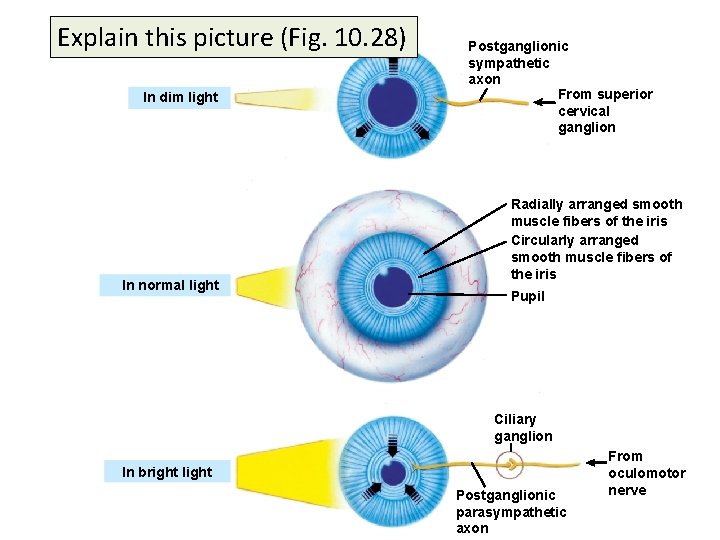
Explain this picture (Fig. 10. 28) In dim light In normal light Postganglionic sympathetic axon From superior cervical ganglion Radially arranged smooth muscle fibers of the iris Circularly arranged smooth muscle fibers of the iris Pupil Ciliary ganglion In bright light Postganglionic parasympathetic axon From oculomotor nerve
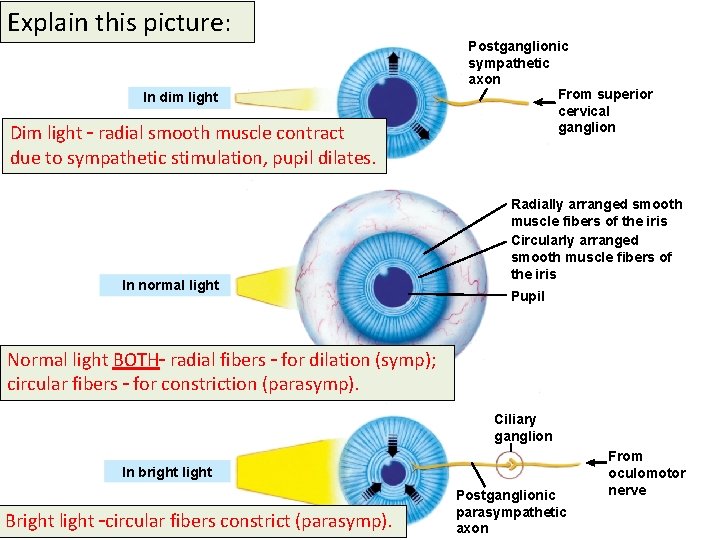
Explain this picture: In dim light Dim light – radial smooth muscle contract due to sympathetic stimulation, pupil dilates. In normal light Postganglionic sympathetic axon From superior cervical ganglion Radially arranged smooth muscle fibers of the iris Circularly arranged smooth muscle fibers of the iris Pupil Normal light BOTH– radial fibers – for dilation (symp); circular fibers – for constriction (parasymp). Ciliary ganglion In bright light Bright light –circular fibers constrict (parasymp). Postganglionic parasympathetic axon From oculomotor nerve
• DEFINE: accommodation
• DEFINE: accommodation – the ability of the eyes to keep the image focused on the retina as the distance between the eyes and the object varies. • Accommodation is due to the muscles that pull on the lens, which is involved in focusing.
• Define: refraction
• Define: refraction • Refraction is the differential bending of light when it passes through substances of different densities, such as air, the cornea, or the lens.
• Define: astigmatism
• Define: astigmatism Astigmatism refers to a blurry vision when light enters the eye from different areas. This is due to the unequal curvature of the cornea and/or lens so that light does not always focus on the retina.
CH 10 Food that is salty causes ____ to enter gustatory cells and stimulate the release of a neurotransmitter.
CH 10 Food that is salty causes ____Na+_ to enter gustatory cells and stimulate the release of a neurotransmitter.
• Discuss how light is transduced into an action potential in the eye. Name all cell types involved. Include events at the photoreceptor membrane and disc, and include the relevance of the bleaching reaction. Your answer must not be more than 10 sentences. Please number them.
• Discuss how light is transduced into an action potential in the eye. Name all cell types involved. Include events at the photoreceptor membrane and disc, and include the relevance of the bleaching reaction. Your answer must not be more than 10 sentences. Please number them. • 1. When light enters the eye, it goes to the retina where photreceptors are located. 2. Light causes the dissociation of 11 -cis retinal from photopsin. 3. This causes G proteins to dissociate and activate a phosphodiesterase, creating GMP. 4. sodium channels close, resulting in hyperpolarization. 5. less inhibitory neurotransmitter is released onto the bipolar cells. 6. bipolar cells activate to send an action potential to the optic nerve…. What’s the bleaching reaction? Did I forget that?
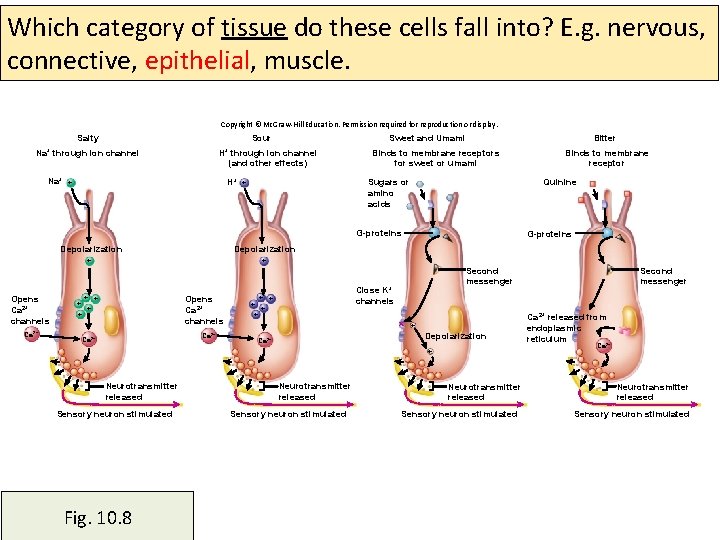
Which category of tissue do these cells fall into? E. g. nervous, connective, epithelial, muscle. Copyright © Mc. Graw-Hill Education. Permission required for reproduction or display. Salty Sour Na+ through ion channel Na+ Sweet and Umami H+ through ion channel (and other effects) H+ + Bitter Binds to membrane receptors for sweet or umami Sugars or amino acids + Quinine G-proteins Opens Ca 2+ channels Ca 2+ Depolarization + + + + Opens Ca 2+ channels Ca 2+ G-proteins Second messenger Close K+ channels + + + x + Depolarization Ca 2+ Sensory neuron stimulated Fig. 10. 8 Neurotransmitter released Sensory neuron stimulated Second messenger Ca 2+ released from endoplasmic reticulum 2+ Ca + Neurotransmitter released Binds to membrane receptor Neurotransmitter released Sensory neuron stimulated
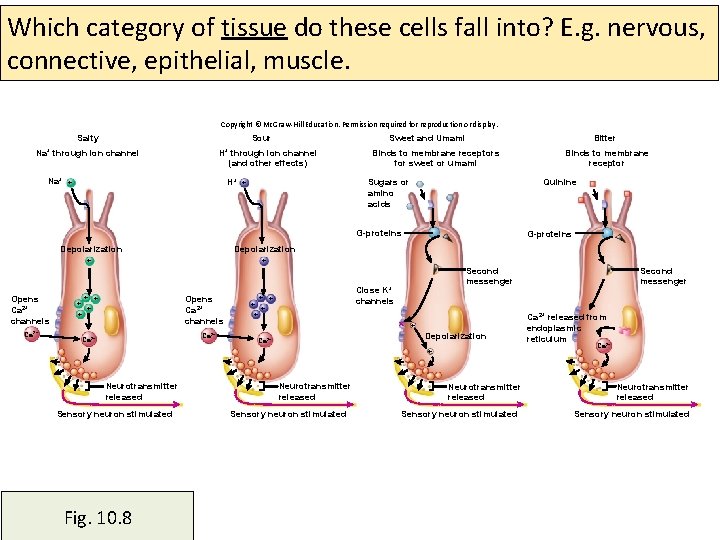
Which category of tissue do these cells fall into? E. g. nervous, connective, epithelial, muscle. Copyright © Mc. Graw-Hill Education. Permission required for reproduction or display. Salty Sour Na+ through ion channel Na+ Sweet and Umami H+ through ion channel (and other effects) H+ + Bitter Binds to membrane receptors for sweet or umami Sugars or amino acids + Quinine G-proteins Opens Ca 2+ channels Ca 2+ Depolarization + + + + Opens Ca 2+ channels Ca 2+ G-proteins Second messenger Close K+ channels + + + x + Depolarization Ca 2+ Sensory neuron stimulated Fig. 10. 8 Neurotransmitter released Sensory neuron stimulated Second messenger Ca 2+ released from endoplasmic reticulum 2+ Ca + Neurotransmitter released Binds to membrane receptor Neurotransmitter released Sensory neuron stimulated