
Review representation reflective intentional constructionist process of meaning
![Part Four: Prison 3. The Carceral [293 -308] XLI. Mettray: discplinary model at the](https://slidetodoc.com/presentation_image_h2/73db0ae3943617731a8f82f21928fcab/image-26.jpg "Part Four: Prison 3. The Carceral [293 -308] XLI. Mettray: discplinary model at the")
![The Carceral(2) XLII. "carceral archipelago" [1640/297] A. discipline inside and outside the prison B.](https://slidetodoc.com/presentation_image_h2/73db0ae3943617731a8f82f21928fcab/image-27.jpg "The Carceral(2) XLII. \"carceral archipelago\" [1640/297] A. discipline inside and outside the prison B.")
![The Carceral(3): Power & knowledge XLII. "carceral archipelago" [1640/297] B. results of this spread](https://slidetodoc.com/presentation_image_h2/73db0ae3943617731a8f82f21928fcab/image-28.jpg "The Carceral(3): Power & knowledge XLII. \"carceral archipelago\" [1640/297] B. results of this spread")
- Slides: 42
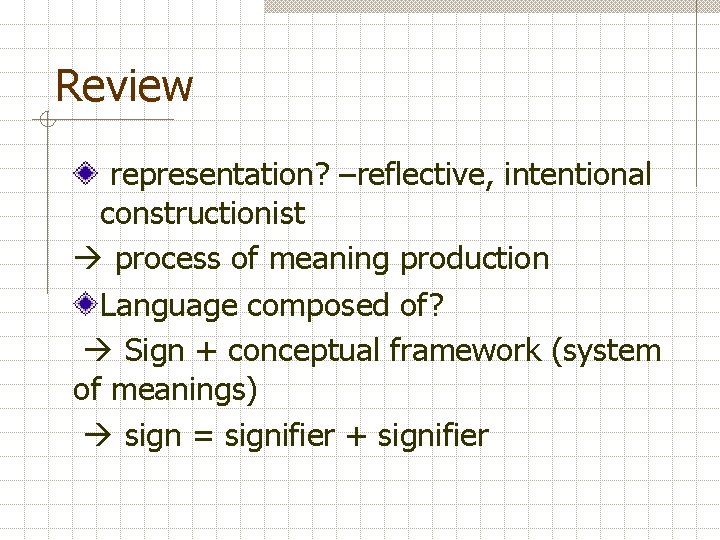
Review representation? –reflective, intentional constructionist process of meaning production Language composed of? Sign + conceptual framework (system of meanings) sign = signifier + signifier
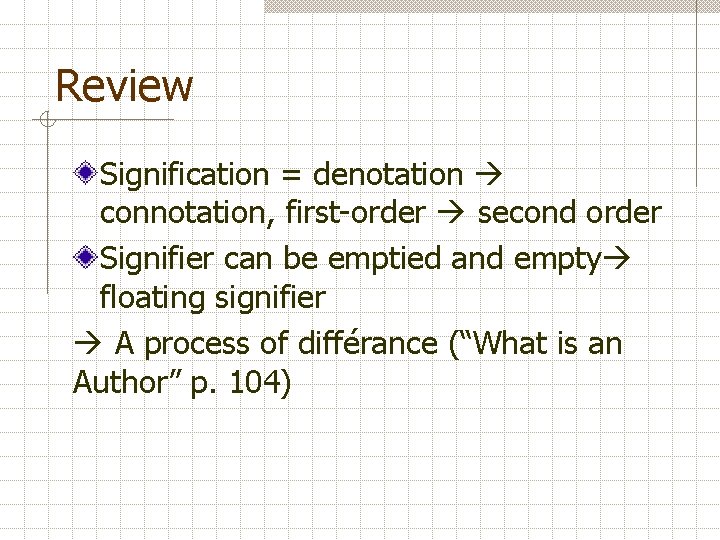
Review Signification = denotation connotation, first-order second order Signifier can be emptied and empty floating signifier A process of différance (“What is an Author” p. 104)
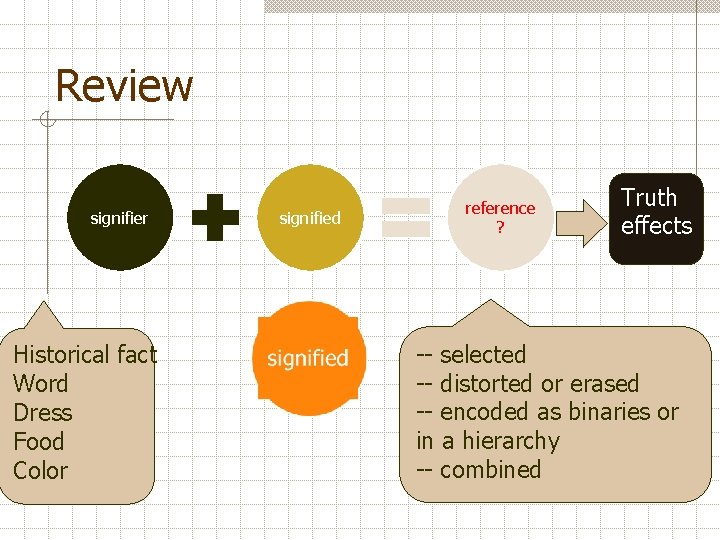
Review signifier Historical fact Word Dress Food Color signified reference ? Truth effects -- selected -- distorted or erased -- encoded as binaries or in a hierarchy -- combined
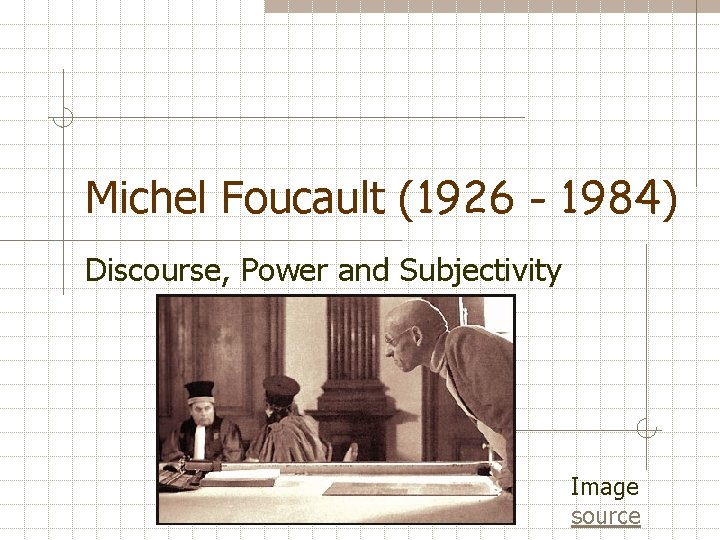
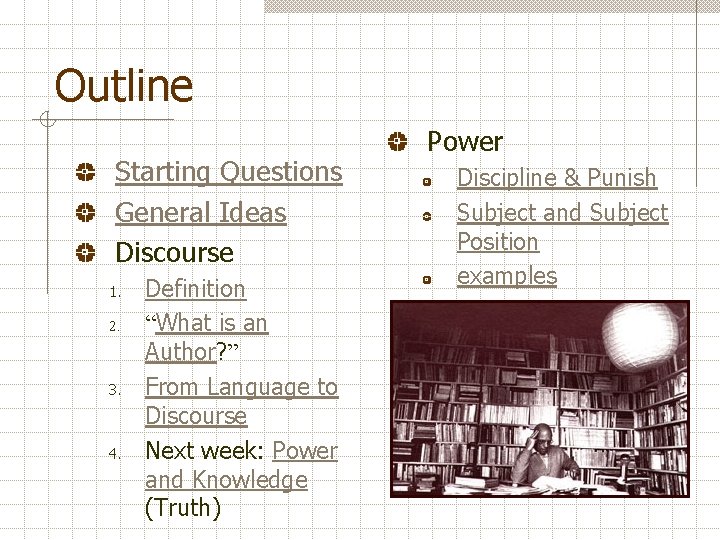
Michel Foucault (1926 - 1984) Discourse, Power and Subjectivity Image source
Outline Starting Questions General Ideas Discourse 1. 2. 3. 4. Definition “What is an Author? ” From Language to Discourse Next week: Power and Knowledge (Truth) Power Discipline & Punish Subject and Subject Position examples
Starting Questions 1: Discourse, “Truth” & Power What is discourse and how is an individual (such as an author or a reader) related to a discourse? (WR 44; VM 142) Do you agree with Foucault’s argument that --"nothing has any meaning outside of discourse“?
Starting Questions 1: Discourse, “Truth” & Power What discourse, or its “the regime of truth, ” makes the following statements valid? Madness is a mental illness. Masturbation causes sexual impotence. sodomy = gay = homosexual = queer = 怪胎 next week: What are the examples of society’s carceral system? How does it function? next week: Do we question disciplinary powers such those of the teachers’, judge’s and doctors’? Or to what extent should they be questioned?
Foucault: General Ideas Two periods: 1) Archaeology of knowledge-- rules and strategies formation of subjectpositions, knowledge and episteme. (e. g. “Man” as a product of modernity. ) “What is an Author” – 1969 –transitional article 2) Genealogy of power/knowledge – extends his discussions to a variety of institutions and non-discursive practices; mutual support of power and knowledge. e. g. Discipline and Punish, History of Sexuality.
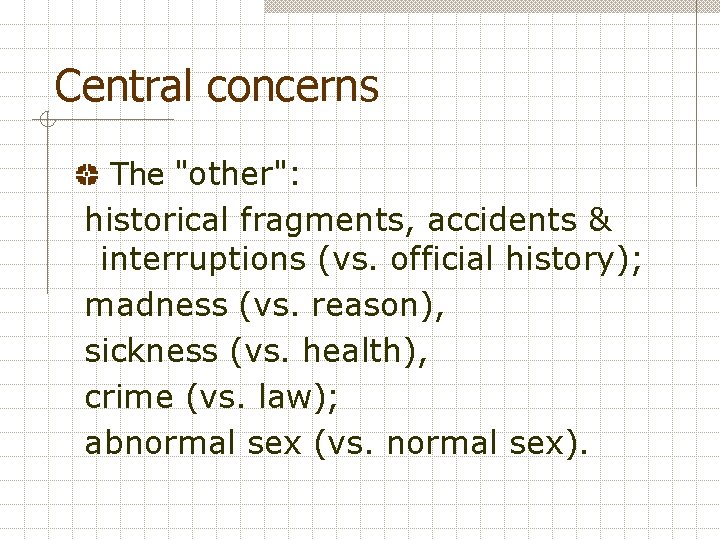
Central concerns The "other": historical fragments, accidents & interruptions (vs. official history); madness (vs. reason), sickness (vs. health), crime (vs. law); abnormal sex (vs. normal sex).
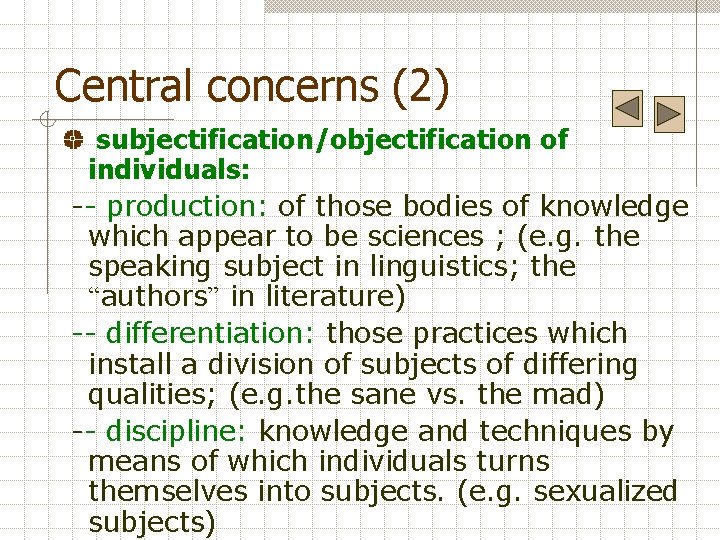
Central concerns (2) subjectification/objectification of individuals: -- production: of those bodies of knowledge which appear to be sciences ; (e. g. the speaking subject in linguistics; the “authors” in literature) -- differentiation: those practices which install a division of subjects of differing qualities; (e. g. the sane vs. the mad) -- discipline: knowledge and techniques by means of which individuals turns themselves into subjects. (e. g. sexualized subjects)
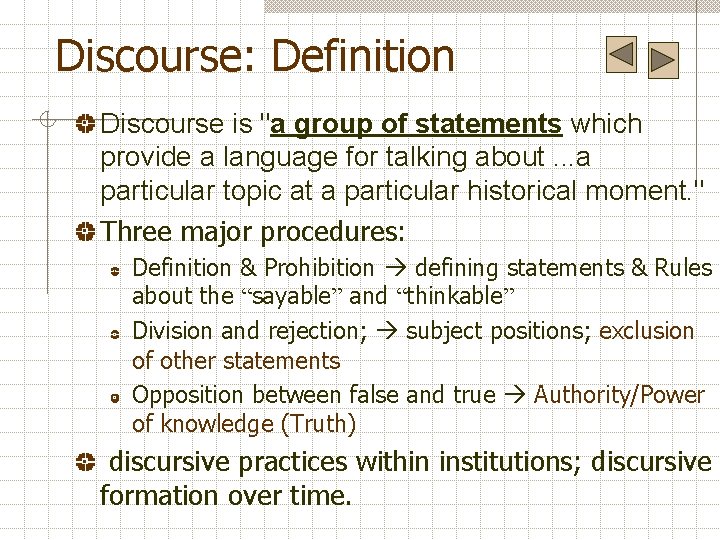
Discourse: Definition Discourse is "a group of statements which provide a language for talking about. . . a particular topic at a particular historical moment. " Three major procedures: Definition & Prohibition defining statements & Rules about the “sayable” and “thinkable” Division and rejection; subject positions; exclusion of other statements Opposition between false and true Authority/Power of knowledge (Truth) discursive practices within institutions; discursive formation over time.
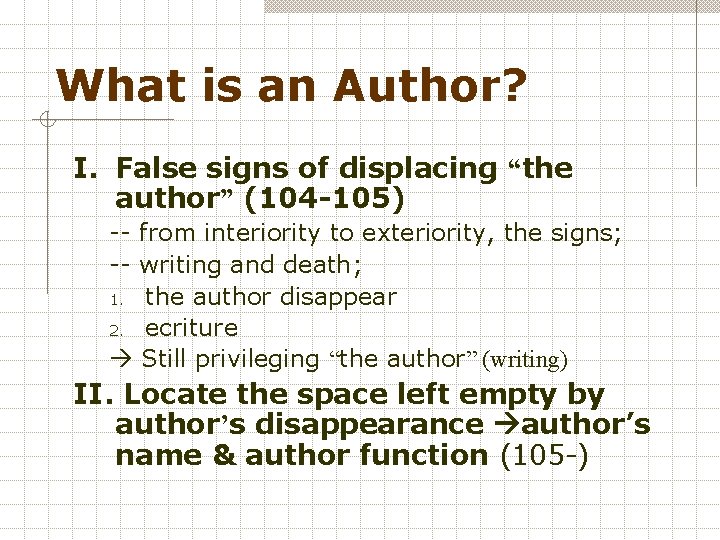
What is an Author? I. False signs of displacing “the author” (104 -105) -- from interiority to exteriority, the signs; -- writing and death; 1. the author disappear 2. ecriture Still privileging “the author” (writing) II. Locate the space left empty by author’s disappearance author’s name & author function (105 -)
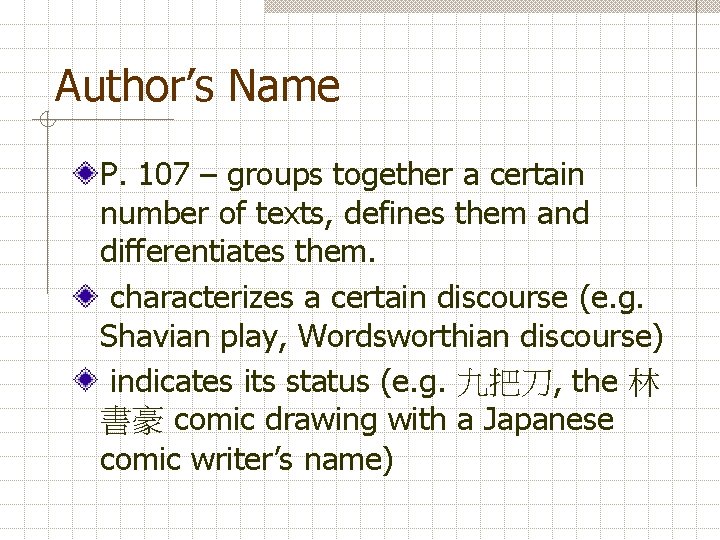
Author’s Name P. 107 – groups together a certain number of texts, defines them and differentiates them. characterizes a certain discourse (e. g. Shavian play, Wordsworthian discourse) indicates its status (e. g. 九把刀, the 林 書豪 comic drawing with a Japanese comic writer’s name)
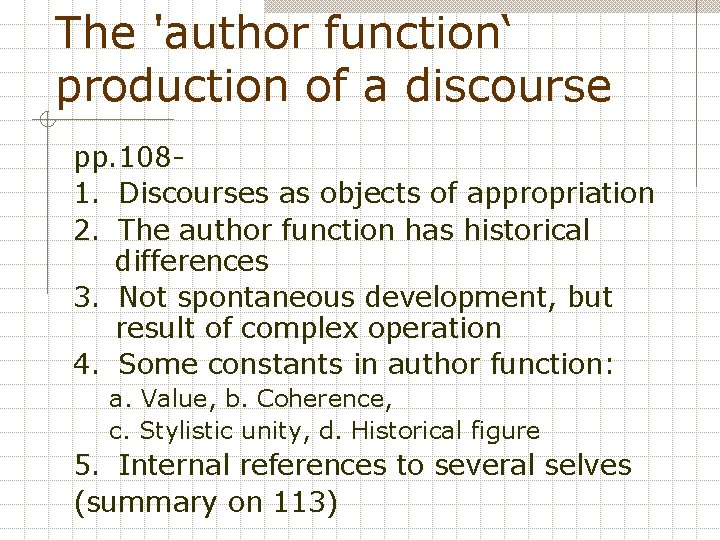
The 'author function‘ production of a discourse pp. 1081. Discourses as objects of appropriation 2. The author function has historical differences 3. Not spontaneous development, but result of complex operation 4. Some constants in author function: a. Value, b. Coherence, c. Stylistic unity, d. Historical figure 5. Internal references to several selves (summary on 113)
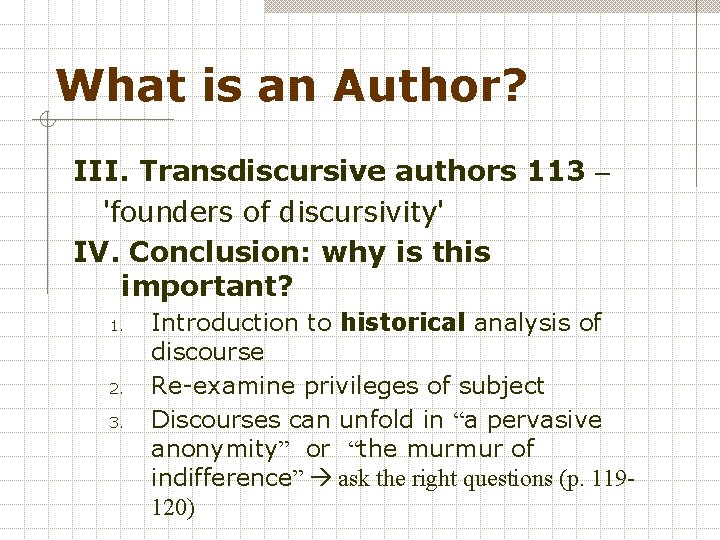
What is an Author? III. Transdiscursive authors 113 – 'founders of discursivity' IV. Conclusion: why is this important? 1. 2. 3. Introduction to historical analysis of discourse Re-examine privileges of subject Discourses can unfold in “a pervasive anonymity” or “the murmur of indifference” ask the right questions (p. 119120)
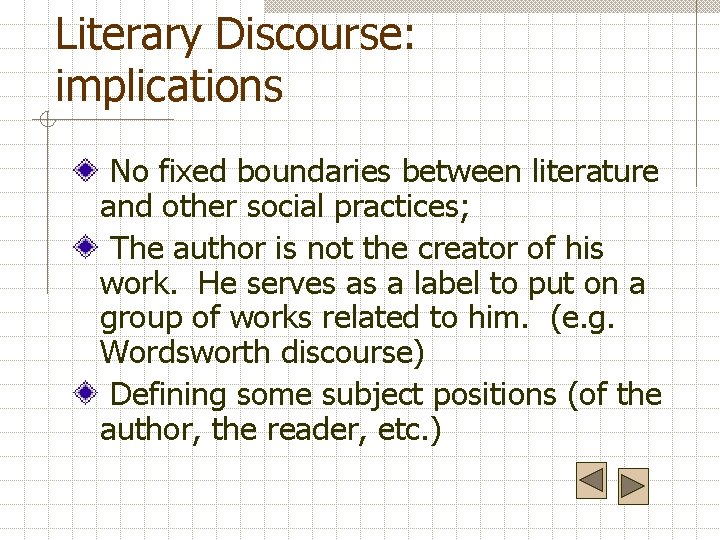
Literary Discourse: implications No fixed boundaries between literature and other social practices; The author is not the creator of his work. He serves as a label to put on a group of works related to him. (e. g. Wordsworth discourse) Defining some subject positions (of the author, the reader, etc. )
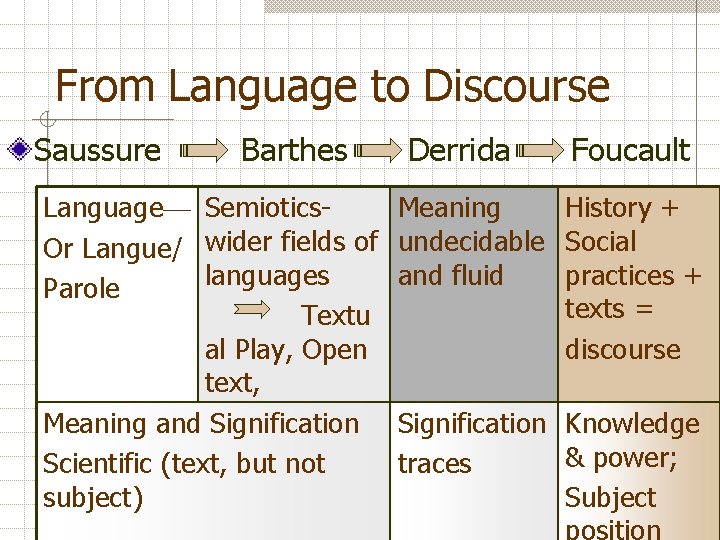
From Language to Discourse Saussure Barthes Derrida Language— Semiotics. Meaning Or Langue/ wider fields of undecidable languages and fluid Parole Textu al Play, Open text, Meaning and Signification Scientific (text, but not traces subject) Foucault History + Social practices + texts = discourse Knowledge & power; Subject
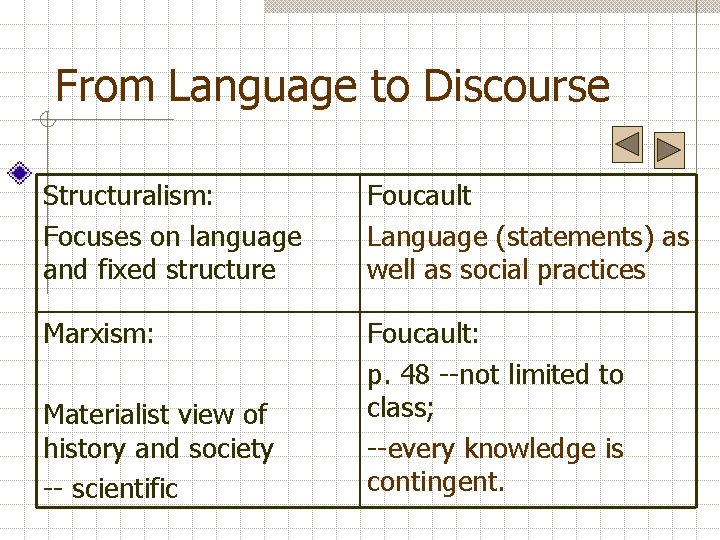
From Language to Discourse Structuralism: Focuses on language and fixed structure Foucault Language (statements) as well as social practices Marxism: Foucault: p. 48 --not limited to class; --every knowledge is contingent. Materialist view of history and society -- scientific
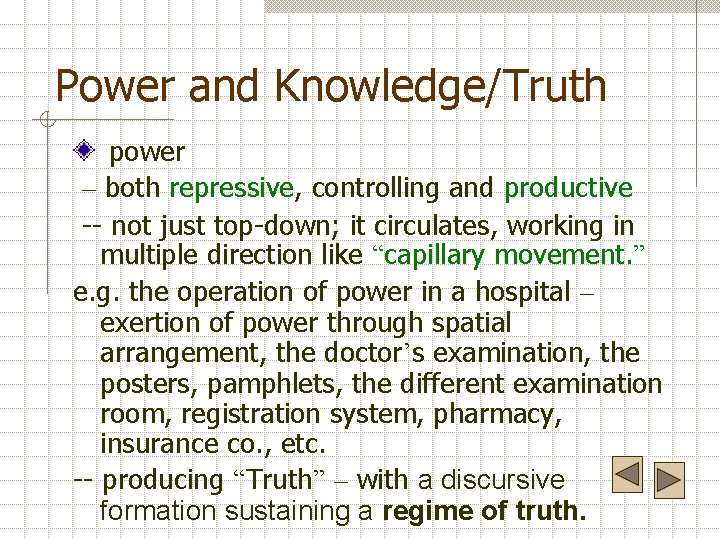
Power and Knowledge/Truth power – both repressive, controlling and productive -- not just top-down; it circulates, working in multiple direction like “capillary movement. ” e. g. the operation of power in a hospital – exertion of power through spatial arrangement, the doctor’s examination, the posters, pamphlets, the different examination room, registration system, pharmacy, insurance co. , etc. -- producing “Truth” – with a discursive formation sustaining a regime of truth.
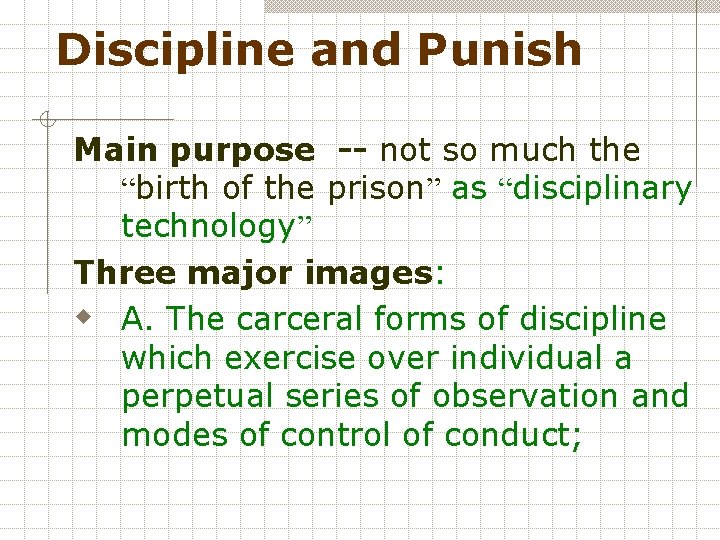
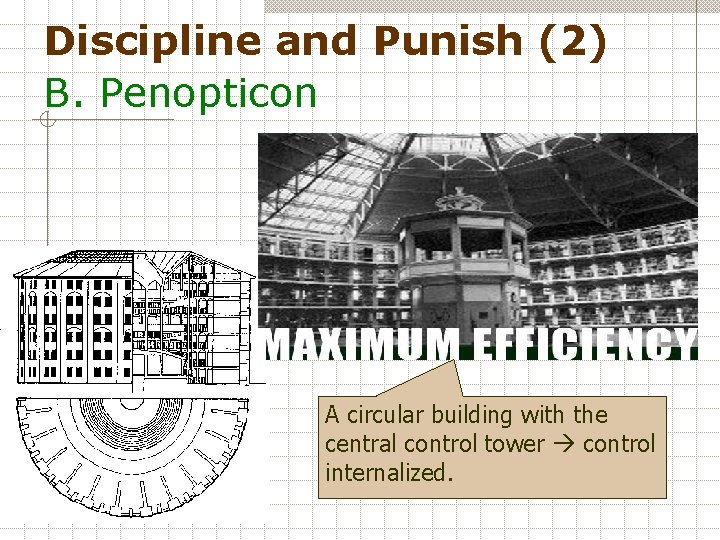
Discipline and Punish Main purpose -- not so much the “birth of the prison” as “disciplinary technology” Three major images: w A. The carceral forms of discipline which exercise over individual a perpetual series of observation and modes of control of conduct;
Discipline and Punish (2) B. Penopticon A circular building with the central control tower control internalized.
Discipline and Punish (3) C. Disciplinary Society C. Carceral power opens up the entire fabric of society to a normalizing regulation. (Miller 200 -01)
Discipline and Punish 4 Parts: 1. Torture -- soul – “born out of methods of punishment, supervision and constraint”; “the prison of the body” (29 -30) -- torture -- part of truth-production mechanism (35 -37)
Discipline and Punish 4 Parts: 2. Punishment -- gentler forms: public works and incarceration 3. Discipline 1. Docile Bodies (135 -69) -- The aim of disciplinary technology is to forge “a docile body that may be subjected, used, transformed and improved” (136)
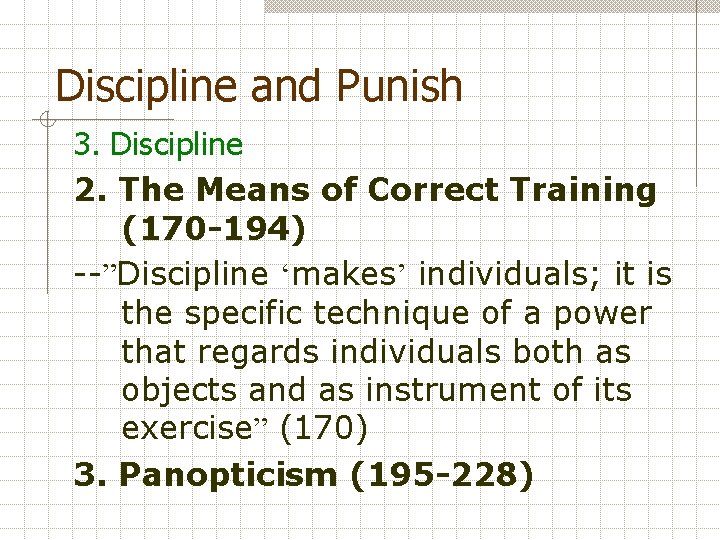
Discipline and Punish 3. Discipline 2. The Means of Correct Training (170 -194) --”Discipline ‘makes’ individuals; it is the specific technique of a power that regards individuals both as objects and as instrument of its exercise” (170) 3. Panopticism (195 -228)
Part Four: Prison 3. The Carceral [293 -308] XLI. Mettray: discplinary model at the extreme [1637/292 -96] A. all the coercive technologies of behavior [292 -93] B. technicians of behavior [294 -95] C. specificity of Mettray training [295]
The Carceral(2) XLII. "carceral archipelago" [1640/297] A. discipline inside and outside the prison B. results of this spread 1. continuity of offense/deviation from norm[1640] 2. recruitment of disciplinary "careers“[1641] there is no outside 1642 3. making the power natural and legitimate, lowering threshold of penality [301 -03]
The Carceral(3): Power & knowledge XLII. "carceral archipelago" [1640/297] B. results of this spread 4. the norm [1644/304]: a mixture of legality and nature, the prescription and constitution. p. 256 – power + sciences of man -- “The delinquent makes it possible to join [moral and political monsters and juridical subjects] and to constitute under the authority of medicine, psychology or criminology, an individual in whom the offender of the law and the object of
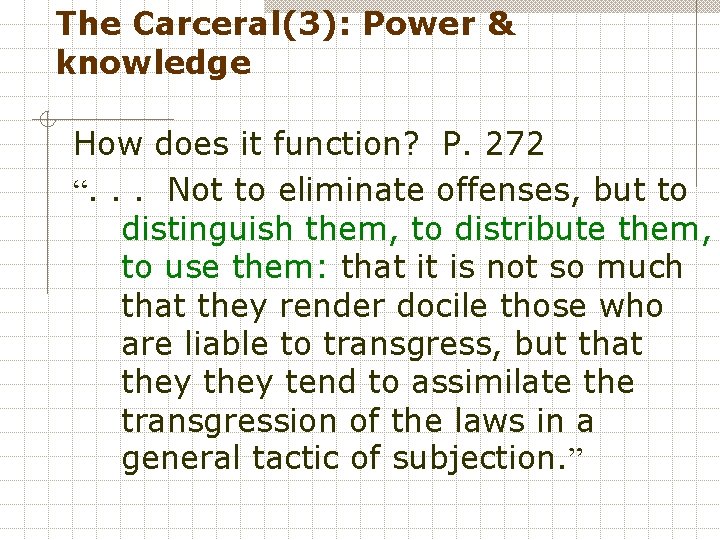
The Carceral(3): Power & knowledge How does it function? P. 272 “. . . Not to eliminate offenses, but to distinguish them, to distribute them, to use them: that it is not so much that they render docile those who are liable to transgress, but that they tend to assimilate the transgression of the laws in a general tactic of subjection. ”
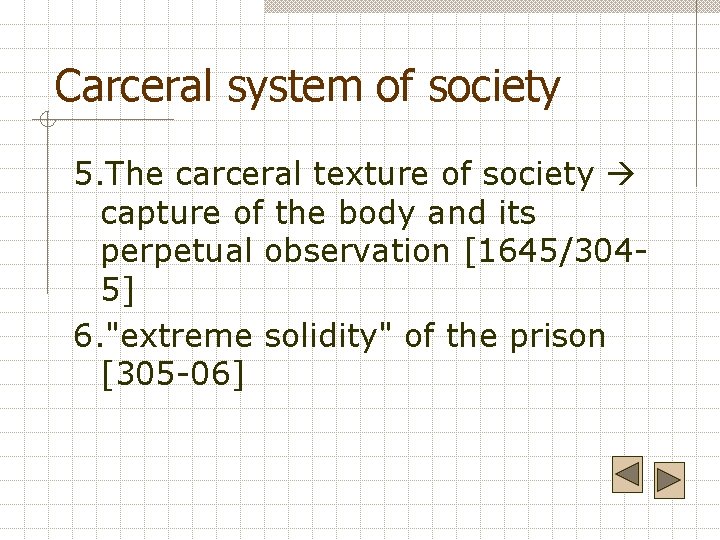
Carceral system of society 5. The carceral texture of society capture of the body and its perpetual observation [1645/3045] 6. "extreme solidity" of the prison [305 -06]
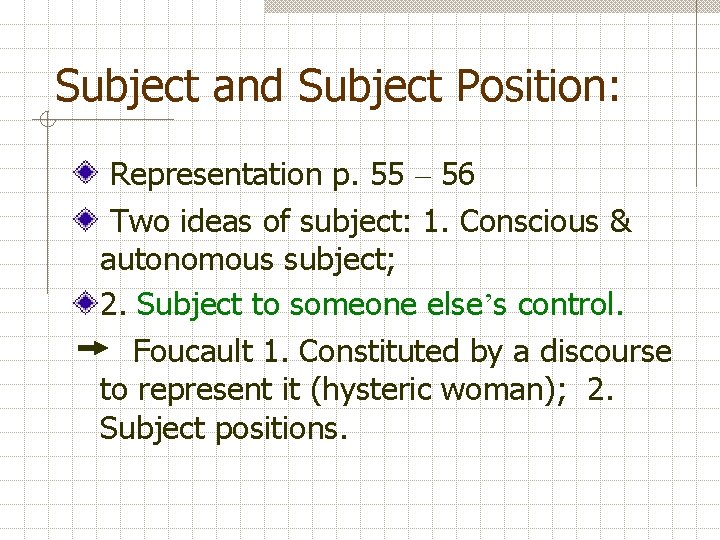
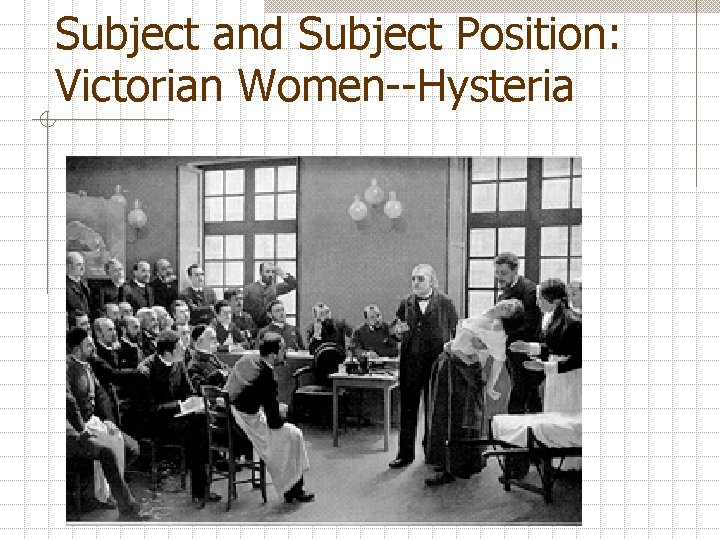
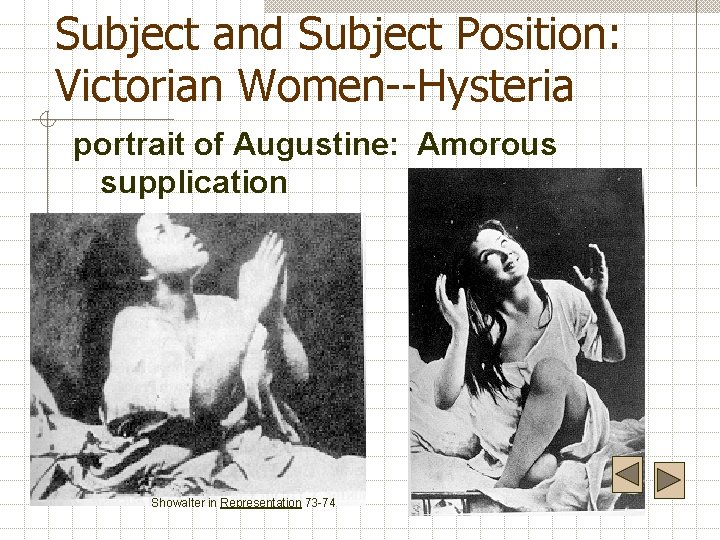
Subject and Subject Position: Representation p. 55 – 56 Two ideas of subject: 1. Conscious & autonomous subject; 2. Subject to someone else’s control. Foucault 1. Constituted by a discourse to represent it (hysteric woman); 2. Subject positions.
Subject and Subject Position: Victorian Women--Hysteria
Subject and Subject Position: Victorian Women--Hysteria portrait of Augustine: Amorous supplication Showalter in Representation 73 -74
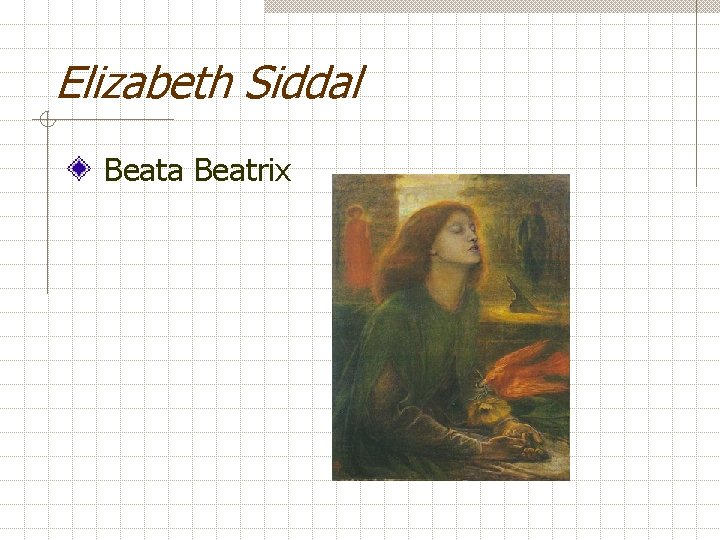
Elizabeth Siddal Beata Beatrix
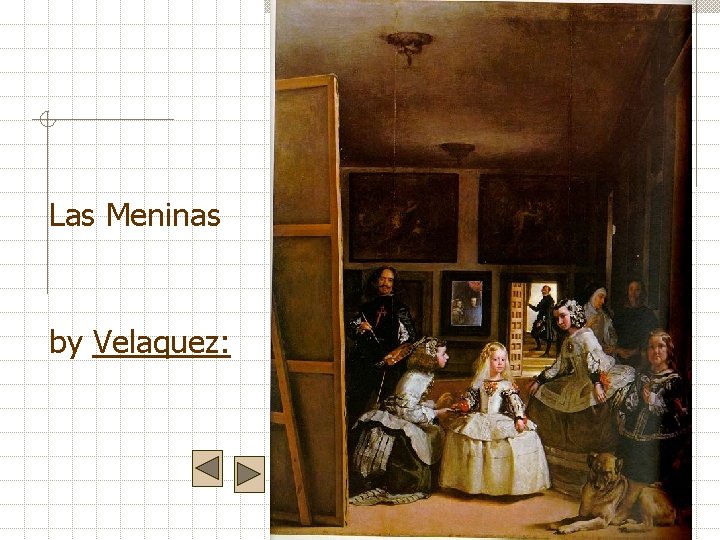
Las Meninas by Velaquez:
More Examples Jan Van Eyck Arnolfini Wedding Portrait w http: //artchronicler. wordpress. com/2010/02/15 /jan-van-eyck-and-the-arnolfini-weddingportrait-3/ Myths of Sexuality: Representations of Women in Victorian Britain
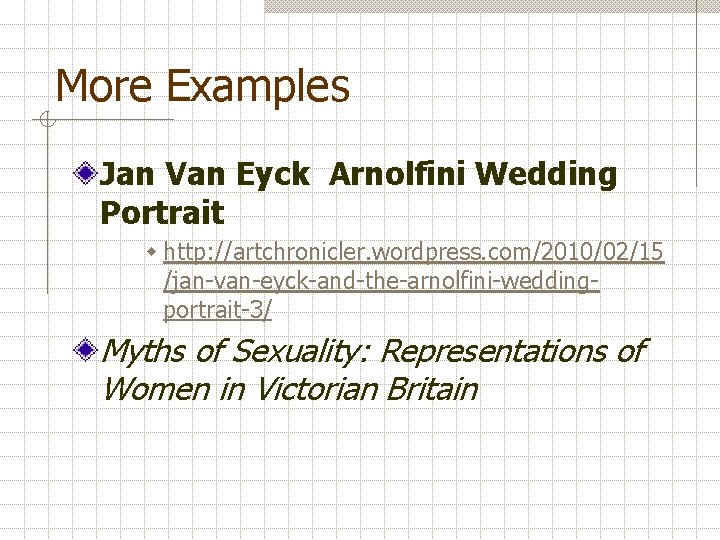
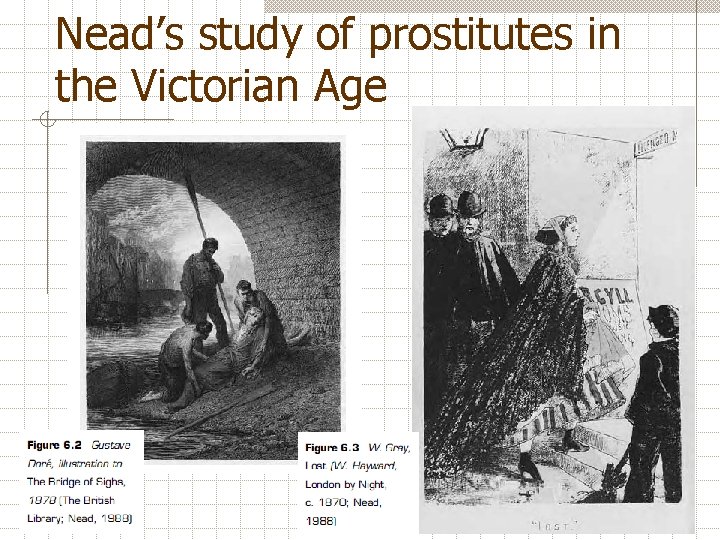
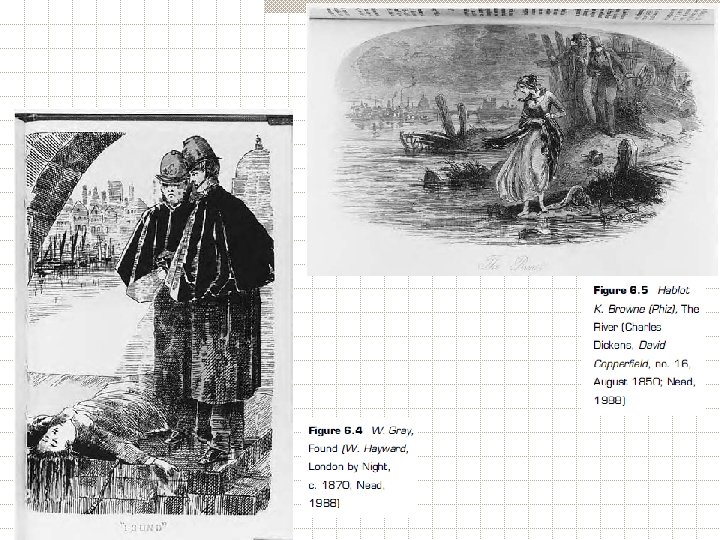
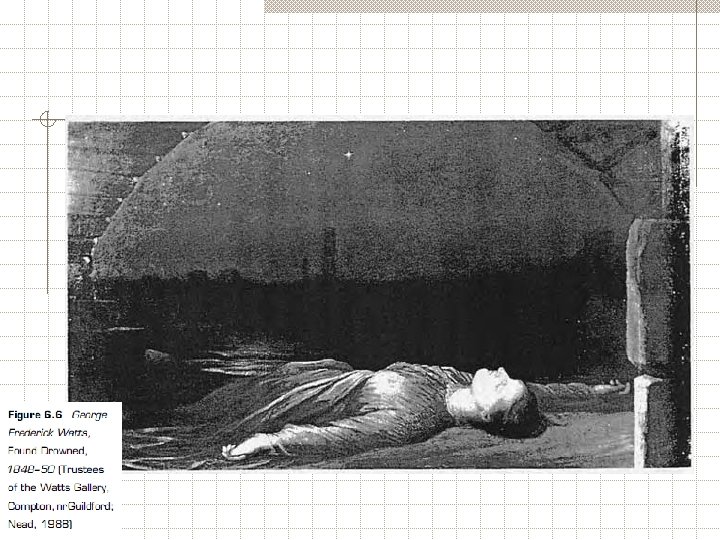
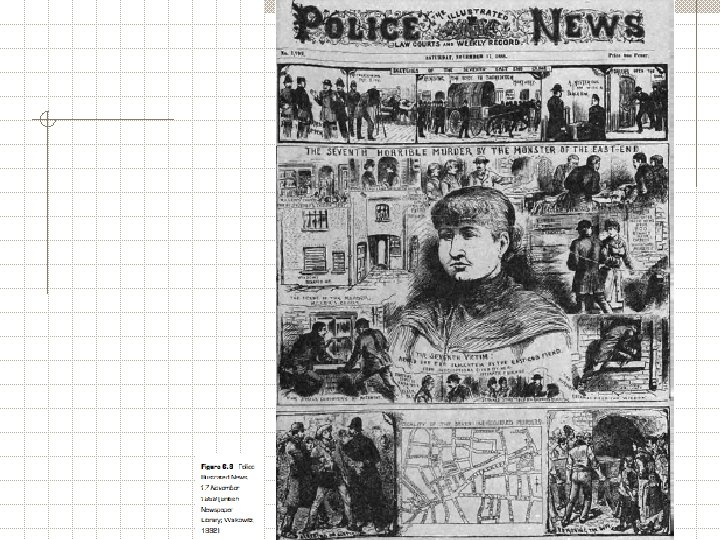
Nead’s study of prostitutes in the Victorian Age
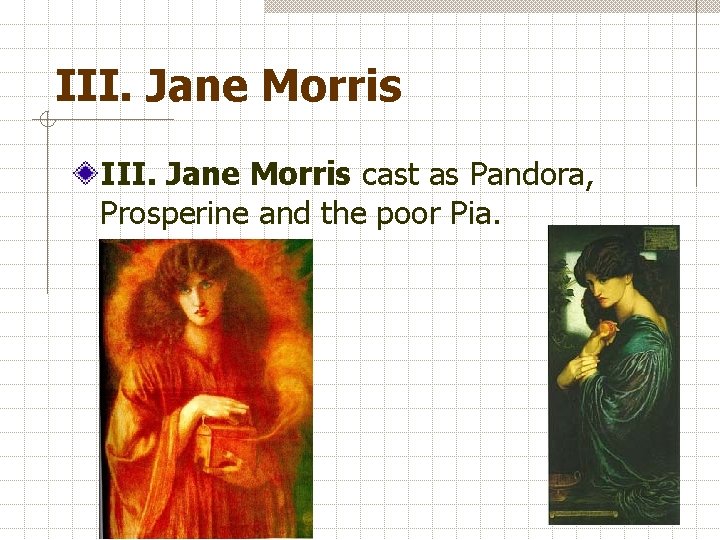
III. Jane Morris cast as Pandora, Prosperine and the poor Pia.
References Miller, Peter. Domination & Power. Routledge: 12/01/1987. Representation: Cultural Representations and Signifying Practices. Ed. Stuart Hall. London: Sage, 1997 Nead, L. (1988) Myths of Sexuality: Representations of Women in Victorian Britain. Oxford: Basil. . .