
Review Rate Equation for Enzymatic Reaction L 11
- Slides: 27
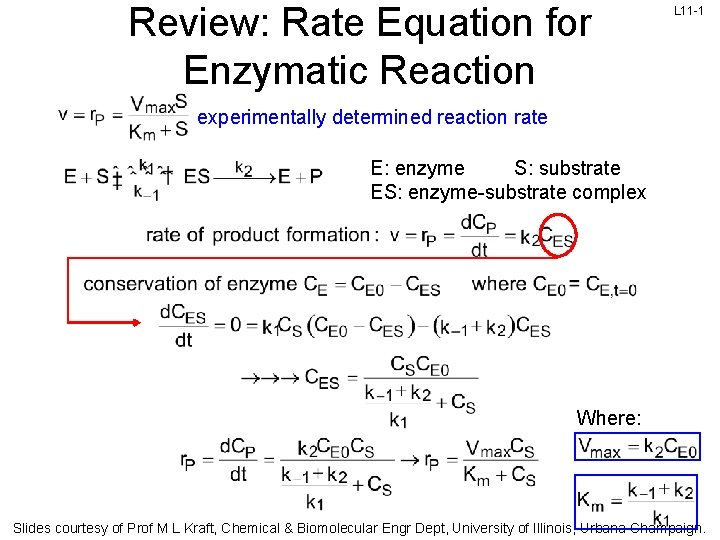
Review: Rate Equation for Enzymatic Reaction L 11 -1 experimentally determined reaction rate E: enzyme S: substrate ES: enzyme-substrate complex Where: Slides courtesy of Prof M L Kraft, Chemical & Biomolecular Engr Dept, University of Illinois, Urbana-Champaign.
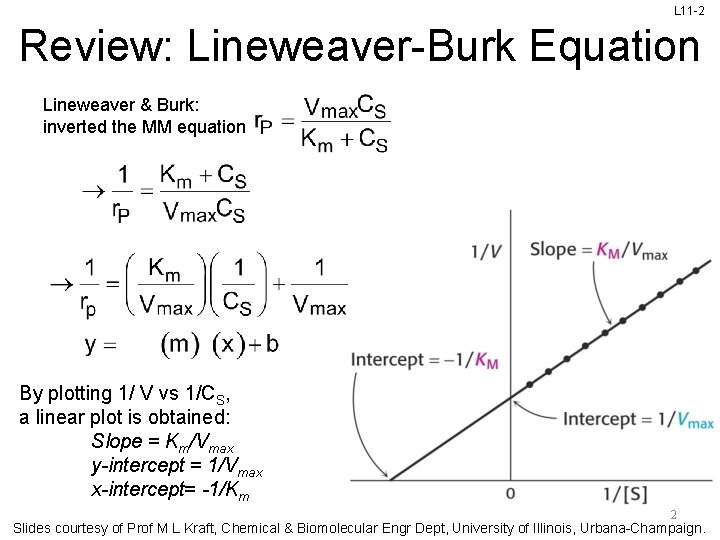
L 11 -2 Review: Lineweaver-Burk Equation Lineweaver & Burk: inverted the MM equation By plotting 1/ V vs 1/CS, a linear plot is obtained: Slope = Km/Vmax y-intercept = 1/Vmax x-intercept= -1/Km 2 Slides courtesy of Prof M L Kraft, Chemical & Biomolecular Engr Dept, University of Illinois, Urbana-Champaign.
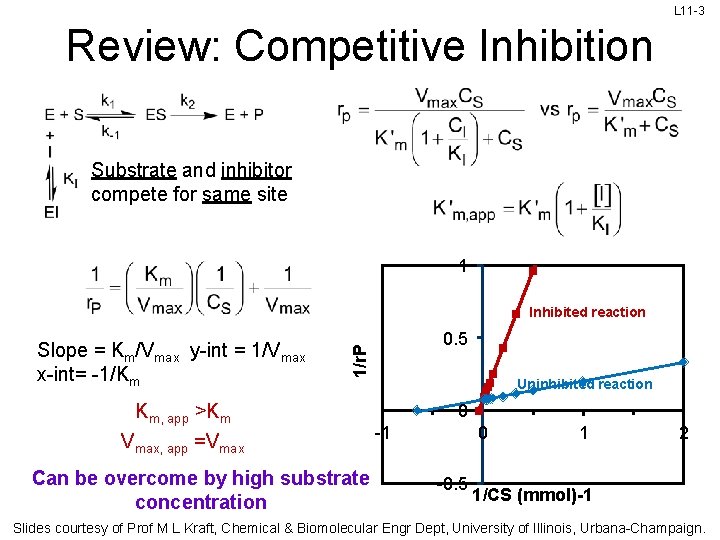
L 11 -3 Review: Competitive Inhibition Substrate and inhibitor compete for same site 1 Inhibited reaction 0. 5 1/r. P Slope = Km/Vmax y-int = 1/Vmax x-int= -1/Km Km, app >Km Vmax, app =Vmax Can be overcome by high substrate concentration Uninhibited reaction 0 -1 0 -0. 5 1 2 1/CS (mmol)-1 Slides courtesy of Prof M L Kraft, Chemical & Biomolecular Engr Dept, University of Illinois, Urbana-Champaign.
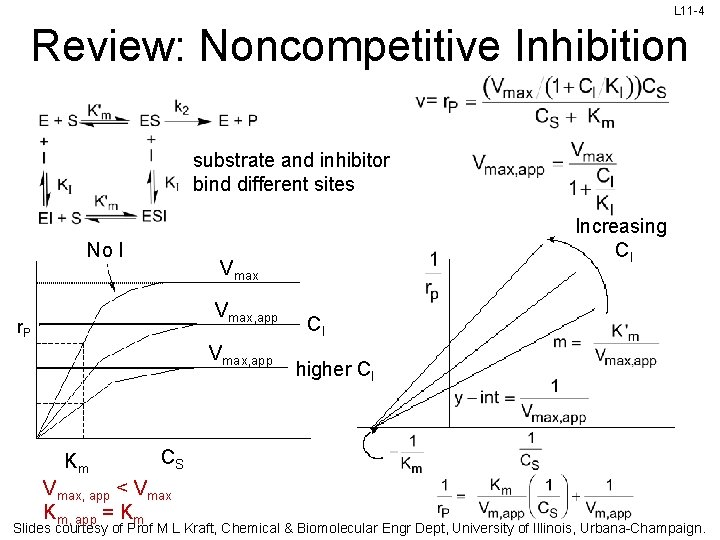
L 11 -4 Review: Noncompetitive Inhibition substrate and inhibitor bind different sites No I Vmax, app r. P Vmax, app Km Increasing CI CI higher CI CS Vmax, app < Vmax Km, app = Km Slides courtesy of Prof M L Kraft, Chemical & Biomolecular Engr Dept, University of Illinois, Urbana-Champaign.
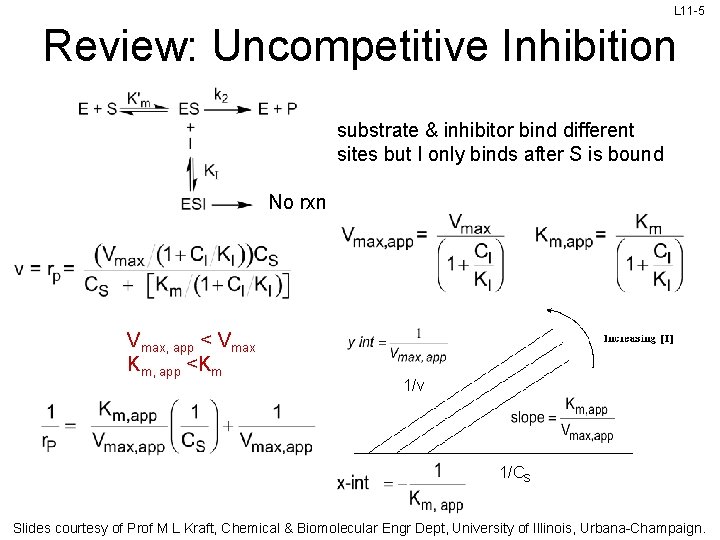
L 11 -5 Review: Uncompetitive Inhibition substrate & inhibitor bind different sites but I only binds after S is bound No rxn Vmax, app < Vmax Km, app <Km 1/v 1/CS Slides courtesy of Prof M L Kraft, Chemical & Biomolecular Engr Dept, University of Illinois, Urbana-Champaign.
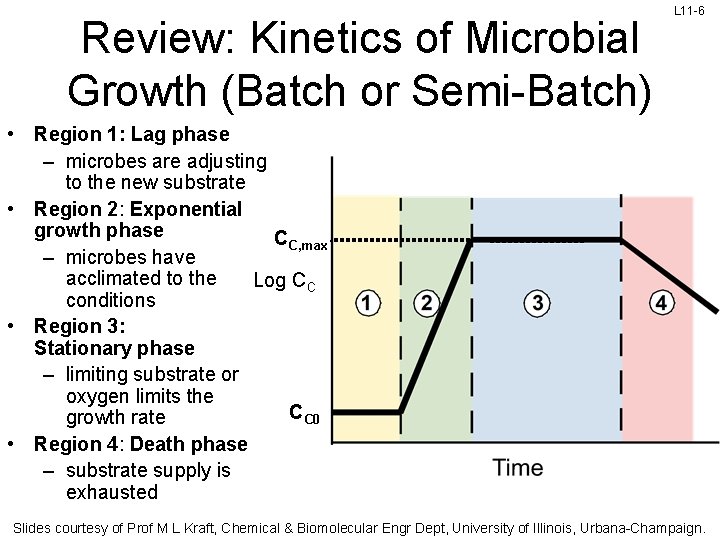
Review: Kinetics of Microbial Growth (Batch or Semi-Batch) L 11 -6 • Region 1: Lag phase – microbes are adjusting to the new substrate • Region 2: Exponential growth phase CC, max – microbes have acclimated to the Log CC conditions • Region 3: Stationary phase – limiting substrate or oxygen limits the CC 0 growth rate • Region 4: Death phase – substrate supply is exhausted Slides courtesy of Prof M L Kraft, Chemical & Biomolecular Engr Dept, University of Illinois, Urbana-Champaign.
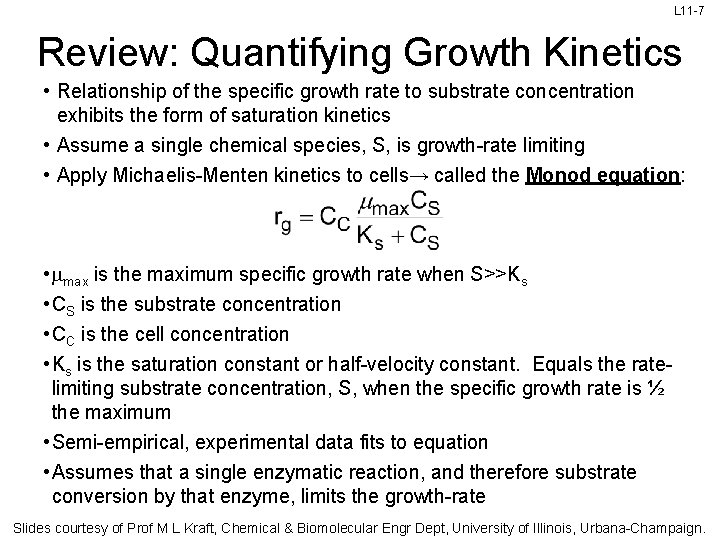
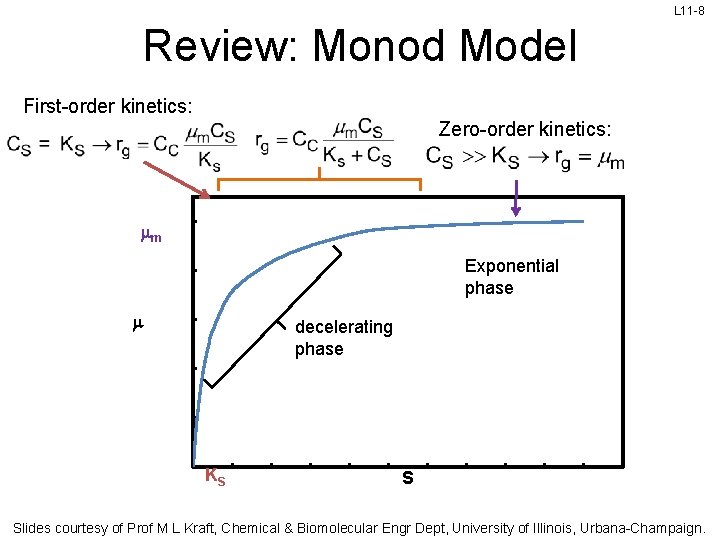
L 11 -7 Review: Quantifying Growth Kinetics • Relationship of the specific growth rate to substrate concentration exhibits the form of saturation kinetics • Assume a single chemical species, S, is growth-rate limiting • Apply Michaelis-Menten kinetics to cells→ called the Monod equation: • mmax is the maximum specific growth rate when S>>Ks • CS is the substrate concentration • CC is the cell concentration • Ks is the saturation constant or half-velocity constant. Equals the ratelimiting substrate concentration, S, when the specific growth rate is ½ the maximum • Semi-empirical, experimental data fits to equation • Assumes that a single enzymatic reaction, and therefore substrate conversion by that enzyme, limits the growth-rate Slides courtesy of Prof M L Kraft, Chemical & Biomolecular Engr Dept, University of Illinois, Urbana-Champaign.
L 11 -8 Review: Monod Model First-order kinetics: Zero-order kinetics: mm Exponential phase m decelerating phase KS S Slides courtesy of Prof M L Kraft, Chemical & Biomolecular Engr Dept, University of Illinois, Urbana-Champaign.
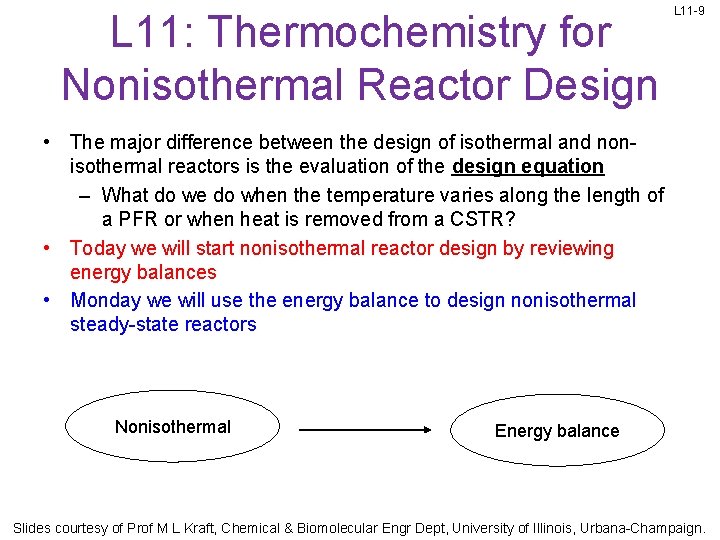
L 11: Thermochemistry for Nonisothermal Reactor Design L 11 -9 • The major difference between the design of isothermal and nonisothermal reactors is the evaluation of the design equation – What do we do when the temperature varies along the length of a PFR or when heat is removed from a CSTR? • Today we will start nonisothermal reactor design by reviewing energy balances • Monday we will use the energy balance to design nonisothermal steady-state reactors Nonisothermal Energy balance Slides courtesy of Prof M L Kraft, Chemical & Biomolecular Engr Dept, University of Illinois, Urbana-Champaign.
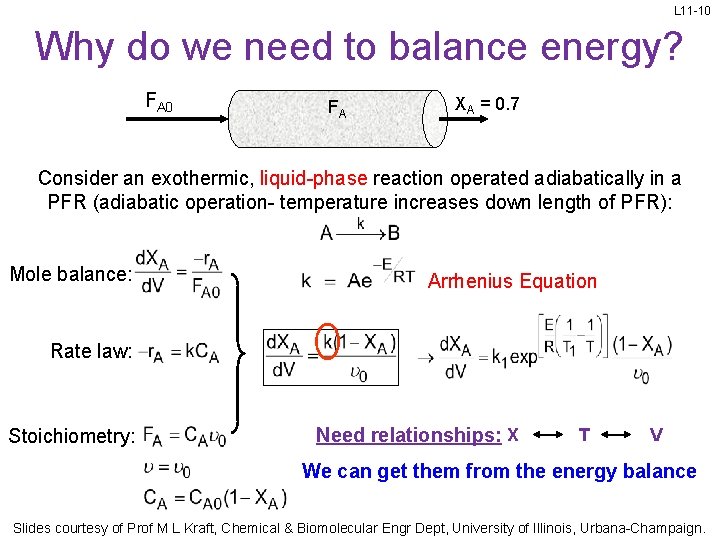
L 11 -10 Why do we need to balance energy? FA 0 FA XA = 0. 7 Consider an exothermic, liquid-phase reaction operated adiabatically in a PFR (adiabatic operation- temperature increases down length of PFR): Mole balance: Arrhenius Equation Rate law: Stoichiometry: Need relationships: X T V We can get them from the energy balance Slides courtesy of Prof M L Kraft, Chemical & Biomolecular Engr Dept, University of Illinois, Urbana-Champaign.
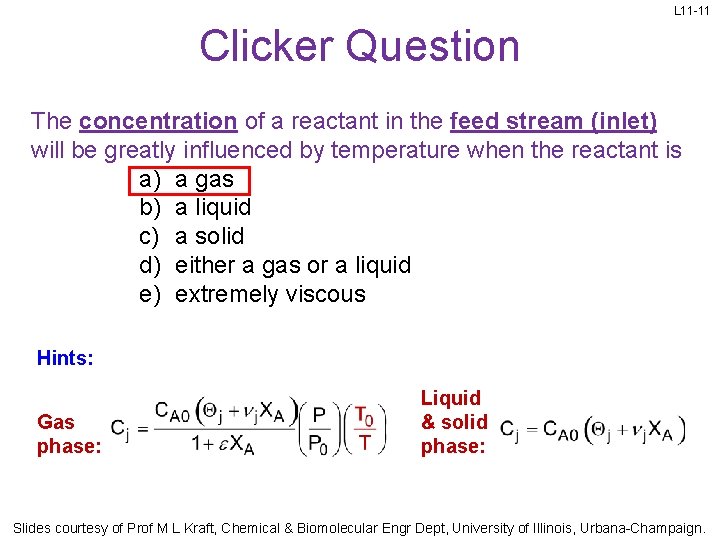
L 11 -11 Clicker Question The concentration of a reactant in the feed stream (inlet) will be greatly influenced by temperature when the reactant is a) a gas b) a liquid c) a solid d) either a gas or a liquid e) extremely viscous Hints: Gas phase: Liquid & solid phase: Slides courtesy of Prof M L Kraft, Chemical & Biomolecular Engr Dept, University of Illinois, Urbana-Champaign.
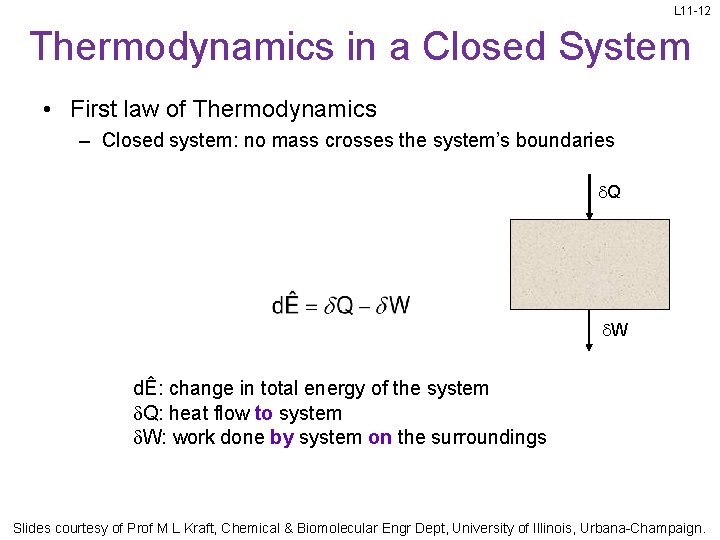
L 11 -12 Thermodynamics in a Closed System • First law of Thermodynamics – Closed system: no mass crosses the system’s boundaries Q W dÊ: change in total energy of the system Q: heat flow to system W: work done by system on the surroundings Slides courtesy of Prof M L Kraft, Chemical & Biomolecular Engr Dept, University of Illinois, Urbana-Champaign.
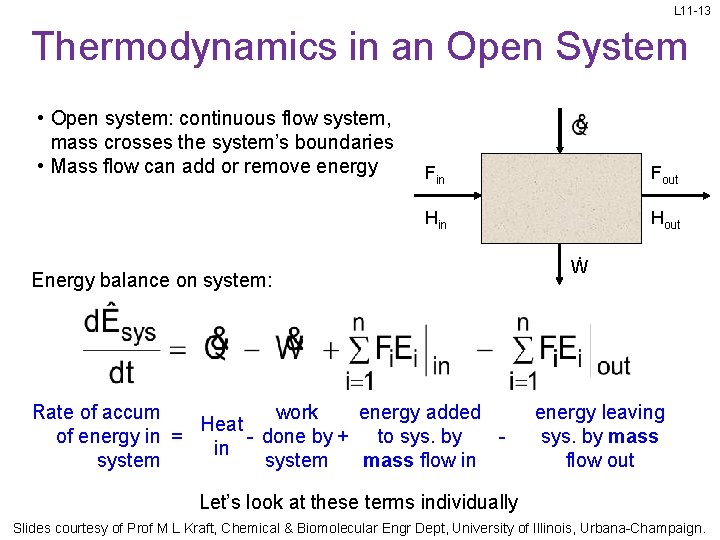
L 11 -13 Thermodynamics in an Open System • Open system: continuous flow system, mass crosses the system’s boundaries • Mass flow can add or remove energy Fin Fout Hin Hout Energy balance on system: Rate of accum work energy added Heat of energy in = - done by + to sys. by in system mass flow in Ẇ energy leaving sys. by mass flow out Let’s look at these terms individually Slides courtesy of Prof M L Kraft, Chemical & Biomolecular Engr Dept, University of Illinois, Urbana-Champaign.
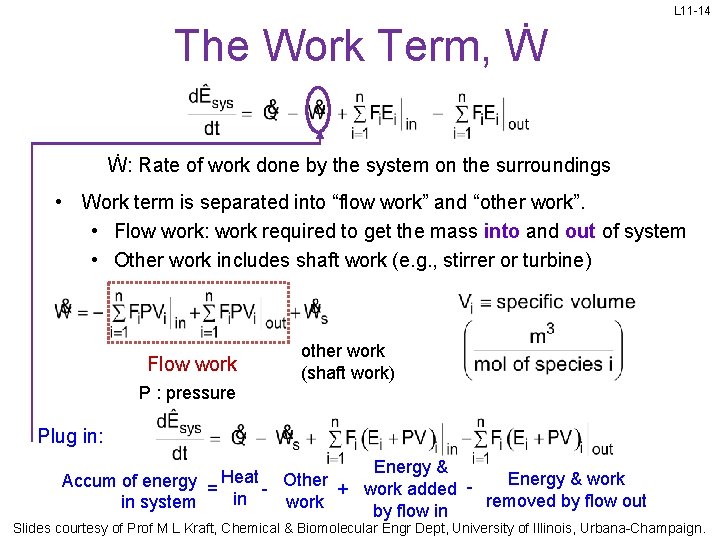
L 11 -14 The Work Term, Ẇ Ẇ: Rate of work done by the system on the surroundings • Work term is separated into “flow work” and “other work”. • Flow work: work required to get the mass into and out of system • Other work includes shaft work (e. g. , stirrer or turbine) Flow work other work (shaft work) P : pressure Plug in: Energy & work Accum of energy = Heat - Other + work added in removed by flow out work in system by flow in Slides courtesy of Prof M L Kraft, Chemical & Biomolecular Engr Dept, University of Illinois, Urbana-Champaign.
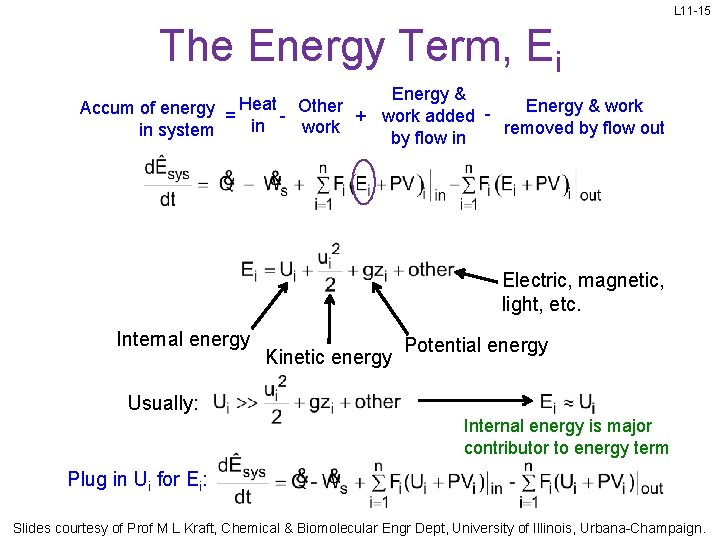
L 11 -15 The Energy Term, Ei Energy & work Accum of energy = Heat - Other + work added in work removed by flow out in system by flow in Electric, magnetic, light, etc. Internal energy Kinetic energy Potential energy Usually: Internal energy is major contributor to energy term Plug in Ui for Ei: Slides courtesy of Prof M L Kraft, Chemical & Biomolecular Engr Dept, University of Illinois, Urbana-Champaign.
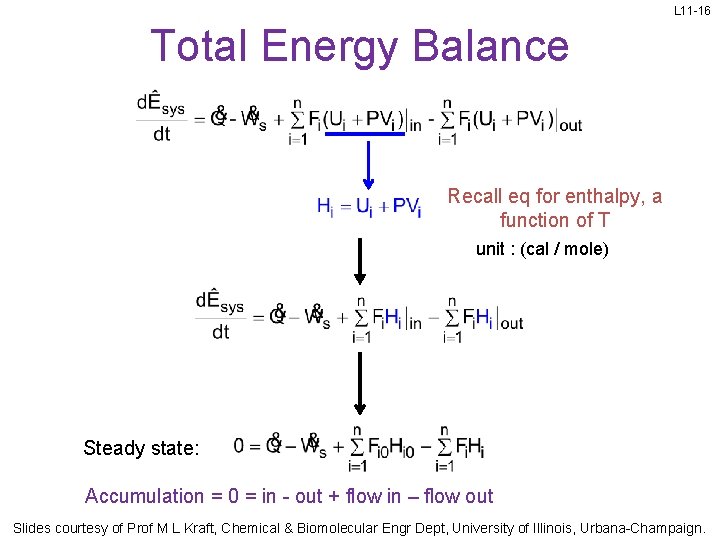
L 11 -16 Total Energy Balance Recall eq for enthalpy, a function of T unit : (cal / mole) Steady state: Accumulation = 0 = in - out + flow in – flow out Slides courtesy of Prof M L Kraft, Chemical & Biomolecular Engr Dept, University of Illinois, Urbana-Champaign.
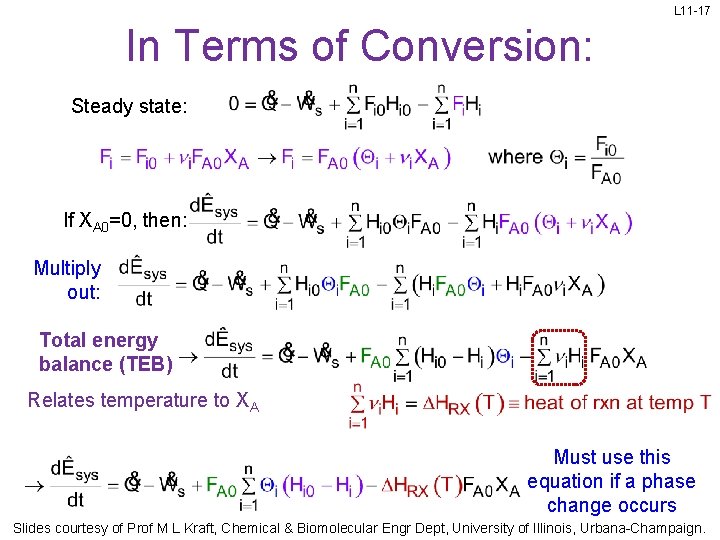
L 11 -17 In Terms of Conversion: Steady state: If XA 0=0, then: Multiply out: Total energy balance (TEB) Relates temperature to XA Must use this equation if a phase change occurs Slides courtesy of Prof M L Kraft, Chemical & Biomolecular Engr Dept, University of Illinois, Urbana-Champaign.
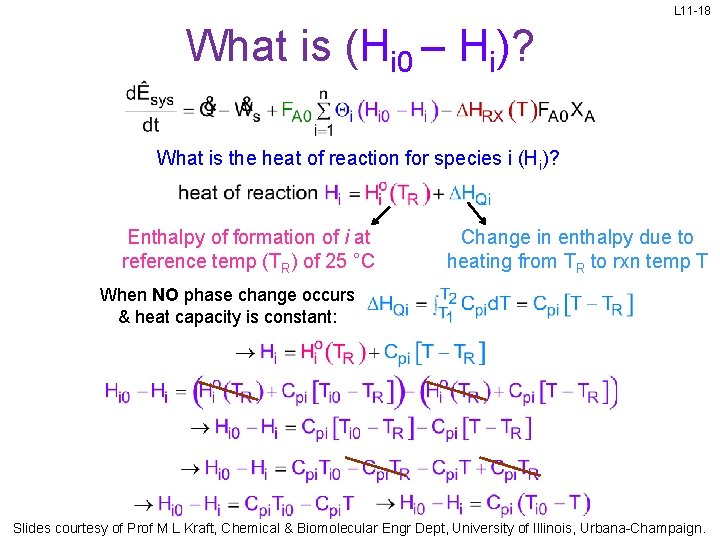
L 11 -18 What is (Hi 0 – Hi)? What is the heat of reaction for species i (Hi)? Enthalpy of formation of i at reference temp (TR) of 25 °C Change in enthalpy due to heating from TR to rxn temp T When NO phase change occurs & heat capacity is constant: Slides courtesy of Prof M L Kraft, Chemical & Biomolecular Engr Dept, University of Illinois, Urbana-Champaign.
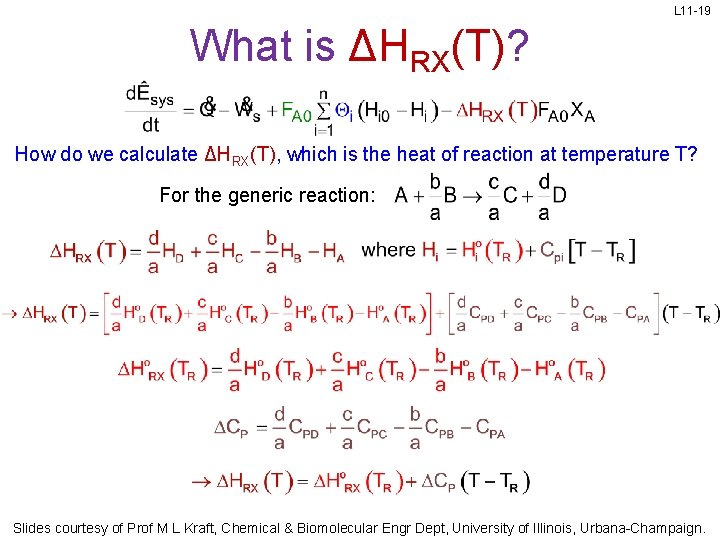
L 11 -19 What is ΔHRX(T)? How do we calculate ΔHRX(T), which is the heat of reaction at temperature T? For the generic reaction: Slides courtesy of Prof M L Kraft, Chemical & Biomolecular Engr Dept, University of Illinois, Urbana-Champaign.
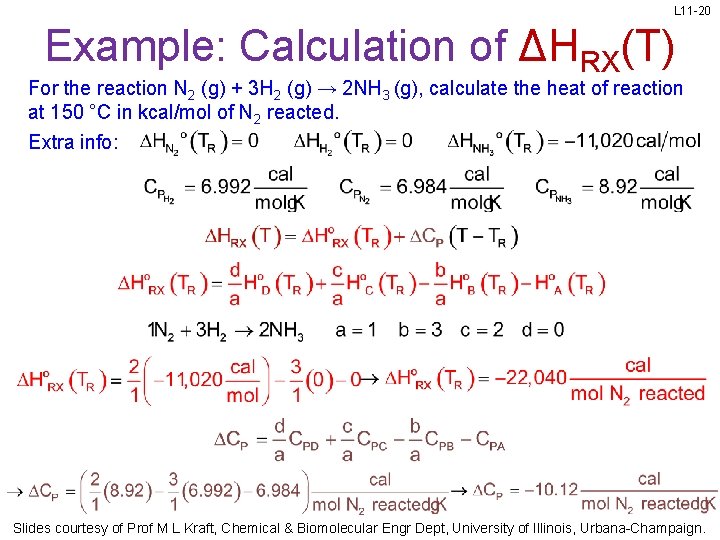
L 11 -20 Example: Calculation of ΔHRX(T) For the reaction N 2 (g) + 3 H 2 (g) → 2 NH 3 (g), calculate the heat of reaction at 150 °C in kcal/mol of N 2 reacted. Extra info: Slides courtesy of Prof M L Kraft, Chemical & Biomolecular Engr Dept, University of Illinois, Urbana-Champaign.
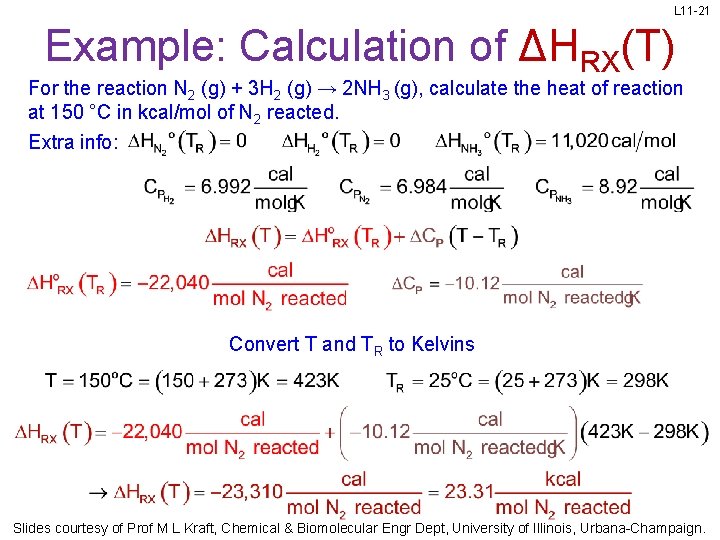
L 11 -21 Example: Calculation of ΔHRX(T) For the reaction N 2 (g) + 3 H 2 (g) → 2 NH 3 (g), calculate the heat of reaction at 150 °C in kcal/mol of N 2 reacted. Extra info: Convert T and TR to Kelvins Slides courtesy of Prof M L Kraft, Chemical & Biomolecular Engr Dept, University of Illinois, Urbana-Champaign.
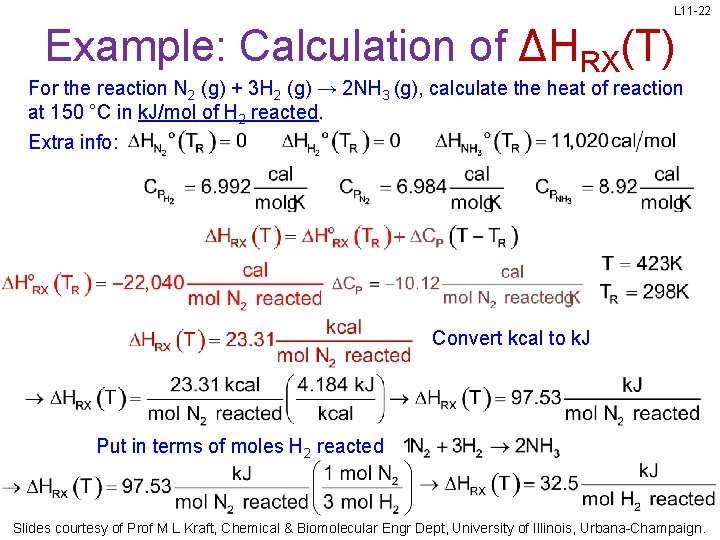
L 11 -22 Example: Calculation of ΔHRX(T) For the reaction N 2 (g) + 3 H 2 (g) → 2 NH 3 (g), calculate the heat of reaction at 150 °C in k. J/mol of H 2 reacted. Extra info: Convert kcal to k. J Put in terms of moles H 2 reacted Slides courtesy of Prof M L Kraft, Chemical & Biomolecular Engr Dept, University of Illinois, Urbana-Champaign.
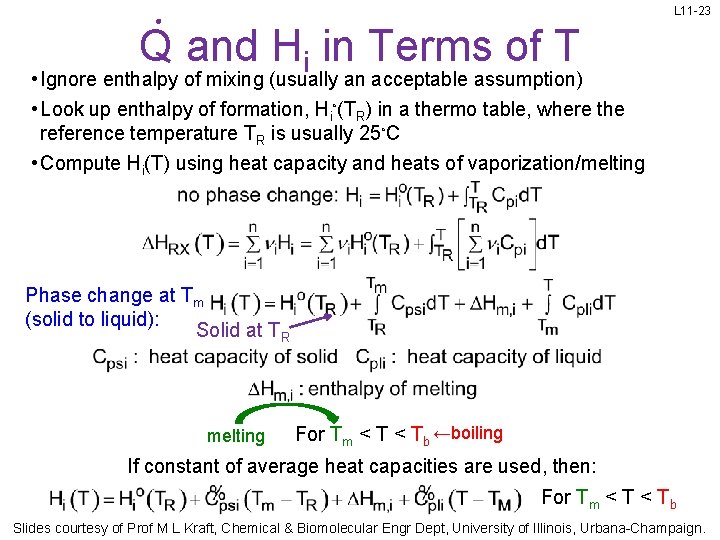
L 11 -23 Q and Hi in Terms of T • Ignore enthalpy of mixing (usually an acceptable assumption) • Look up enthalpy of formation, Hi◦(TR) in a thermo table, where the reference temperature TR is usually 25◦C • Compute Hi(T) using heat capacity and heats of vaporization/melting Phase change at Tm (solid to liquid): Solid at TR melting For Tm < Tb ←boiling If constant of average heat capacities are used, then: For Tm < Tb Slides courtesy of Prof M L Kraft, Chemical & Biomolecular Engr Dept, University of Illinois, Urbana-Champaign.
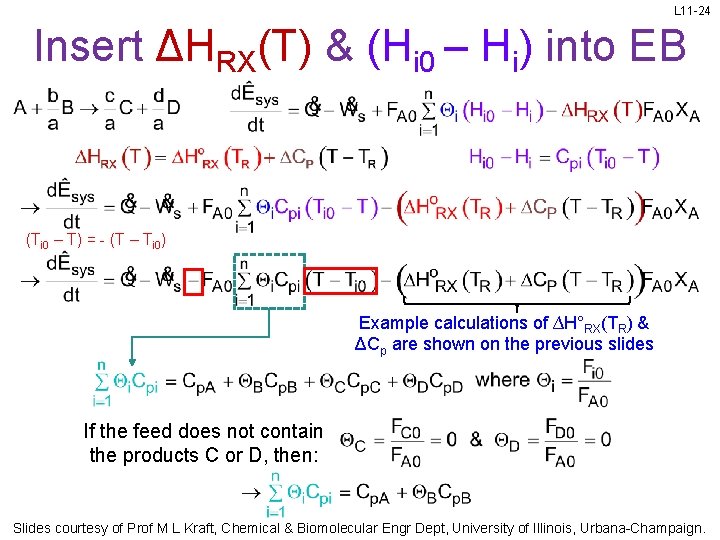
L 11 -24 Insert ΔHRX(T) & (Hi 0 – Hi) into EB (Ti 0 – T) = - (T – Ti 0) Example calculations of ∆H°RX(TR) & ΔCp are shown on the previous slides If the feed does not contain the products C or D, then: Slides courtesy of Prof M L Kraft, Chemical & Biomolecular Engr Dept, University of Illinois, Urbana-Champaign.
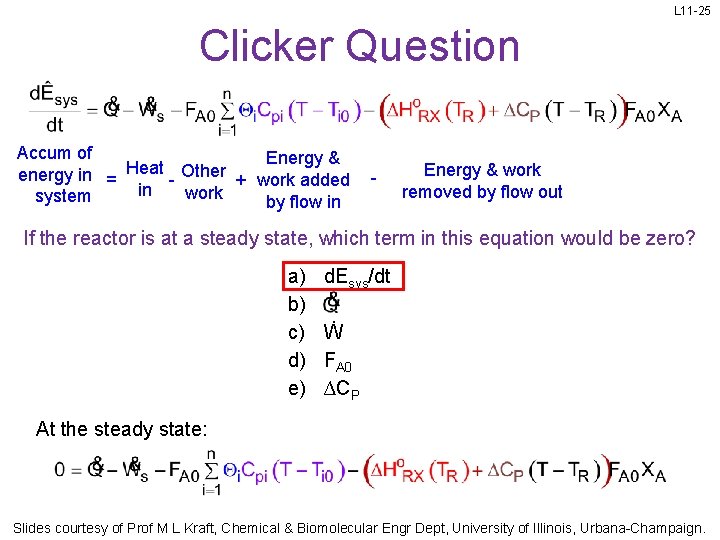
L 11 -25 Clicker Question Accum of Energy & Heat Other energy in = + work added in work system by flow in - Energy & work removed by flow out If the reactor is at a steady state, which term in this equation would be zero? a) b) c) d) e) d. Esys/dt Ẇ FA 0 ∆CP At the steady state: Slides courtesy of Prof M L Kraft, Chemical & Biomolecular Engr Dept, University of Illinois, Urbana-Champaign.
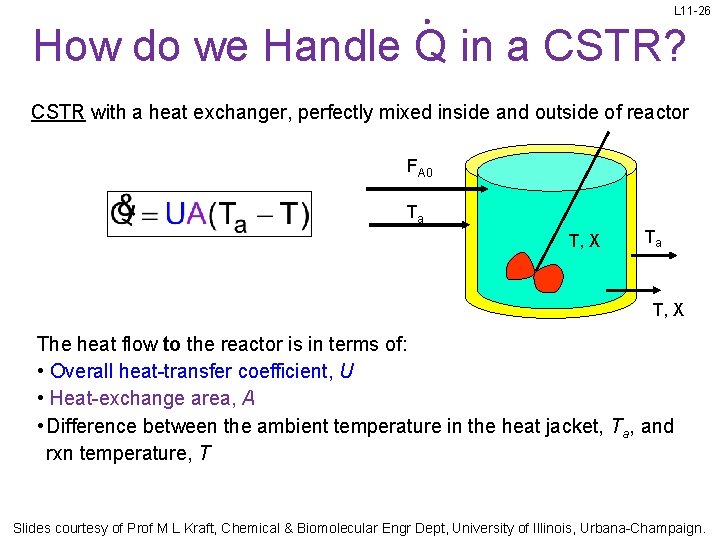
L 11 -26 How do we Handle Q in a CSTR? CSTR with a heat exchanger, perfectly mixed inside and outside of reactor FA 0 Ta T, X The heat flow to the reactor is in terms of: • Overall heat-transfer coefficient, U • Heat-exchange area, A • Difference between the ambient temperature in the heat jacket, Ta, and rxn temperature, T Slides courtesy of Prof M L Kraft, Chemical & Biomolecular Engr Dept, University of Illinois, Urbana-Champaign.
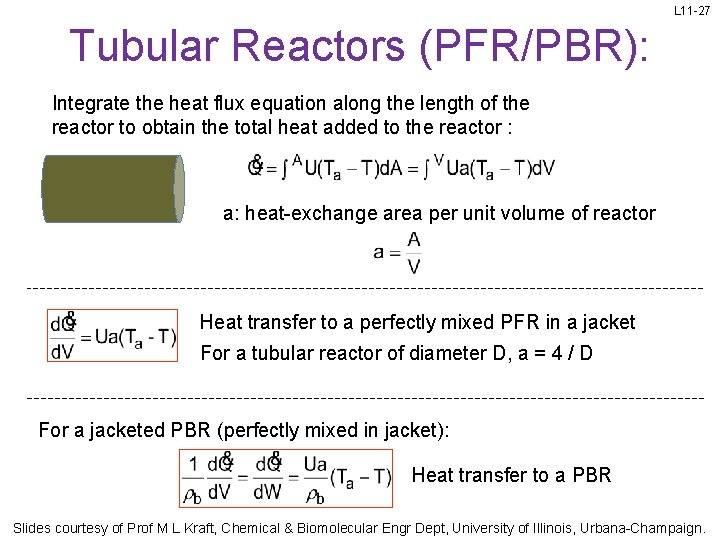
L 11 -27 Tubular Reactors (PFR/PBR): Integrate the heat flux equation along the length of the reactor to obtain the total heat added to the reactor : a: heat-exchange area per unit volume of reactor Heat transfer to a perfectly mixed PFR in a jacket For a tubular reactor of diameter D, a = 4 / D For a jacketed PBR (perfectly mixed in jacket): Heat transfer to a PBR Slides courtesy of Prof M L Kraft, Chemical & Biomolecular Engr Dept, University of Illinois, Urbana-Champaign.