
Review Questions Define n variables types of shared
Review Questions Define n variables, types of shared variables, message-passing, shared-memory system, system topology n program-counter/guarded command program syntax n global state, atomic action execution, fixpoint n synchronous, partially and fully synchronous execution n computation, execution semantics: interleaving, power-set n fairness, weak-fairness n prefix, suffix, property n causality, computation equivalence 1
Wave Algorithms n n ring algorithm tree algorithm echo algorithm polling algorithm 2
Wave Algorithms n n n Wave algorithm satisfies the following three properties u termination: each computation is finite u decision: each computation contains at least one decide event u dependence: in each computation each decide event is causally preceded by an event in each process initiator (starter) - process that execution of its actions spontaneously non-initiator(follower) - starts execution only when receives a message wave algorithms differ in many respects, some features: u centralized (single-source) - one initiator; decentralized (multisource) - multiple initiators u topology - ring, tree, clique, etc. u initial knowledge: F each process knows its own unique name F each process knows the names of its neighbors u number of decisions to occur in each process 3 usually wave algorithms exchange messages with no content - tokens
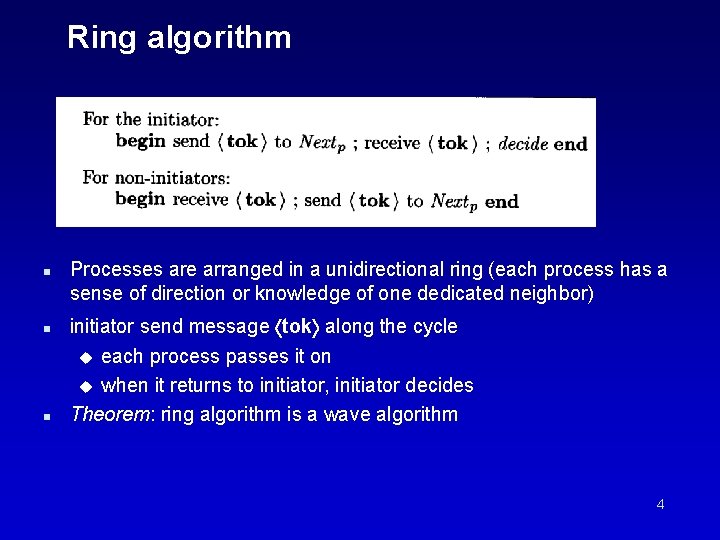
Ring algorithm n n n Processes are arranged in a unidirectional ring (each process has a sense of direction or knowledge of one dedicated neighbor) initiator send message tok along the cycle u each process passes it on u when it returns to initiator, initiator decides Theorem: ring algorithm is a wave algorithm 4
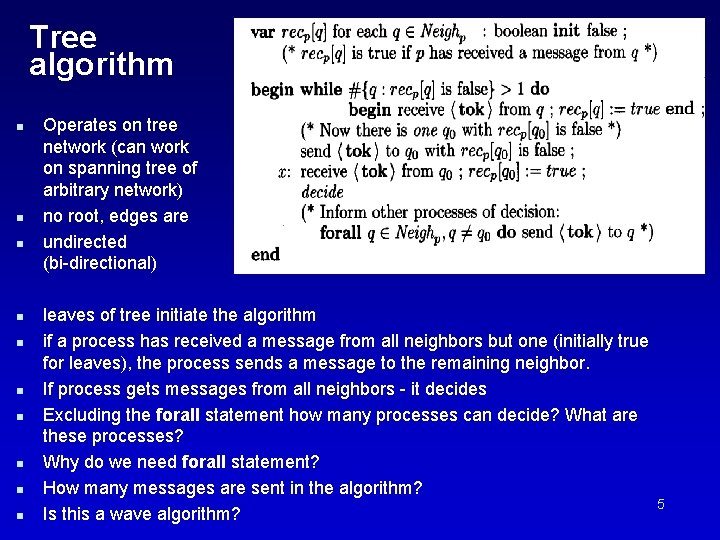
Tree algorithm n n n n n Operates on tree network (can work on spanning tree of arbitrary network) no root, edges are undirected (bi-directional) leaves of tree initiate the algorithm if a process has received a message from all neighbors but one (initially true for leaves), the process sends a message to the remaining neighbor. If process gets messages from all neighbors - it decides Excluding the forall statement how many processes can decide? What are these processes? Why do we need forall statement? How many messages are sent in the algorithm? Is this a wave algorithm? 5
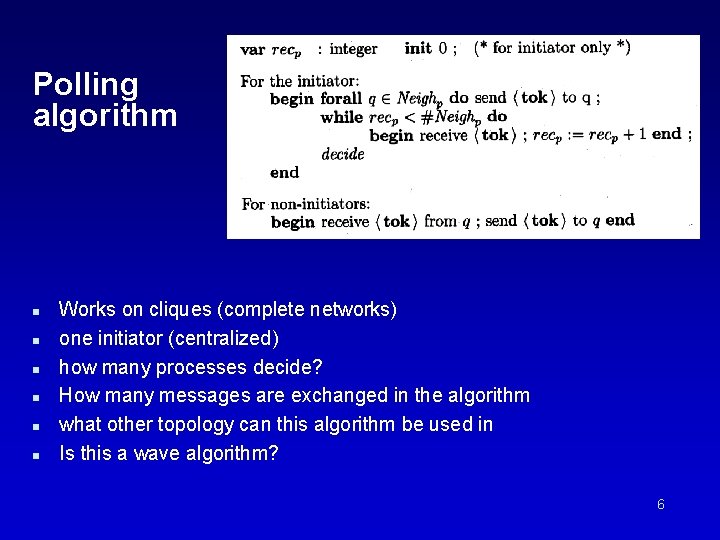
Polling algorithm n n n Works on cliques (complete networks) one initiator (centralized) how many processes decide? How many messages are exchanged in the algorithm what other topology can this algorithm be used in Is this a wave algorithm? 6
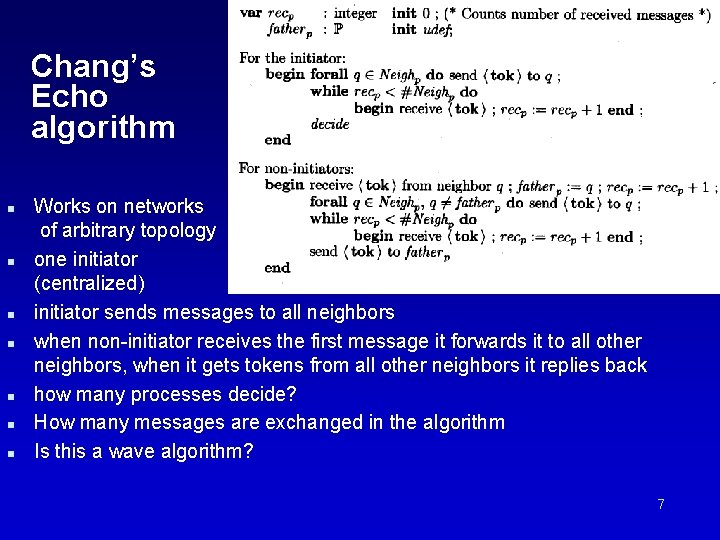
Chang’s Echo algorithm n n n n Works on networks of arbitrary topology one initiator (centralized) initiator sends messages to all neighbors when non-initiator receives the first message it forwards it to all other neighbors, when it gets tokens from all other neighbors it replies back how many processes decide? How many messages are exchanged in the algorithm Is this a wave algorithm? 7
- Slides: 7