
Review Psychomotor Assessments Process how to vs Product

- Slides: 37
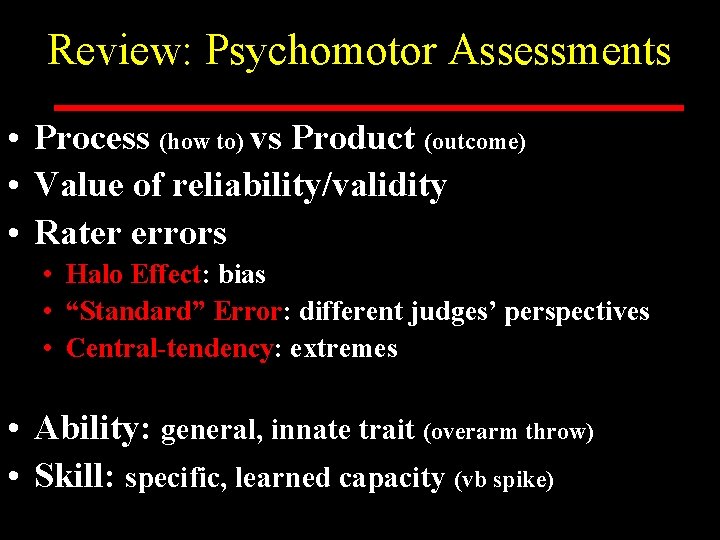
Review: Psychomotor Assessments • Process (how to) vs Product (outcome) • Value of reliability/validity • Rater errors • Halo Effect: bias • “Standard” Error: different judges’ perspectives • Central-tendency: extremes • Ability: general, innate trait (overarm throw) • Skill: specific, learned capacity (vb spike)
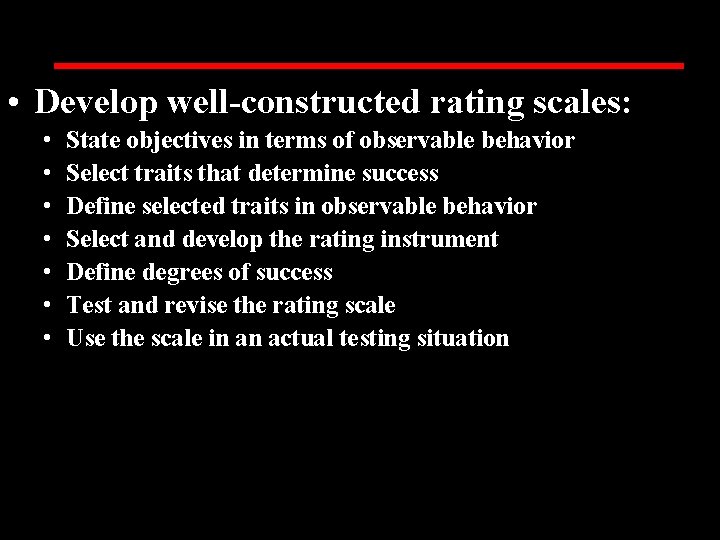
• Develop well-constructed rating scales: • • State objectives in terms of observable behavior Select traits that determine success Define selected traits in observable behavior Select and develop the rating instrument Define degrees of success Test and revise the rating scale Use the scale in an actual testing situation
Physical Fitness and Activity Assessment in Youth HPER 3150 Dr. Ayers
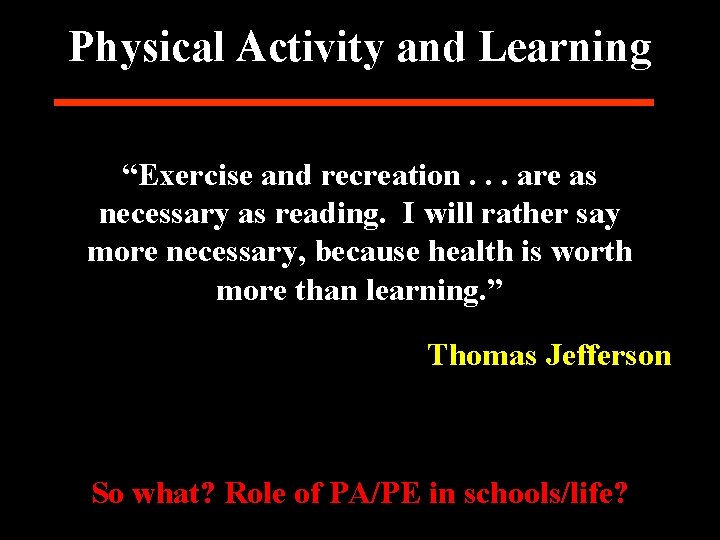
Physical Activity and Learning “Exercise and recreation. . . are as necessary as reading. I will rather say more necessary, because health is worth more than learning. ” Thomas Jefferson So what? Role of PA/PE in schools/life?
Relationship Between Physical Activity and Fitness Children are not “little adults” Child’s score on aerobic fitness test does not predict endurance activity performance What DOES matter is the development of lifelong, regular PA patterns
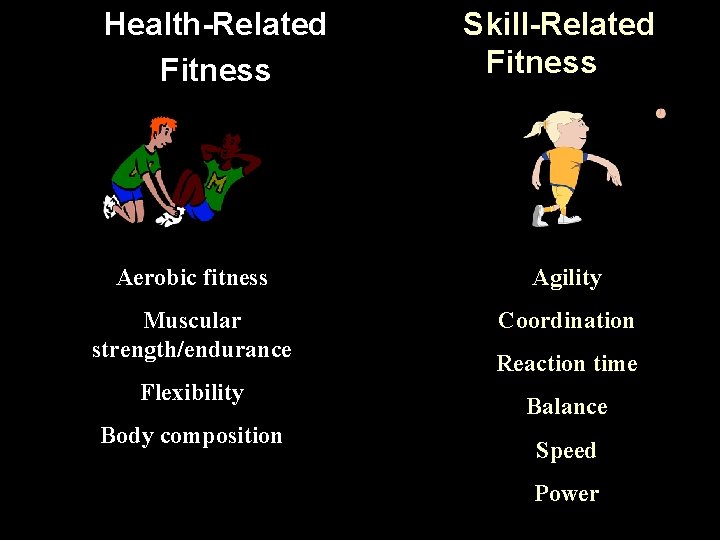
Health-Related Fitness Skill-Related Fitness Aerobic fitness Agility Muscular strength/endurance Coordination Flexibility Body composition Reaction time Balance Speed Power
National Fitness Studies • Dr. Hans Kraus study (1954): • 42% of American children passed the assessment, while • 92% of European school children passed the assessment • President Eisenhower was shocked and established the President’s Council on Youth Fitness (1956) • Contemporary relevance: http: //www. redorbit. com/news/health/1637795/obesity_in_the_militar y_on_the_rise/
Are American Children and Youth Fit? Passing Rates on Youth Fitness Tests Corbin & Pangrazi (RQES, 1992) Strong et al. (2005)
AMA quotes 1967 • “Inadequate physical education programs must be strengthened. . ” • “There is need . . to widen physical education offerings. . which contribute to . . wellbeing” • “Every pupil should. . [be exposed] to physical education which promotes understanding of the significance of physical education in maintaining health. ”
Secretary of Health and Human Services 1996 “Schools and universities need to reintroduce daily, quality physical activity as a key component of a comprehensive education. ”
1996 Publication of Physical Activity Health A Report of the Surgeon General
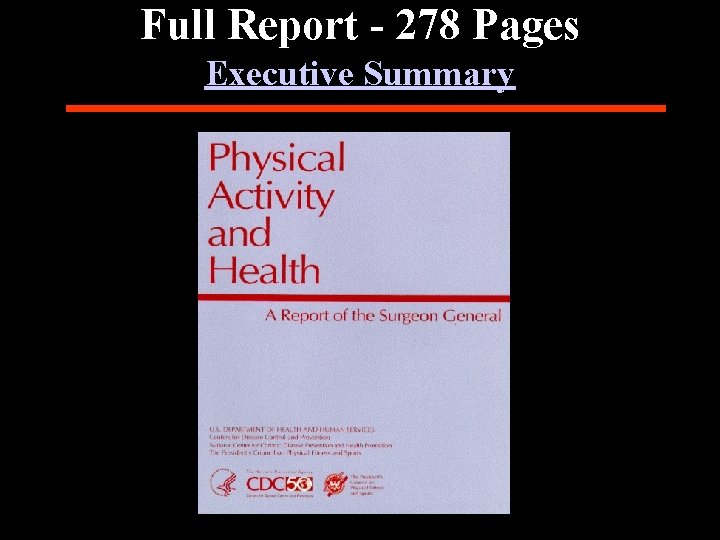
Full Report - 278 Pages Executive Summary
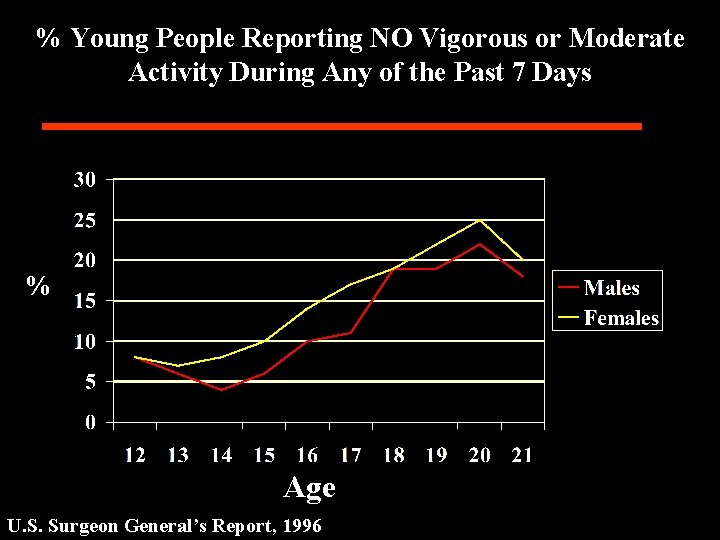
% Young People Reporting NO Vigorous or Moderate Activity During Any of the Past 7 Days % Age U. S. Surgeon General’s Report, 1996
Other Prominent National Reports Healthy People 2010 Shape of the Nation 2006 F as in Fat Report 2007
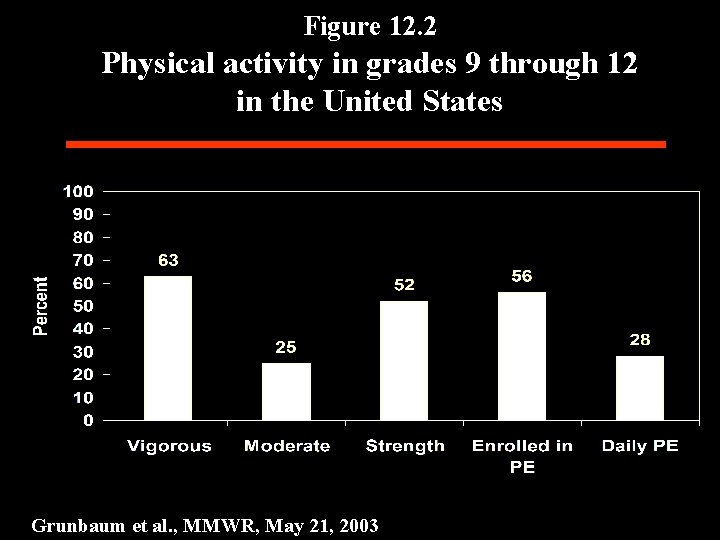
Figure 12. 2 Physical activity in grades 9 through 12 in the United States Grunbaum et al. , MMWR, May 21, 2003
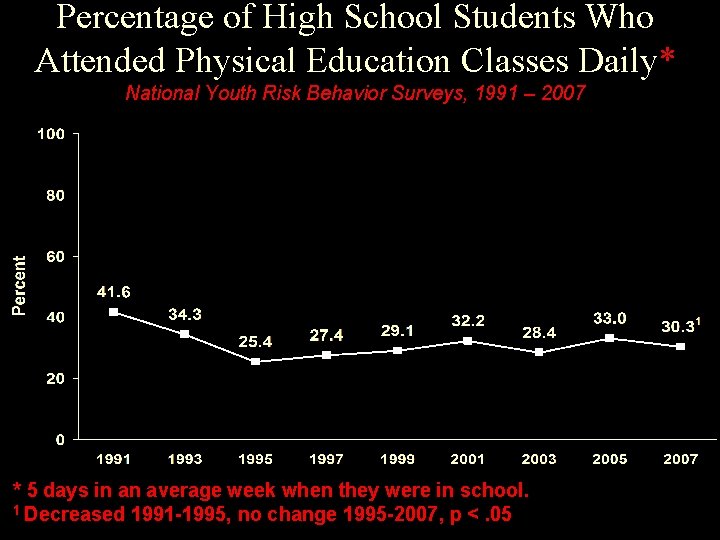
Percentage of High School Students Who Attended Physical Education Classes Daily* National Youth Risk Behavior Surveys, 1991 – 2007 * 5 days in an average week when they were in school. 1 Decreased 1991 -1995, no change 1995 -2007, p <. 05
Proportion of Adults Engaging in Regular Physical Activity http: //www. cdc. gov/nchs/data/nhis/earlyrelease/200 812_07. pdf
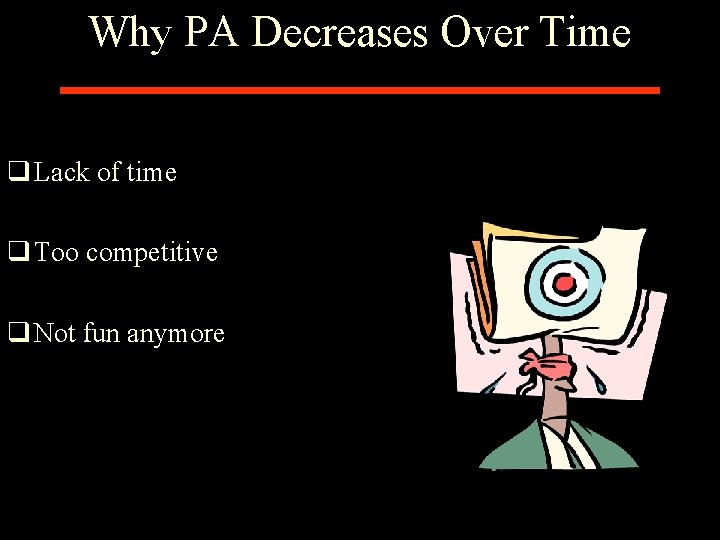
Why PA Decreases Over Time q Lack of time q Too competitive q Not fun anymore
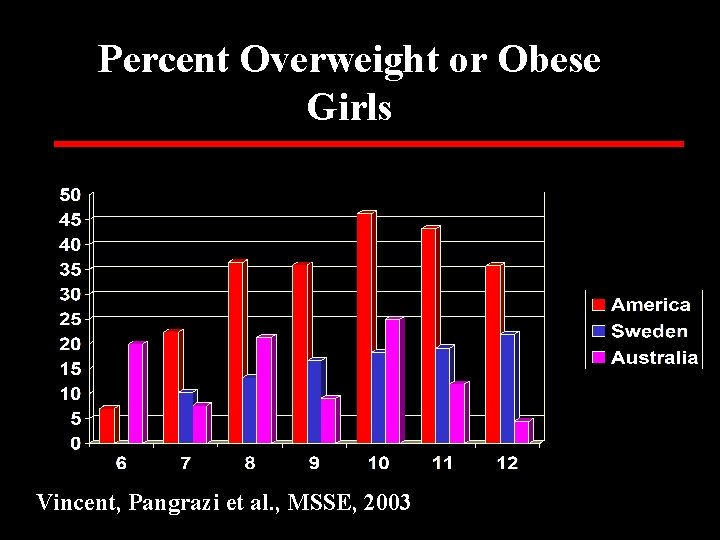
Percent Overweight or Obese Girls Vincent, Pangrazi et al. , MSSE, 2003
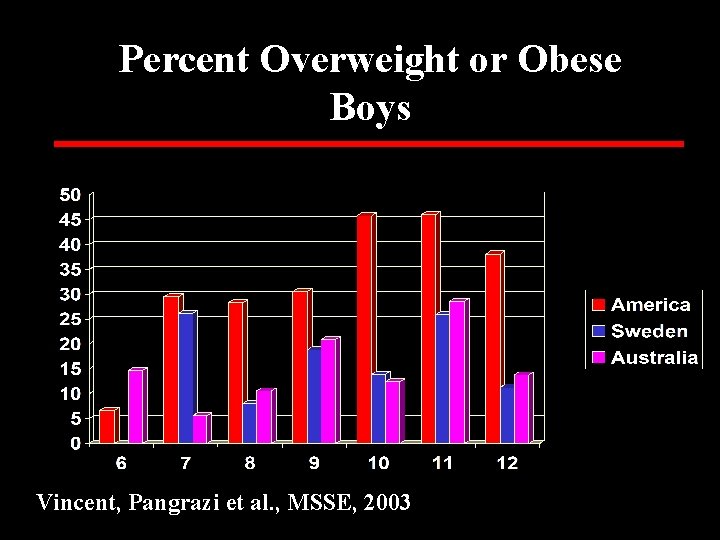
Percent Overweight or Obese Boys Vincent, Pangrazi et al. , MSSE, 2003
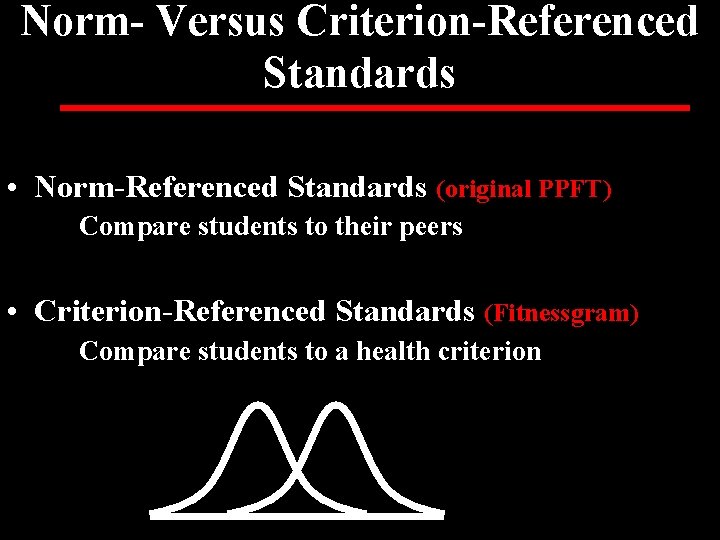
Norm- Versus Criterion-Referenced Standards • Norm-Referenced Standards (original PPFT) Compare students to their peers • Criterion-Referenced Standards (Fitnessgram) Compare students to a health criterion
Review: Youth Fitness I • Relationship of fitness/activity to life • Two types of fitness • Health-related Skill-related • Relationship between age and physical activity • Reasons for decreasing PA with age • Norm- & Criterion-referenced standards
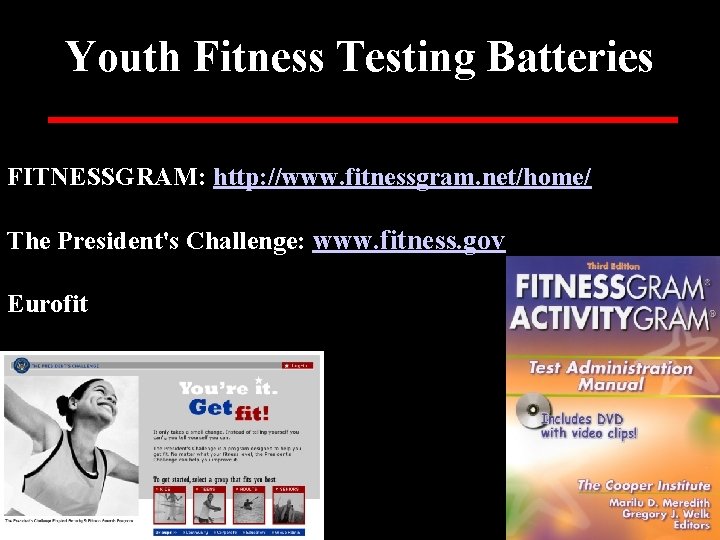
Youth Fitness Testing Batteries FITNESSGRAM: http: //www. fitnessgram. net/home/ The President's Challenge: www. fitness. gov Eurofit
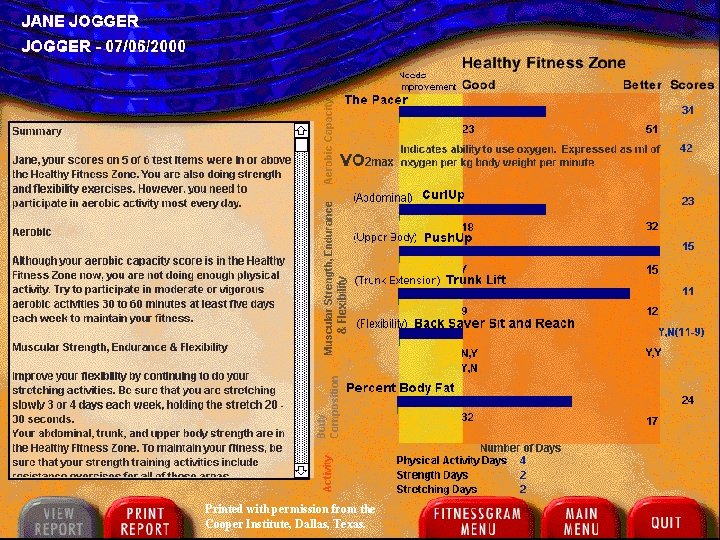
FITNESSGRAM PACER Skinfolds* Curl-Up Trunk Lift Push-Ups
Printed with permission from the Cooper Institute, Dallas, Texas.
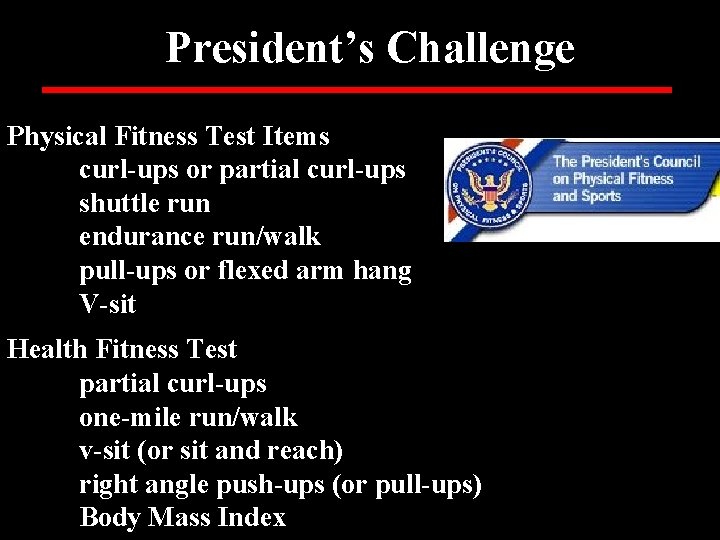
President’s Challenge Physical Fitness Test Items curl-ups or partial curl-ups shuttle run endurance run/walk pull-ups or flexed arm hang V-sit Health Fitness Test partial curl-ups one-mile run/walk v-sit (or sit and reach) right angle push-ups (or pull-ups) Body Mass Index
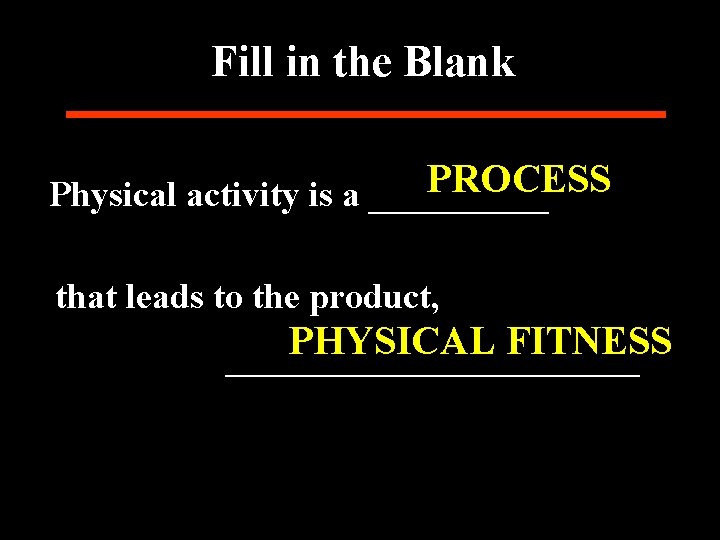
Fill in the Blank PROCESS Physical activity is a _____ that leads to the product, PHYSICAL FITNESS ____________
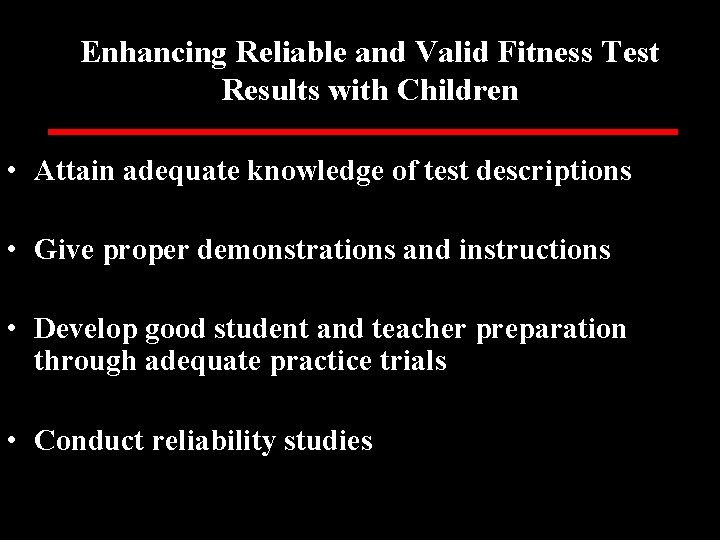
Enhancing Reliable and Valid Fitness Test Results with Children • Attain adequate knowledge of test descriptions • Give proper demonstrations and instructions • Develop good student and teacher preparation through adequate practice trials • Conduct reliability studies
Special Children Brockport Physical Fitness Test Items See Table 12 -12
Measuring Physical Activity in Youth • Physical activity improves the overall health of children • Physically inactive children tend to become inactive adults with higher risks for chronic diseases • Physically active children tend to become active adults with lower risks for chronic diseases
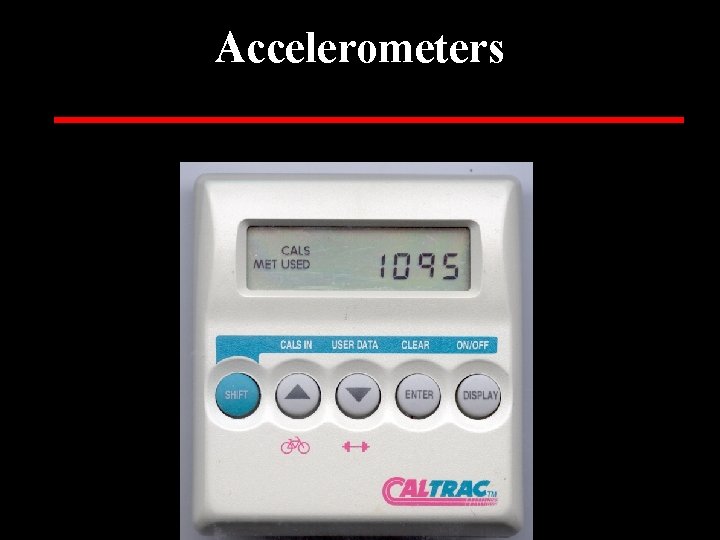
Accelerometers
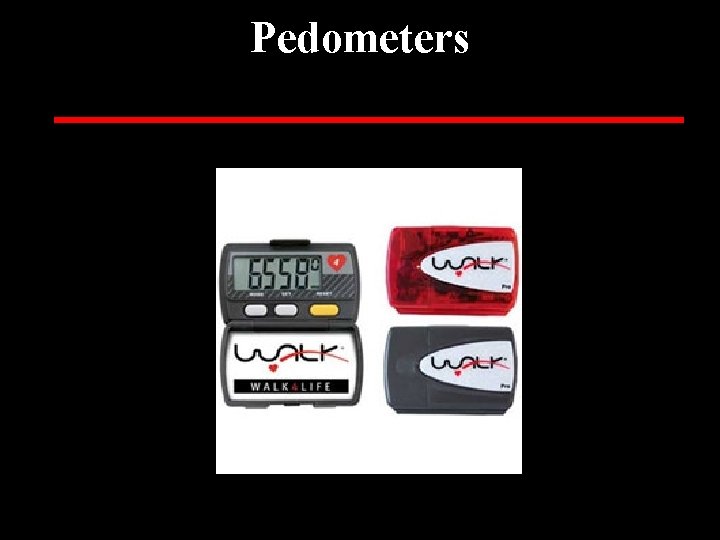
Pedometers
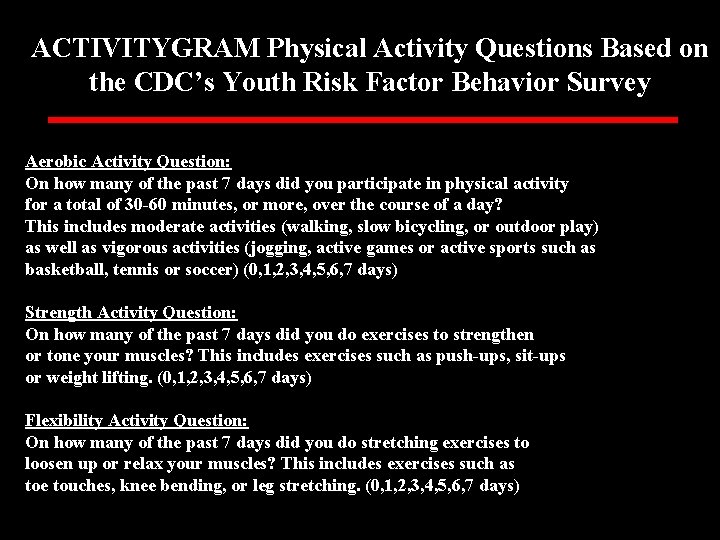
ACTIVITYGRAM Physical Activity Questions Based on the CDC’s Youth Risk Factor Behavior Survey Aerobic Activity Question: On how many of the past 7 days did you participate in physical activity for a total of 30 -60 minutes, or more, over the course of a day? This includes moderate activities (walking, slow bicycling, or outdoor play) as well as vigorous activities (jogging, active games or active sports such as basketball, tennis or soccer) (0, 1, 2, 3, 4, 5, 6, 7 days) Strength Activity Question: On how many of the past 7 days did you do exercises to strengthen or tone your muscles? This includes exercises such as push-ups, sit-ups or weight lifting. (0, 1, 2, 3, 4, 5, 6, 7 days) Flexibility Activity Question: On how many of the past 7 days did you do stretching exercises to loosen up or relax your muscles? This includes exercises such as toe touches, knee bending, or leg stretching. (0, 1, 2, 3, 4, 5, 6, 7 days)
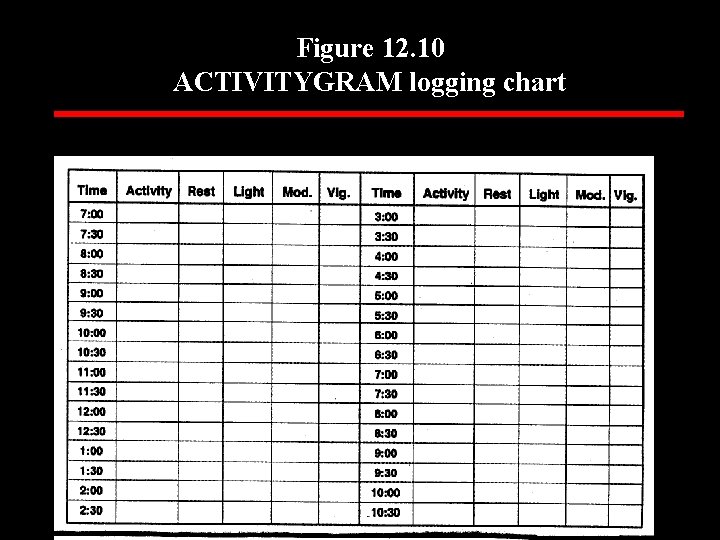
Figure 12. 10 ACTIVITYGRAM logging chart
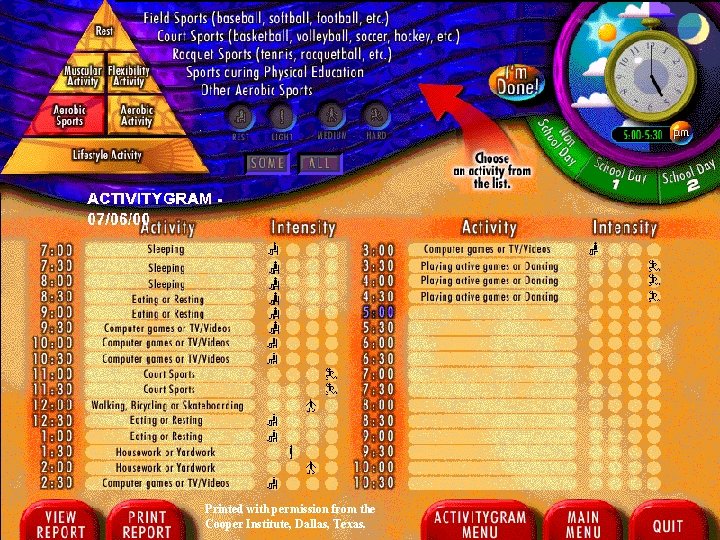
Printed with permission from the Cooper Institute, Dallas, Texas.
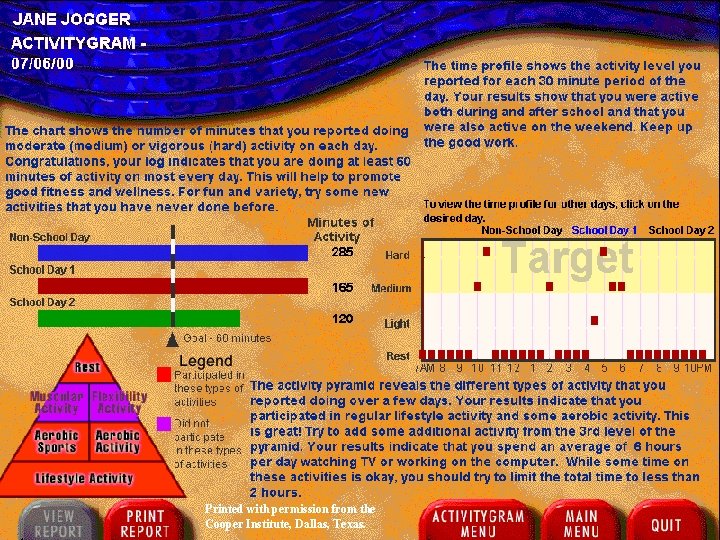
Printed with permission from the Cooper Institute, Dallas, Texas.
Tell a friend one thing you learned TODAY that you will use as a professional