
Review Printing Trees into Bytecodes To evaluate e
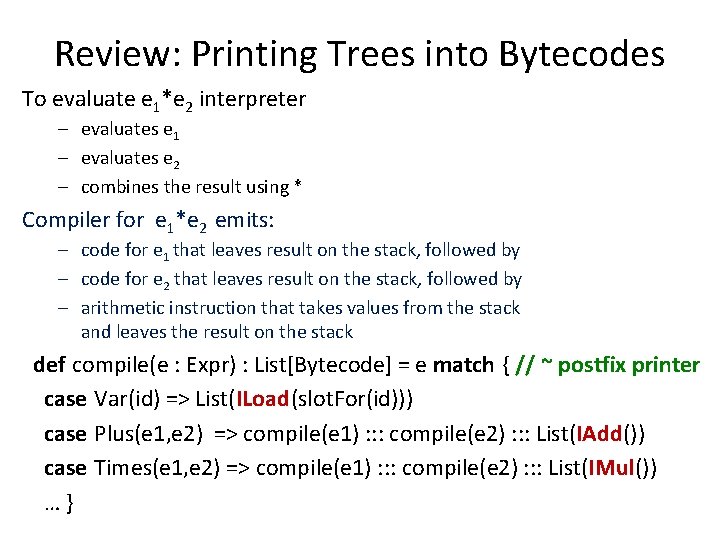
Review: Printing Trees into Bytecodes To evaluate e 1*e 2 interpreter – evaluates e 1 – evaluates e 2 – combines the result using * Compiler for e 1*e 2 emits: – code for e 1 that leaves result on the stack, followed by – code for e 2 that leaves result on the stack, followed by – arithmetic instruction that takes values from the stack and leaves the result on the stack def compile(e : Expr) : List[Bytecode] = e match { // ~ postfix printer case Var(id) => List(ILoad(slot. For(id))) case Plus(e 1, e 2) => compile(e 1) : : : compile(e 2) : : : List(IAdd()) case Times(e 1, e 2) => compile(e 1) : : : compile(e 2) : : : List(IMul()) …}
![Shorthand Notation for Translation [ e 1 + e 2 ] = [ e](http://slidetodoc.com/presentation_image_h2/ebb74be7f525a2559d901676b8cc8c32/image-2.jpg "Shorthand Notation for Translation [ e 1 + e 2 ] = [ e")
Shorthand Notation for Translation [ e 1 + e 2 ] = [ e 1 ] [ e 2 ] iadd [ e 1 * e 2 ] = [ e 1 ] [ e 2 ] imul
Code Generation for Control Structures
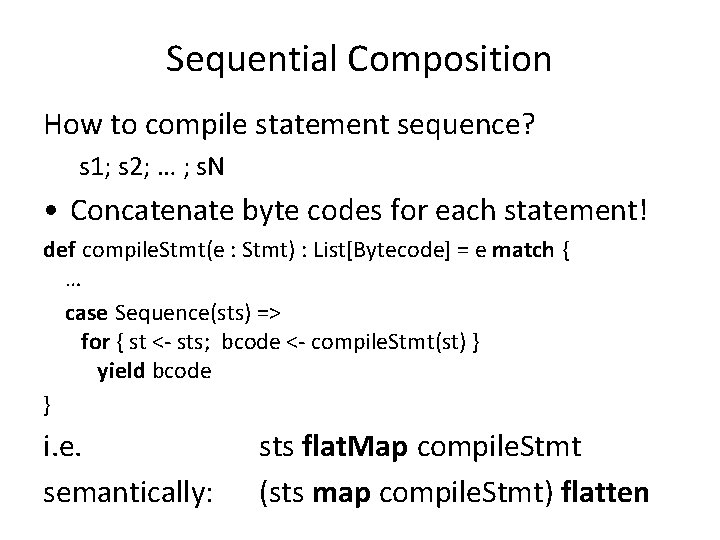
Sequential Composition How to compile statement sequence? s 1; s 2; … ; s. N • Concatenate byte codes for each statement! def compile. Stmt(e : Stmt) : List[Bytecode] = e match { … case Sequence(sts) => for { st <- sts; bcode <- compile. Stmt(st) } yield bcode } i. e. semantically: sts flat. Map compile. Stmt (sts map compile. Stmt) flatten

Compiling Control: Example static void count(int from, int to, int step) { int counter = from; while (counter < to) { counter = counter + step; } } We need to see how to: • translate boolean expressions • generate jumps for control 0: iload_0 1: istore_3 2: iload_3 3: iload_1 4: if_icmpge 7: iload_3 8: iload_2 9: iadd 10: istore_3 11: goto 2 14: return 14
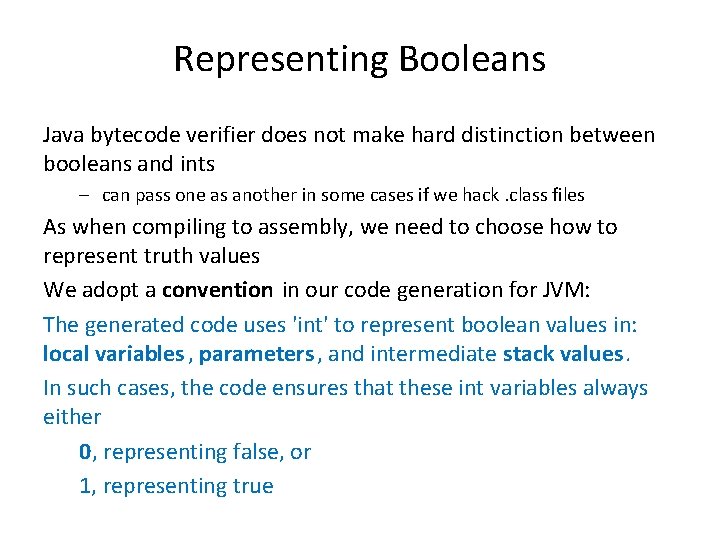
Representing Booleans Java bytecode verifier does not make hard distinction between booleans and ints – can pass one as another in some cases if we hack. class files As when compiling to assembly, we need to choose how to represent truth values We adopt a convention in our code generation for JVM: The generated code uses 'int' to represent boolean values in: local variables , parameters , and intermediate stack values. In such cases, the code ensures that these int variables always either 0, representing false, or 1, representing true
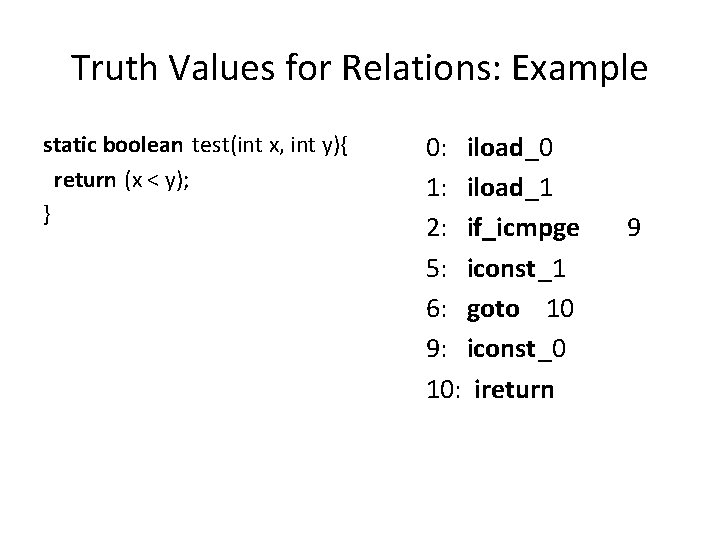
Truth Values for Relations: Example static boolean test(int x, int y){ return (x < y); } 0: iload_0 1: iload_1 2: if_icmpge 5: iconst_1 6: goto 10 9: iconst_0 10: ireturn 9
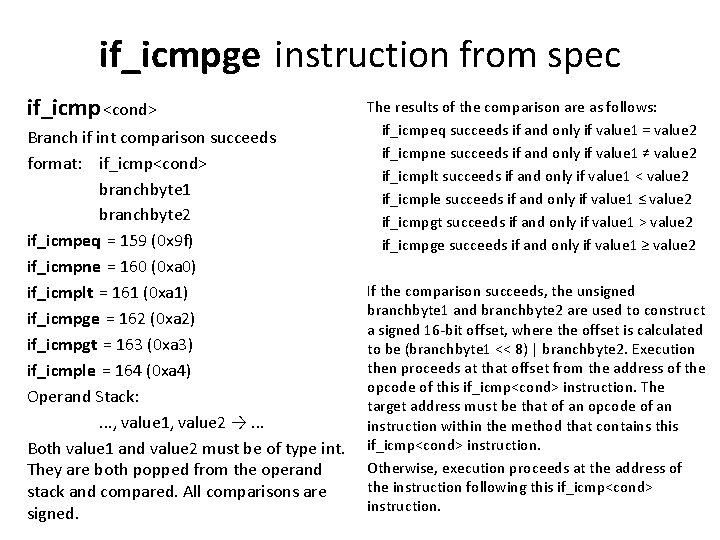
if_icmpge instruction from spec if_icmp <cond> Branch if int comparison succeeds format: if_icmp<cond> branchbyte 1 branchbyte 2 if_icmpeq = 159 (0 x 9 f) if_icmpne = 160 (0 xa 0) if_icmplt = 161 (0 xa 1) if_icmpge = 162 (0 xa 2) if_icmpgt = 163 (0 xa 3) if_icmple = 164 (0 xa 4) Operand Stack: . . . , value 1, value 2 →. . . Both value 1 and value 2 must be of type int. They are both popped from the operand stack and compared. All comparisons are signed. The results of the comparison are as follows: if_icmpeq succeeds if and only if value 1 = value 2 if_icmpne succeeds if and only if value 1 ≠ value 2 if_icmplt succeeds if and only if value 1 < value 2 if_icmple succeeds if and only if value 1 ≤ value 2 if_icmpgt succeeds if and only if value 1 > value 2 if_icmpge succeeds if and only if value 1 ≥ value 2 If the comparison succeeds, the unsigned branchbyte 1 and branchbyte 2 are used to construct a signed 16 -bit offset, where the offset is calculated to be (branchbyte 1 << 8) | branchbyte 2. Execution then proceeds at that offset from the address of the opcode of this if_icmp<cond> instruction. The target address must be that of an opcode of an instruction within the method that contains this if_icmp<cond> instruction. Otherwise, execution proceeds at the address of the instruction following this if_icmp<cond> instruction.
![Compiling Relational Expressions def compile(e : Expr) : List[Bytecode] = e match { …](http://slidetodoc.com/presentation_image_h2/ebb74be7f525a2559d901676b8cc8c32/image-9.jpg "Compiling Relational Expressions def compile(e : Expr) : List[Bytecode] = e match { …")
Compiling Relational Expressions def compile(e : Expr) : List[Bytecode] = e match { … case Times(e 1, e 2) => compile(e 1) : : : compile(e 2) : : : List(IMul()) case Comparison(e 1, op, e 2) => { val n. False = get. Fresh. Label(); val n. After = get. Fresh. Label() is there a dual compile(e 1) translation? : : : compile(e 2) : : : List( if_icmp_instruction(converse(op), n. False), IConst 1, goto_instruction(n. After), label(n. False), IConst 0, label(n. After)) // result: 0 or 1 added to stack } } A separate pass resolves labels before emitting class file
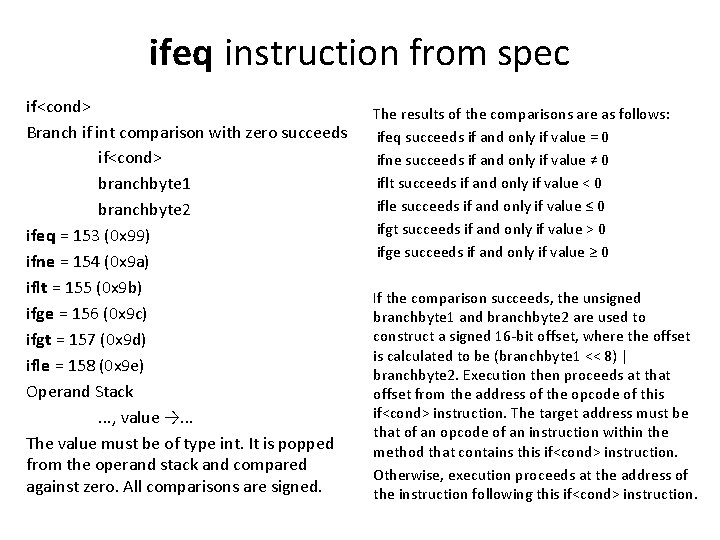
ifeq instruction from spec if<cond> Branch if int comparison with zero succeeds if<cond> branchbyte 1 branchbyte 2 ifeq = 153 (0 x 99) ifne = 154 (0 x 9 a) iflt = 155 (0 x 9 b) ifge = 156 (0 x 9 c) ifgt = 157 (0 x 9 d) ifle = 158 (0 x 9 e) Operand Stack. . . , value →. . . The value must be of type int. It is popped from the operand stack and compared against zero. All comparisons are signed. The results of the comparisons are as follows: ifeq succeeds if and only if value = 0 ifne succeeds if and only if value ≠ 0 iflt succeeds if and only if value < 0 ifle succeeds if and only if value ≤ 0 ifgt succeeds if and only if value > 0 ifge succeeds if and only if value ≥ 0 If the comparison succeeds, the unsigned branchbyte 1 and branchbyte 2 are used to construct a signed 16 -bit offset, where the offset is calculated to be (branchbyte 1 << 8) | branchbyte 2. Execution then proceeds at that offset from the address of the opcode of this if<cond> instruction. The target address must be that of an opcode of an instruction within the method that contains this if<cond> instruction. Otherwise, execution proceeds at the address of the instruction following this if<cond> instruction.
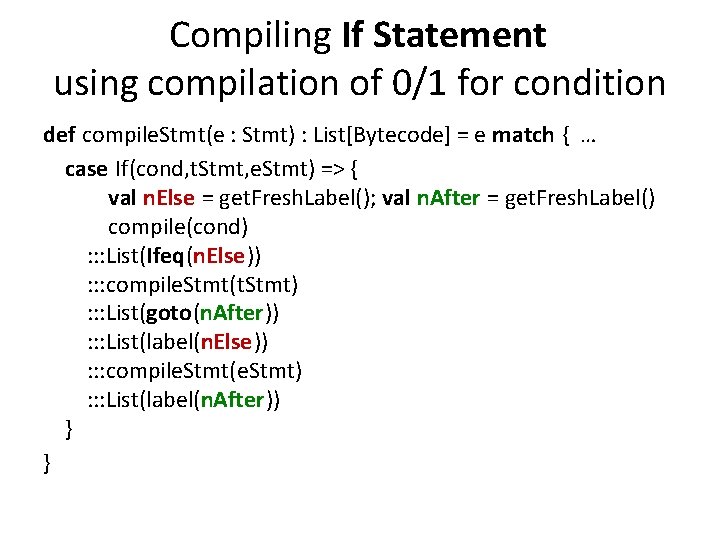
Compiling If Statement using compilation of 0/1 for condition def compile. Stmt(e : Stmt) : List[Bytecode] = e match { … case If(cond, t. Stmt, e. Stmt) => { val n. Else = get. Fresh. Label(); val n. After = get. Fresh. Label() compile(cond) : : : List(Ifeq(n. Else)) : : : compile. Stmt(t. Stmt) : : : List(goto(n. After)) : : : List(label(n. Else)) : : : compile. Stmt(e. Stmt) : : : List(label(n. After)) } }
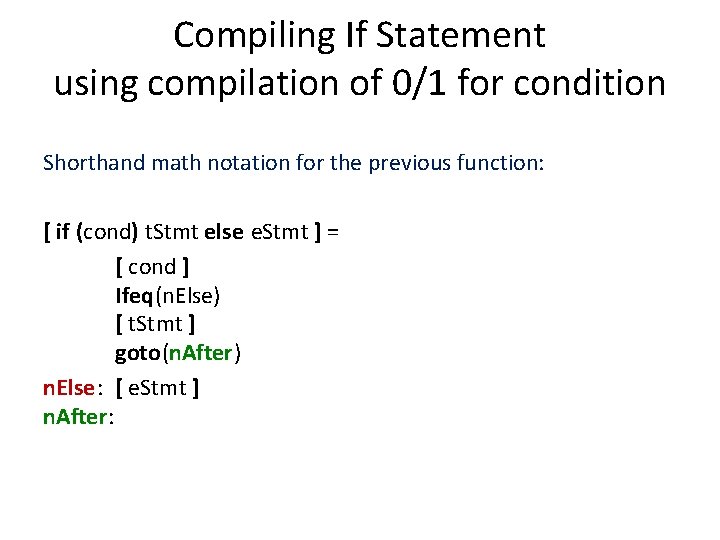
Compiling If Statement using compilation of 0/1 for condition Shorthand math notation for the previous function: [ if (cond) t. Stmt else e. Stmt ] = [ cond ] Ifeq(n. Else) [ t. Stmt ] goto(n. After) n. Else: [ e. Stmt ] n. After:
![Compiling While Statement using compilation of 0/1 for condition [ while (cond) stmt ]](http://slidetodoc.com/presentation_image_h2/ebb74be7f525a2559d901676b8cc8c32/image-13.jpg "Compiling While Statement using compilation of 0/1 for condition [ while (cond) stmt ]")
Compiling While Statement using compilation of 0/1 for condition [ while (cond) stmt ] = n. Start: [ cond ] Ifeq(n. Exit) [ stmt ] goto(n. Start) n. Exit: give a translation with only one jump during loop
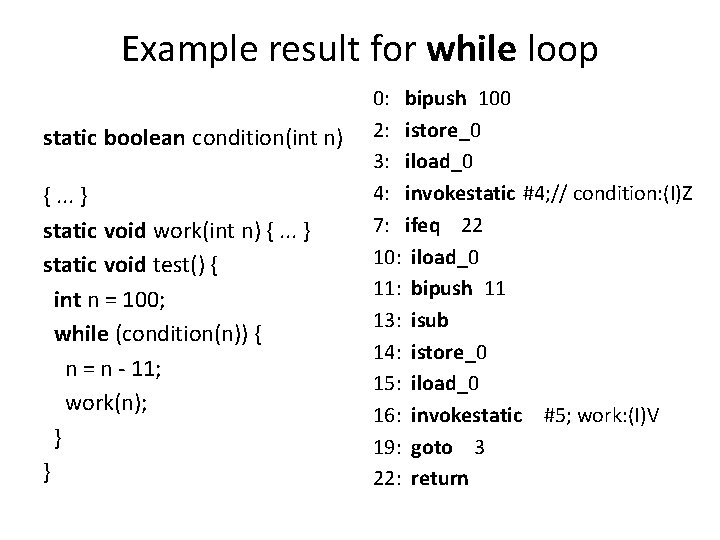
Example result for while loop static boolean condition(int n) {. . . } static void work(int n) {. . . } static void test() { int n = 100; while (condition(n)) { n = n - 11; work(n); } } 0: bipush 100 2: istore_0 3: iload_0 4: invokestatic #4; // condition: (I)Z 7: ifeq 22 10: iload_0 11: bipush 11 13: isub 14: istore_0 15: iload_0 16: invokestatic #5; work: (I)V 19: goto 3 22: return
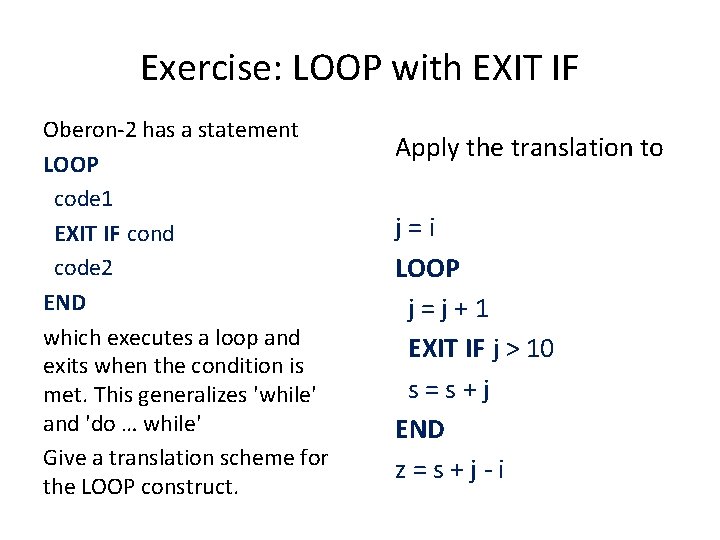
Exercise: LOOP with EXIT IF Oberon-2 has a statement LOOP code 1 EXIT IF cond code 2 END which executes a loop and exits when the condition is met. This generalizes 'while' and 'do … while' Give a translation scheme for the LOOP construct. Apply the translation to j=i LOOP j=j+1 EXIT IF j > 10 s=s+j END z=s+j-i
![solution [ LOOP code 1 EXIT IF cond code 2 END ] = start:](http://slidetodoc.com/presentation_image_h2/ebb74be7f525a2559d901676b8cc8c32/image-16.jpg "solution [ LOOP code 1 EXIT IF cond code 2 END ] = start:")
solution [ LOOP code 1 EXIT IF cond code 2 END ] = start: [ code 1 ] [ cond ] ifneq exit [ code 2 ] goto start exit:
How to compile complex boolean expressions expressed using &&, || ?
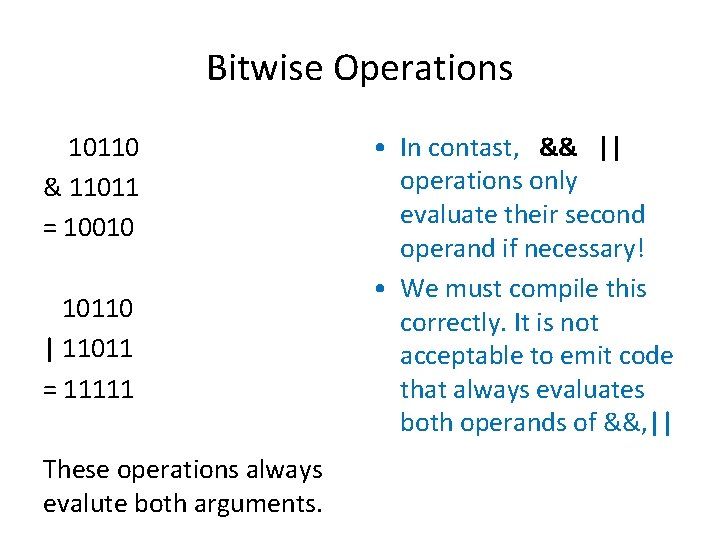
Bitwise Operations 10110 & 11011 = 10010 10110 | 11011 = 11111 These operations always evalute both arguments. • In contast, && || operations only evaluate their second operand if necessary! • We must compile this correctly. It is not acceptable to emit code that always evaluates both operands of &&, ||
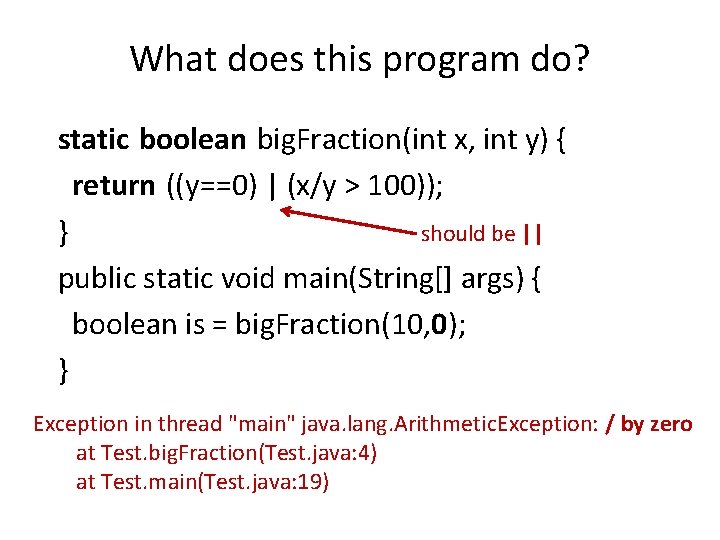
What does this program do? static boolean big. Fraction(int x, int y) { return ((y==0) | (x/y > 100)); should be || } public static void main(String[] args) { boolean is = big. Fraction(10, 0); } Exception in thread "main" java. lang. Arithmetic. Exception: / by zero at Test. big. Fraction(Test. java: 4) at Test. main(Test. java: 19)
![What does this function do? static int iterate() { int[] a = new int[10];](http://slidetodoc.com/presentation_image_h2/ebb74be7f525a2559d901676b8cc8c32/image-20.jpg "What does this function do? static int iterate() { int[] a = new int[10];")
What does this function do? static int iterate() { int[] a = new int[10]; int i = 0; int res = 0; while ((i < a. length) & (a[i] >= 0)) { i = i + 1; res = res + 1; should be && } return res; } Exception in thread "main" java. lang. Array. Index. Out. Of. Bounds. Exception : 10 at Test. iterate(Test. java: 16) at Test. main(Test. java: 25)
![Compiling Bitwise Operations - Easy [ e 1 & e 2 ] = [](http://slidetodoc.com/presentation_image_h2/ebb74be7f525a2559d901676b8cc8c32/image-21.jpg "Compiling Bitwise Operations - Easy [ e 1 & e 2 ] = [")
Compiling Bitwise Operations - Easy [ e 1 & e 2 ] = [ e 1 ] [ e 2 ] iand [ e 1 && e 2 ] = [ e 1 ] [ e 2 ] … [ e 1 | e 2 ] = [ e 1 ] [ e 2 ] ior not allowed to evaluate e 2 if e 1 is false! Also for (e 1 || e 2): if e 1 true, e 2 not evaluated
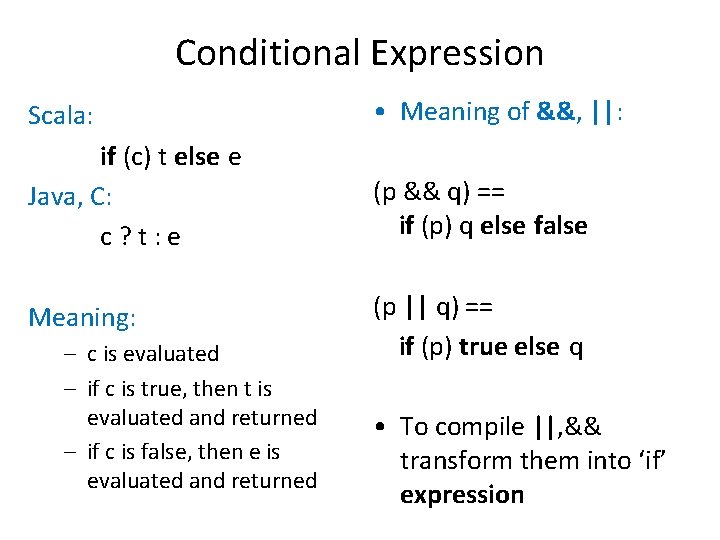
Conditional Expression Scala: • Meaning of &&, ||: if (c) t else e Java, C: c? t: e (p && q) == if (p) q else false Meaning: (p || q) == if (p) true else q – c is evaluated – if c is true, then t is evaluated and returned – if c is false, then e is evaluated and returned • To compile ||, && transform them into ‘if’ expression
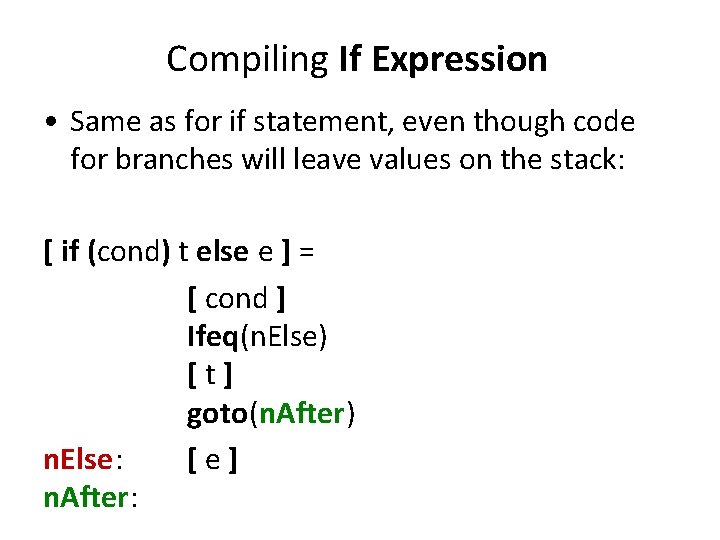
Compiling If Expression • Same as for if statement, even though code for branches will leave values on the stack: [ if (cond) t else e ] = [ cond ] Ifeq(n. Else) [t] goto(n. After) n. Else: [e] n. After:
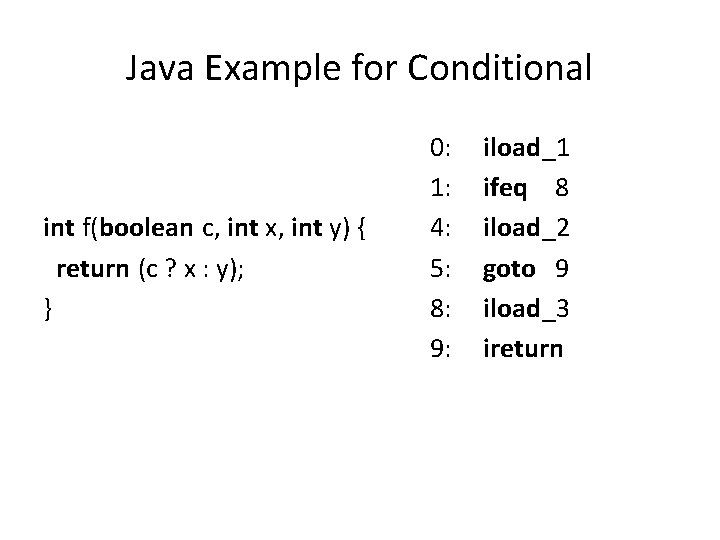
Java Example for Conditional int f(boolean c, int x, int y) { return (c ? x : y); } 0: 1: 4: 5: 8: 9: iload_1 ifeq 8 iload_2 goto 9 iload_3 ireturn
![Compiling && [ if (cond) t else e ] = [ cond ] Ifeq(n.](http://slidetodoc.com/presentation_image_h2/ebb74be7f525a2559d901676b8cc8c32/image-25.jpg "Compiling && [ if (cond) t else e ] = [ cond ] Ifeq(n.")
Compiling && [ if (cond) t else e ] = [ cond ] Ifeq(n. Else) [t] goto(n. After) n. Else: [ e ] n. After: [ p && q ] = [ if (p) q else false ] = [p] Ifeq(n. Else) [q] goto(n. After) n. Else: iconst_0 n. After:
![Compiling || [ if (cond) t else e ] = [ cond ] Ifeq(n.](http://slidetodoc.com/presentation_image_h2/ebb74be7f525a2559d901676b8cc8c32/image-26.jpg "Compiling || [ if (cond) t else e ] = [ cond ] Ifeq(n.")
Compiling || [ if (cond) t else e ] = [ cond ] Ifeq(n. Else) [t] goto(n. After) n. Else: [ e ] n. After: [ p || q ] = [ if (p) true else q ] = [p] Ifeq(n. Else) iconst_1 goto(n. After) n. Else: [ q ] n. After:
![true, false, variables [ true ] = iconst_1 for boolean variable b, for which](http://slidetodoc.com/presentation_image_h2/ebb74be7f525a2559d901676b8cc8c32/image-27.jpg "true, false, variables [ true ] = iconst_1 for boolean variable b, for which")
true, false, variables [ true ] = iconst_1 for boolean variable b, for which n = slot(b) [ false ] = iconst_0 [b]= iload_n [ b = e ] = (assignment) [e] istore_n
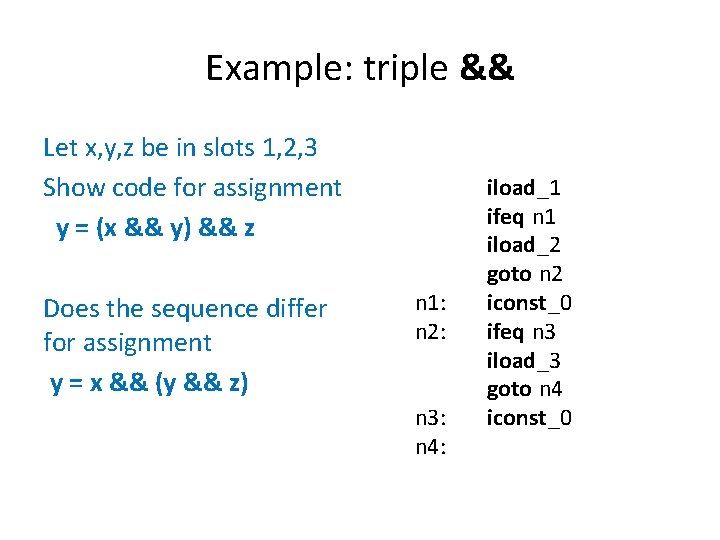
Example: triple && Let x, y, z be in slots 1, 2, 3 Show code for assignment y = (x && y) && z Does the sequence differ for assignment y = x && (y && z) n 1: n 2: n 3: n 4: iload_1 ifeq n 1 iload_2 goto n 2 iconst_0 ifeq n 3 iload_3 goto n 4 iconst_0
- Slides: 28