
Review Preoperational Centration equilibrium no coordination of thinking

Review Pre-operational Centration: equilibrium : no coordination of thinking, measure the numbers of coins using own assumption Concrete operational De-Centration: disequilibrium : coordination of thinking, measure the numbers of coins using thinking process using various aspects
What is learning? • • Concentration how to concentrate? Rehearsal; practice. Does it help? Categorical organization in memory as a strategy Learn how to remember needs to have a purpose and own strategy active involvement with the material and his concentration on the task Powers of concentration and memory are fostered in social interaction Paying more attention and complete more complicated tasks when these are more relevant to their own lives and interests and meaningful to them
Are young children illogical, or limited processors of information? • If the pre-operational children fail more than the older ones due to lack of experiences not of lack of logicalities. Then it could be possible to help them to learn how to think logically.
No pre-operational stage • But they were unable to learn or be taught how to reason logically. • Or the task (Piaget) were so unfamiliar to children ---. • Do adults reason logically in the manner implied by Piagetian theory?
Answers (Wood, Wood and Middleton, 1978) What does it mean to be taught well to complete the task on his own? What should be said or done first?
• Too much specific instruction increases child’s successful completion of the task, but decreases child’s development and responsibility for completing the task. • Too less specific instruction would not help child to complete the task but increases child’s responsibility for competing the task.
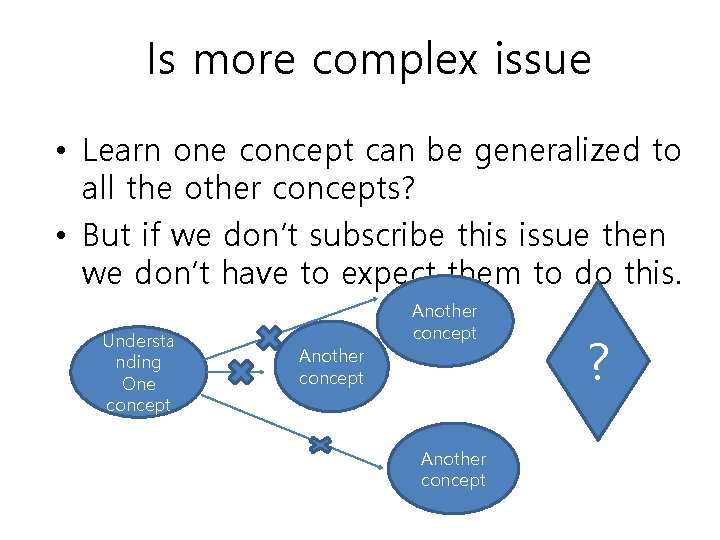
Is more complex issue • Learn one concept can be generalized to all the other concepts? • But if we don’t subscribe this issue then we don’t have to expect them to do this. Understa nding One concept Another concept ?
HOW CHILDREN LEARN COMMUNICATION? • Prompted by that which currently fills their senses. • One word, two words, three words, four words by the age of three. • Have failed to know exact development of language (Crystal, 1976) • Need paralinguistic features to understand what they mean
Synchronicity • A gesture accompanies an act of spontaneous speech at its peak. • Coordinating the act of communication. • Synchronicity of movement plays an important role in the achievement of mutual understanding. • Hearer and listener seems to be in tune.
Narrative • Usually brief talk in the child • Responsive to the adults • Need tolerance in listening to uncertainty and a willingness to wait for a speaker’s meaning to become clear • Getting things right and telling things as they really are is not usually a serious requirement. • Frequent question hinder the responses.
Teach children contingently • Making any help given conditional upon the child’s understanding of previous levels of instruction • No left the child alone when he was overwhelmed by the task, and also guaranteed him greater scope for initiative when he showed signs of success.
Levels used to classify teaching in the pyramid task. 1. General verbal encouragement (why don’t you try to put some blocks together? ) 2. Specific verbal instruction (can you find the four biggest blocks? ) 3. Assists in choice of material (let’s try to put these big ones together) 4. Prepares material for assembly (selecting the blocks and lining them up) 5. Demonstrates an operation (how a set of four blocks fit together, doing several operations herself while the child looks on)
Literacy Development?
Oral difficulty causes written difficulty. • Predict children who have problems either in hearing or in analysing the sound patterns of speech will face reading problems because they lack the necessary basis for learning how to ‘encode’ written symbols into speech sounds. • But it’s not a natural product of the ability to talk. • An object of attention or study. • Children learn literacy through quite different developmental routes, e. g. nursery rhymes, stories, word play and language games.
Fun factors; words game, stories etc • Enable them an awareness of the various levels and functions of language and may be an important preparation for the achievement of literacy itself.
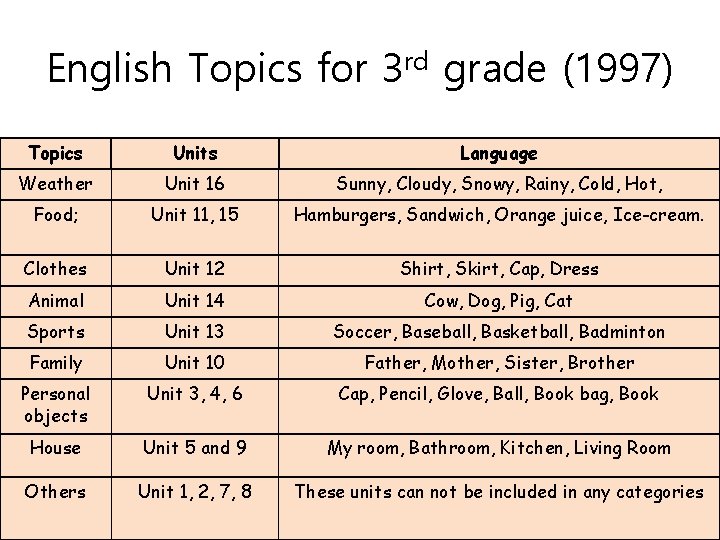
English Topics for 3 rd grade (1997) Topics Units Language Weather Unit 16 Sunny, Cloudy, Snowy, Rainy, Cold, Hot, Food; Unit 11, 15 Hamburgers, Sandwich, Orange juice, Ice-cream. Clothes Unit 12 Shirt, Skirt, Cap, Dress Animal Unit 14 Cow, Dog, Pig, Cat Sports Unit 13 Soccer, Baseball, Basketball, Badminton Family Unit 10 Father, Mother, Sister, Brother Personal objects Unit 3, 4, 6 Cap, Pencil, Glove, Ball, Book bag, Book House Unit 5 and 9 My room, Bathroom, Kitchen, Living Room Others Unit 1, 2, 7, 8 These units can not be included in any categories
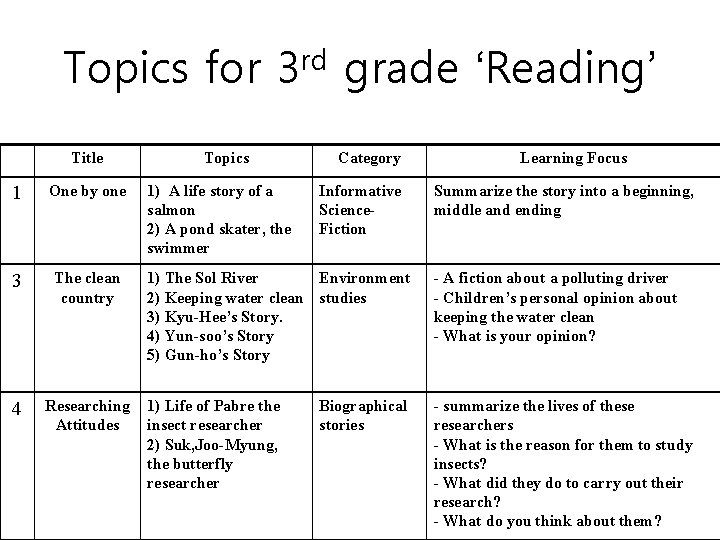
Topics for 3 rd grade ‘Reading’ Title 1 One by one 3 The clean country 4 Researching Attitudes Topics 1) A life story of a salmon 2) A pond skater, the swimmer Category Informative Science. Fiction Learning Focus Summarize the story into a beginning, middle and ending 1) The Sol River Environment 2) Keeping water clean studies 3) Kyu-Hee’s Story. 4) Yun-soo’s Story 5) Gun-ho’s Story - A fiction about a polluting driver - Children’s personal opinion about keeping the water clean - What is your opinion? 1) Life of Pabre the insect researcher 2) Suk, Joo-Myung, the butterfly researcher - summarize the lives of these researchers - What is the reason for them to study insects? - What did they do to carry out their research? - What do you think about them? Biographical stories
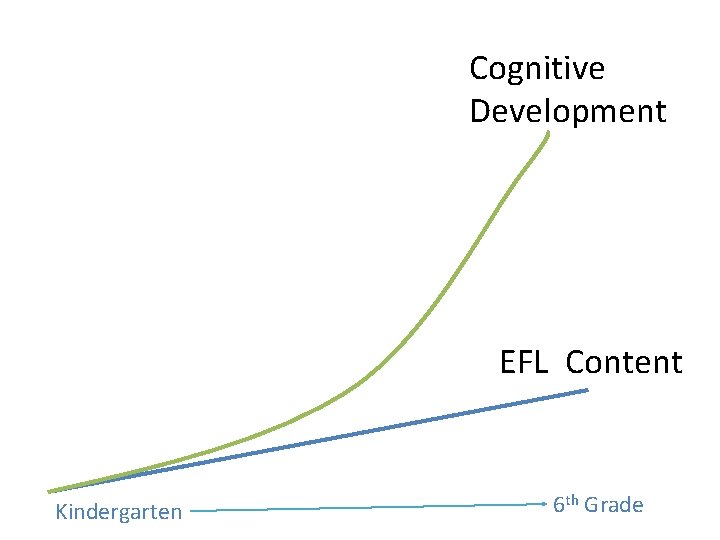
Cognitive Development EFL Content Kindergarten 6 th Grade
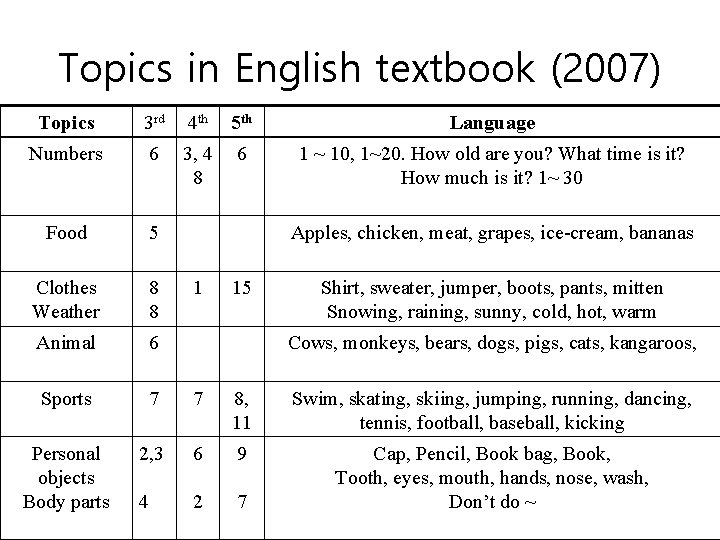
Topics in English textbook (2007) Topics 3 rd 4 th 5 th Language Numbers 6 3, 4 8 6 1 ~ 10, 1~20. How old are you? What time is it? How much is it? 1~ 30 Food 5 Clothes Weather 8 8 Animal 6 Sports 7 7 8, 11 Swim, skating, skiing, jumping, running, dancing, tennis, football, baseball, kicking Personal objects Body parts 2, 3 6 9 4 2 7 Cap, Pencil, Book bag, Book, Tooth, eyes, mouth, hands, nose, wash, Don’t do ~ Apples, chicken, meat, grapes, ice-cream, bananas 1 15 Shirt, sweater, jumper, boots, pants, mitten Snowing, raining, sunny, cold, hot, warm Cows, monkeys, bears, dogs, pigs, cats, kangaroos,
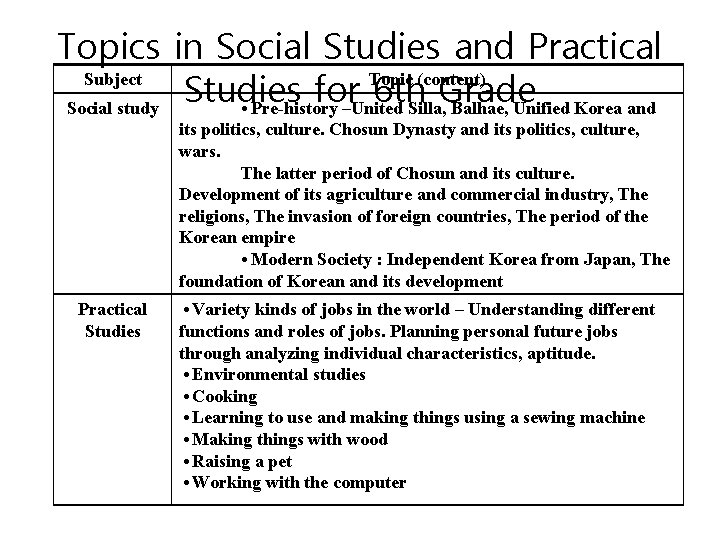
Topics in Social Studies and Practical Subject Topic (content) Studies for 6 th Grade Social study • Pre-history –United Silla, Balhae, Unified Korea and its politics, culture. Chosun Dynasty and its politics, culture, wars. The latter period of Chosun and its culture. Development of its agriculture and commercial industry, The religions, The invasion of foreign countries, The period of the Korean empire • Modern Society : Independent Korea from Japan, The foundation of Korean and its development Practical Studies • Variety kinds of jobs in the world – Understanding different functions and roles of jobs. Planning personal future jobs through analyzing individual characteristics, aptitude. • Environmental studies • Cooking • Learning to use and making things using a sewing machine • Making things with wood • Raising a pet • Working with the computer
Kindergarten geography related topics • Oceans and continents : map, sea, land, sky, direction • Countries and flags • Houses in the world.
Primary school • 3 rd Grade • Understanding the concept of a community and village. • Direction, location, function of places in the village.
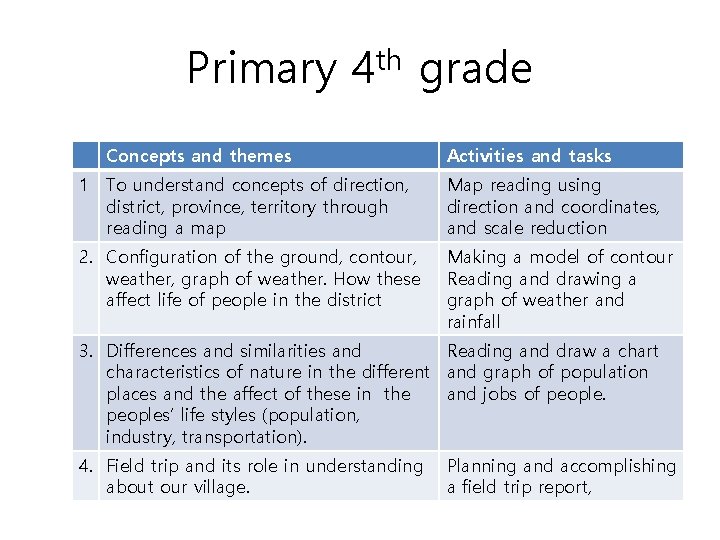
Primary 4 th grade Concepts and themes Activities and tasks 1 To understand concepts of direction, district, province, territory through reading a map Map reading using direction and coordinates, and scale reduction 2. Configuration of the ground, contour, weather, graph of weather. How these affect life of people in the district Making a model of contour Reading and drawing a graph of weather and rainfall 3. Differences and similarities and Reading and draw a chart characteristics of nature in the different and graph of population places and the affect of these in the and jobs of peoples’ life styles (population, industry, transportation). 4. Field trip and its role in understanding about our village. Planning and accomplishing a field trip report,
High school geography • "to develop in young people a knowledge and understanding of the place they live in, of other people and places, and of how people and places inter-relate and interconnect; of the significance of location; of human and physical environments; of peopleenvironment relationships; and of the causes and consequences of change,
• to develop the skills needed to carry out geographical study, e. g. geographical enquiry, mapwork and fieldwork • to stimulate an interest in, and encourage and appreciation of the world around us, and • to develop an informed concern for the world around us and an ability and willingness to take positive action, both locally and globally. “ • http: //geography. about. com/od/lists/u/ba sics. htm
Chapter 11 Reading and Mathematics 1. Why is it that rhyme is so important in learning to read? 2. Think about the major challenges presented to a child learning to read an alphabetic script. 3. Think about the evidence suggesting that children must acquire certain logical abilities before they can understand number.
Question 1 • Why is it that rhyme is so important in learning to read? • What is rhyme?
Definitions • Orthographies: • Phonemes: smallest unit of sound. Alphabetic. • Phonemic awareness: • Morpheme : a unit of meaning • Children 4, 5, and 6 learn better with syllables than phonemes
Learning to read and phonemic awareness • The more children have learned about phonemes, the better they read and write (Bjaalid, Hoien, & Lundberg, 1996; Demont & Gombert, 1996; Ehri, 1995; ---)
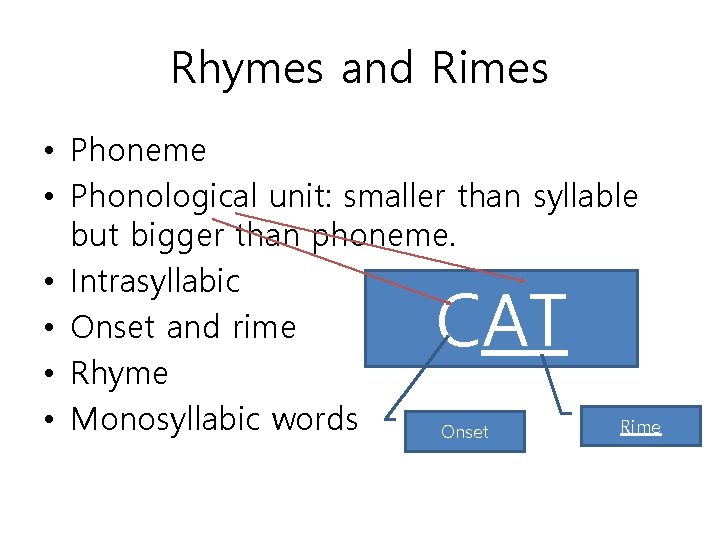
Rhymes and Rimes • Phoneme • Phonological unit: smaller than syllable but bigger than phoneme. • Intrasyllabic • Onset and rime • Rhyme • Monosyllabic words Rime Onset CAT
Early awareness of rimes predicts reading success • 3 yr: rhyme oddity problems (hat, cat, pin) Well but not perfectly • Success in learning rhyme in early age predicts later literacy ( Bradley & Bryant, 1983; Bryant, Maclean, Bradley, & Crossland, 1990)
Using Onsets and rhymes to learn letter sequences • Give cue rhyme words and apply this into reading unknown words. • Successful • ?
Why is it that rhyme is so important in learning to read? • Why? English script is notoriously capricious at the level of the relationships between single letters and phonemes, but the relationship between sequences of letters and sequences of phonemes is a great deal more reliable. • Any other?
Question 4: Think about the major challenges presented to a child learning to read an alphabetic script • • • Conditional rules: C+a, u. , o= K C + I, e, y = S Letter-sound associations Morepheme words: unpacked. Overgeneralization
Think about the major challenges presented to a Korean child learning to read an alphabetic script • Yoon (2007)
Number and counting
Definitions • Cardinality: any set of items with a particular number is equal in quantity to any other set with the same number of items in it. No mater how these numbers are aligned. • Ordinality: Numbers come in an ordered scale of magnitude: transitive inferences.
Universal counting principles 1. How to count: one-to-one principle, which is that one must count all the objects in a set once and once only: each one must be given just one number tag. 2. Stable order principle: one must produce the number words, when counting, in a set order, and in the same set order each time. 3. Last number counted: The last number counted represents the value of the set.
Q 3: Think about the evidence suggesting that children must acquire certain logical abilities before they can understand number. • Lack of logic and cardinality. Conservation Greco (1962) 4 and 8 ask them to count one of the sets and were then asked to infer the number of the second set. Both age group failed.
Q 3: Think about the evidence suggesting that children must acquire certain logical abilities before they can understand number. • Young children do not realize that • Same number = same quantity • One-to one correspondence.
What about other mathematical concepts? Addition, Subtraction, Multiplication Division, Fraction, Equation, etc. Can the pre-operational children understand all these concepts? What about concrete-operational children? Why and how?
Homework • Modify one of phonics activity reflecting the characteristics of age 6 and age 11. • Select one mathematical concept and find out ways of teaching the concept reflecting children’s cognitive level. • Read chapter 13 and answer to only three questions among these 4 QS number 1 -2 -34. • Find out how and what do children in preschool and primary school learn concepts in scientific matters.
- Slides: 43