
Review on Fabrication Methods of in situ Metal

Review on Fabrication Methods of in situ Metal Matrix Composites By: 1. 2. 3. 4. 5. 6. 7. LAW MEI LIN MOHD AQHAIRI BIN BAHARI MOHAMAD IZZUDIN BIN ABDUL HAMID NOOR AYUHAAN BINTI ABD LAH RIANAH BINTI JIREN SITI SAINILLAH BINTI SULAIMAN NADIAH BINTI JAAFAR B 050810007 B 050810175 B 050810048 B 050910310 B 050910060 B 050910279 B 050910296 4 BMFB 1 4 BMFB 2 4 BMFB 1 1
What is In Situ? In situ is a Latin phrase which translates literally to 'In position'. 2

What is in situ techniques? Involve a chemical reaction resulting in the formation of a very fine and thermodynamically stable reinforcing ceramic phase within a metal matrix. 3
Advantages of in situ techniques 1. There is thermodynamic compatibility at the matrix-reinforcement interface. 2. Also, the reinforcement surfaces are likely to be free of contamination. ~ Therefore, stronger matrixdispersion bond can be achieved. 4
Technologies 1. Powder Metallurgy Method (Fabrication of in situ Fe/Ti. C) 2. Liquid-Gas Reaction (Fabrication Al. N/Al composite) 3. Solid-Gas-Liquid Reaction Method (Formation of fine single crystal Ti. C platelets in the Al based matrix ) 4. In situ – Processed by Ingot Metallurgy (Fabrication of Al-Ti. C composites) 5. Plasma Metallurgy Method 5

In situ – Processed by Ingot Metallurgy What it means? in which the solidification process where the reinforcing particles are formed in situ in the molten alloy. Attractiveness: 1. Simplicity 2. Economy 3. Flexibility 6
In situ – Processed by Ingot Metallurgy 1. Tong and Fang (1998) fabricated Al-Ti. C composites: • with refined microstructure, • enhanced dispersion hardening of the reinforcing phases 7

Process 8
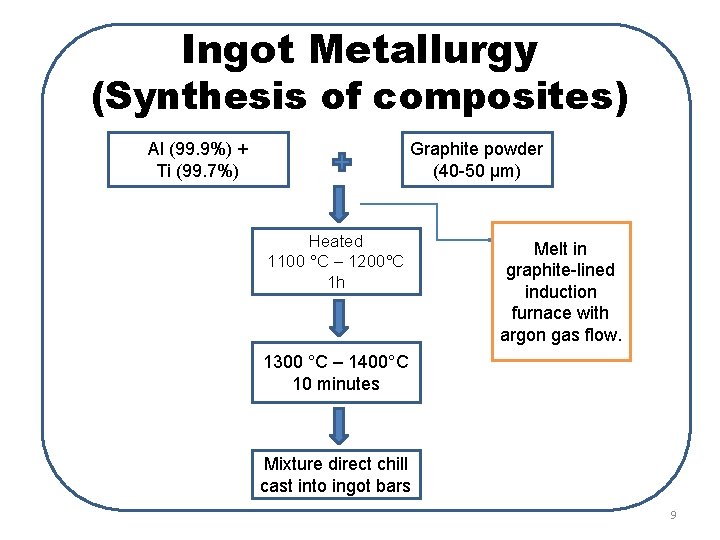
Ingot Metallurgy (Synthesis of composites) Al (99. 9%) + Ti (99. 7%) Graphite powder (40 -50 μm) Heated 1100 °C – 1200°C 1 h Melt in graphite-lined induction furnace with argon gas flow. 1300 °C – 1400°C 10 minutes Mixture direct chill cast into ingot bars 9

Diagram Example of Ingot Metallurgy 10
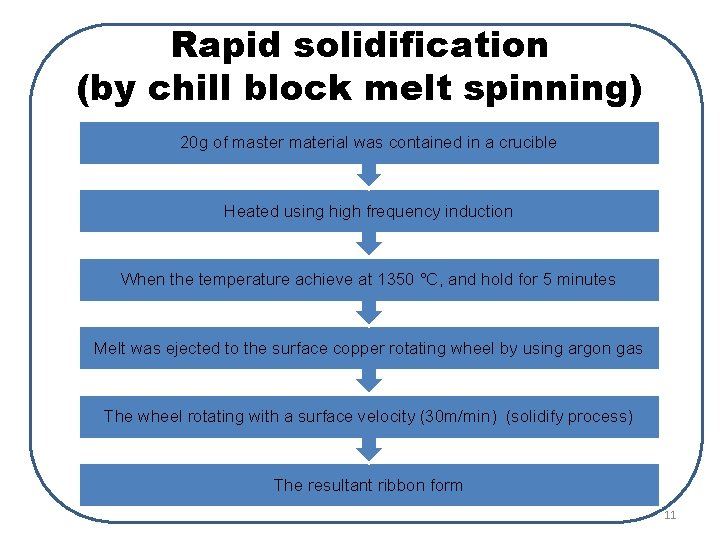
Rapid solidification (by chill block melt spinning) 20 g of master material was contained in a crucible Heated using high frequency induction When the temperature achieve at 1350 °C, and hold for 5 minutes Melt was ejected to the surface copper rotating wheel by using argon gas The wheel rotating with a surface velocity (30 m/min) (solidify process) The resultant ribbon form 11
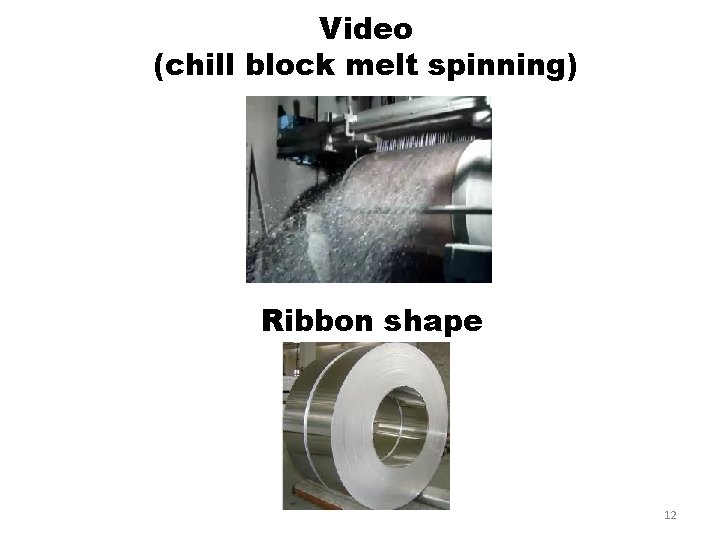
Video (chill block melt spinning) Ribbon shape 12
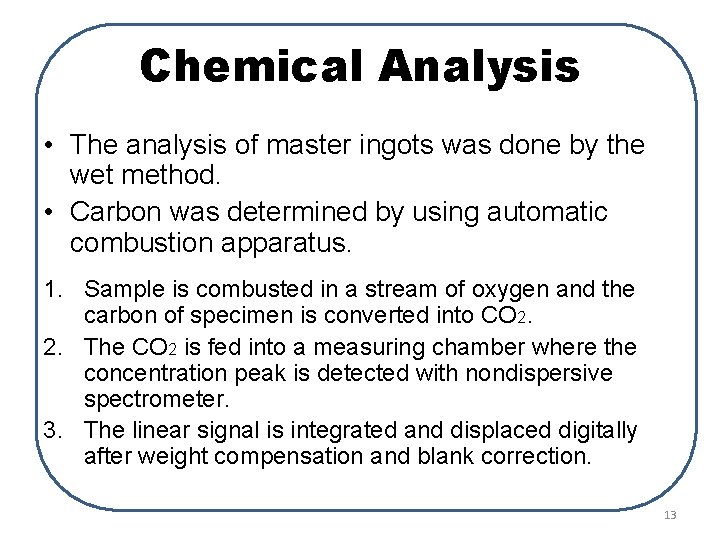
Chemical Analysis • The analysis of master ingots was done by the wet method. • Carbon was determined by using automatic combustion apparatus. 1. Sample is combusted in a stream of oxygen and the carbon of specimen is converted into CO 2. 2. The CO 2 is fed into a measuring chamber where the concentration peak is detected with nondispersive spectrometer. 3. The linear signal is integrated and displaced digitally after weight compensation and blank correction. 13
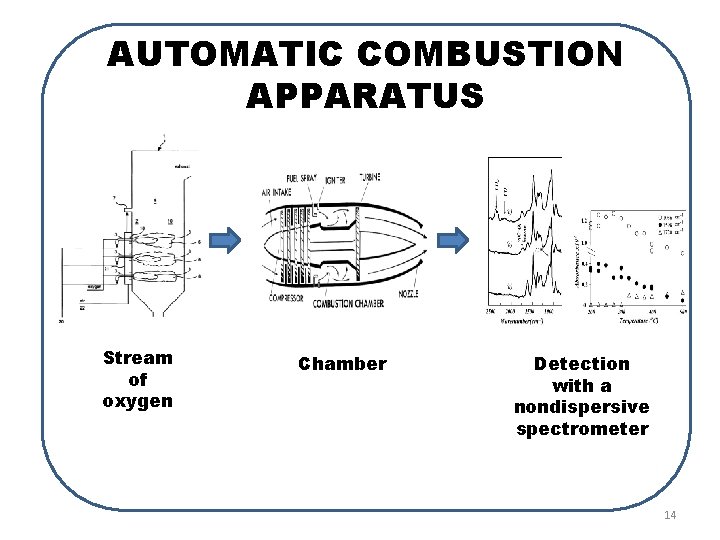
AUTOMATIC COMBUSTION APPARATUS Stream of oxygen Chamber Detection with a nondispersive spectrometer 14

Applications 15
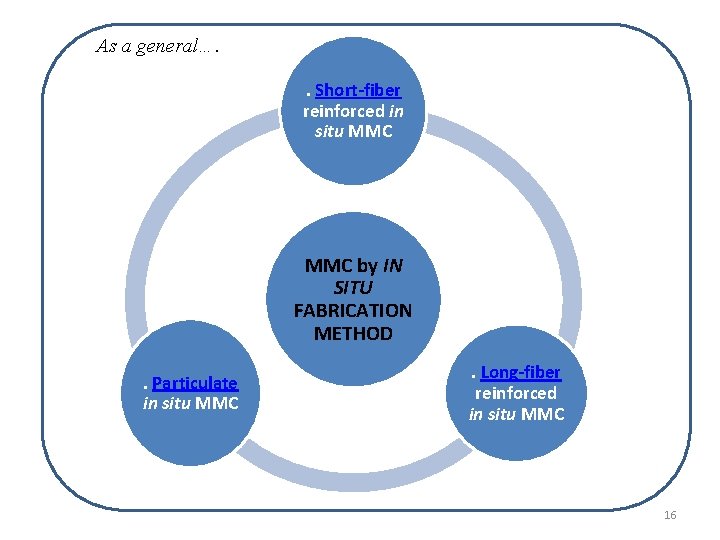
As a general…. . Short-fiber reinforced in situ MMC by IN SITU FABRICATION METHOD. Particulate in situ MMC . Long-fiber reinforced in situ MMC 16
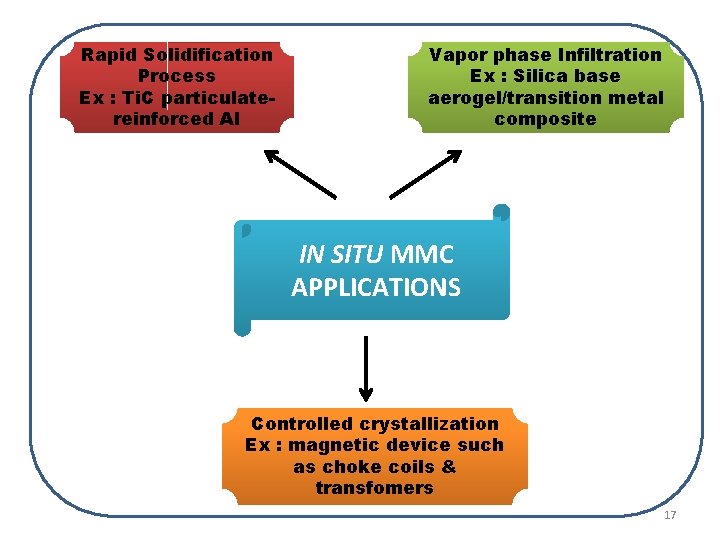
Rapid Solidification Process Ex : Ti. C particulatereinforced Al Vapor phase Infiltration Ex : Silica base aerogel/transition metal composite IN SITU MMC APPLICATIONS Controlled crystallization Ex : magnetic device such as choke coils & transfomers 17
APPLICATIONS OF IN SITU 1) Aerospace v. In the aerospace industry, equipment on-board aircraft must be tested in situ, or in place, to confirm everything functions properly as a system 2) Petroleum production v. In situ refers to recovery techniques which apply heat or solvents to heavy oil or bitumen reservoirs beneath the earth's crust. 3) Experimental Physics v. In situ refers to a method of data collection or manipulation of a sample without exposure to an external environment. 4) Biology v. In situ means to examine the phenomenon exactly in place where it occurs (i. e. without moving it to some special medium).

Q&A 19
1. What is the criteria for reinforcement selection? In general, There are necessary criteria or conditions that must be satisfied for the selection of a ceramic as reinforcement in the manufacture of good and standard metal matrix composites. Such criteria include density, melting temperature, size and shape, elastic modulus, tensile strength, thermal stability, compatibility with matrix material, coefficient of thermal expansion, and cost.
2. Why choose Ti and Al for the In-situ processed by Ingot metallurgy? In general, selection of metal or its alloy as matrix for production of MMC depends on the type, required properties and the kind of application where such composite is required. From this experiment, Al based and Ti based metal matrix composites have a high potential for advanced structural applications when high specific strength as well as good elevated temperature resistance.
3. Why the particulate reinforced MMCs are more interesting due to their ease of fabrication, low costs, and isotropic properties? Answer : The properties of MMCs are controlled by the size and volume fraction of the reinforcement phase as well by the nature of the matrix reinforcement interface 4. In traditional MMCs, wetting between molten metal and reinforcements is often poor. How this problem can be treated? Answer : This problem can be treated through a strongly reactive alloying addition, such as Mg and Li and through reinforcement coating.
5) How do we know if MMC is a hybrid composite? 6) What do you have in mind about in situ hybrid composite? A metal matrix composite (MMC) is composite material with at least two constituent parts, one being a metal. The other material may be a different metal or another material, such as a ceramic or organic compound. When at least three materials are present, it is called a hybrid composite. Scientist do hybrid to pick up good qualities. So there are 2 things better in something they try to mix and make a best item. For e. g. some flower have good looks but no smell and other have great smell but dull look so they mix and try to make a flower with great look and smell together. The authors suggest that it may name as in situ hybrid composite because: 1) It can be achieved in a short processing time 2) Many kinds of ceramic powder can be put into alloy liquid
- Slides: 23