
Review of Virginias Financial Aid Funding Formulas and
- Slides: 18
Review of Virginia's Financial Aid Funding Formulas and Awarding Practices Student Financial Aid Research Network Conference June 11, 2020 0
Tom Allison Senior Associate of Finance & Innovation State Council of Higher Education for Virginia Tomallison@schev. edu @Tomallison Review of Financial Aid Funding Formulas and Awarding Practices https: //www. schev. edu/docs/default-source/Reports-and. Studies/2019/financialaidreport 102019. pdf 1
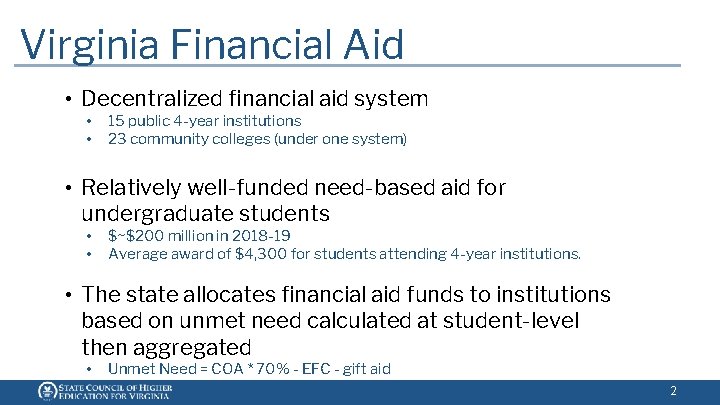
Virginia Financial Aid • Decentralized financial aid system • • 15 public 4 -year institutions 23 community colleges (under one system) • Relatively well-funded need-based aid for undergraduate students • • $~$200 million in 2018 -19 Average award of $4, 300 for students attending 4 -year institutions. • The state allocates financial aid funds to institutions based on unmet need calculated at student-level then aggregated • Unmet Need = COA * 70% - EFC - gift aid 2
Budget Bill - HB 1700 (Chapter 854) K. 1. The State Council of Higher Education for Virginia, in consultation from representatives from House Appropriations Committee, Senate Finance Committee, Department of Planning and Budget, Secretary of Finance and Secretary of Education, as well as representatives of public higher education institutions, shall review financial aid funding models and awarding practices. 2. The Council shall review current and prospective financial aid funding models including, but not limited to, how the various models determine individual and aggregate student financial need, the recommended state portion of meeting that need, how funding is most efficiently and effectively allocated among the institutions, how financial aid allocations can be aligned with other funding for higher education and how these funds are used to address student affordability and completion of a degree. The review shall also assess how the utilization of tuition and fee revenue for financial aid, pursuant to the Top Jobs Act, prioritizes and addresses affordability for low- and middle-income students. 3. By November 1, 2019, the Council shall submit a report and any related recommendations to the Governor and the Chairmen of the House Appropriations and Senate Finance Committees. 3
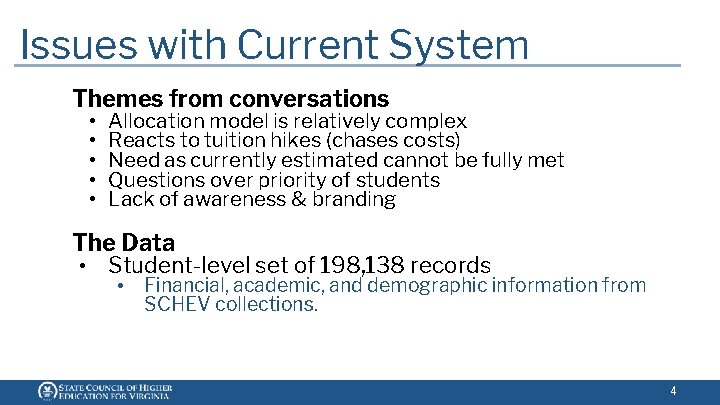
Issues with Current System Themes from conversations • • • Allocation model is relatively complex Reacts to tuition hikes (chases costs) Need as currently estimated cannot be fully met Questions over priority of students Lack of awareness & branding The Data • Student-level set of 198, 138 records • Financial, academic, and demographic information from SCHEV collections. 4
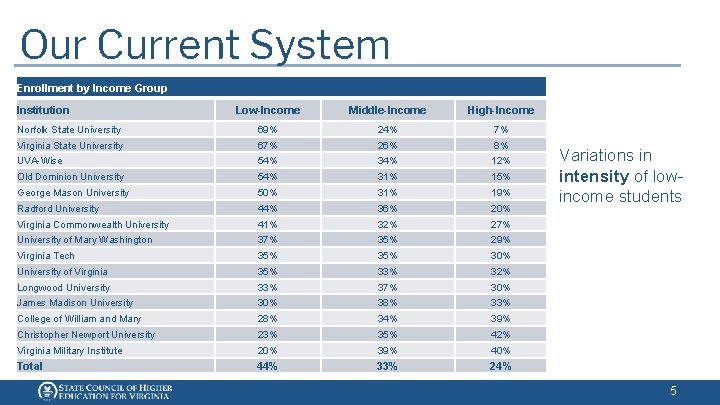
Our Current System Enrollment by Income Group Institution Low-Income Middle-Income High-Income Norfolk State University 69% 24% 7% Virginia State University 67% 26% 8% UVA-Wise 54% 34% 12% Old Dominion University 54% 31% 15% George Mason University 50% 31% 19% Radford University 44% 36% 20% Virginia Commonwealth University 41% 32% 27% University of Mary Washington 37% 35% 29% Virginia Tech 35% 30% University of Virginia 35% 33% 32% Longwood University 33% 37% 30% James Madison University 30% 38% 33% College of William and Mary 28% 34% 39% Christopher Newport University 23% 35% 42% Virginia Military Institute 20% 39% 40% Total 44% 33% 24% Variations in intensity of lowincome students 5
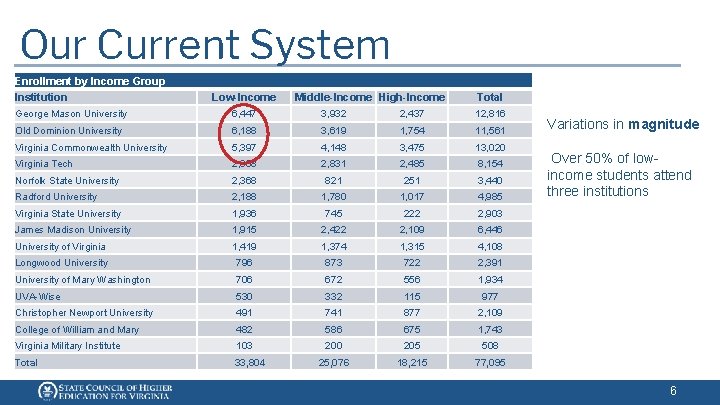
Our Current System Enrollment by Income Group Institution Low-Income Middle-Income High-Income Total George Mason University 6, 447 3, 932 2, 437 12, 816 Old Dominion University 6, 188 3, 619 1, 754 11, 561 Virginia Commonwealth University 5, 397 4, 148 3, 475 13, 020 Virginia Tech 2, 838 2, 831 2, 485 8, 154 Norfolk State University 2, 368 821 251 3, 440 Radford University 2, 188 1, 780 1, 017 4, 985 Virginia State University 1, 936 745 222 2, 903 James Madison University 1, 915 2, 422 2, 109 6, 446 University of Virginia 1, 419 1, 374 1, 315 4, 108 Longwood University 796 873 722 2, 391 University of Mary Washington 706 672 556 1, 934 UVA-Wise 530 332 115 977 Christopher Newport University 491 741 877 2, 109 College of William and Mary 482 586 675 1, 743 Virginia Military Institute 103 200 205 508 Total 33, 804 25, 076 18, 215 77, 095 Variations in magnitude Over 50% of lowincome students attend three institutions 6
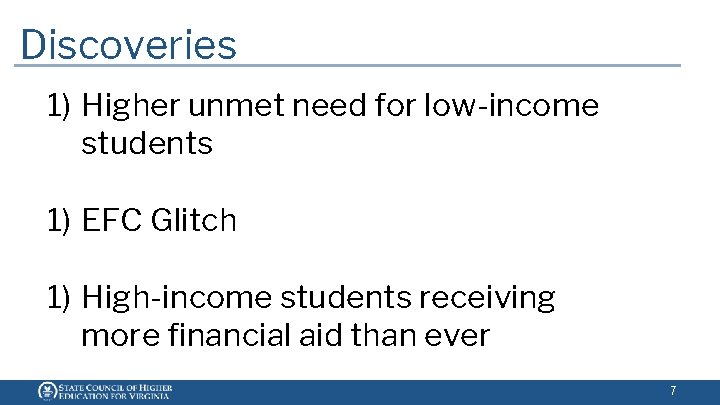
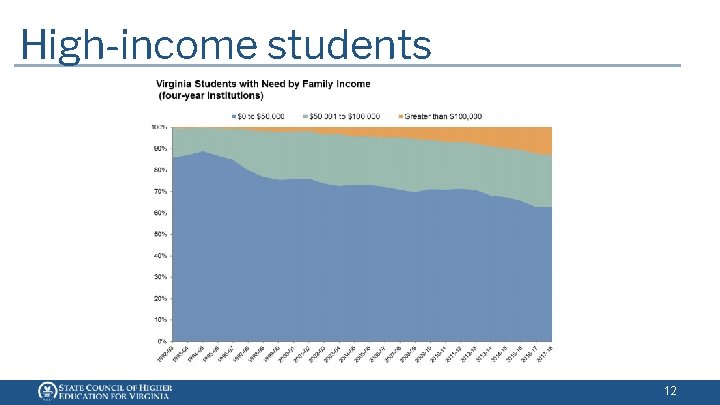
Discoveries 1) Higher unmet need for low-income students 1) EFC Glitch 1) High-income students receiving more financial aid than ever 7
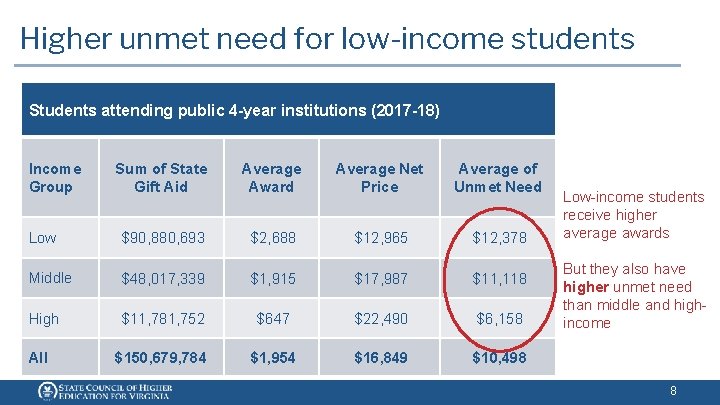
Higher unmet need for low-income students Students attending public 4 -year institutions (2017 -18) Income Group Sum of State Gift Aid Average Award Average Net Price Average of Unmet Need Low $90, 880, 693 $2, 688 $12, 965 $12, 378 Middle $48, 017, 339 $1, 915 $17, 987 $11, 118 High $11, 781, 752 $647 $22, 490 $6, 158 $150, 679, 784 $1, 954 $16, 849 $10, 498 All Low-income students receive higher average awards But they also have higher unmet need than middle and highincome 8
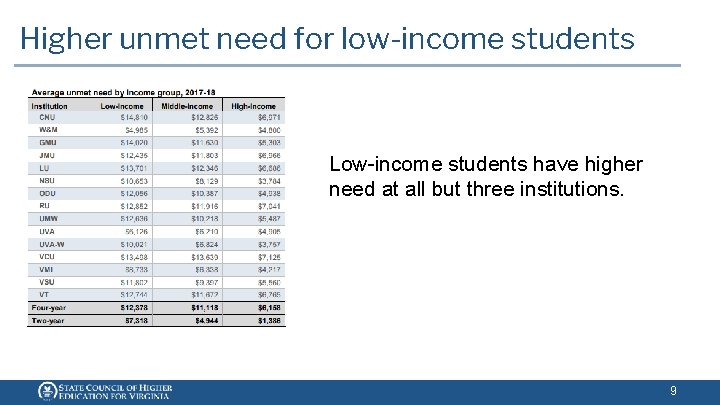
Higher unmet need for low-income students Low-income students have higher need at all but three institutions. 9
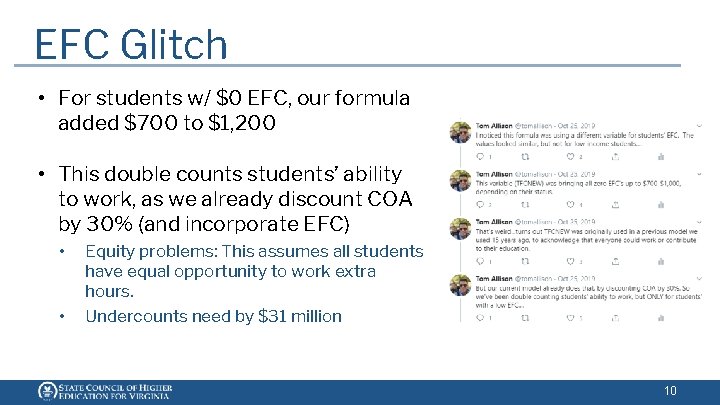
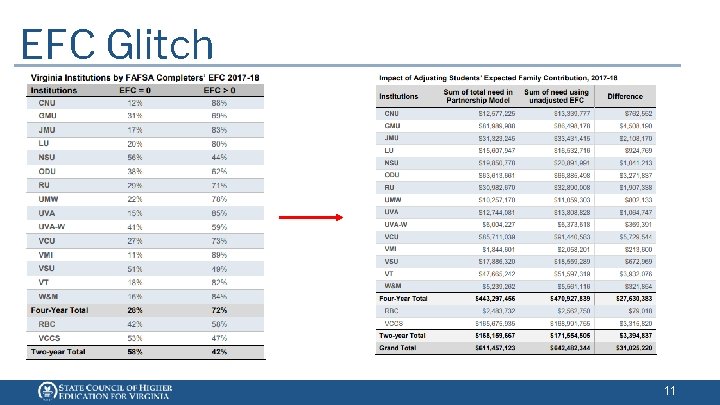
EFC Glitch • For students w/ $0 EFC, our formula added $700 to $1, 200 • This double counts students’ ability to work, as we already discount COA by 30% (and incorporate EFC) • • Equity problems: This assumes all students have equal opportunity to work extra hours. Undercounts need by $31 million 10
EFC Glitch 11
High-income students 12
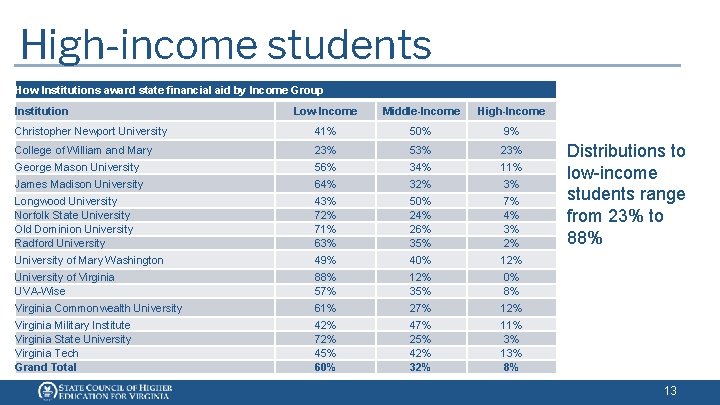
High-income students How Institutions award state financial aid by Income Group Institution Low-Income Middle-Income High-Income Christopher Newport University 41% 50% 9% College of William and Mary 23% 53% 23% George Mason University 56% 34% 11% James Madison University 64% 32% 3% Longwood University Norfolk State University Old Dominion University Radford University 43% 72% 71% 63% 50% 24% 26% 35% 7% 4% 3% 2% University of Mary Washington 49% 40% 12% University of Virginia UVA-Wise 88% 57% 12% 35% 0% 8% Virginia Commonwealth University 61% 27% 12% Virginia Military Institute Virginia State University Virginia Tech Grand Total 42% 72% 45% 60% 47% 25% 42% 32% 11% 3% 13% 8% Distributions to low-income students range from 23% to 88% 13
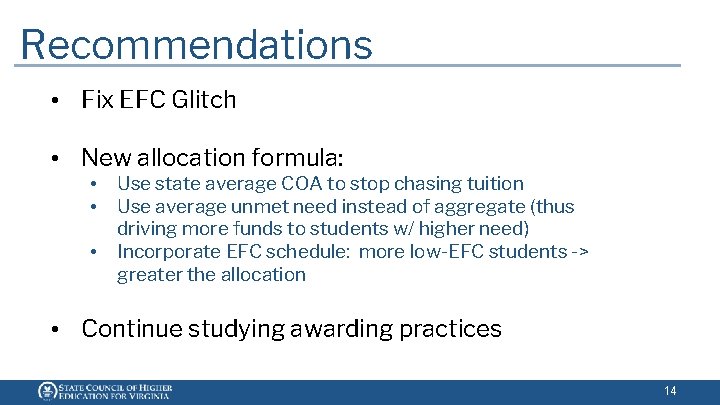
Recommendations • Fix EFC Glitch • New allocation formula: • • • Use state average COA to stop chasing tuition Use average unmet need instead of aggregate (thus driving more funds to students w/ higher need) Incorporate EFC schedule: more low-EFC students -> greater the allocation • Continue studying awarding practices 14
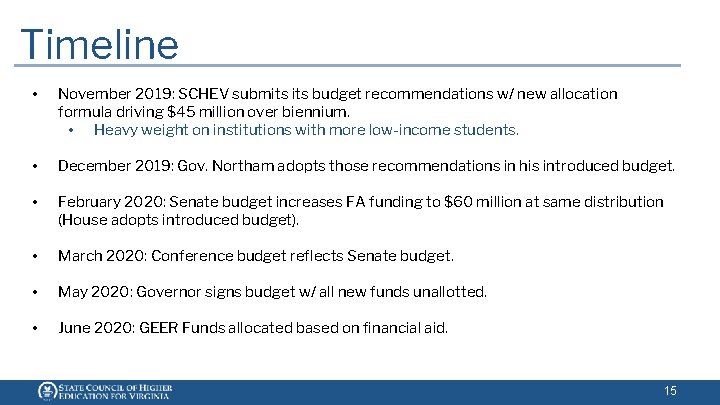
Timeline • November 2019: SCHEV submits budget recommendations w/ new allocation formula driving $45 million over biennium. • Heavy weight on institutions with more low-income students. • December 2019: Gov. Northam adopts those recommendations in his introduced budget. • February 2020: Senate budget increases FA funding to $60 million at same distribution (House adopts introduced budget). • March 2020: Conference budget reflects Senate budget. • May 2020: Governor signs budget w/ all new funds unallotted. • June 2020: GEER Funds allocated based on financial aid. 15
Takeaways • The importance of vision (literally) • Buy-in matters • You never know how the work will be used (don’t give up) 16
Discussion 17