
Review of Ultrasonic Imaging 1 Clinical Values of
- Slides: 24
Review of Ultrasonic Imaging 1
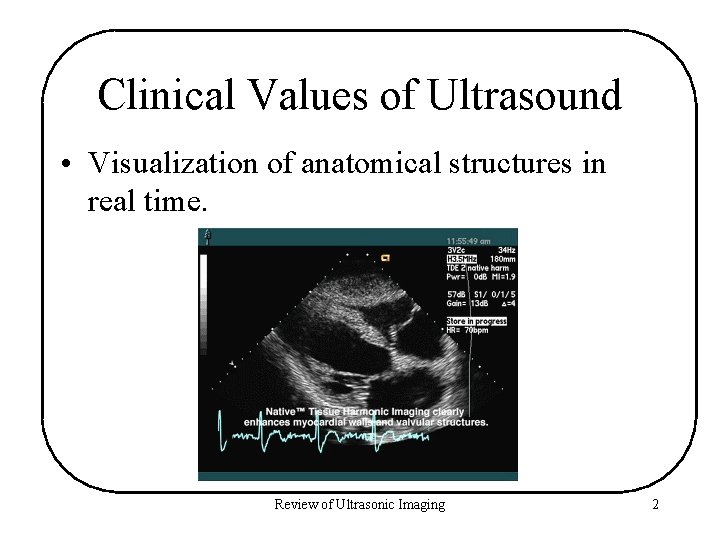
Clinical Values of Ultrasound • Visualization of anatomical structures in real time. Review of Ultrasonic Imaging 2
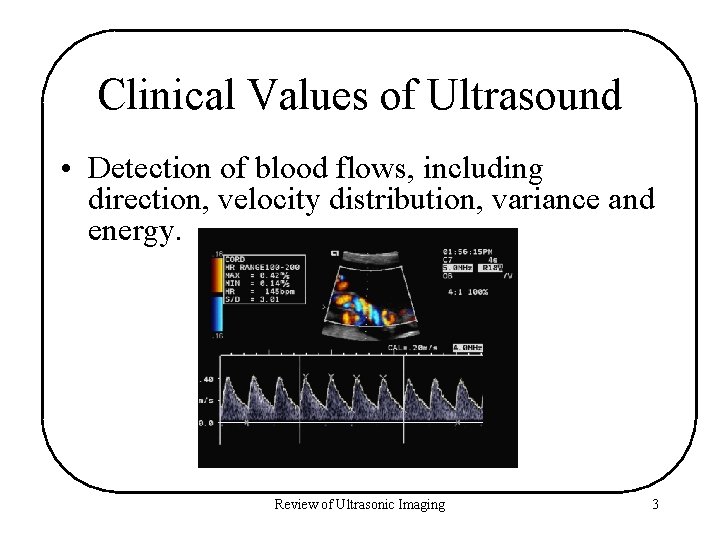
Clinical Values of Ultrasound • Detection of blood flows, including direction, velocity distribution, variance and energy. Review of Ultrasonic Imaging 3
Clinical Values of Ultrasound • Estimation of mechanical properties such as strain, elasticity, attenuation, acoustic backscattering, …etc. • Treatment of diseased tissue by hyperthermia. • Treatment of stones by extracorporeal lithotripsy. Review of Ultrasonic Imaging 4
Characteristics of Ultrasonic Imaging • Real-time. • Reflection mode. • Non-invasive. • Access limited. • Body type dependent. Review of Ultrasonic Imaging 5
Factors of Image Quality • • • Spatial resolution. Contrast resolution. Temporal resolution. Uniformity. Sensitivity. Penetration. Review of Ultrasonic Imaging 6
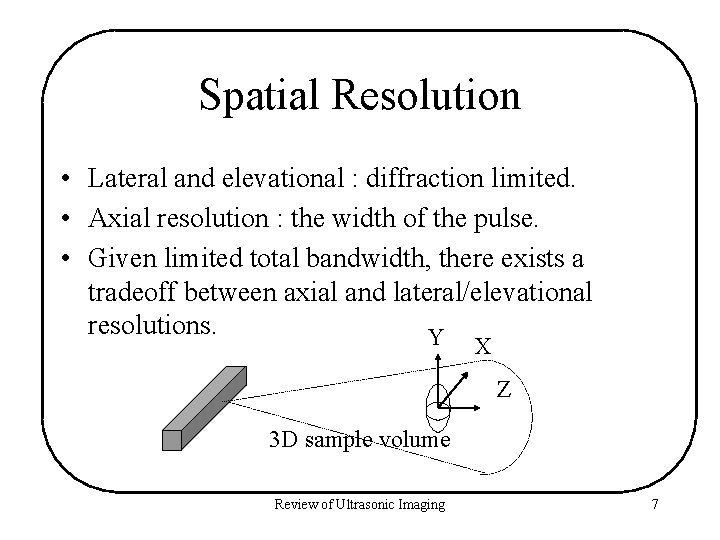
Spatial Resolution • Lateral and elevational : diffraction limited. • Axial resolution : the width of the pulse. • Given limited total bandwidth, there exists a tradeoff between axial and lateral/elevational resolutions. Y X Z 3 D sample volume Review of Ultrasonic Imaging 7
Lateral Resolution (X) • Diffraction limited. • Fourier transform of the aperture function (in focus, CW). • Determined by frequency, active aperture size and depth. • Fixed transmit focus and dynamic receive focus. Review of Ultrasonic Imaging 8
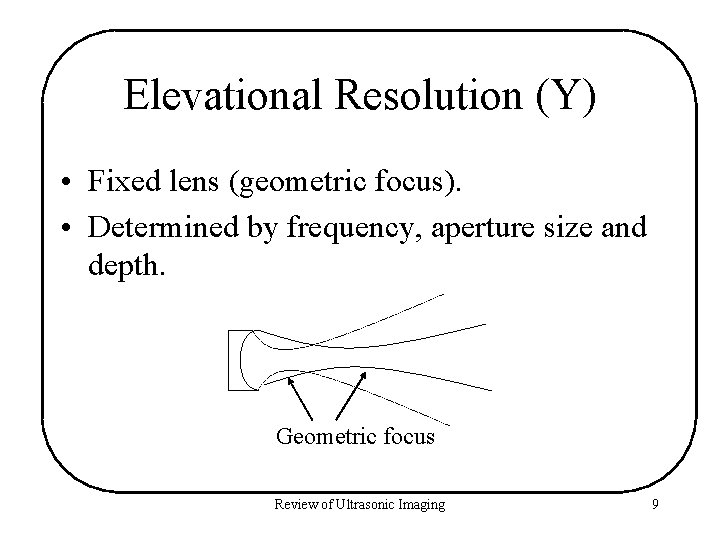
Elevational Resolution (Y) • Fixed lens (geometric focus). • Determined by frequency, aperture size and depth. Geometric focus Review of Ultrasonic Imaging 9
Axial Resolution (Z) • • Pulse width (absolute bandwidth). System and transducer bandwidth. Transmit power. Attenuation consideration. Review of Ultrasonic Imaging 10
Contrast Resolution • Contrast resolution is determined by both spatial resolution and speckle noise variations. • Speckle comes from coherent interference of diffuse scatterers. In-coherent processing must be used to reduce speckle noise. • There exists a tradeoff between contrast and spatial resolutions. Review of Ultrasonic Imaging 11
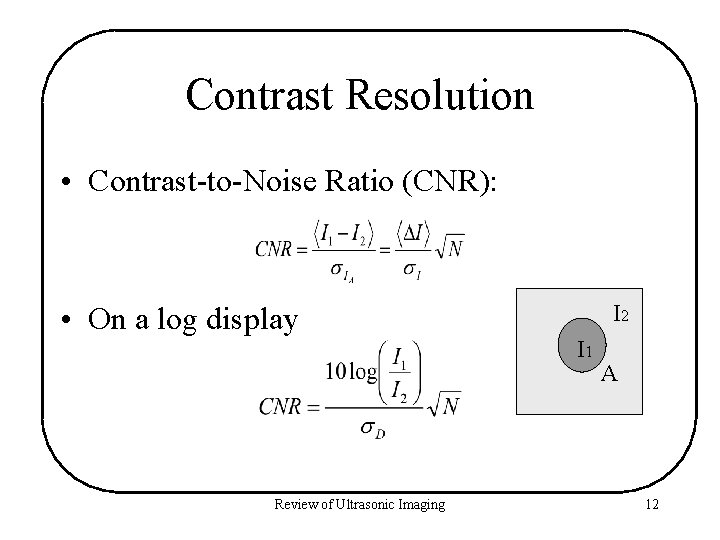
Contrast Resolution • Contrast-to-Noise Ratio (CNR): • On a log display Review of Ultrasonic Imaging I 2 I 1 A 12
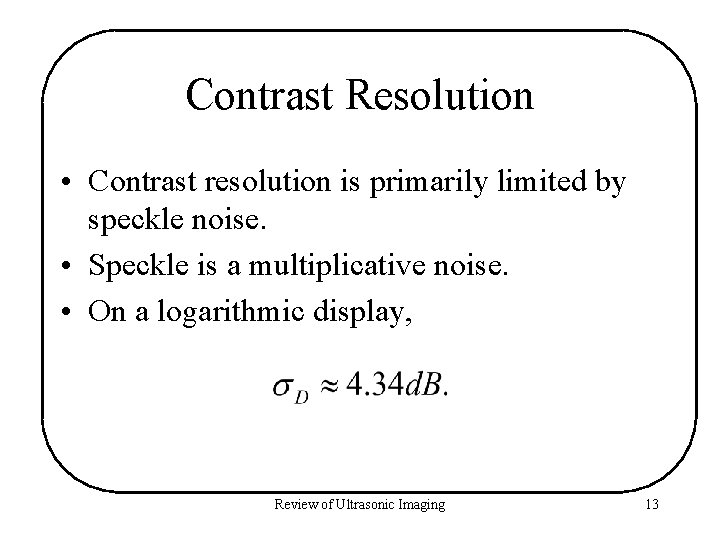
Contrast Resolution • Contrast resolution is primarily limited by speckle noise. • Speckle is a multiplicative noise. • On a logarithmic display, Review of Ultrasonic Imaging 13
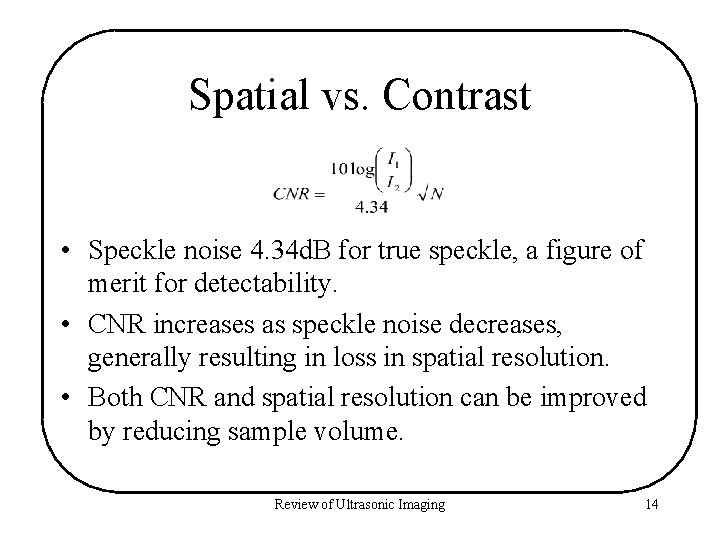
Spatial vs. Contrast • Speckle noise 4. 34 d. B for true speckle, a figure of merit for detectability. • CNR increases as speckle noise decreases, generally resulting in loss in spatial resolution. • Both CNR and spatial resolution can be improved by reducing sample volume. Review of Ultrasonic Imaging 14
Speckle Reduction Techniques • Must be done in-coherently. • Spatial filtering, loss in spatial resolution. • Compounding: – Compound image of the same object with different speckle appearance. – Better edge definition. – Sub-optimal spatial resolution. Review of Ultrasonic Imaging 15
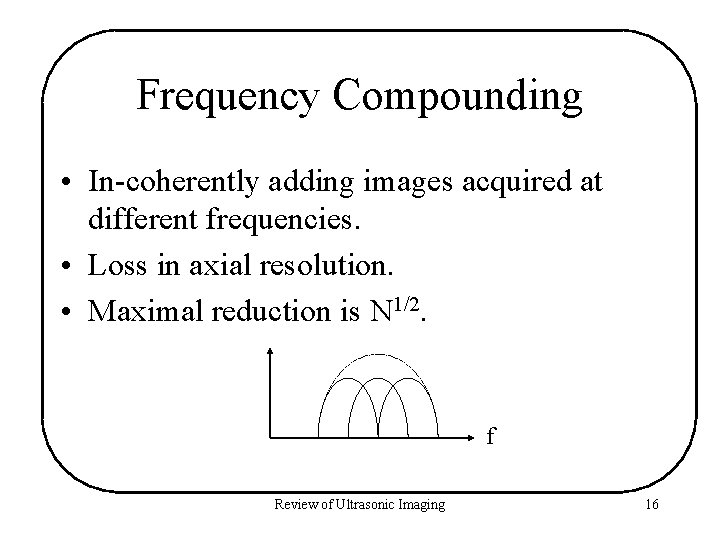
Frequency Compounding • In-coherently adding images acquired at different frequencies. • Loss in axial resolution. • Maximal reduction is N 1/2. f Review of Ultrasonic Imaging 16
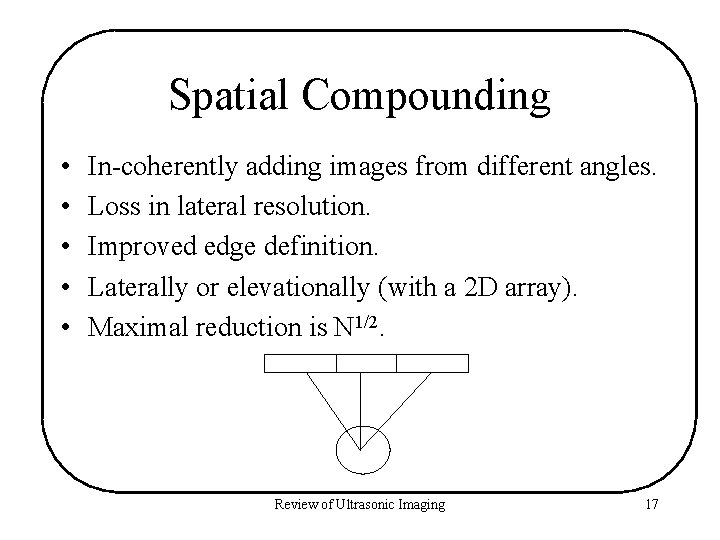
Spatial Compounding • • • In-coherently adding images from different angles. Loss in lateral resolution. Improved edge definition. Laterally or elevationally (with a 2 D array). Maximal reduction is N 1/2. Review of Ultrasonic Imaging 17
Temporal Resolution • Temporal resolution is determined by acoustic frame rate. It is also related to spatial Nyquist criterion. • Temporal resolution is fundamentally limited by sound velocity but can be improved by signal processing in some cases. • There exists a tradeoff between temporal and spatial resolutions. Review of Ultrasonic Imaging 18
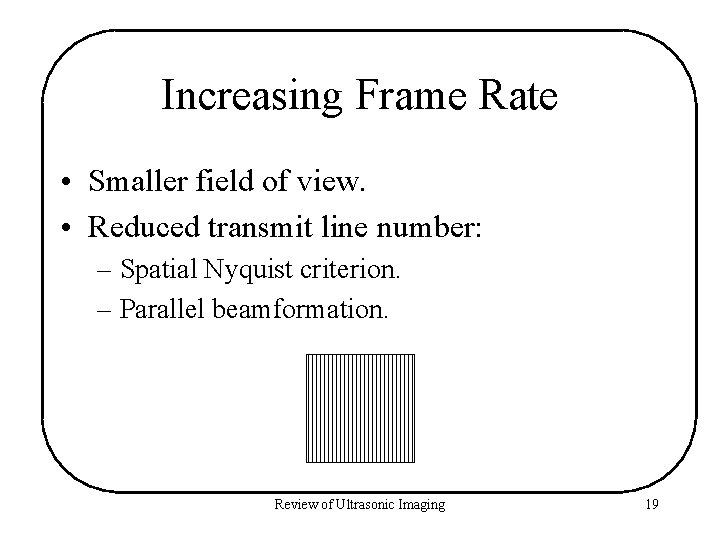
Increasing Frame Rate • Smaller field of view. • Reduced transmit line number: – Spatial Nyquist criterion. – Parallel beamformation. Review of Ultrasonic Imaging 19
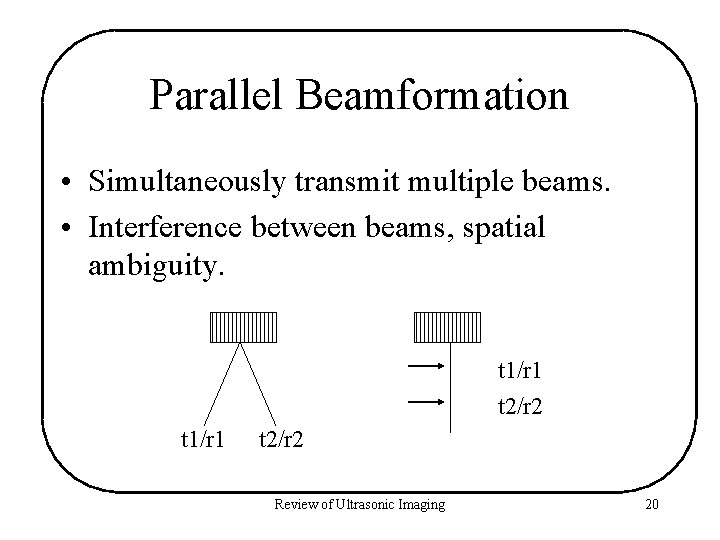
Parallel Beamformation • Simultaneously transmit multiple beams. • Interference between beams, spatial ambiguity. t 1/r 1 t 2/r 2 Review of Ultrasonic Imaging 20
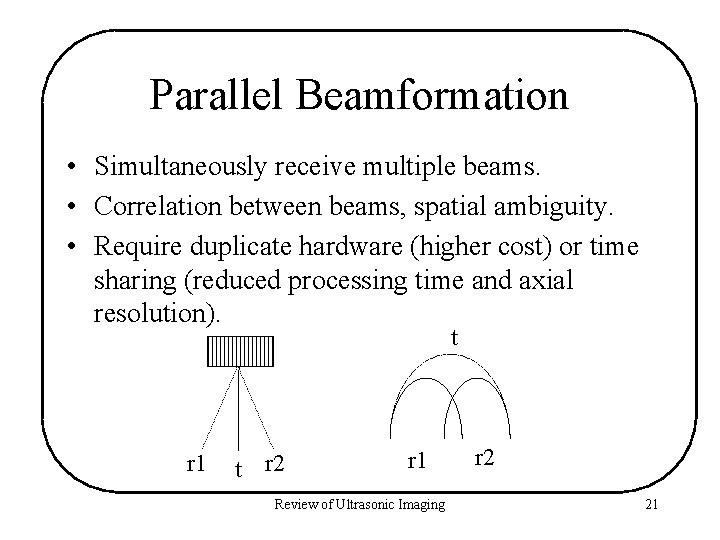
Parallel Beamformation • Simultaneously receive multiple beams. • Correlation between beams, spatial ambiguity. • Require duplicate hardware (higher cost) or time sharing (reduced processing time and axial resolution). t r 1 t r 2 r 1 Review of Ultrasonic Imaging r 2 21
Image Uniformity • Image uniformity is usually referred to as the variations of the system’s point spread function throughout the entire image. • Factors of image uniformity include depth of field, pulse shapes and variations due to lateral displacements. • To achieve image uniformity, a sophisticated imaging system is required. Review of Ultrasonic Imaging 22
Sensitivity • Sensitivity is defined in the context of the detection of weak signals. • Sensitivity is determined by transducer design and system’s dynamic range. • Sensitivity is particularly important in Doppler imaging and can be improved by signal processing. Review of Ultrasonic Imaging 23
Penetration • Penetration is determined by acoustic power delivered to the body on transmit and the dynamic range of the system on receive. • The transmit power is regulated for safety reasons. Hence, penetration must be improved without exceeding regulations. Review of Ultrasonic Imaging 24