
Review of the Comparison of Adjectives Positive Degree
- Slides: 8
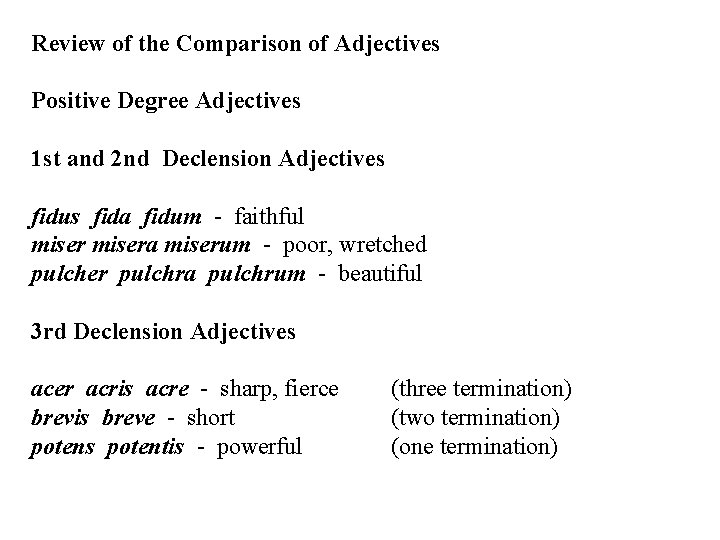
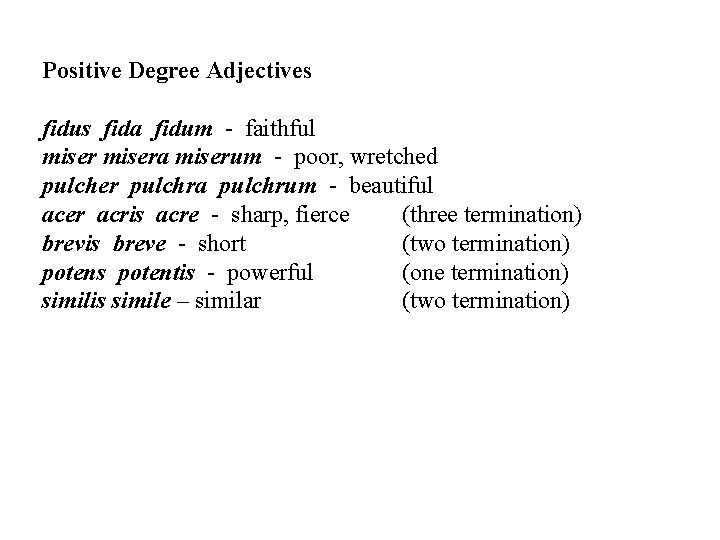
Review of the Comparison of Adjectives Positive Degree Adjectives 1 st and 2 nd Declension Adjectives fidus fida fidum - faithful misera miserum - poor, wretched pulcher pulchra pulchrum - beautiful 3 rd Declension Adjectives acer acris acre - sharp, fierce brevis breve - short potens potentis - powerful (three termination) (two termination) (one termination)
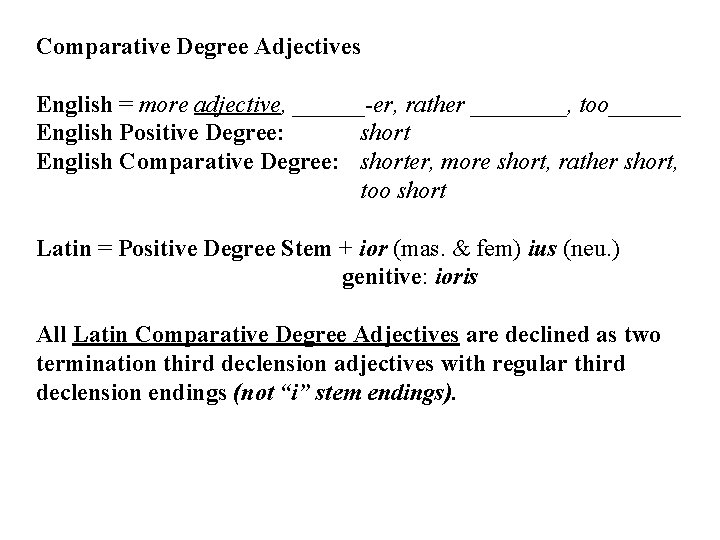
Comparative Degree Adjectives English = more adjective, ______-er, rather ____, too______ English Positive Degree: short English Comparative Degree: shorter, more short, rather short, too short Latin = Positive Degree Stem + ior (mas. & fem) ius (neu. ) genitive: ioris All Latin Comparative Degree Adjectives are declined as two termination third declension adjectives with regular third declension endings (not “i” stem endings).
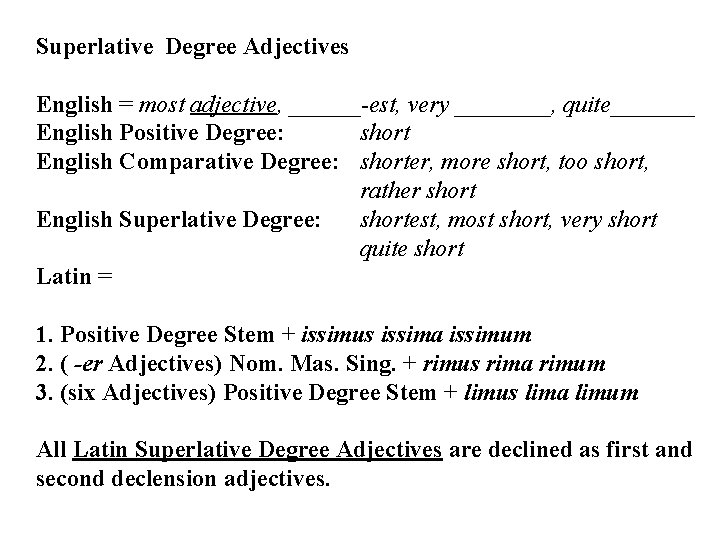
Superlative Degree Adjectives English = most adjective, ______-est, very ____, quite_______ English Positive Degree: short English Comparative Degree: shorter, more short, too short, rather short English Superlative Degree: shortest, most short, very short quite short Latin = 1. Positive Degree Stem + issimus issima issimum 2. ( -er Adjectives) Nom. Mas. Sing. + rimus rima rimum 3. (six Adjectives) Positive Degree Stem + limus lima limum All Latin Superlative Degree Adjectives are declined as first and second declension adjectives.
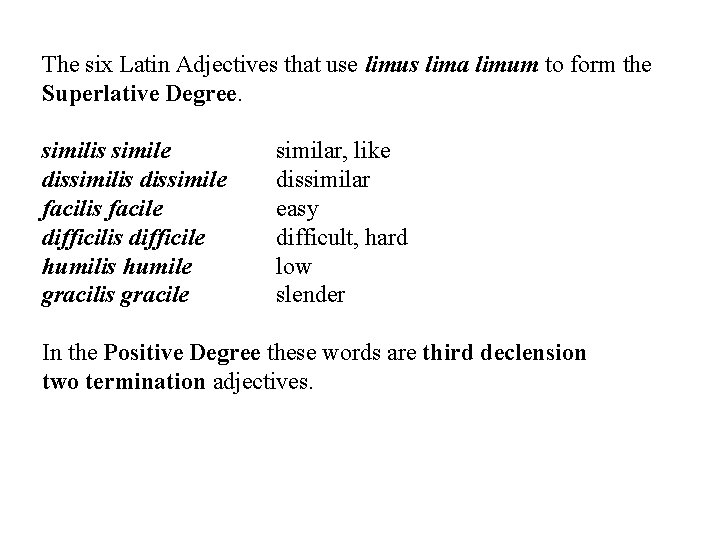
The six Latin Adjectives that use limus lima limum to form the Superlative Degree. similis simile dissimilis dissimile facilis facile difficilis difficile humilis humile gracilis gracile similar, like dissimilar easy difficult, hard low slender In the Positive Degree these words are third declension two termination adjectives.
Positive Degree Adjectives fidus fida fidum - faithful misera miserum - poor, wretched pulcher pulchra pulchrum - beautiful acer acris acre - sharp, fierce (three termination) brevis breve - short (two termination) potens potentis - powerful (one termination) similis simile – similar (two termination)
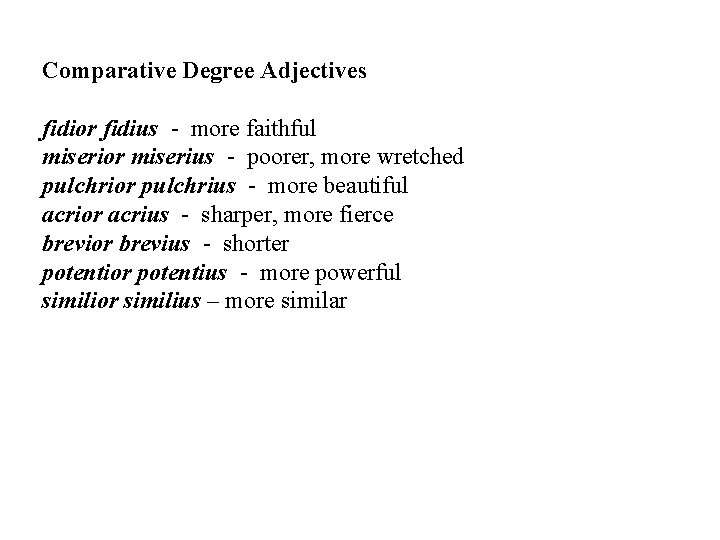
Comparative Degree Adjectives fidior fidius - more faithful miserior miserius - poorer, more wretched pulchrior pulchrius - more beautiful acrior acrius - sharper, more fierce brevior brevius - shorter potentior potentius - more powerful similior similius – more similar
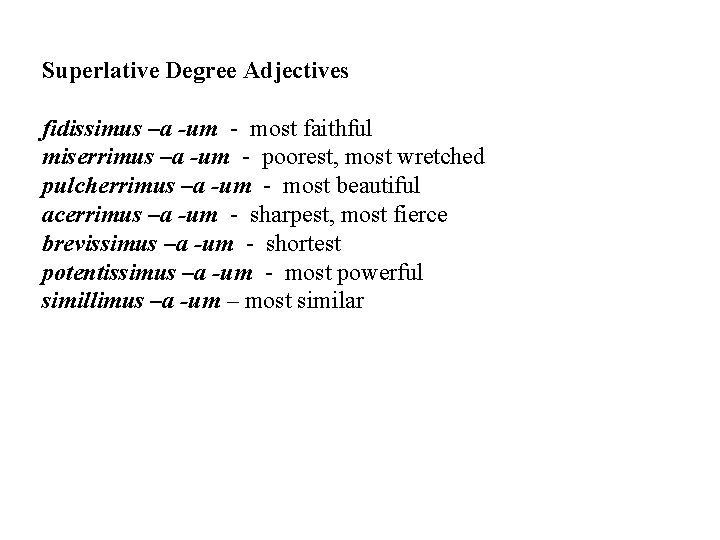
Superlative Degree Adjectives fidissimus –a -um - most faithful miserrimus –a -um - poorest, most wretched pulcherrimus –a -um - most beautiful acerrimus –a -um - sharpest, most fierce brevissimus –a -um - shortest potentissimus –a -um - most powerful simillimus –a -um – most similar
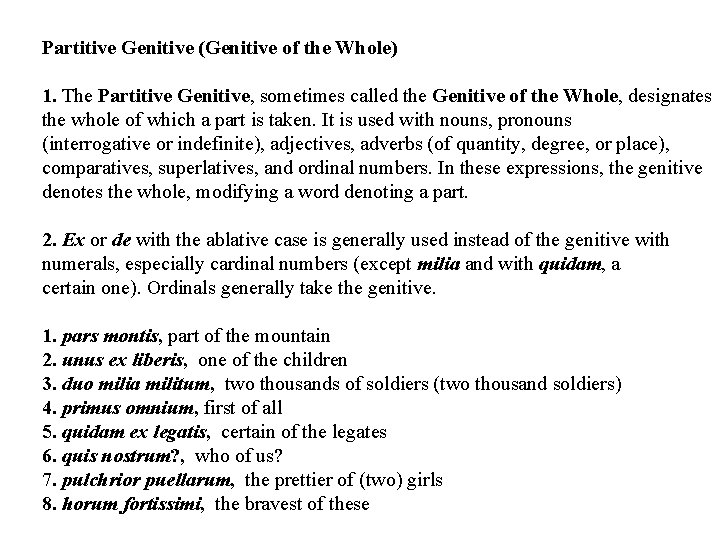
Partitive Genitive (Genitive of the Whole) 1. The Partitive Genitive, sometimes called the Genitive of the Whole, designates the whole of which a part is taken. It is used with nouns, pronouns (interrogative or indefinite), adjectives, adverbs (of quantity, degree, or place), comparatives, superlatives, and ordinal numbers. In these expressions, the genitive denotes the whole, modifying a word denoting a part. 2. Ex or de with the ablative case is generally used instead of the genitive with numerals, especially cardinal numbers (except milia and with quidam, a certain one). Ordinals generally take the genitive. 1. pars montis, part of the mountain 2. unus ex liberis, one of the children 3. duo milia militum, two thousands of soldiers (two thousand soldiers) 4. primus omnium, first of all 5. quidam ex legatis, certain of the legates 6. quis nostrum? , who of us? 7. pulchrior puellarum, the prettier of (two) girls 8. horum fortissimi, the bravest of these