
Review of the Blue Mud Shrimp Mystery Melissa

Review of the Blue Mud Shrimp Mystery Melissa Kilgore Lane Community College Eugene, Oregon
Overview �Authors: Ashley Mc. Culloch and Misty Scevola from EARTH 2008 �A lesson about zombie shrimp and invasive species �Lesson Location: Newport, Oregon, but any location can be used �Included Lesson Resources: Lesson plan, Letter from a fisherman describing the decline of blue mud shrimp, Power. Point presentation, Notebook entry worksheet, Rubric, Blank “Wanted Poster, ” web articles and resources �https: //www. mbari. org/blue-mud-shrimp-mystery/
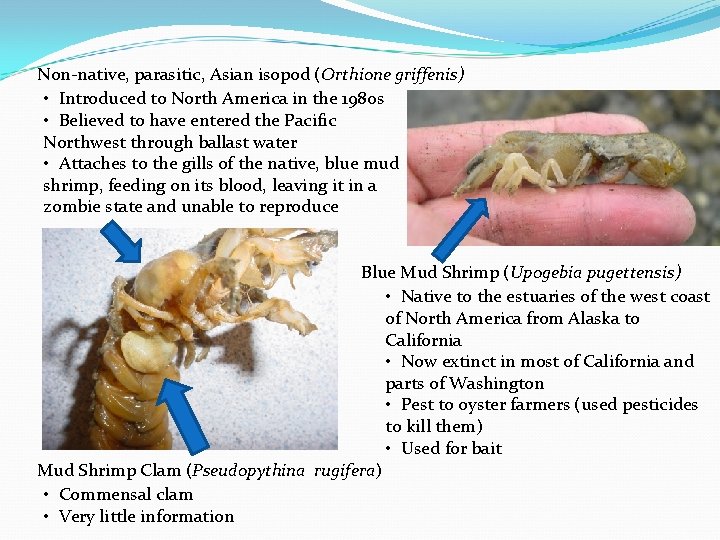
Non-native, parasitic, Asian isopod (Orthione griffenis) • Introduced to North America in the 1980 s • Believed to have entered the Pacific Northwest through ballast water • Attaches to the gills of the native, blue mud shrimp, feeding on its blood, leaving it in a zombie state and unable to reproduce Blue Mud Shrimp (Upogebia pugettensis) • Native to the estuaries of the west coast of North America from Alaska to California • Now extinct in most of California and parts of Washington • Pest to oyster farmers (used pesticides to kill them) • Used for bait Mud Shrimp Clam (Pseudopythina rugifera) • Commensal clam • Very little information
Class usage of this lesson: �Non-majors marine biology course with 25 college students �Read the fisherman’s letter to the class. �Brainstormed ideas for the decline of shrimp populations. �Showed the Power. Point but did not include the ESP system/technology (at the end of the Power. Point). �Had students work in groups to develop “Wanted Posters” on white boards. �Had students share their “Wanted Posters” with the class.
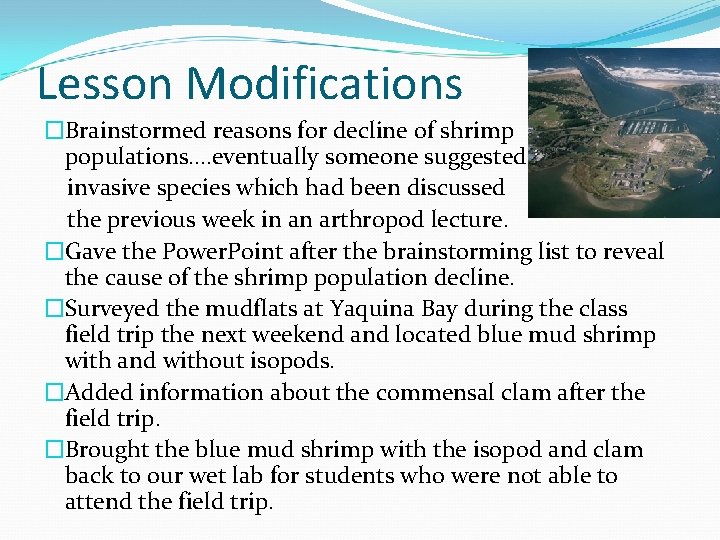
Lesson Modifications �Brainstormed reasons for decline of shrimp populations…. eventually someone suggested invasive species which had been discussed the previous week in an arthropod lecture. �Gave the Power. Point after the brainstorming list to reveal the cause of the shrimp population decline. �Surveyed the mudflats at Yaquina Bay during the class field trip the next weekend and located blue mud shrimp with and without isopods. �Added information about the commensal clam after the field trip. �Brought the blue mud shrimp with the isopod and clam back to our wet lab for students who were not able to attend the field trip.
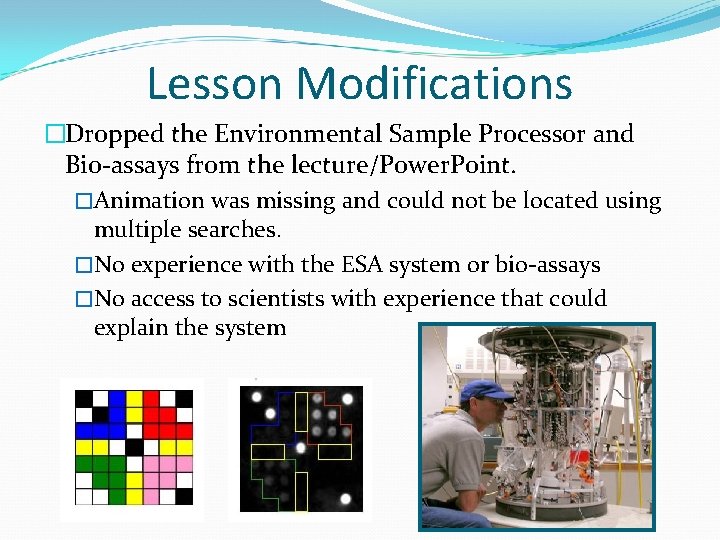
Lesson Modifications �Dropped the Environmental Sample Processor and Bio-assays from the lecture/Power. Point. �Animation was missing and could not be located using multiple searches. �No experience with the ESA system or bio-assays �No access to scientists with experience that could explain the system
Future Modifications �Always include the mud flat survey at Hatfield in my marine biology field trips. �Learn about the ESP and bio-assay process? �Stipulate that students do their “Wanted Posters” on marine non-native species of Oregon. All groups picked plants and animals that were land-based. �Add the commensal clam information to the lecture. �Speak to Oregon State University researcher John Chapman to learn more about the blue mud shrimp, isopod, and shrimp clam.
- Slides: 7