
Review of Simple Machines What are they Simple
- Slides: 12
Review of Simple Machines
What are they? Simple machines are machines with few or no moving parts that are used to make work easier!
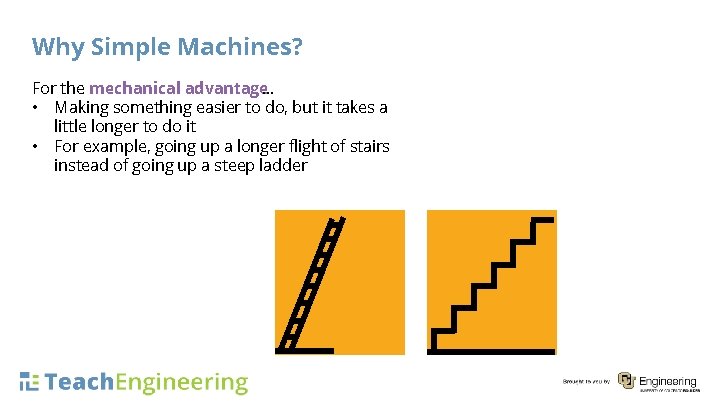
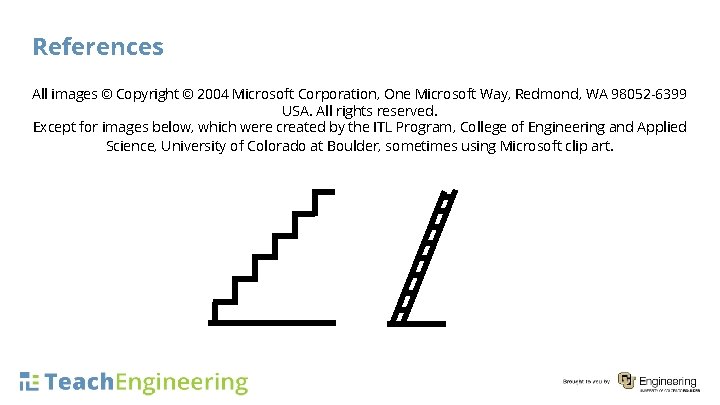
Why Simple Machines? For the mechanical advantage… • Making something easier to do, but it takes a little longer to do it • For example, going up a longer flight of stairs instead of going up a steep ladder
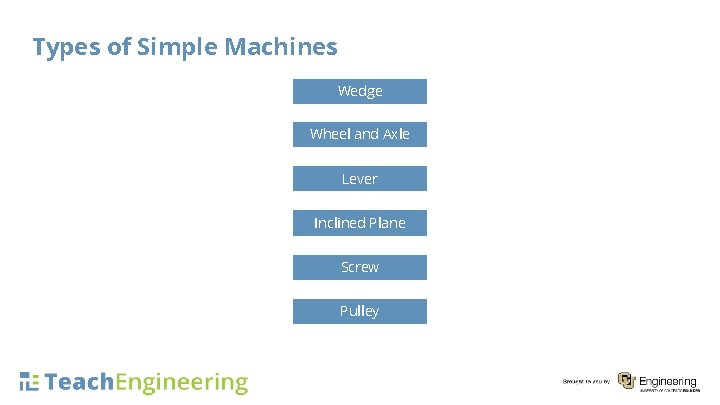
Types of Simple Machines Wedge Wheel and Axle Lever Inclined Plane Screw Pulley
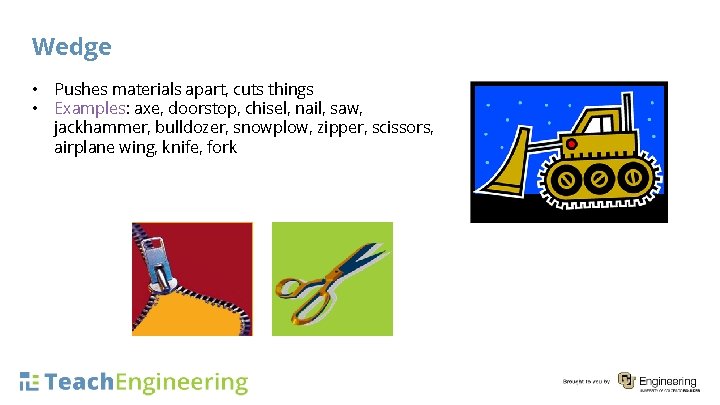
Wedge • • Pushes materials apart, cuts things Examples: axe, doorstop, chisel, nail, saw, jackhammer, bulldozer, snowplow, zipper, scissors, airplane wing, knife, fork Photos should be a square like this.
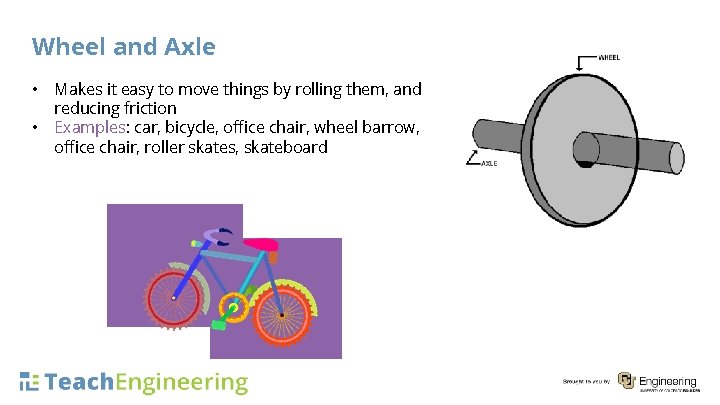
Wheel and Axle • • Makes it easy to move things by rolling them, and reducing friction Examples: car, bicycle, office chair, wheel barrow, office chair, roller skates, skateboard Photos should be a square like this.
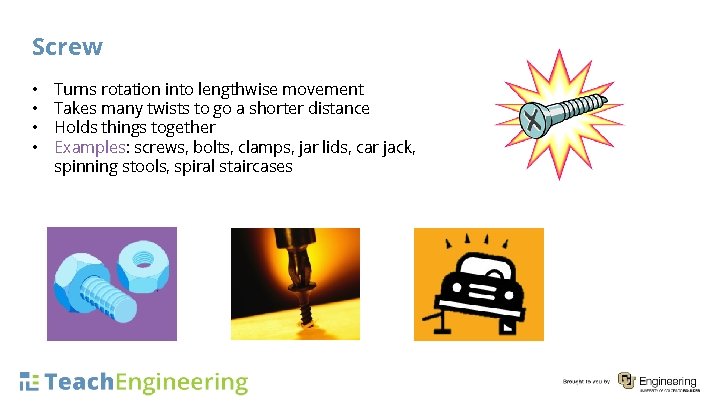
Screw • • Turns rotation into lengthwise movement Takes many twists to go a shorter distance Holds things together Examples: screws, bolts, clamps, jar lids, car jack, spinning stools, spiral staircases
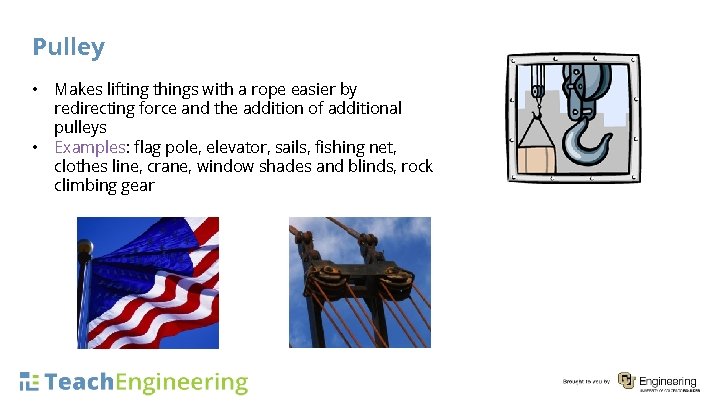
Pulley • • Makes lifting things with a rope easier by redirecting force and the addition of additional pulleys Examples: flag pole, elevator, sails, fishing net, clothes line, crane, window shades and blinds, rock climbing gear Photos should be a square like this.
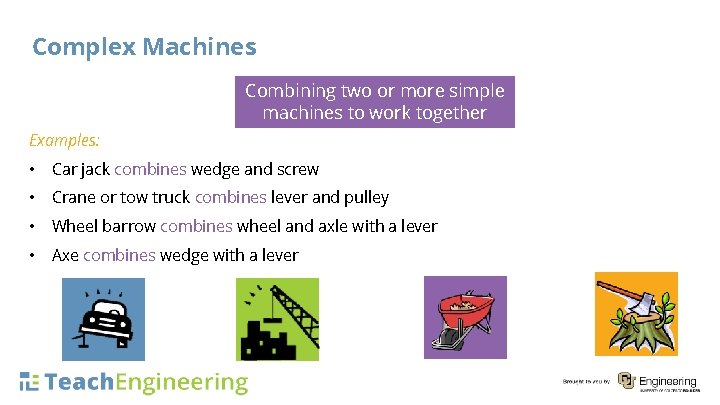
Complex Machines Combining two or more simple machines to work together Examples: • Car jack combines wedge and screw • Crane or tow truck combines lever and pulley • Wheel barrow combines wheel and axle with a lever • Axe combines wedge with a lever
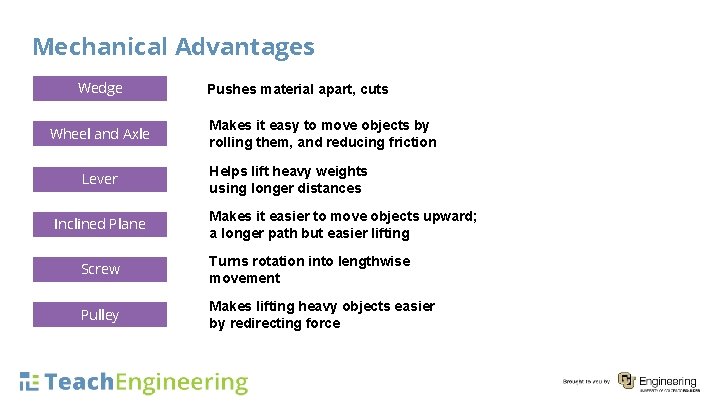
Mechanical Advantages Wedge Wheel and Axle Lever Inclined Plane Pushes material apart, cuts Makes it easy to move objects by rolling them, and reducing friction Helps lift heavy weights using longer distances Makes it easier to move objects upward; a longer path but easier lifting Screw Turns rotation into lengthwise movement Pulley Makes lifting heavy objects easier by redirecting force
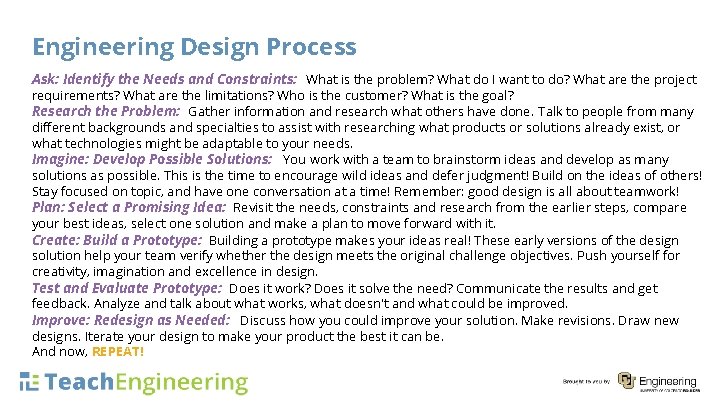
Engineering Design Process Ask: Identify the Needs and Constraints: What is the problem? What do I want to do? What are the project requirements? What are the limitations? Who is the customer? What is the goal? Research the Problem: Gather information and research what others have done. Talk to people from many different backgrounds and specialties to assist with researching what products or solutions already exist, or what technologies might be adaptable to your needs. Imagine: Develop Possible Solutions: You work with a team to brainstorm ideas and develop as many solutions as possible. This is the time to encourage wild ideas and defer judgment! Build on the ideas of others! Stay focused on topic, and have one conversation at a time! Remember: good design is all about teamwork! Plan: Select a Promising Idea: Revisit the needs, constraints and research from the earlier steps, compare your best ideas, select one solution and make a plan to move forward with it. Create: Build a Prototype: Building a prototype makes your ideas real! These early versions of the design solution help your team verify whether the design meets the original challenge objectives. Push yourself for creativity, imagination and excellence in design. Test and Evaluate Prototype: Does it work? Does it solve the need? Communicate the results and get feedback. Analyze and talk about what works, what doesn't and what could be improved. Improve: Redesign as Needed: Discuss how you could improve your solution. Make revisions. Draw new designs. Iterate your design to make your product the best it can be. And now, REPEAT!
References All images © Copyright © 2004 Microsoft Corporation, One Microsoft Way, Redmond, WA 98052 -6399 USA. All rights reserved. Except for images below, which were created by the ITL Program, College of. Photos Engineering and should be. Applied a Science, University of Colorado at Boulder, sometimes using Microsoft cliplike art. this. square