
Review of rf structure test results High gradient





- Slides: 28
Review of rf structure test results • High gradient results • 30 GHz • 11. 4 GHz For more detailed high gradient results please see: The first ACE, June 2007 http: //indico. cern. ch/conference. Display. py? conf. Id=15452 The x-band structure design and testing workshop: June 2007 http: //indico. cern. ch/conference. Display. py? conf. Id=15112 The High-Gradient workshop, October 2006 http: //hg 2006. web. cern. ch/HG 2006 Steffen Döbert, ACE, 16. 01. 2008
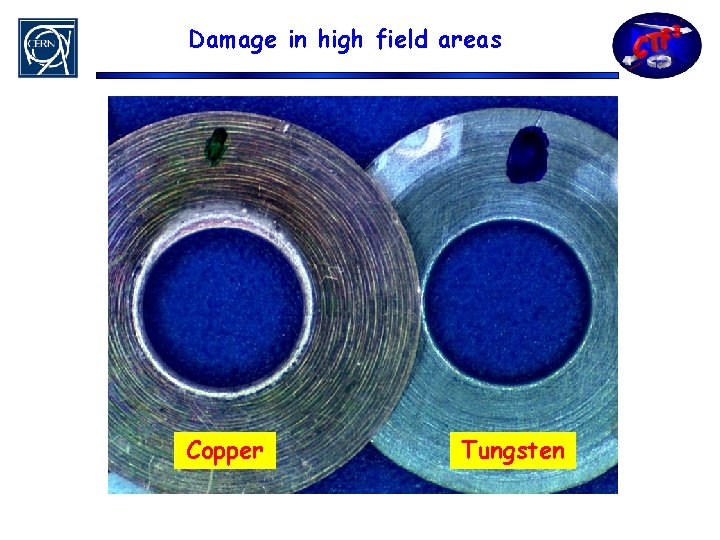
Damage in high field areas Copper Tungsten
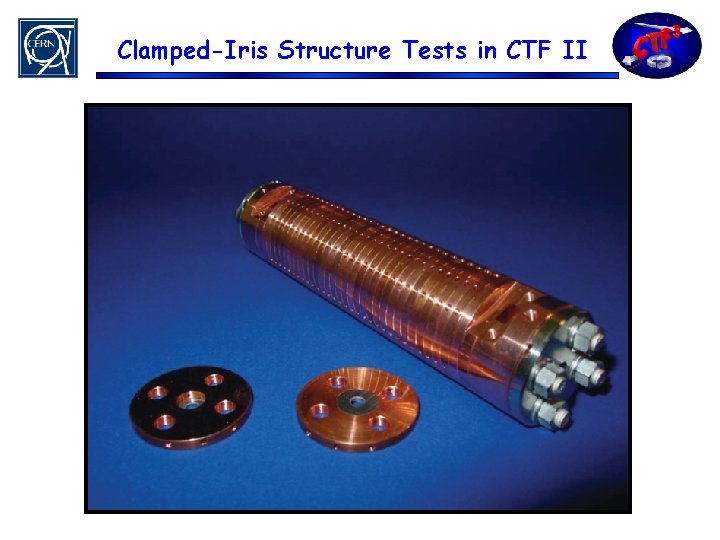
Clamped-Iris Structure Tests in CTF II
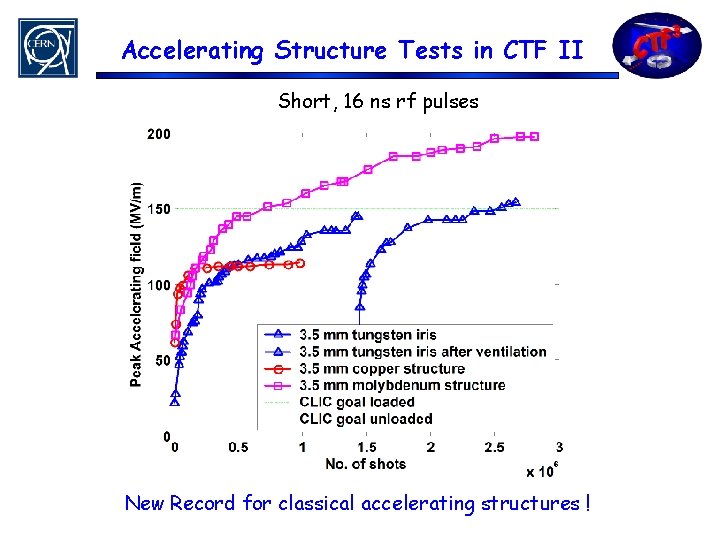
Accelerating Structure Tests in CTF II Short, 16 ns rf pulses New Record for classical accelerating structures !
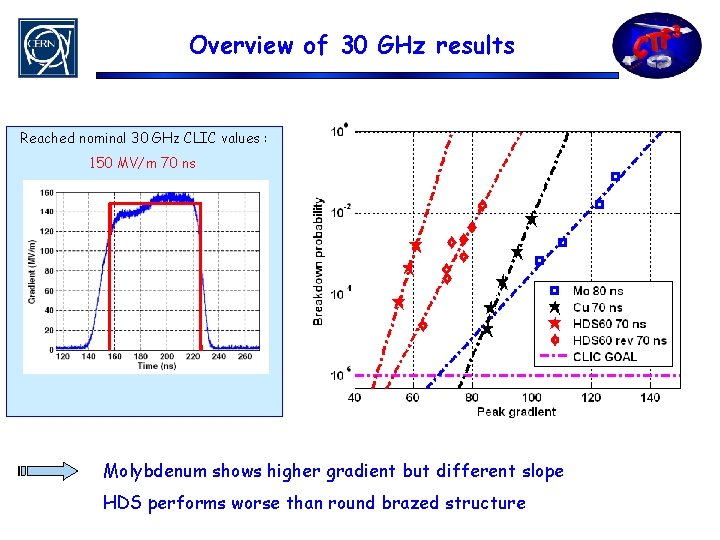
Overview of 30 GHz results Reached nominal 30 GHz CLIC values : 150 MV/m 70 ns Molybdenum shows higher gradient but different slope HDS performs worse than round brazed structure
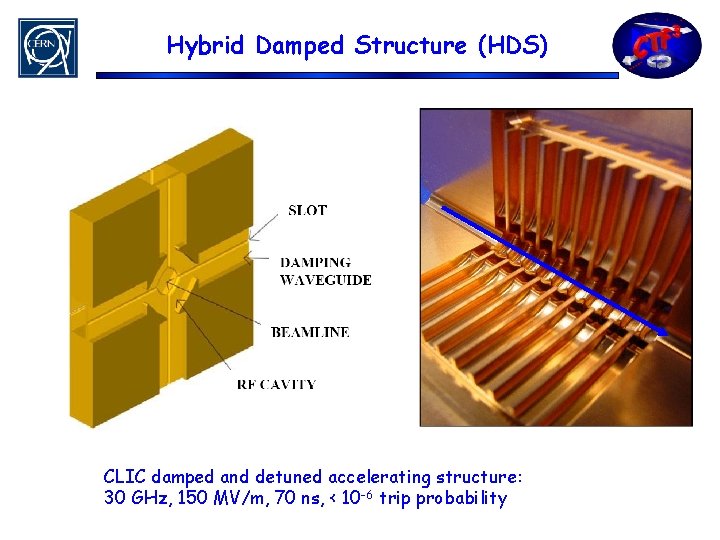
Hybrid Damped Structure (HDS) CLIC damped and detuned accelerating structure: 30 GHz, 150 MV/m, 70 ns, < 10 -6 trip probability
Accelerating Structures made out of milled quadrants HDS 60
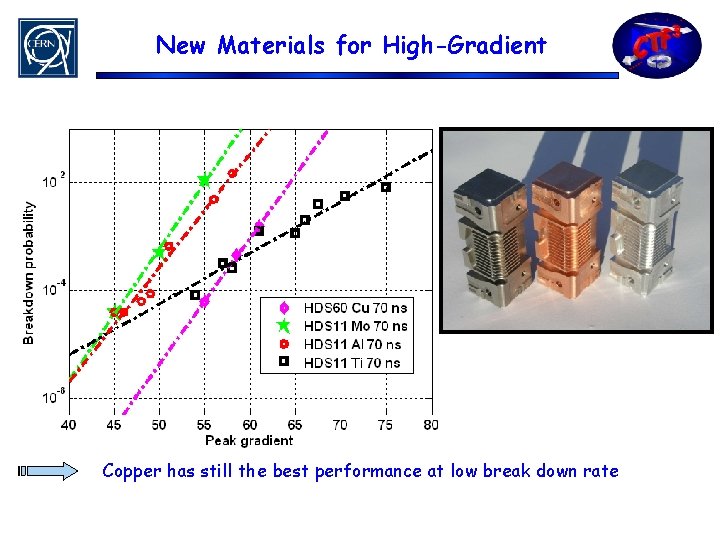
New Materials for High-Gradient Copper has still the best performance at low break down rate
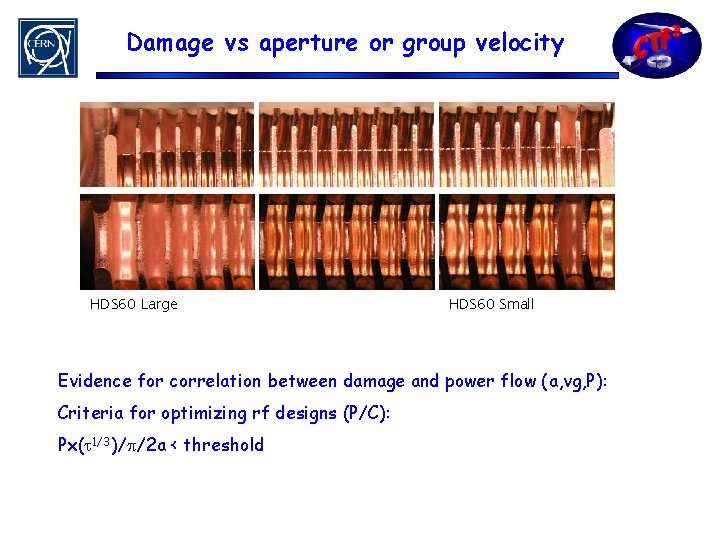
Damage vs aperture or group velocity HDS 60 Large HDS 60 Small Evidence for correlation between damage and power flow (a, vg, P): Criteria for optimizing rf designs (P/C): Px(t 1/3)/p/2 a < threshold
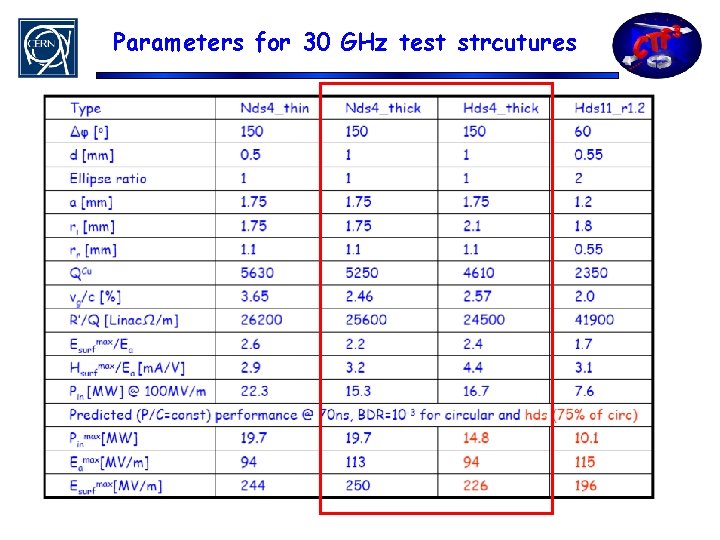
Parameters for 30 GHz test strcutures
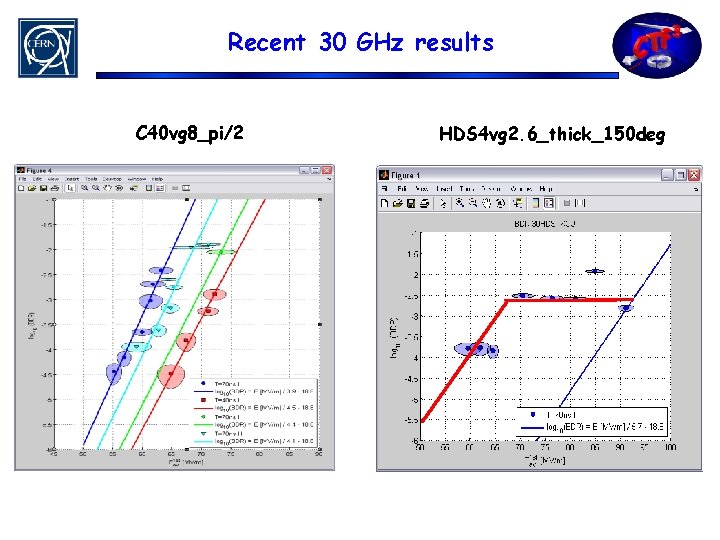
Recent 30 GHz results C 40 vg 8_pi/2 HDS 4 vg 2. 6_thick_150 deg
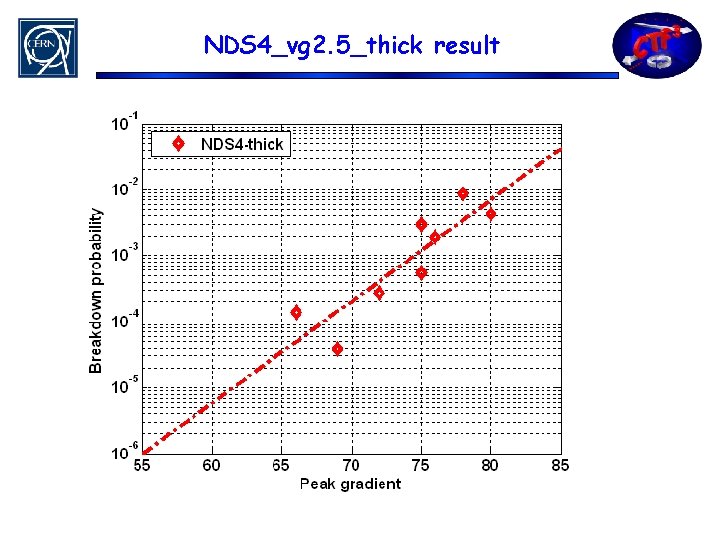
NDS 4_vg 2. 5_thick result
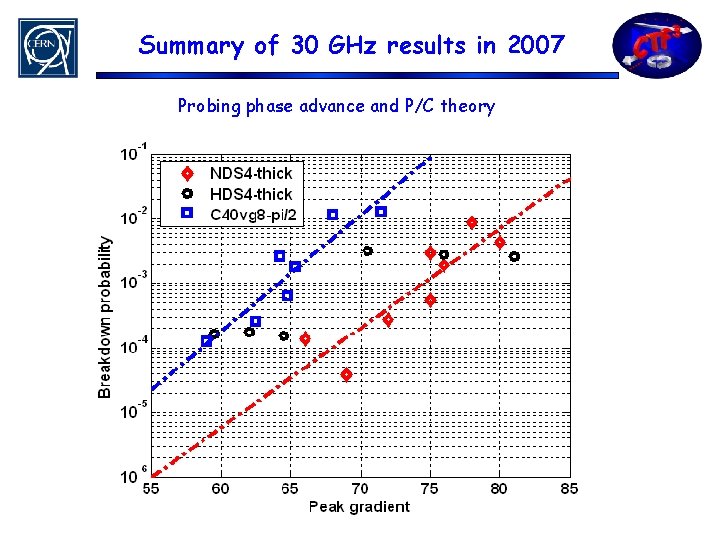
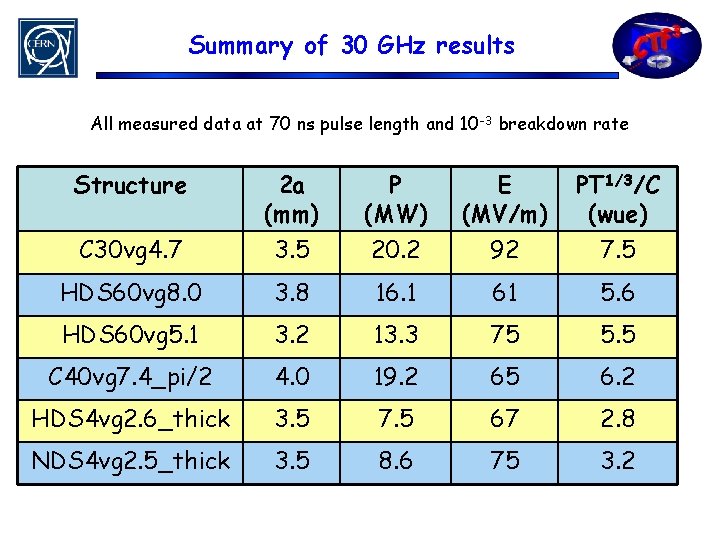
Summary of 30 GHz results in 2007 Probing phase advance and P/C theory
Summary of 30 GHz results All measured data at 70 ns pulse length and 10 -3 breakdown rate Structure 2 a (mm) P (MW) E (MV/m) PT 1/3/C (wue) C 30 vg 4. 7 3. 5 20. 2 92 7. 5 HDS 60 vg 8. 0 3. 8 16. 1 61 5. 6 HDS 60 vg 5. 1 3. 2 13. 3 75 5. 5 C 40 vg 7. 4_pi/2 4. 0 19. 2 65 6. 2 HDS 4 vg 2. 6_thick 3. 5 7. 5 67 2. 8 NDS 4 vg 2. 5_thick 3. 5 8. 6 75 3. 2
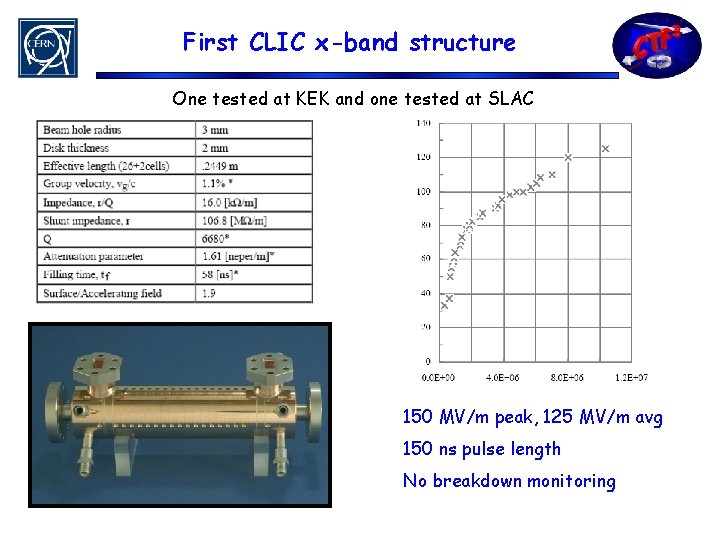
First CLIC x-band structure One tested at KEK and one tested at SLAC 150 MV/m peak, 125 MV/m avg 150 ns pulse length No breakdown monitoring
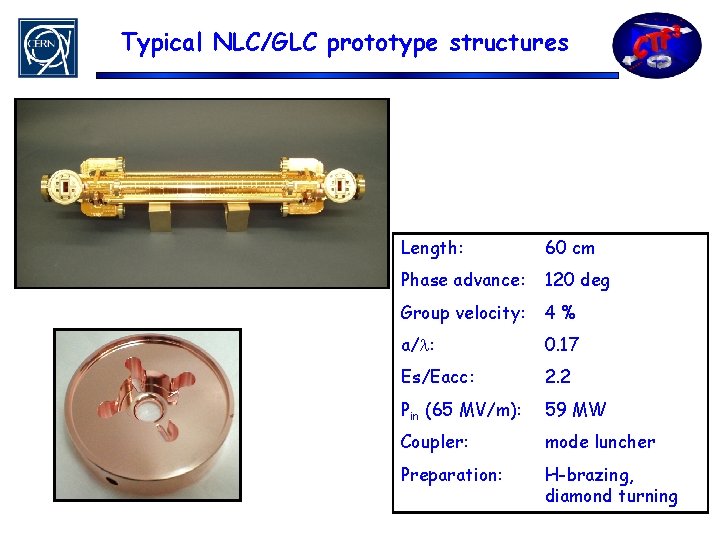
Typical NLC/GLC prototype structures Length: 60 cm Phase advance: 120 deg Group velocity: 4% a/l: 0. 17 Es/Eacc: 2. 2 Pin (65 MV/m): 59 MW Coupler: mode luncher Preparation: H-brazing, diamond turning
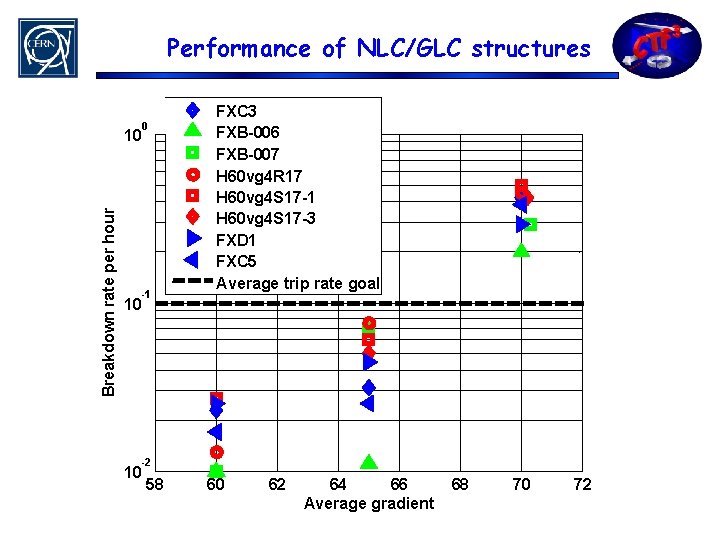
Performance of NLC/GLC structures 0 Breakdown rate per hour 10 -1 FXC 3 FXB-006 FXB-007 H 60 vg 4 R 17 H 60 vg 4 S 17 -1 H 60 vg 4 S 17 -3 FXD 1 FXC 5 Average trip rate goal 10 -2 10 58 60 62 64 66 Average gradient 68 70 72
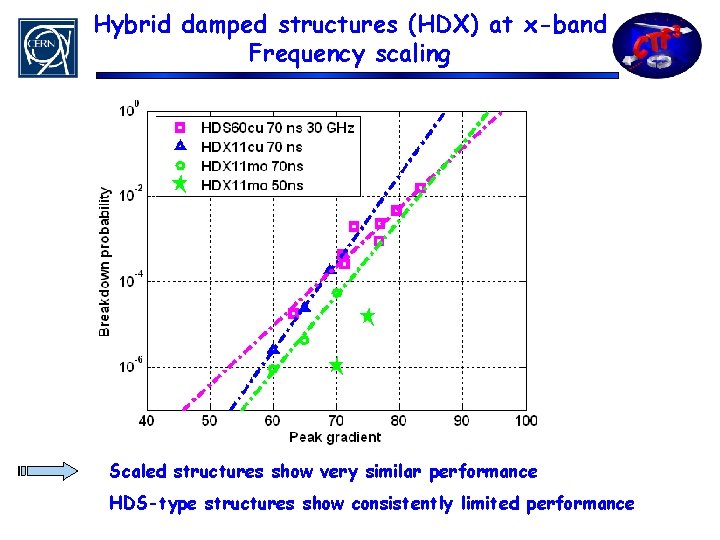
Hybrid damped structures (HDX) at x-band Frequency scaling Scaled structures show very similar performance HDS-type structures show consistently limited performance
A reference structure for CLIC from NLC Length: 53 cm Phase advance: 120 deg Group velocity: 3 % a/l: 0. 13 Es/Eacc: 2. 2 Pin (65 MV/m): 41 MW Coupler: mode luncher Preparation: H-brazing, diamond turning
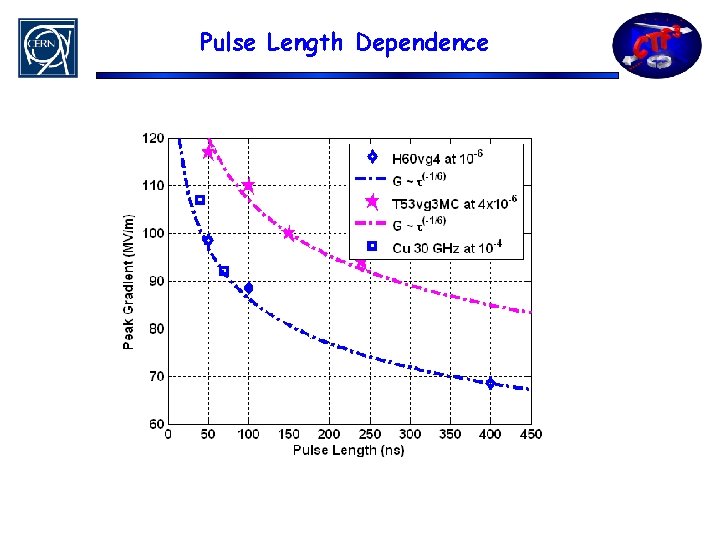
Tests of old NLC structures at short pulses T 53 vg 3 MC can be used as a first reference for the new CLIC parameters CLIC goal
Pulse Length Dependence
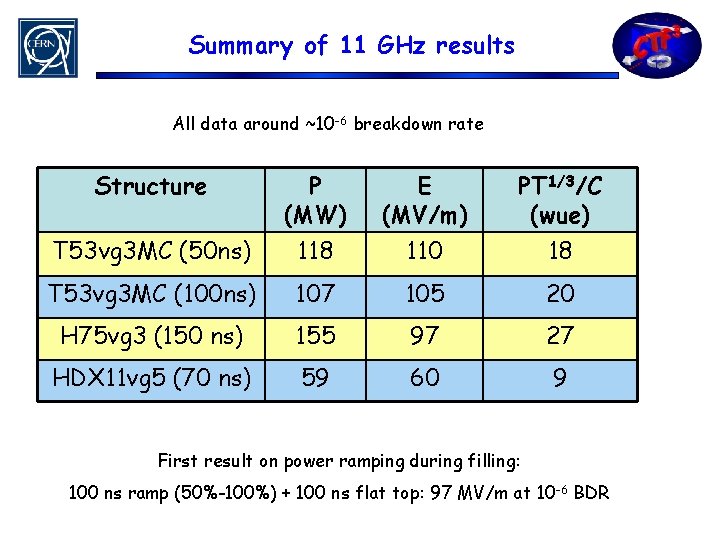
Summary of 11 GHz results All data around ~10 -6 breakdown rate Structure P (MW) E (MV/m) PT 1/3/C (wue) T 53 vg 3 MC (50 ns) 118 110 18 T 53 vg 3 MC (100 ns) 107 105 20 H 75 vg 3 (150 ns) 155 97 27 HDX 11 vg 5 (70 ns) 59 60 9 First result on power ramping during filling: 100 ns ramp (50%-100%) + 100 ns flat top: 97 MV/m at 10 -6 BDR
Tapered Damped Structure Test in ASSET Successful experimental verification of strong cell damping and benchmarking of codes Test results
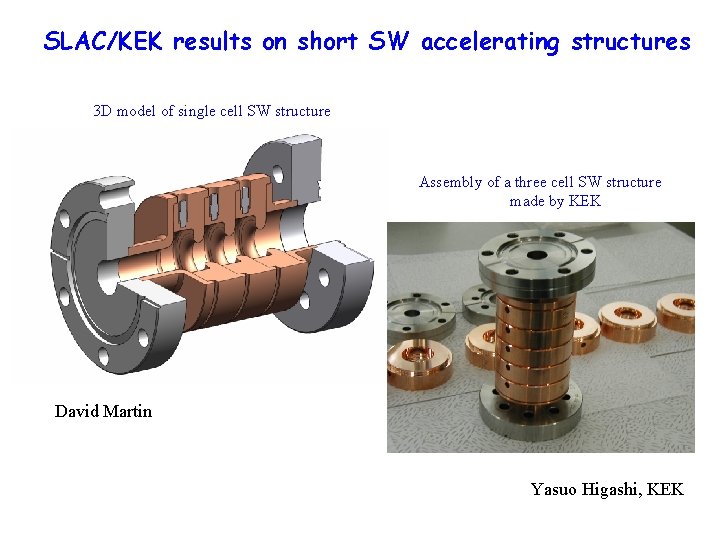
SLAC/KEK results on short SW accelerating structures 3 D model of single cell SW structure Assembly of a three cell SW structure made by KEK David Martin Yasuo Higashi, KEK
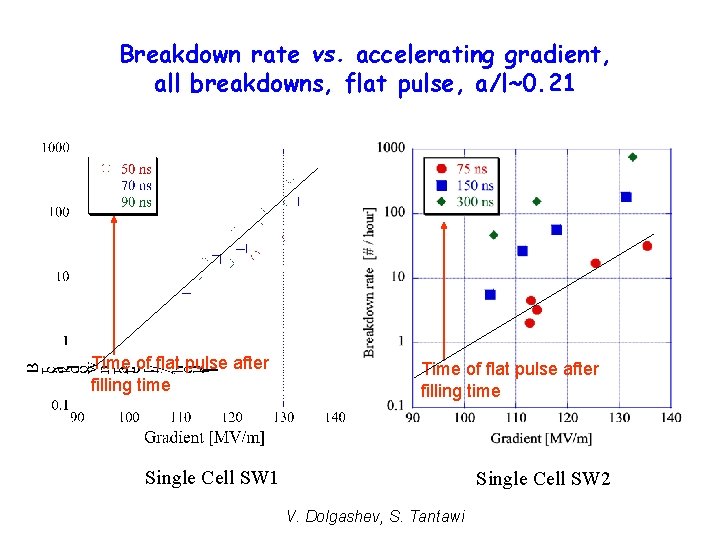
Breakdown rate vs. accelerating gradient, all breakdowns, flat pulse, a/l~0. 21 Time of flat pulse after filling time Single Cell SW 1 Single Cell SW 2 V. Dolgashev, S. Tantawi
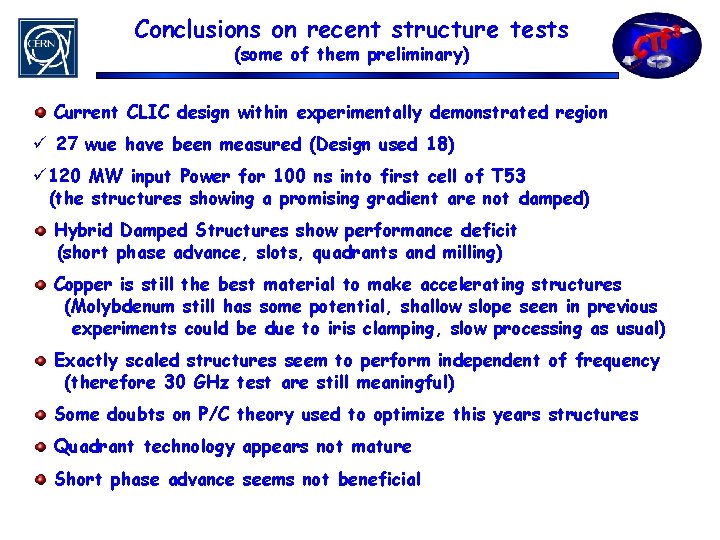
Conclusions on recent structure tests (some of them preliminary) Current CLIC design within experimentally demonstrated region ü 27 wue have been measured (Design used 18) ü 120 MW input Power for 100 ns into first cell of T 53 (the structures showing a promising gradient are not damped) Hybrid Damped Structures show performance deficit (short phase advance, slots, quadrants and milling) Copper is still the best material to make accelerating structures (Molybdenum still has some potential, shallow slope seen in previous experiments could be due to iris clamping, slow processing as usual) Exactly scaled structures seem to perform independent of frequency (therefore 30 GHz test are still meaningful) Some doubts on P/C theory used to optimize this years structures Quadrant technology appears not mature Short phase advance seems not beneficial
The end, reserve slides following
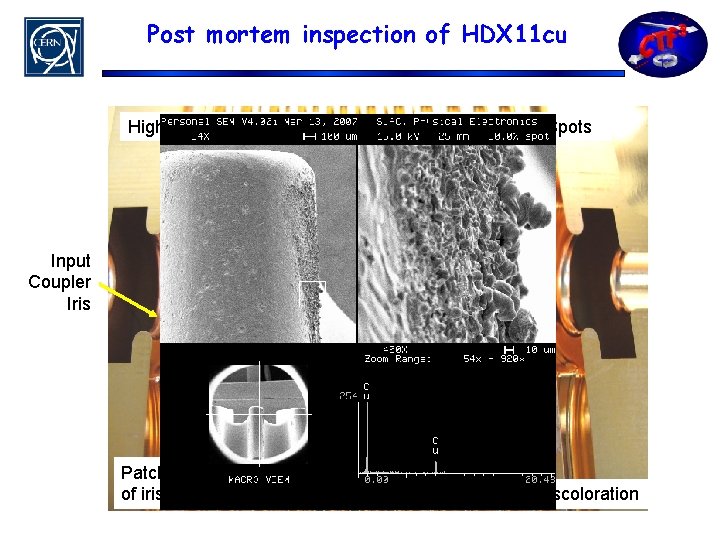
Post mortem inspection of HDX 11 cu High Current Region Scattered Dark Spots Input Coupler Iris Patchy breakdown areas along sides of irises Areas of Discoloration