
Review of Probability and Statistics i e things
Review of Probability and Statistics (i. e. things you learned in Ec 10 and need to remember to do well in this class!) Economics 20 - Prof. Anderson 1

Random Variables X is a random variable if it represents a random draw from some population a discrete random variable can take on only selected values a continuous random variable can take on any value in a real interval associated with each random variable is a probability distribution Economics 20 - Prof. Anderson 2
Random Variables – Examples the outcome of a coin toss – a discrete random variable with P(Heads)=. 5 and P(Tails)=. 5 the height of a selected student – a continuous random variable drawn from an approximately normal distribution Economics 20 - Prof. Anderson 3
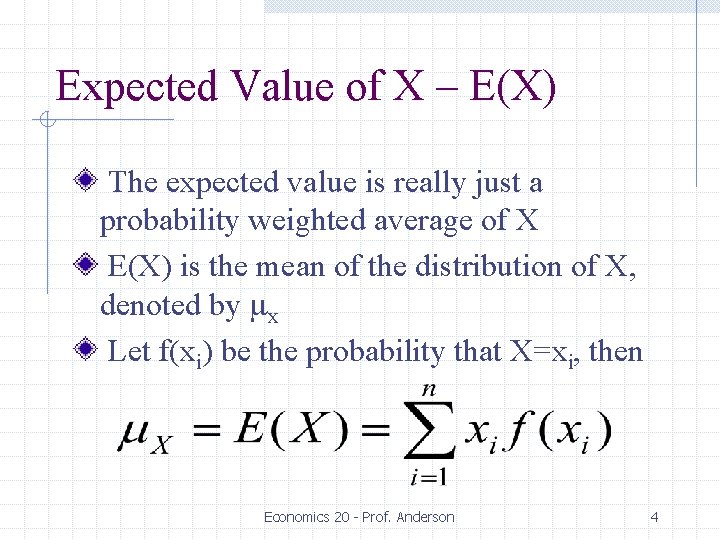
Expected Value of X – E(X) The expected value is really just a probability weighted average of X E(X) is the mean of the distribution of X, denoted by mx Let f(xi) be the probability that X=xi, then Economics 20 - Prof. Anderson 4
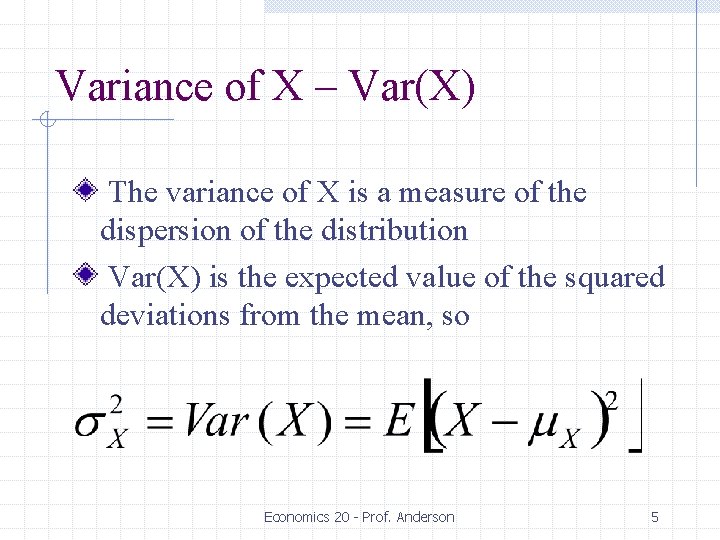
Variance of X – Var(X) The variance of X is a measure of the dispersion of the distribution Var(X) is the expected value of the squared deviations from the mean, so Economics 20 - Prof. Anderson 5
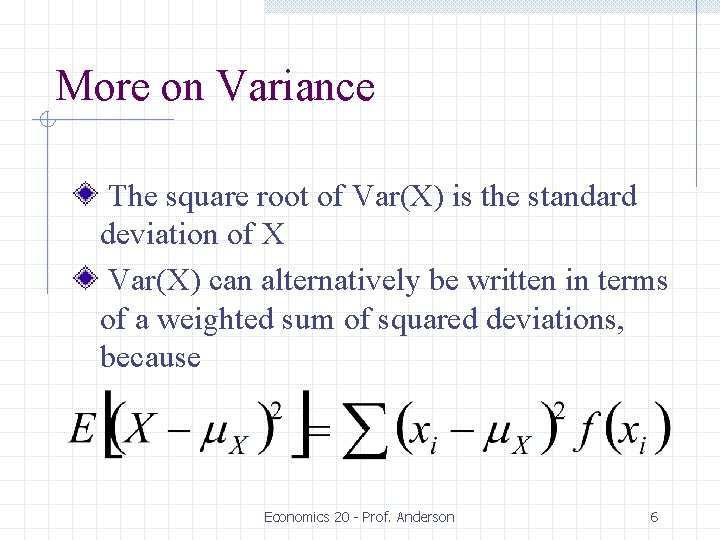
More on Variance The square root of Var(X) is the standard deviation of X Var(X) can alternatively be written in terms of a weighted sum of squared deviations, because Economics 20 - Prof. Anderson 6
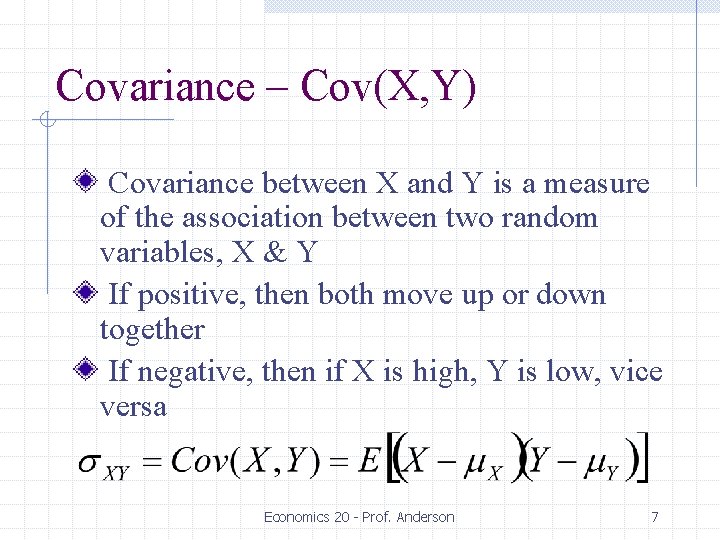
Covariance – Cov(X, Y) Covariance between X and Y is a measure of the association between two random variables, X & Y If positive, then both move up or down together If negative, then if X is high, Y is low, vice versa Economics 20 - Prof. Anderson 7
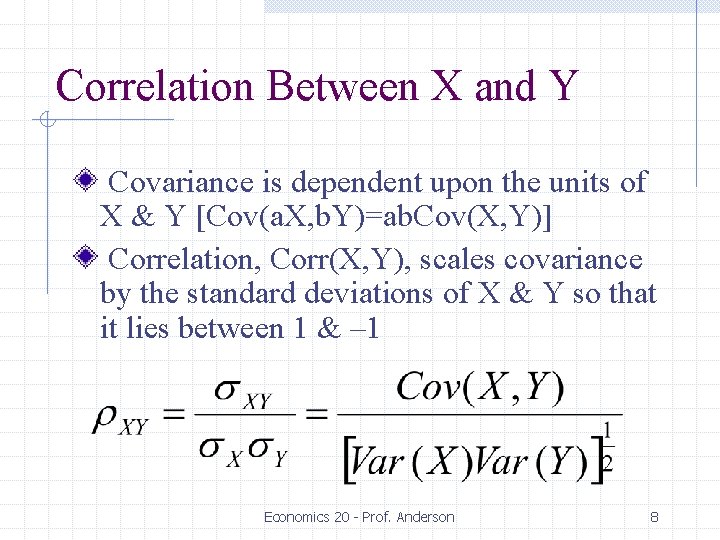
Correlation Between X and Y Covariance is dependent upon the units of X & Y [Cov(a. X, b. Y)=ab. Cov(X, Y)] Correlation, Corr(X, Y), scales covariance by the standard deviations of X & Y so that it lies between 1 & – 1 Economics 20 - Prof. Anderson 8
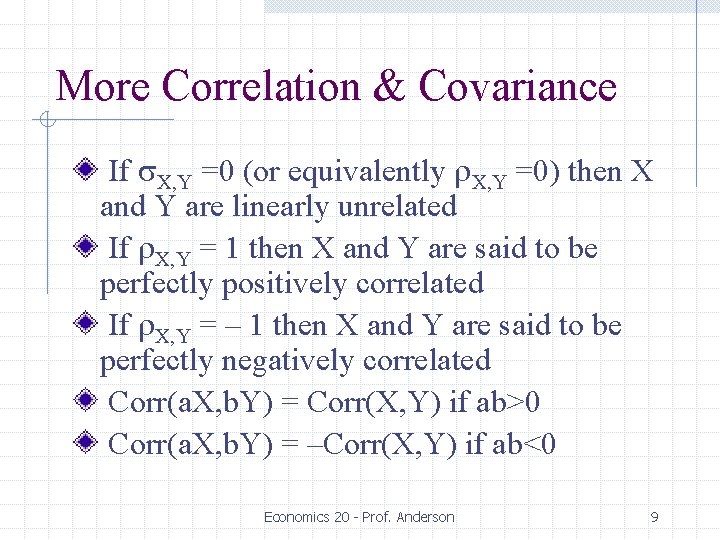
More Correlation & Covariance If s. X, Y =0 (or equivalently r. X, Y =0) then X and Y are linearly unrelated If r. X, Y = 1 then X and Y are said to be perfectly positively correlated If r. X, Y = – 1 then X and Y are said to be perfectly negatively correlated Corr(a. X, b. Y) = Corr(X, Y) if ab>0 Corr(a. X, b. Y) = –Corr(X, Y) if ab<0 Economics 20 - Prof. Anderson 9

Properties of Expectations E(a)=a, Var(a)=0 E(m. X)=m. X, i. e. E(E(X))=E(X) E(a. X+b)=a. E(X)+b E(X+Y)=E(X)+E(Y) E(X-Y)=E(X)-E(Y) E(X- m. X)=0 or E(X-E(X))=0 E((a. X)2)=a 2 E(X 2) Economics 20 - Prof. Anderson 10
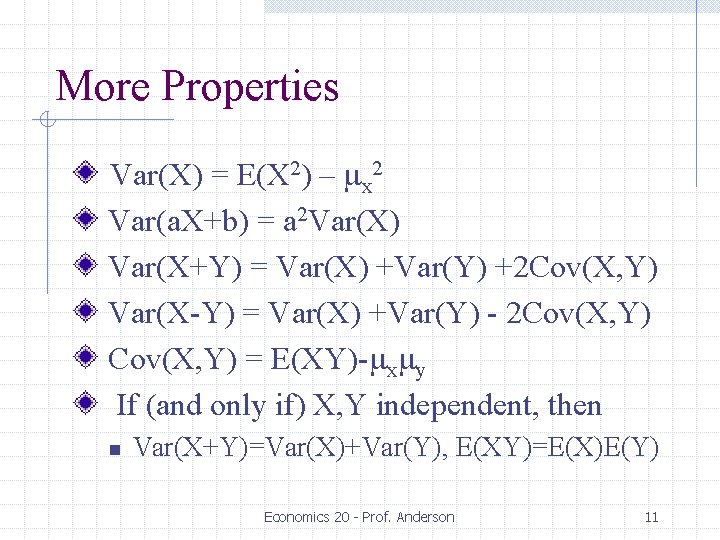
More Properties Var(X) = E(X 2) – mx 2 Var(a. X+b) = a 2 Var(X) Var(X+Y) = Var(X) +Var(Y) +2 Cov(X, Y) Var(X-Y) = Var(X) +Var(Y) - 2 Cov(X, Y) = E(XY)-mxmy If (and only if) X, Y independent, then n Var(X+Y)=Var(X)+Var(Y), E(XY)=E(X)E(Y) Economics 20 - Prof. Anderson 11
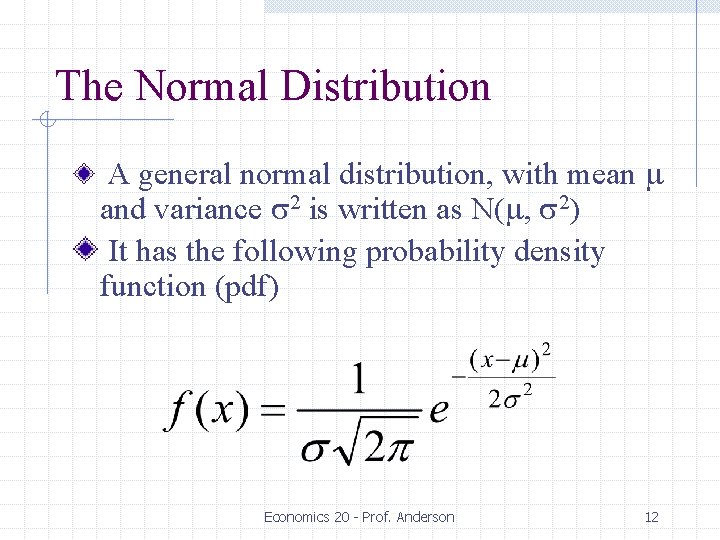
The Normal Distribution A general normal distribution, with mean m and variance s 2 is written as N(m, s 2) It has the following probability density function (pdf) Economics 20 - Prof. Anderson 12
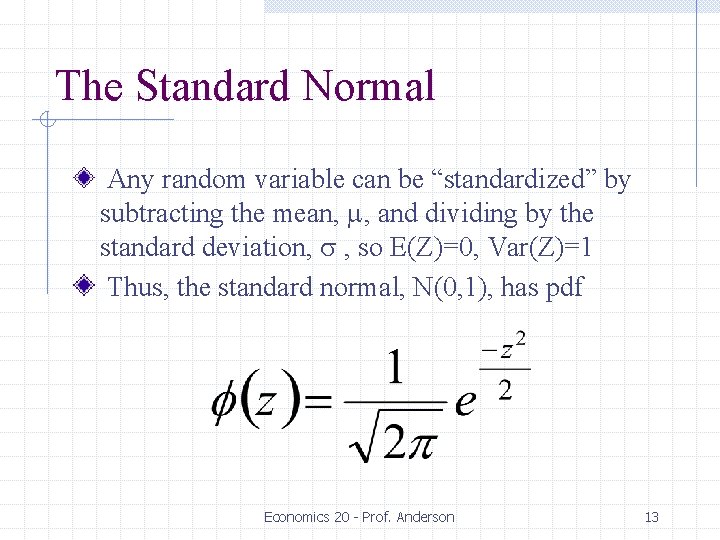
The Standard Normal Any random variable can be “standardized” by subtracting the mean, m, and dividing by the standard deviation, s , so E(Z)=0, Var(Z)=1 Thus, the standard normal, N(0, 1), has pdf Economics 20 - Prof. Anderson 13
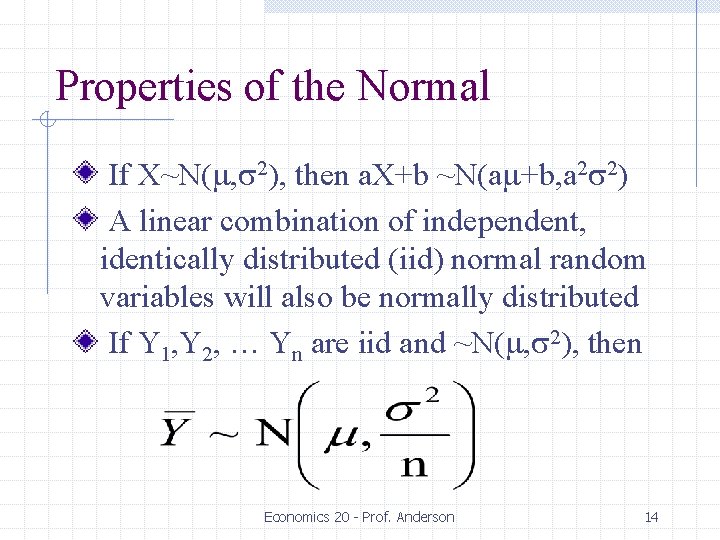
Properties of the Normal If X~N(m, s 2), then a. X+b ~N(am+b, a 2 s 2) A linear combination of independent, identically distributed (iid) normal random variables will also be normally distributed If Y 1, Y 2, … Yn are iid and ~N(m, s 2), then Economics 20 - Prof. Anderson 14

Cumulative Distribution Function For a pdf, f(x), where f(x) is P(X = x), the cumulative distribution function (cdf), F(x), is P(X x); P(X > x) = 1 – F(x) =P(X< – x) For the standard normal, f(z), the cdf is F(z)= P(Z<z), so P(|Z|>a) = 2 P(Z>a) = 2[1 -F(a)] P(a Z b) = F(b) – F(a) Economics 20 - Prof. Anderson 15

The Chi-Square Distribution Suppose that Zi , i=1, …, n are iid ~ N(0, 1), and X= (Zi 2), then X has a chi-square distribution with n degrees of freedom (df), that is X~ 2 n If X~ 2 n, then E(X)=n and Var(X)=2 n Economics 20 - Prof. Anderson 16
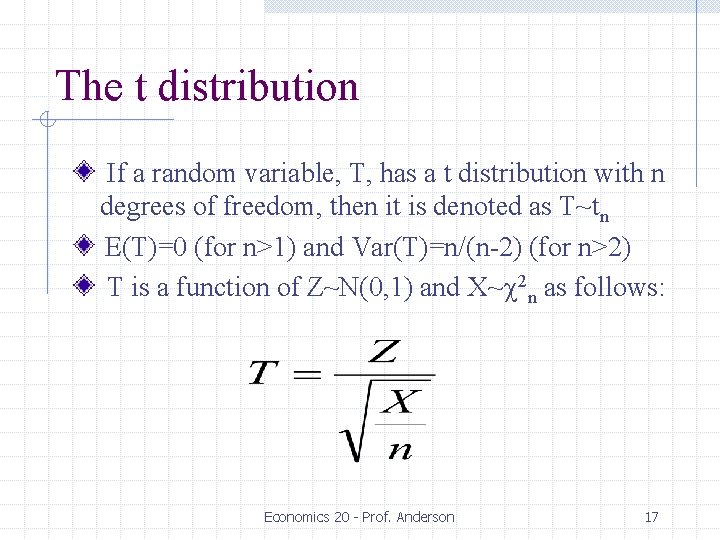
The t distribution If a random variable, T, has a t distribution with n degrees of freedom, then it is denoted as T~tn E(T)=0 (for n>1) and Var(T)=n/(n-2) (for n>2) T is a function of Z~N(0, 1) and X~ 2 n as follows: Economics 20 - Prof. Anderson 17
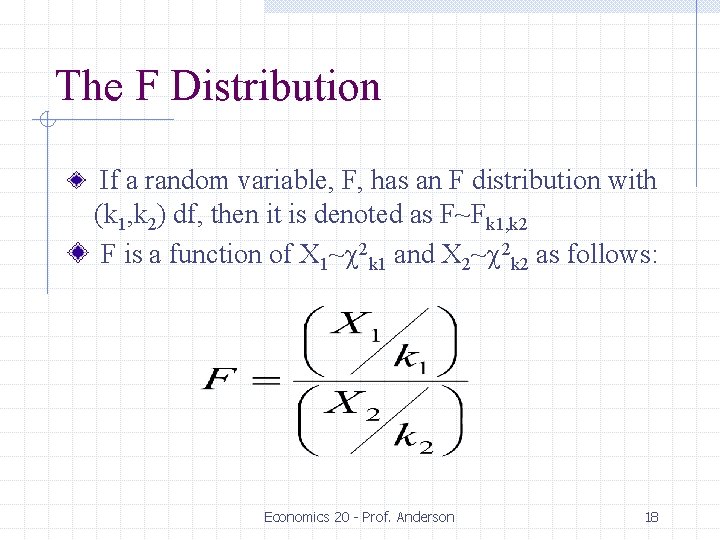
The F Distribution If a random variable, F, has an F distribution with (k 1, k 2) df, then it is denoted as F~Fk 1, k 2 F is a function of X 1~ 2 k 1 and X 2~ 2 k 2 as follows: Economics 20 - Prof. Anderson 18
Random Samples and Sampling For a random variable Y, repeated draws from the same population can be labeled as Y 1, Y 2, . . . , Yn If every combination of n sample points has an equal chance of being selected, this is a random sample A random sample is a set of independent, identically distributed (i. i. d) random variables Economics 20 - Prof. Anderson 19
Estimators and Estimates Typically, we can’t observe the full population, so we must make inferences base on estimates from a random sample An estimator is just a mathematical formula for estimating a population parameter from sample data An estimate is the actual number the formula produces from the sample data Economics 20 - Prof. Anderson 20
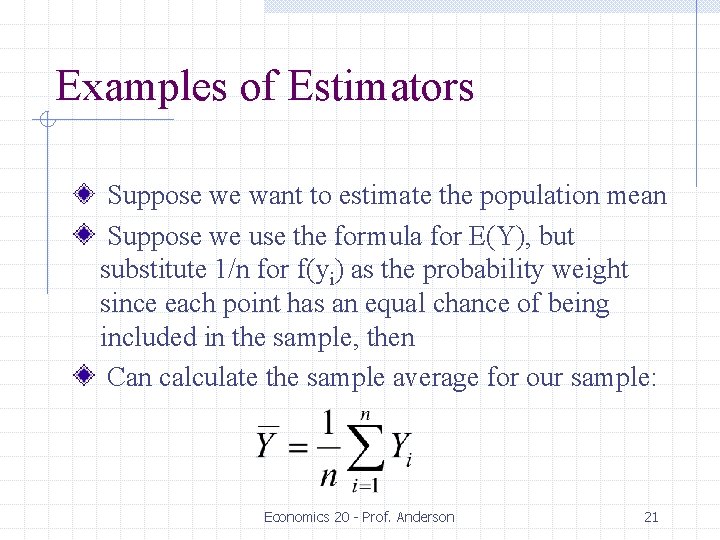
Examples of Estimators Suppose we want to estimate the population mean Suppose we use the formula for E(Y), but substitute 1/n for f(yi) as the probability weight since each point has an equal chance of being included in the sample, then Can calculate the sample average for our sample: Economics 20 - Prof. Anderson 21

What Make a Good Estimator? Unbiasedness Efficiency Mean Square Error (MSE) Asymptotic properties (for large samples): Consistency Economics 20 - Prof. Anderson 22
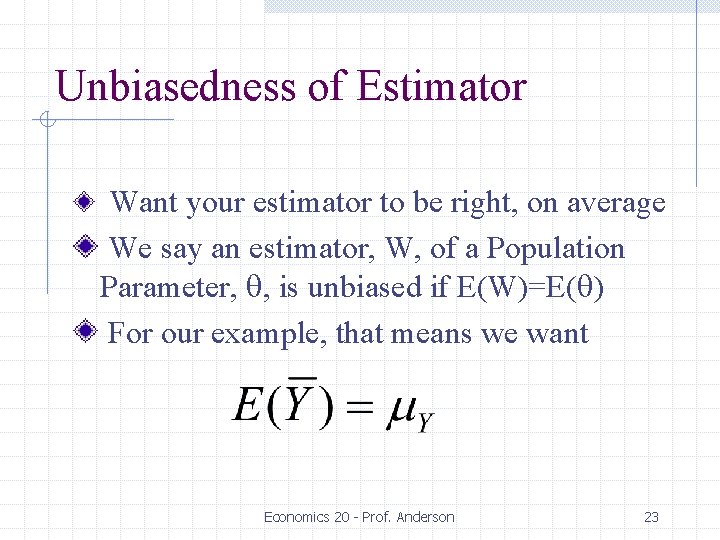
Unbiasedness of Estimator Want your estimator to be right, on average We say an estimator, W, of a Population Parameter, q, is unbiased if E(W)=E(q) For our example, that means we want Economics 20 - Prof. Anderson 23

Proof: Sample Mean is Unbiased Economics 20 - Prof. Anderson 24
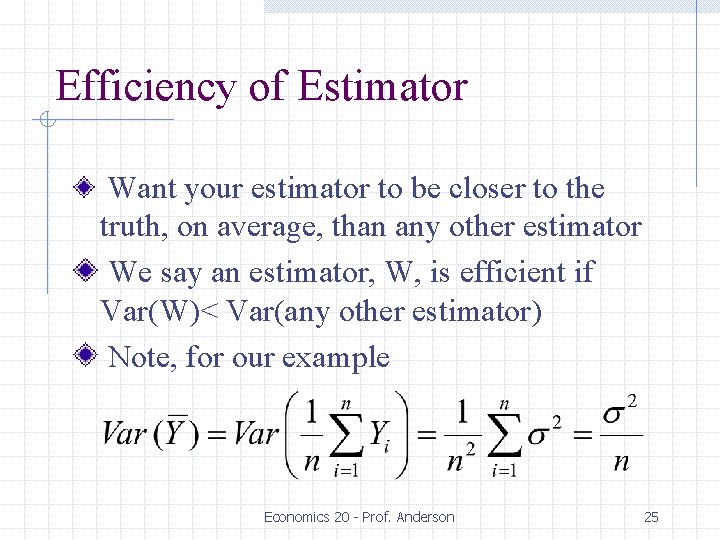
Efficiency of Estimator Want your estimator to be closer to the truth, on average, than any other estimator We say an estimator, W, is efficient if Var(W)< Var(any other estimator) Note, for our example Economics 20 - Prof. Anderson 25
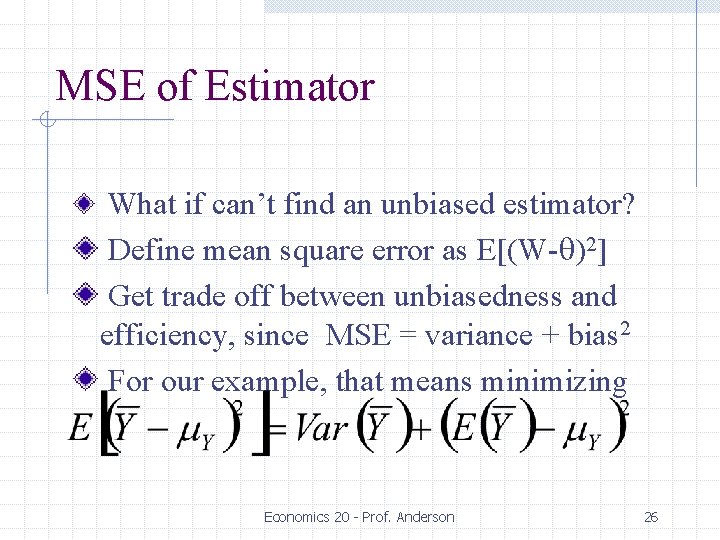
MSE of Estimator What if can’t find an unbiased estimator? Define mean square error as E[(W-q)2] Get trade off between unbiasedness and efficiency, since MSE = variance + bias 2 For our example, that means minimizing Economics 20 - Prof. Anderson 26
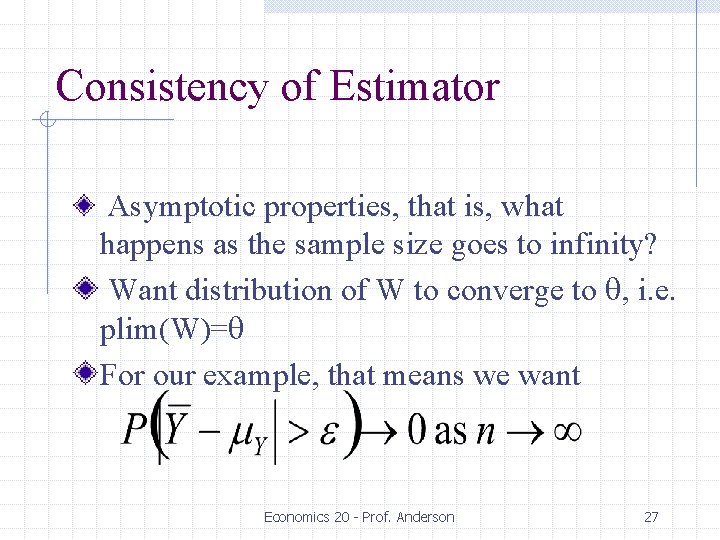
Consistency of Estimator Asymptotic properties, that is, what happens as the sample size goes to infinity? Want distribution of W to converge to q, i. e. plim(W)=q For our example, that means we want Economics 20 - Prof. Anderson 27
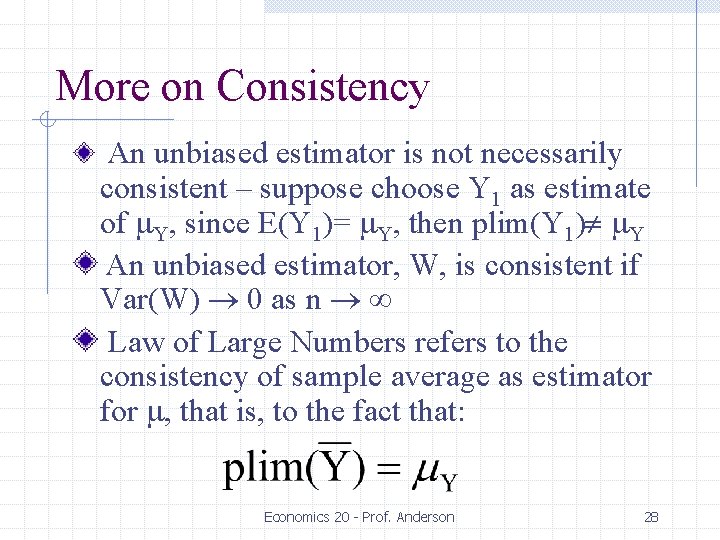
More on Consistency An unbiased estimator is not necessarily consistent – suppose choose Y 1 as estimate of m. Y, since E(Y 1)= m. Y, then plim(Y 1) m. Y An unbiased estimator, W, is consistent if Var(W) 0 as n Law of Large Numbers refers to the consistency of sample average as estimator for m, that is, to the fact that: Economics 20 - Prof. Anderson 28
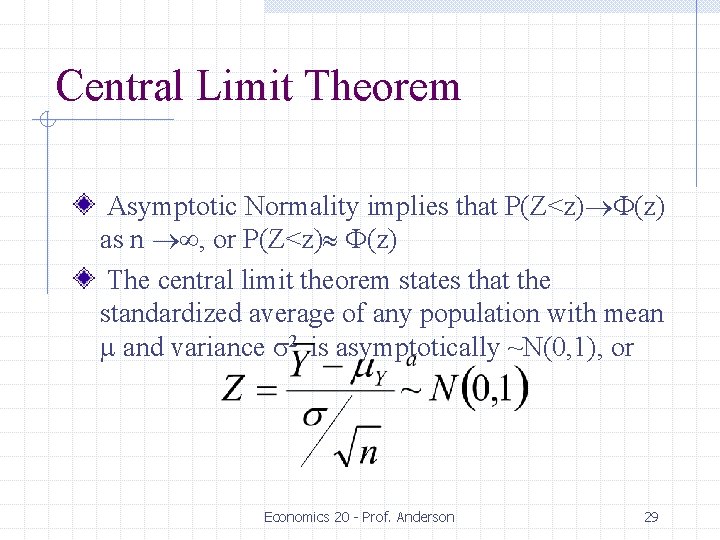
Central Limit Theorem Asymptotic Normality implies that P(Z<z) F(z) as n , or P(Z<z) F(z) The central limit theorem states that the standardized average of any population with mean m and variance s 2 is asymptotically ~N(0, 1), or Economics 20 - Prof. Anderson 29
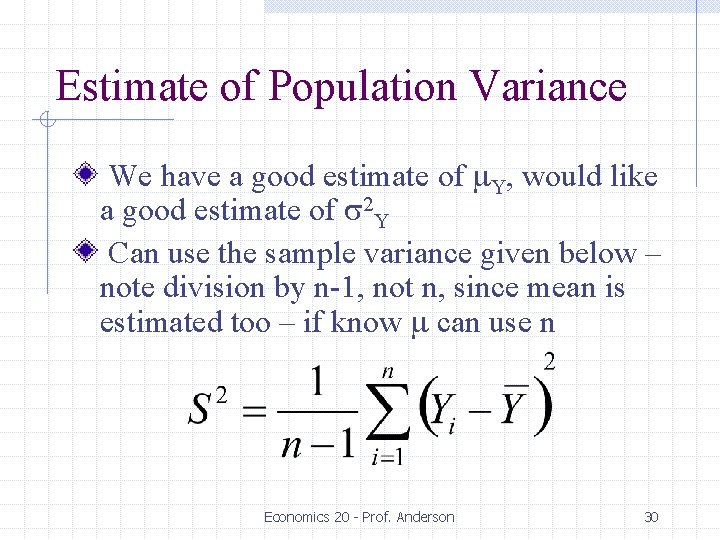
Estimate of Population Variance We have a good estimate of m. Y, would like a good estimate of s 2 Y Can use the sample variance given below – note division by n-1, not n, since mean is estimated too – if know m can use n Economics 20 - Prof. Anderson 30
Estimators as Random Variables Each of our sample statistics (e. g. the sample mean, sample variance, etc. ) is a random variable - Why? Each time we pull a random sample, we’ll get different sample statistics If we pull lots and lots of samples, we’ll get a distribution of sample statistics Economics 20 - Prof. Anderson 31
- Slides: 31