
Review of Part 4 Sun and Stars Basic
Review of Part 4: Sun and Stars Basic Facts of the Sun Distance from earth: 93, 000 miles = 1 A. U. (astronomical unit) Size: about 1% of earth-sun distance, bigger than orbit of the moon Surface temperature: 6, 000 K or 10, 000 o. F Solar Power: at earth’s distance, about 1, 500 Watts per square meter Solar Power on earth: max electrical power: 300 Watts for each square meter, average electrical power: 50 Watts for each square meter. (for comparison, 1 horsepower = 746 Watts)
Review: the Sun’s Structure Fuel of the sun: nuclear fusion that “burns” hydrogen into helium Core: where fusion occurs is 15, 000 K or 27, 000 o. F Radiative zone: heat from core transferred out by radiation Convective zone: heat from radiative zone transferred out by convection Photosphere: surface of the sun where heat is converted into sunlight surface temperature is about 6, 000 K or 10, 000 o. F surface has sunspots and solar flairs around sunspots sunspot size: about the earth’s size sunspot cycle is about 11 years: from near zero spots to a couple hundred spots Atmosphere: Corona extends out about the radius of the sun
Review: the Stars For the nearer stars, we can determine: Brightness: units are in Apparent Magnitude (0=brightest, 5=dimmest by eye) Distance using parallax (trig), works for up to 300 light years Temperature using spectra: amount of blue versus red light Composition using emission and absorption spectra Mass from binary stars that rotate around each other optical binaries spectral binaries (using red and blue shifts) eclipsing binaries (one goes in front of the other as they orbit) astrometric binaries (wobble of star due to orbit of dimmer star)
Review: the Stars Relations between quantities Luminosity is related to Distance and Brightness: L = B/D 2; Luminosity is measured in Absolute Magnitude Area (size) is related to Luminosity and Temperature: L =k(A*T 4) We are now in a position to try to classify stars. To do this, we start by plotting the nearer stars in a graph with Luminosity on the vertical and Temperature (or color) on the horizontal. This plot is called an H-R diagram. See the slide from Part 4 Set 2 slide #30 which is repeated on the next slide. In drawing the diagram, the vertical Luminosity scale at the top is about -10 and at the bottom is about +15 in Absolute Magnitude; the horizontal Temperature (color) scale goes from high temperature (blue) on the left to low temperature (red) on the right.
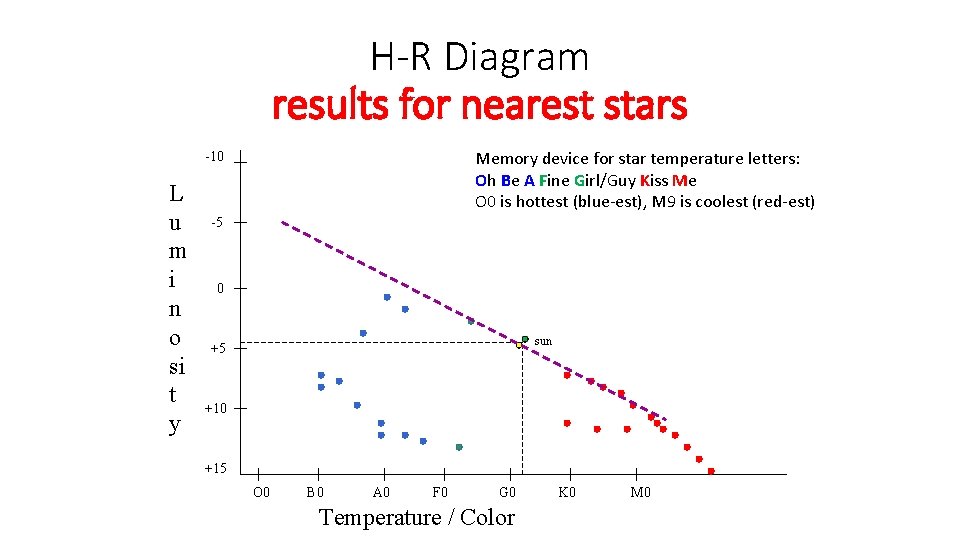
H-R Diagram results for nearest stars Memory device for star temperature letters: Oh Be A Fine Girl/Guy Kiss Me O 0 is hottest (blue-est), M 9 is coolest (red-est) -10 L u m i n o si t y -5 0 sun +5 +10 +15 O 0 B 0 A 0 F 0 G 0 Temperature / Color K 0 M 0
Review: the Stars The dotted line on the H-R diagram showed what we would expect: the stars that are more luminous (more negative absolute magnitude) have a higher surface temperature (more blue). Many stars fall close to that line. We call that line the Main Sequence. Our sun falls on the line, so our sun is a Main Sequence star. Stars below the Main Sequence line must be smaller in area to have a smaller luminosity with the same temperature, so we call these white dwarf stars. We can now look at the Main Sequence stars and correlate their emission and absorption spectra and their mass. With this info, we can now look at more distant stars (they must be very luminous to be seen at these greater distances). We repeat the slide for the brightest stars on the next slide.
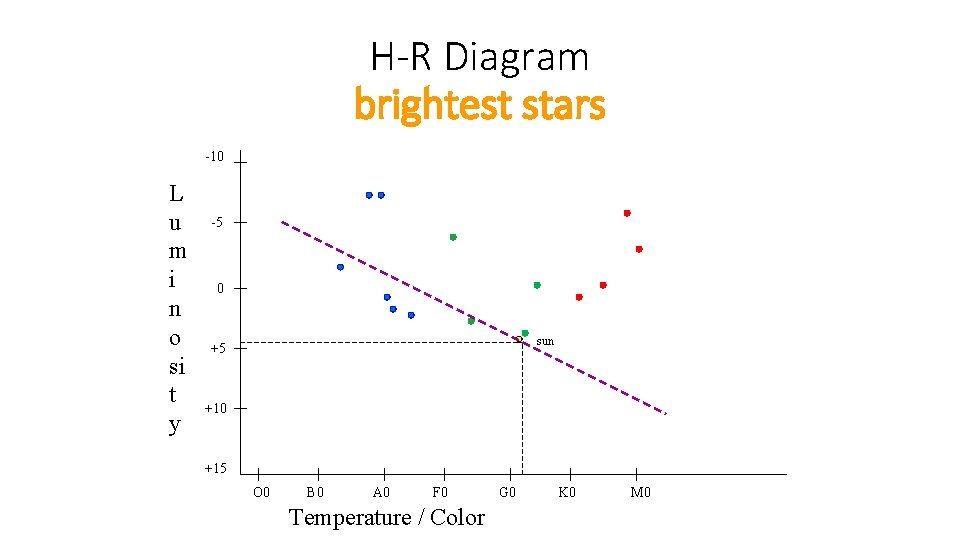
H-R Diagram brightest stars -10 L u m i n o si t y -5 0 sun +5 +10 +15 O 0 B 0 A 0 F 0 Temperature / Color G 0 K 0 M 0
Review: the Stars Since we see stars that are above the Main Sequence, these must be much larger in area (size) to have a higher luminosity and still be at the same temperature (color) as the Main Sequence stars. Thus we call them Giant Stars. We even have Super Giant Stars. From their emission and absorption spectra we can tell what type they are: Main Sequence, Giant, or Super Giant stars labelled I or II Our sun is a G 2 -V star since it is a main sequence star (V) with a Giant stars labelled III or IV surface temperature in the Main Sequence stars labelled V yellow/green that corresponds to a G 2 rating. Dwarf stars Now from their Luminosity and Brightness, we can determine their Distances! The next slide shows the brightest stars – you are responsible for knowing the info on two of them.
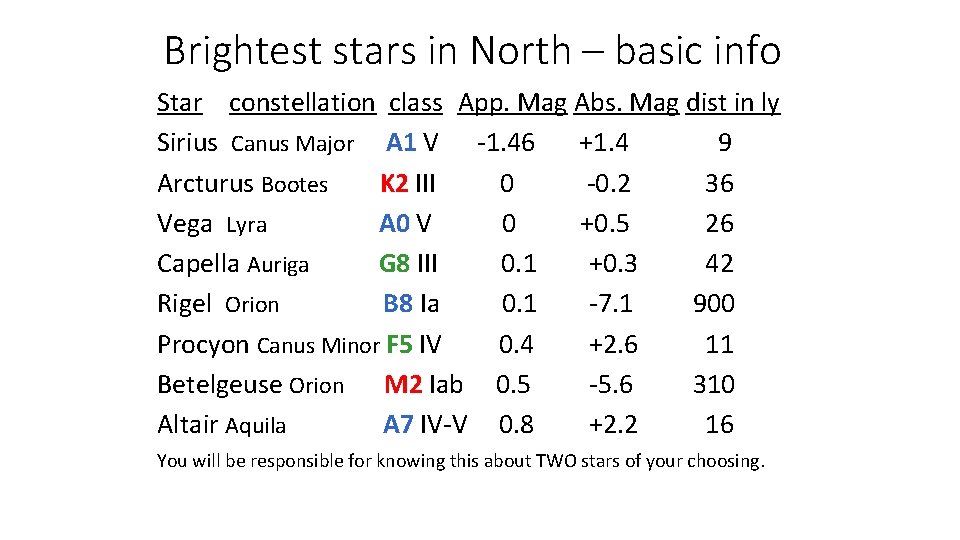
Brightest stars in North – basic info Star constellation class App. Mag Abs. Mag dist in ly Sirius Canus Major A 1 V -1. 46 +1. 4 9 Arcturus Bootes K 2 III 0 -0. 2 36 Vega Lyra A 0 V 0 +0. 5 26 Capella Auriga G 8 III 0. 1 +0. 3 42 Rigel Orion B 8 Ia 0. 1 -7. 1 900 Procyon Canus Minor F 5 IV 0. 4 +2. 6 11 Betelgeuse Orion M 2 Iab 0. 5 -5. 6 310 Altair Aquila A 7 IV-V 0. 8 +2. 2 16 You will be responsible for knowing this about TWO stars of your choosing.
Review: the Stars Other stuff: Dark and bright Nebula: clouds of dust and gas in the interstellar spaces Variable stars: One important type is Cepheid Variables These are especially important because of two things: 1. They change their brightness by up to 50% over a period of days. The time from bright to dim back to bright, called the period, is related to their luminosity. So we can easily measure their time of going brighter then dimmer, and so we can determine their luminosity. 2. These stars are all very luminous Super Giant stars, so we can see them very, very far away. Now knowing their luminosity and measuring their brightness, we can determine their distance. If they are part of a larger group of stars, then we know the distance to the whole group of stars.
Review: Life Cycle of Stars For stars, there are five stages from being born to dying: 1. Birth: Gravitational collapse of a nebula - dark at first, bright later on. 2. Burning hydrogen into helium in the fusion process – main sequence stage mass of original nebula determines where on the main sequence the star lands. 3. Red Giant stage: outer surface expands, core collapses and burns helium into heavier elements (only into elements lighter than iron). 4. Core collapses, blows off planetary nebula (this does not directly form planets) and oscillates. Massive stars go into Cepheid Variable in this stage. 5. Death: different deaths for different mass stars: 1. Stars like the sun shrink to size of earth, become white dwarf stars that gradually cool down and become brown dwarfs 2. For more massive stars, Supernova explosion with remnant turning into a Neutron Star about 15 miles in diameter. The explosion creates elements heavier the iron. 3. For the most massive stars, Supernova explosion with remnant turning into a Black Hole. The next slide is a repeat of Part 4 Set 3 Slide #28 that shows this process.
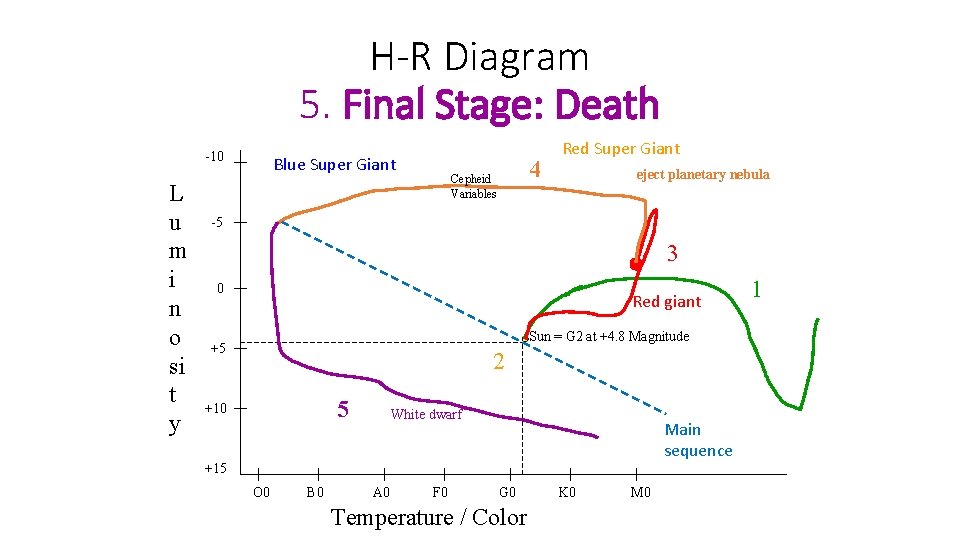
H-R Diagram 5. Final Stage: Death -10 L u m i n o si t y Blue Super Giant 4 Cepheid Variables Red Super Giant eject planetary nebula -5 3 0 Red giant Sun = G 2 at +4. 8 Magnitude +5 2 5 +10 White dwarf Main sequence +15 O 0 B 0 A 0 F 0 G 0 Temperature / Color K 0 M 0 1
Review of Distances So far, we have three methods for determining the distances to stars: 1. Parallax: This uses trigonometry, but is limited to distances less than 300 light years. 2. Brightness depends on Luminosity and Distance: This is based on identifying the stellar type (e. g. , G 2 -V like the sun or B 8 -I like Rigel) which gives the Luminosity, and so by measuring Brightness we can get Distance. This works especially well with stellar groups where we can use several stars to check for consistency. 3. Cepheid Variables: This is based on measuring the period of brightness change and from this getting the Luminosity; so by measuring Brightness we can determine Distance.
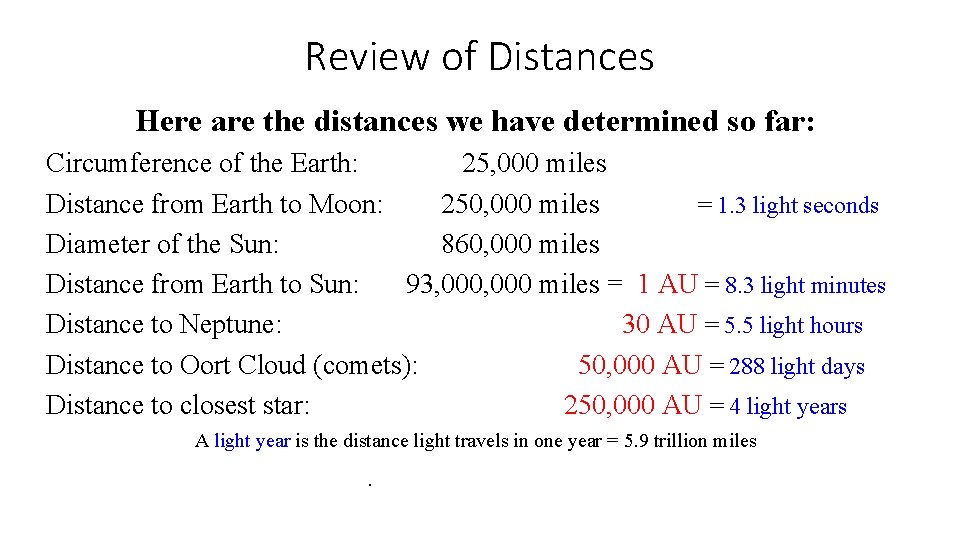
Review of Distances Here are the distances we have determined so far: Circumference of the Earth: 25, 000 miles Distance from Earth to Moon: 250, 000 miles = 1. 3 light seconds Diameter of the Sun: 860, 000 miles Distance from Earth to Sun: 93, 000 miles = 1 AU = 8. 3 light minutes Distance to Neptune: 30 AU = 5. 5 light hours Distance to Oort Cloud (comets): 50, 000 AU = 288 light days Distance to closest star: 250, 000 AU = 4 light years A light year is the distance light travels in one year = 5. 9 trillion miles.
Stars and Planets Most of the nearby stars have planets around them. There are many “hot Jupiters” that orbit very close to their star. Besides the gas giant type, we have identified ice giant planets (like Neptune). We also find “super earth” planets with rocky surfaces but much higher gravities. We find very little rocky material (to form terrestrial type planets) in the habitable zones of close binary stars.
- Slides: 15