
Review of Nucleic Acids and Mutations 1 DNA
- Slides: 45
Review of Nucleic Acids and Mutations 1
DNA Structure and Replication In the mid-1900 s, scientists knew that chromosomes, made up of DNA (deoxyribonucleic acid) and proteins, contained genetic information. However, they did not know whether the DNA or the protein was the actual genetic material. 2
Various reseachers showed that DNA was the genetic material when they performed an experiment with a T 2 virus. By using different radioactively labeled components, they demonstrated that only the virus DNA entered a bacterium to take over the cell and produce new viruses. 3
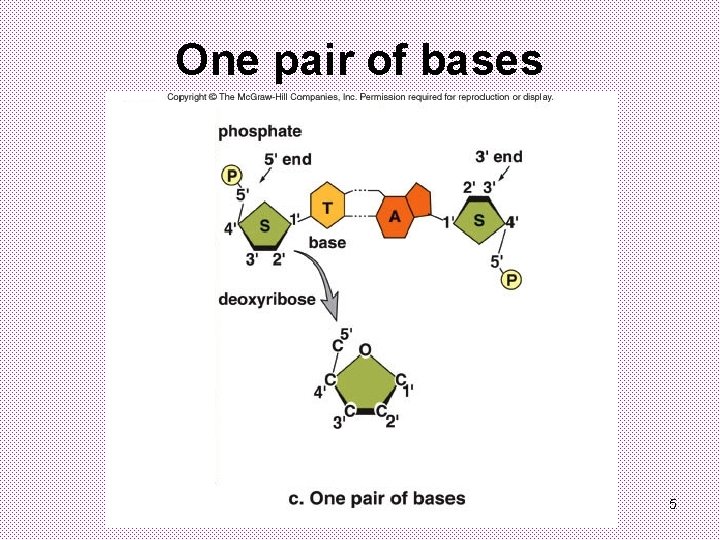
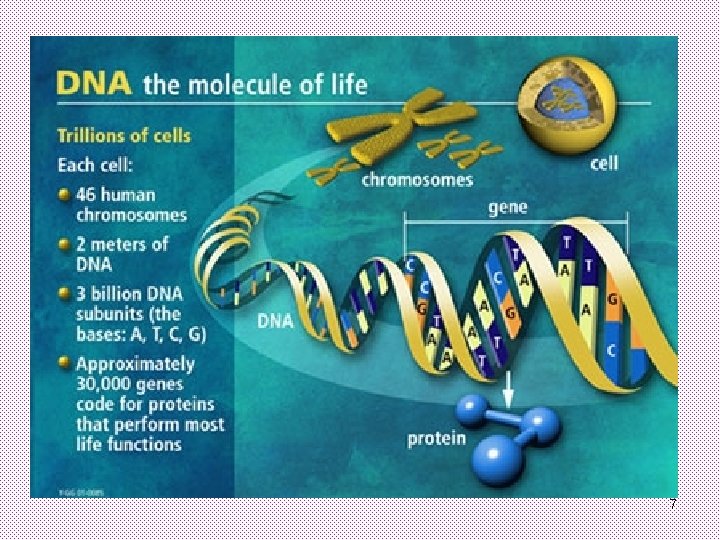
Structure of DNA The structure of DNA was determined by James Watson and Francis Crick in the early 1950 s. DNA is a polynucleotide; nucleotides are composed of a phosphate, a sugar, and a nitrogen-containing base. DNA has the sugar deoxyribose and four different bases: adenine (A), thymine (T), guanine (G), and cytosine (C). 4
One pair of bases 5
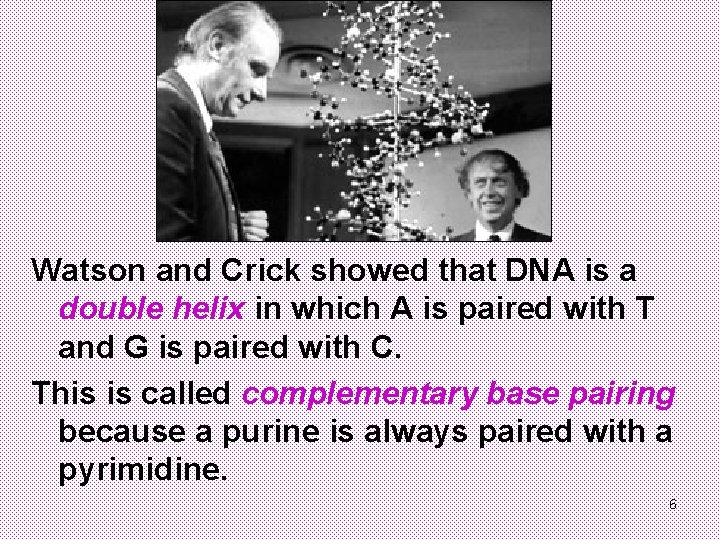
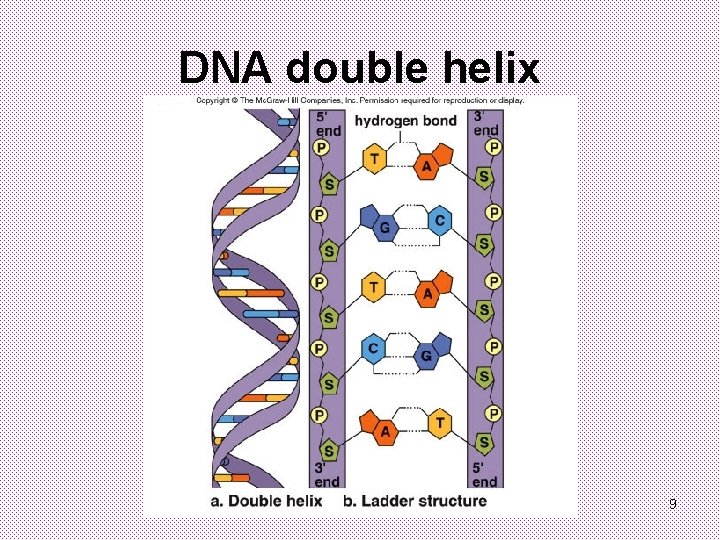
Watson and Crick showed that DNA is a double helix in which A is paired with T and G is paired with C. This is called complementary base pairing because a purine is always paired with a pyrimidine. 6
7
When the DNA double helix unwinds, it resembles a ladder. The sides of the ladder are the sugarphosphate backbones, and the rungs of the ladder are the complementary paired bases. The two DNA strands are anti-parallel – they run in opposite directions. 8
DNA double helix 9
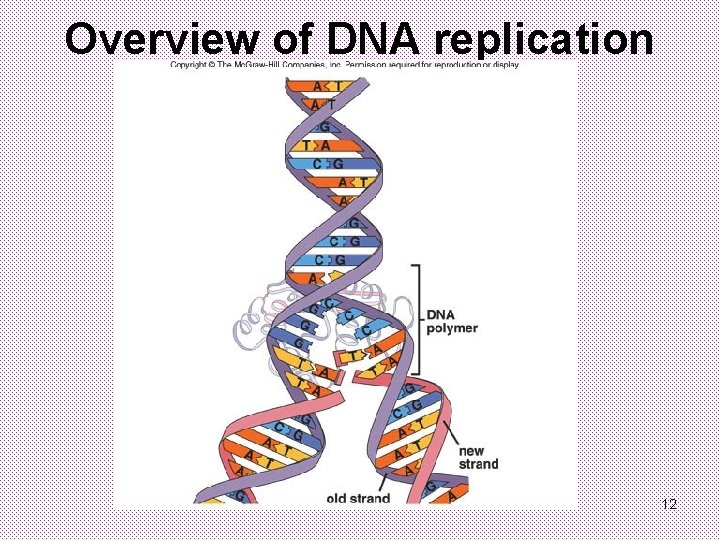
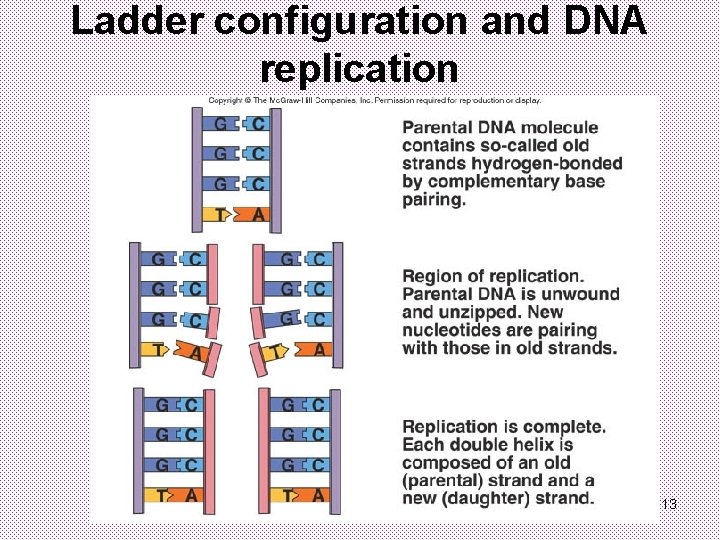
Replication of DNA replication occurs during chromosome duplication; an exact copy of the DNA is produced with the aid of DNA polymerase. Hydrogen bonds between bases break and enzymes “unzip” the molecule. Each old strand of nucleotides serves as a template for each new strand. 10
New nucleotides move into complementary positions are joined by DNA polymerase. The process is semiconservative because each new double helix is composed of an old strand of nucleotides from the parent molecule and one newly-formed strand. Some cancer treatments are aimed at stopping DNA replication in rapidlydividing cancer cells. 11
Overview of DNA replication 12
Ladder configuration and DNA replication 13
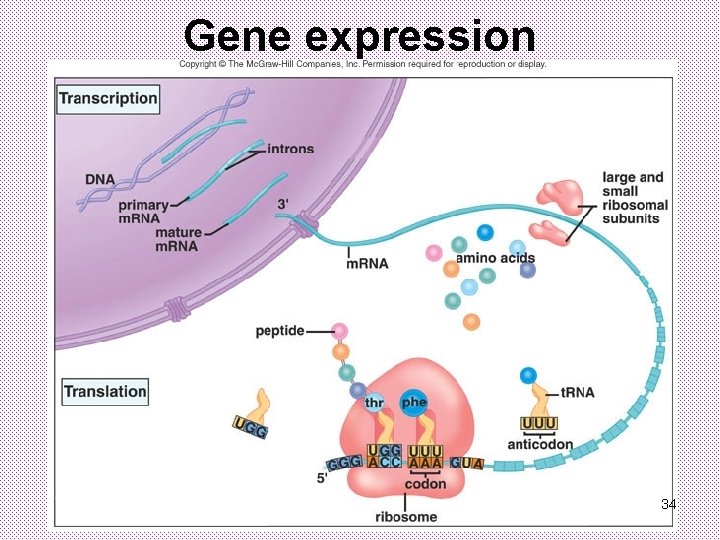
Gene Expression A gene is a segment of DNA that specifies the amino acid sequence of a protein. Gene expression occurs when gene activity leads to a protein product in the cell. A gene does not directly control protein synthesis; instead, it passes its genetic information on to RNA, which is more directly involved in protein synthesis. 14
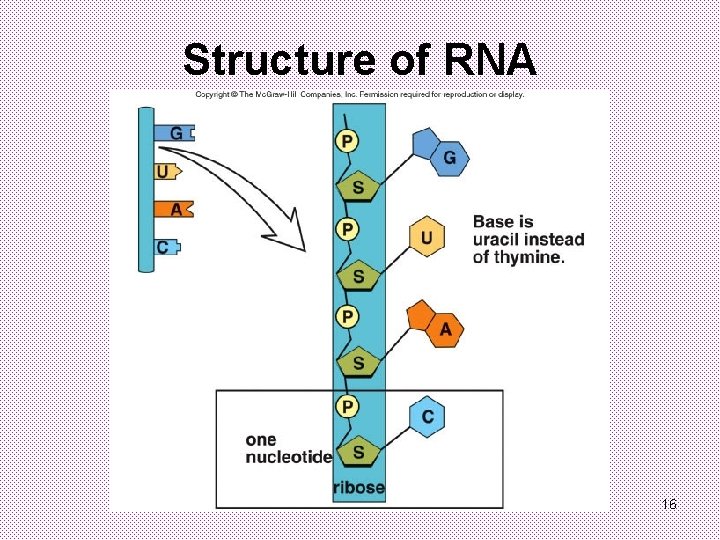
RNA (ribonucleic acid) is a singlestranded nucleic acid in which A pairs with U (uracil) while G pairs with C. Three types of RNA are involved in gene expression: messenger RNA (m. RNA) carries genetic information to the ribosomes, ribosomal RNA (r. RNA) is found in the ribosomes, and transfer RNA (t. RNA) transfers amino acids to the ribosomes, where the protein product is synthesized. 15
Structure of RNA 16
Two processes are involved in the synthesis of proteins in the cell: Transcription makes an RNA molecule complementary to a portion of DNA. Translation occurs when the sequence of bases of m. RNA directs the sequence of amino acids in a polypeptide. 17
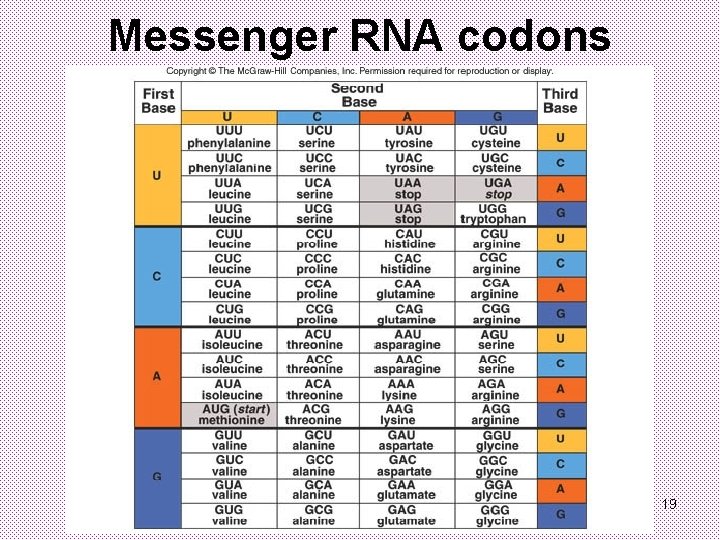
The Genetic Code DNA specifies the synthesis of proteins because it contains a triplet code: every three bases stand for one amino acid. Each three-letter unit of an m. RNA molecule is called a codon. Most amino acids have more than one codon; there are 20 amino acids with a possible 64 different triplets. The code is nearly universal among living organisms. 18
Messenger RNA codons 19
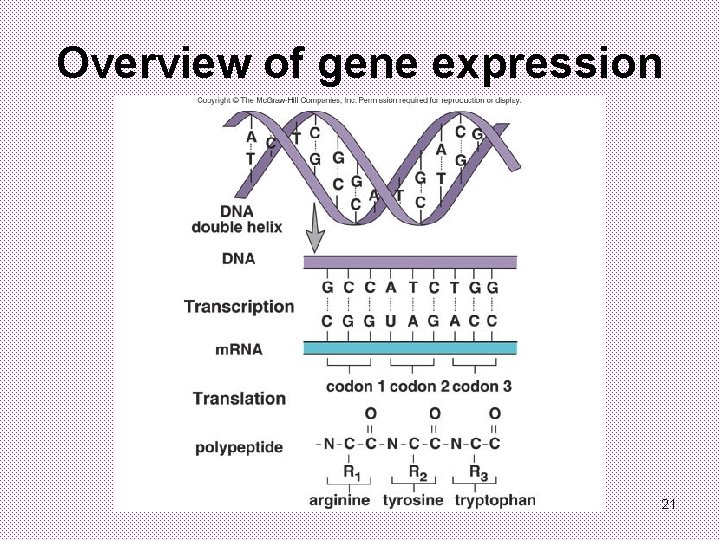
Central Concept The central concept of genetics involves the DNA-to-protein sequence involving transcription and translation. DNA has a sequence of bases that is transcribed into a sequence of bases in m. RNA. Every three bases is a codon that stands for a particular amino acid. 20
Overview of gene expression 21
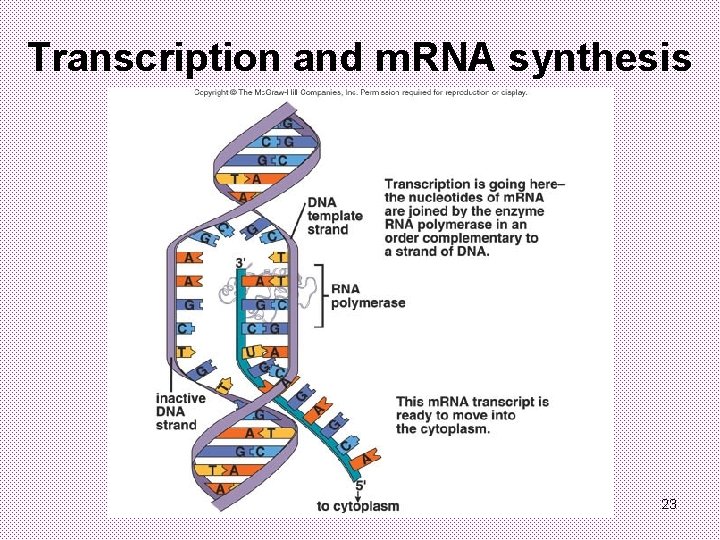
Transcription During transcription in the nucleus, a segment of DNA unwinds and unzips, and the DNA serves as a template for m. RNA formation. RNA polymerase joins the RNA nucleotides so that the codons in m. RNA are complementary to the triplet code in DNA. (Copy blueprint for the electrician!) 22
Transcription and m. RNA synthesis 23
Translation is the second step by which gene expression leads to protein synthesis. During translation, the sequence of codons in m. RNA specifies the order of amino acids in a protein. Translation requires several enzymes and two other types of RNA: transfer RNA and ribosomal RNA. 24
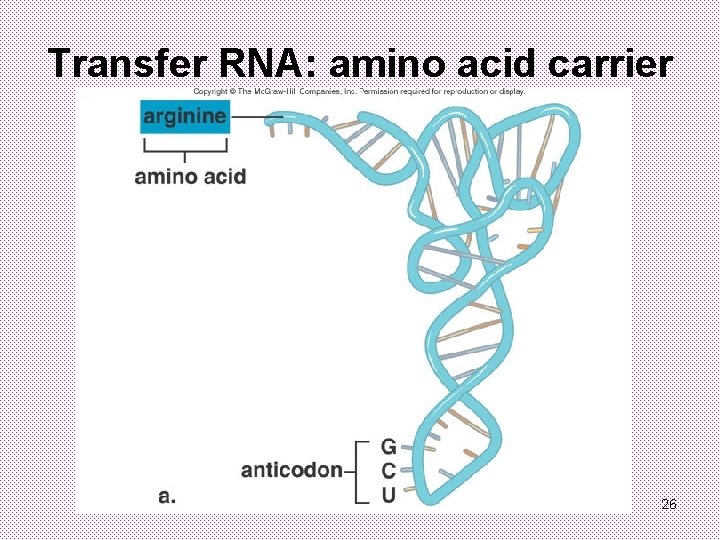
Transfer RNA During translation, transfer RNA (t. RNA) molecules attach to their own particular amino acid and travel to a ribosome. Through complementary base pairing between anticodons of t. RNA and codons of m. RNA, the sequence of t. RNAs and their amino acids form the sequence of the polypeptide. 25
Transfer RNA: amino acid carrier 26
Ribosomal RNA, also called structural RNA, is made in the nucleolus. Proteins made in the cytoplasm move into the nucleus and join with ribosomal RNA to form the subunits of ribosomes. A large subunit and small subunit of a ribosome leave the nucleus and join in the cytoplasm to form a ribosome just prior to protein synthesis. 27
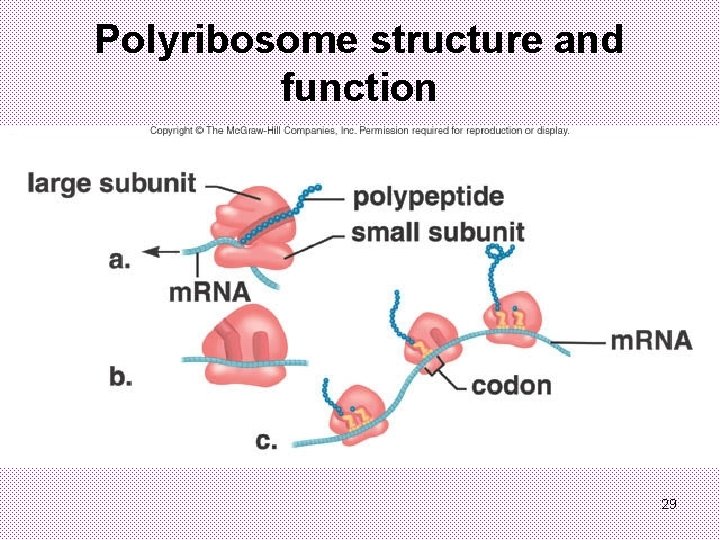
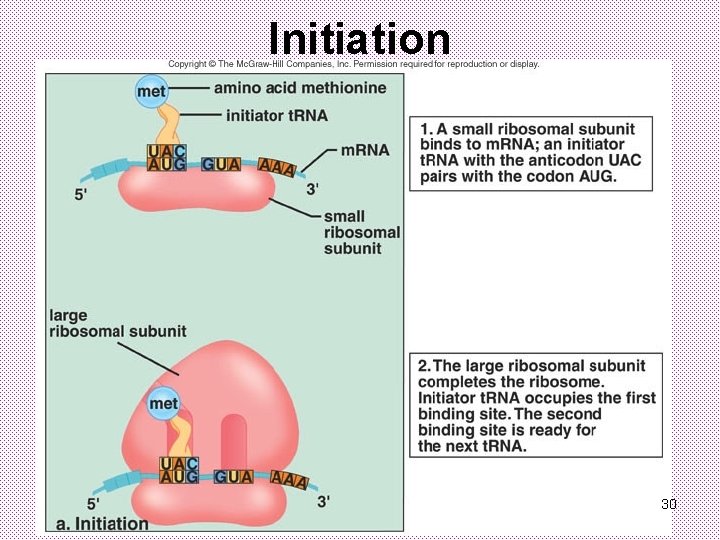
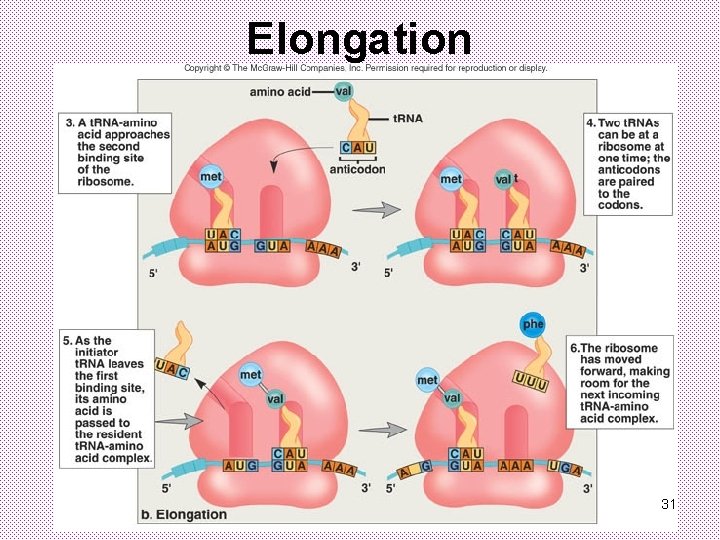
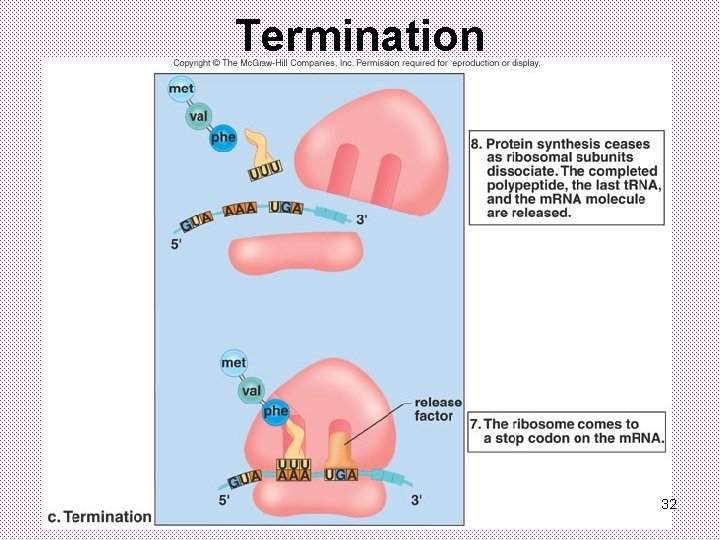
A ribosome has a binding site for m. RNA as well as binding sites for two t. RNA molecules at a time. As the ribosome moves down the m. RNA molecule, new t. RNAs arrive, and a polypeptide forms and grows longer. Translation terminates once the polypeptide is fully formed; the ribosome separates into two subunits and falls off the m. RNA. Several ribosomes may attach and translate the same m. RNA, therefore the name polyribosome. 28
Polyribosome structure and function 29
Initiation 30
Elongation 31
Termination 32
Review of Gene Expression DNA in the nucleus contains a triplet code; each group of three bases stands for one amino acid. During transcription, an m. RNA copy of the DNA template is made. The m. RNA is processed before leaving the nucleus. The m. RNA joins with a ribosome, where t. RNA carries the amino acids into position during translation. 33
Gene expression 34
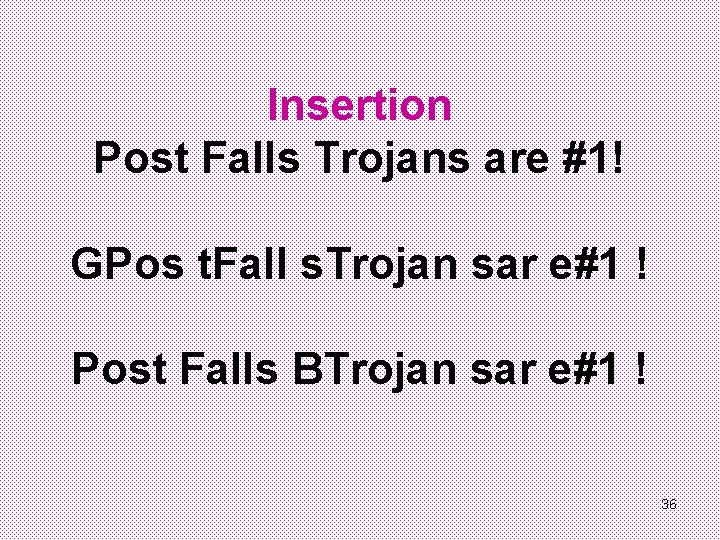
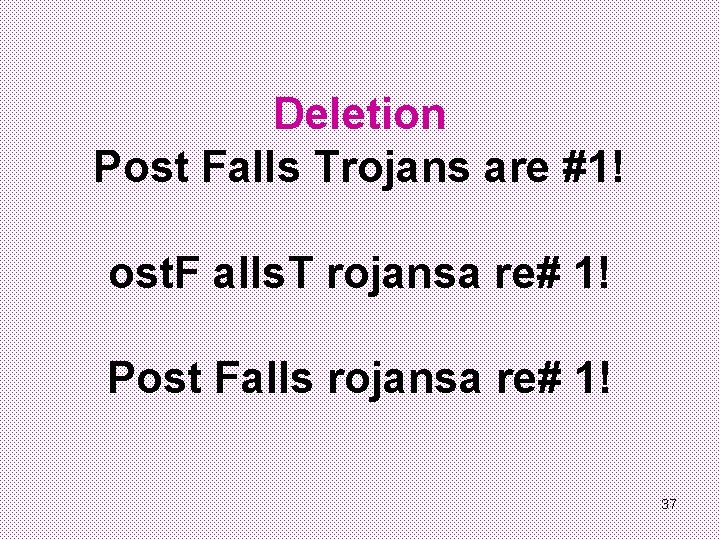
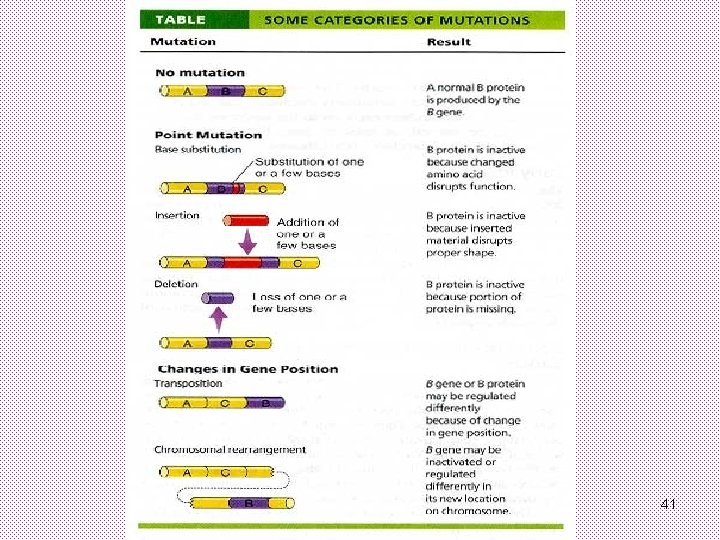
Gene Mutations A gene mutation is a change in the sequence of bases within a gene. Frameshift Mutations Frameshift mutations involve the addition or removal of a base during the formation of m. RNA; these change the genetic message by shifting the “reading frame. ” 35
Insertion Post Falls Trojans are #1! GPos t. Fall s. Trojan sar e#1 ! Post Falls BTrojan sar e#1 ! 36
Deletion Post Falls Trojans are #1! ost. F alls. T rojansa re# 1! Post Falls rojansa re# 1! 37
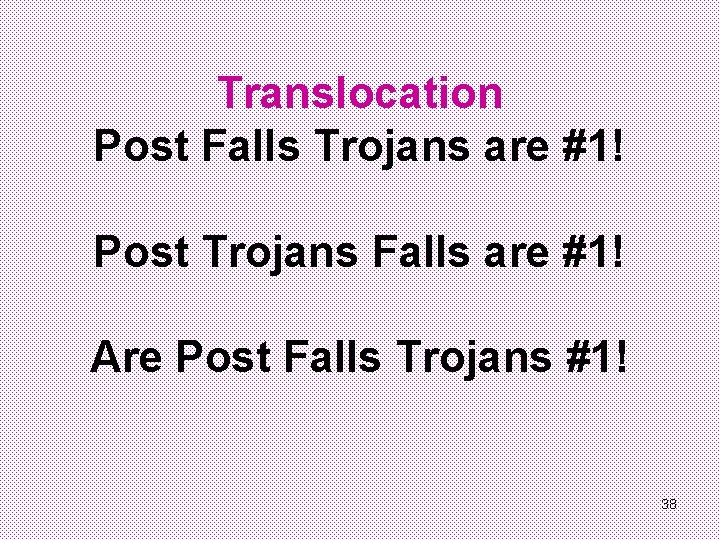
Translocation Post Falls Trojans are #1! Post Trojans Falls are #1! Are Post Falls Trojans #1! 38
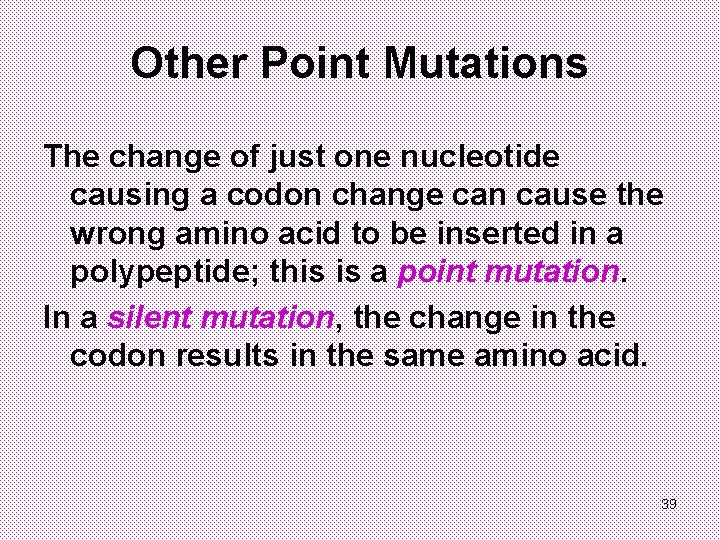
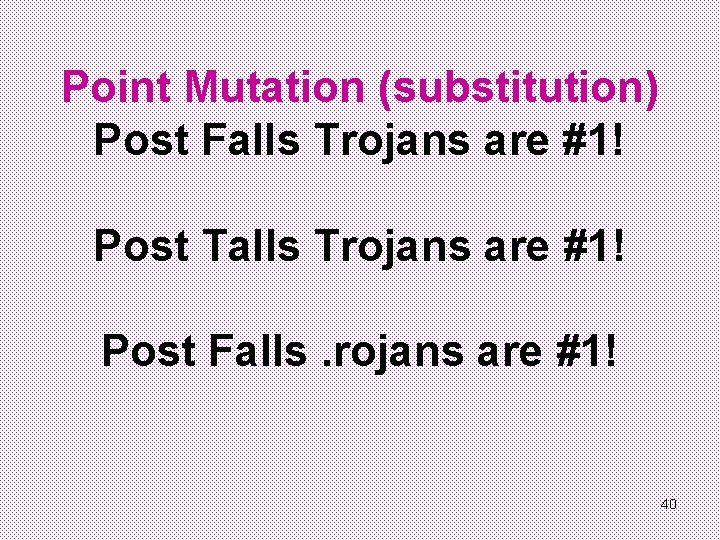
Other Point Mutations The change of just one nucleotide causing a codon change can cause the wrong amino acid to be inserted in a polypeptide; this is a point mutation. In a silent mutation, the change in the codon results in the same amino acid. 39
Point Mutation (substitution) Post Falls Trojans are #1! Post Talls Trojans are #1! Post Falls. rojans are #1! 40
41
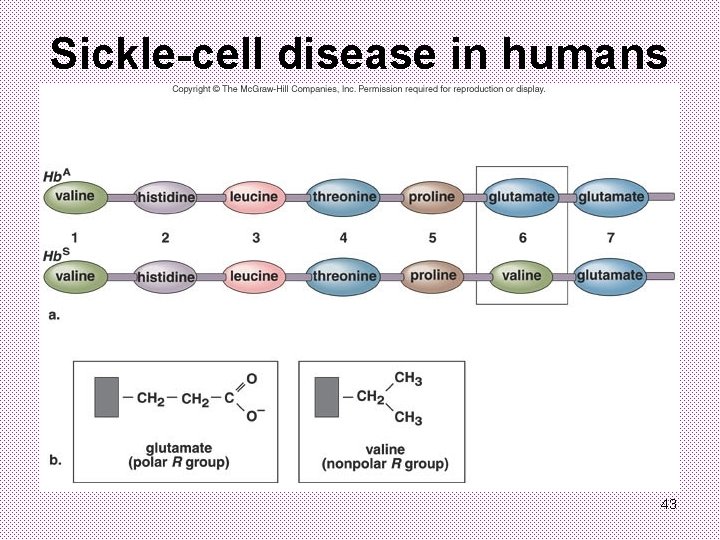
If a codon is changed to a stop codon, the resulting protein may be too short to function; this is a nonsense mutation. If a point mutation involves the substitution of a different amino acid, the result may be a protein that cannot reach its final shape; this is a missense mutation. An example is Hbs which causes sicklecell disease. 42
Sickle-cell disease in humans 43
Chromosomal Mutations Deletion – loss of segment Insertion – addition of segment Inversion – reverse reinsertion of segment Translocation – added to different chromosome Nondisjunction – failure of separation during meiosis 44
Cause and Repair of Mutations can be spontaneous or caused by environmental influences called mutagens. Mutagens include radiation (X-rays, UV radiation), and organic chemicals (in cigarette smoke and pesticides). DNA polymerase proofreads the new strand against the old strand detects mismatched pairs, reducing mistakes to one in a billion nucleotide pairs replicated. 45