
Review of Molecular Absorption Basic properties of molecular
Review of Molecular Absorption Basic properties of molecular absorption (how & why) Absorption Spectrum Absorption coefficient and pressure broadening Transmission Application: basis for estimating column CO 2 and O 2 (TCCON)
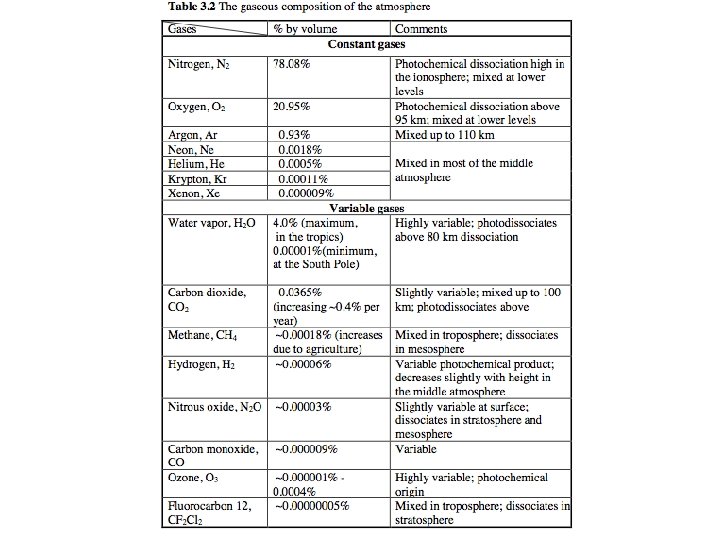
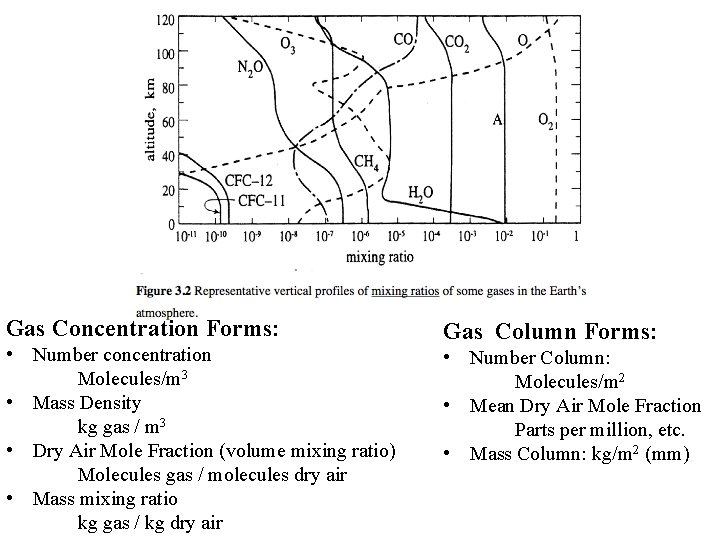
Gas Concentration Forms: • Number concentration Molecules/m 3 • Mass Density kg gas / m 3 • Dry Air Mole Fraction (volume mixing ratio) Molecules gas / molecules dry air • Mass mixing ratio kg gas / kg dry air Gas Column Forms: • Number Column: Molecules/m 2 • Mean Dry Air Mole Fraction Parts per million, etc. • Mass Column: kg/m 2 (mm)
Properties of atmospheric gases. ü Atmospheric gases are highly selective in their ability to absorb and emit radiation. ü Each radiatively active gas has a specific absorption spectrum- its own signature. ü An atmosphere is the mixture of gases and thus the abundance of gases in the atmosphere controls the overall spectral absorption. ü Radiatively active gases in the Earth’s atmosphere can be highly variable in space and time (especially if chemically active!) ü The ability of a molecule to absorb (emit) radiation is determined by its structure which controls whether the molecule has a dipole.
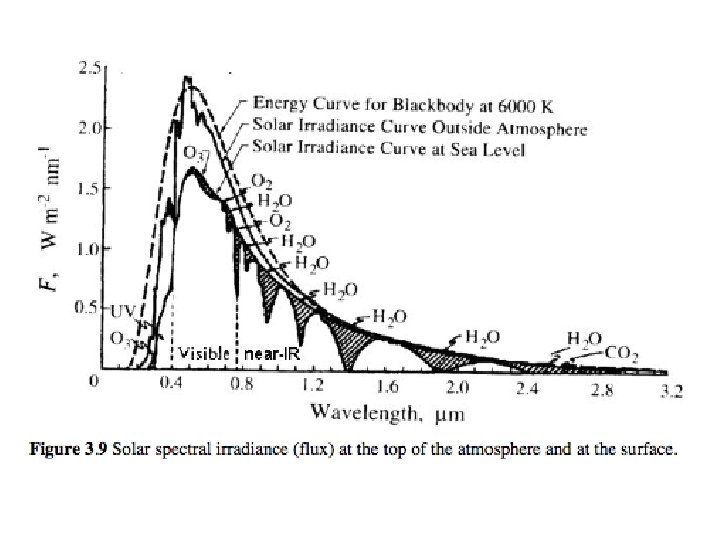
![UV/Vis/NIR Gas Absorption [Gottwald et al. , The SCIAMACHY Book, 2006]](http://slidetodoc.com/presentation_image_h2/fc66787e939b616d8ab05109be506a3f/image-6.jpg "UV/Vis/NIR Gas Absorption [Gottwald et al. , The SCIAMACHY Book, 2006]")
UV/Vis/NIR Gas Absorption [Gottwald et al. , The SCIAMACHY Book, 2006]
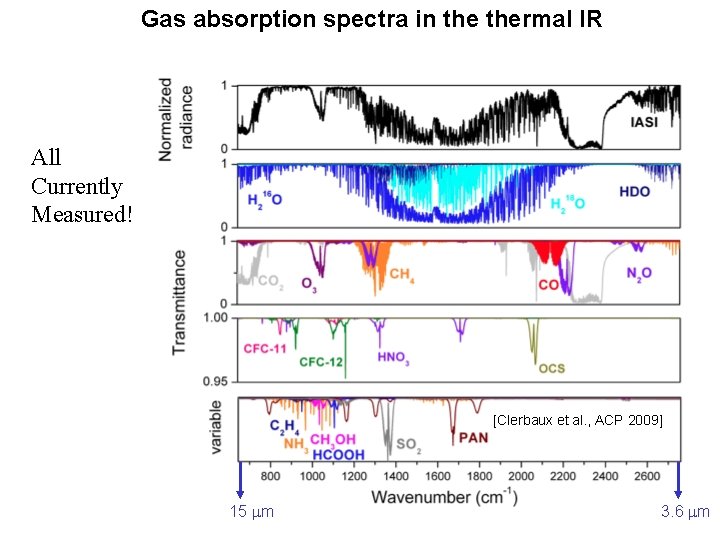
Gas absorption spectra in thermal IR All Currently Measured! [Clerbaux et al. , ACP 2009] 15 m 3. 6 m
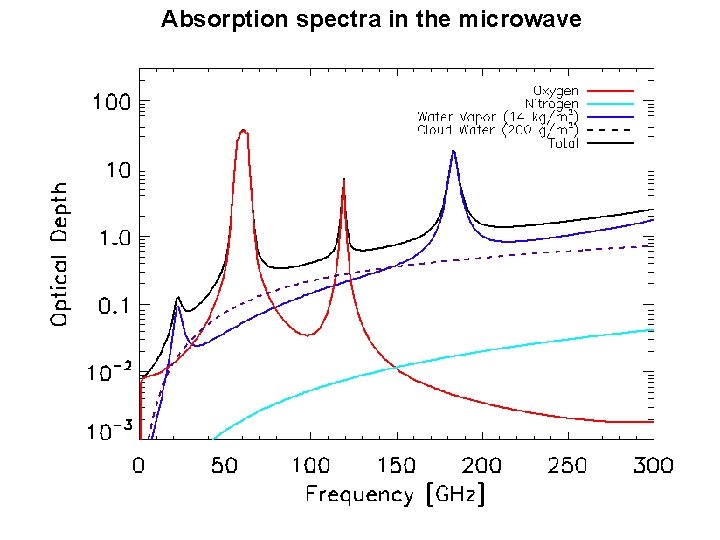
Absorption spectra in the microwave Microwave
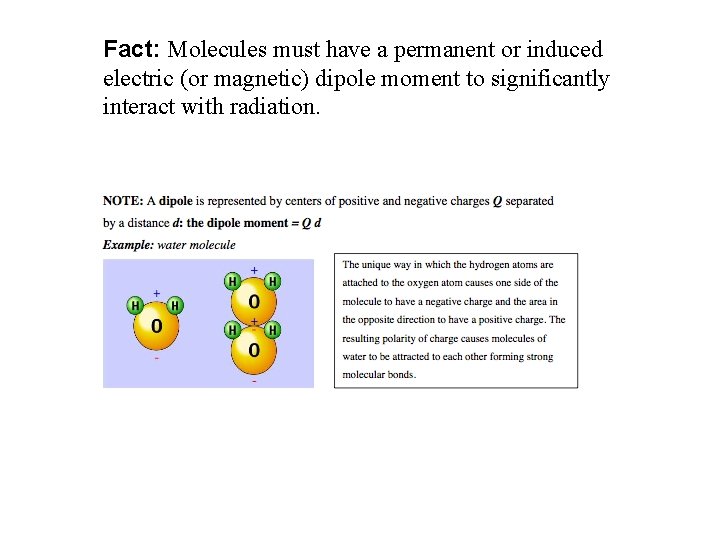
Fact: Molecules must have a permanent or induced electric (or magnetic) dipole moment to significantly interact with radiation.
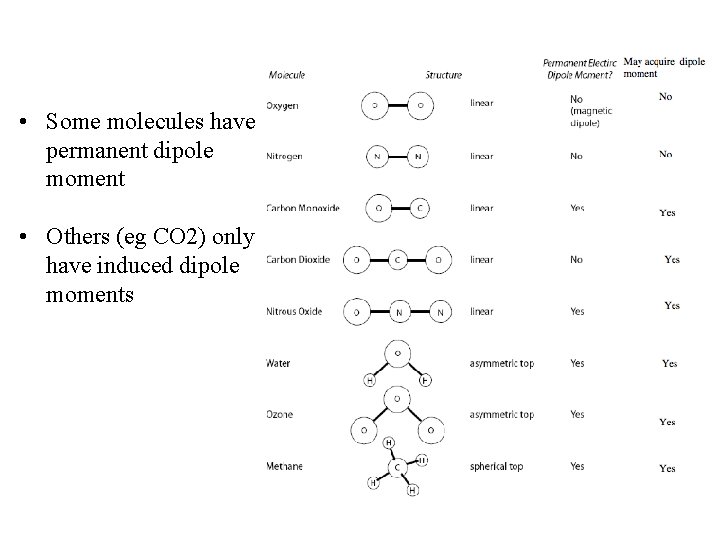
• Some molecules have permanent dipole moment • Others (eg CO 2) only have induced dipole moments
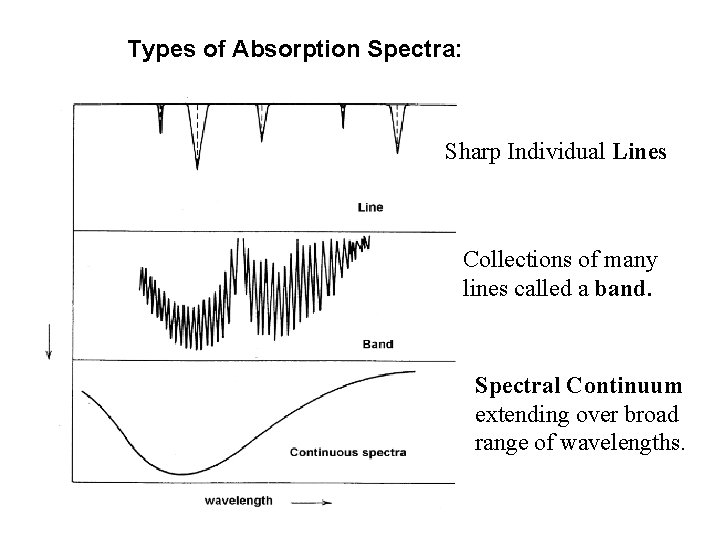
Types of Absorption Spectra: Sharp Individual Lines Collections of many lines called a band. Spectral Continuum extending over broad range of wavelengths.
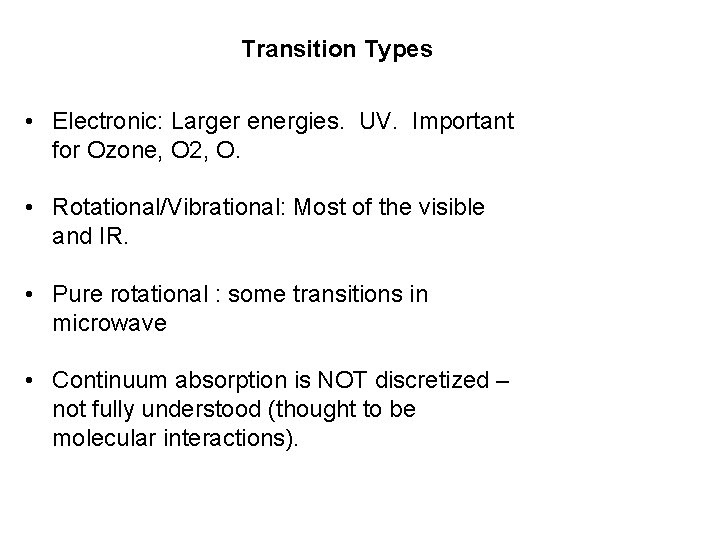
Transition Types • Electronic: Larger energies. UV. Important for Ozone, O 2, O. • Rotational/Vibrational: Most of the visible and IR. • Pure rotational : some transitions in microwave • Continuum absorption is NOT discretized – not fully understood (thought to be molecular interactions).
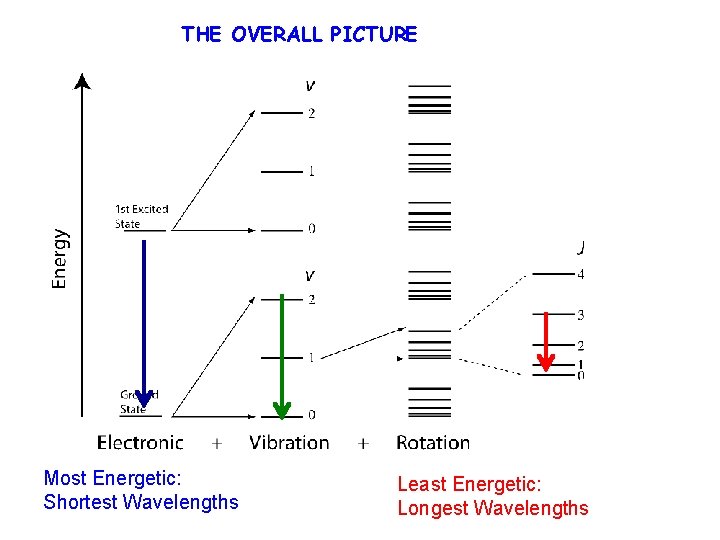
THE OVERALL PICTURE Most Energetic: Shortest Wavelengths Least Energetic: Longest Wavelengths
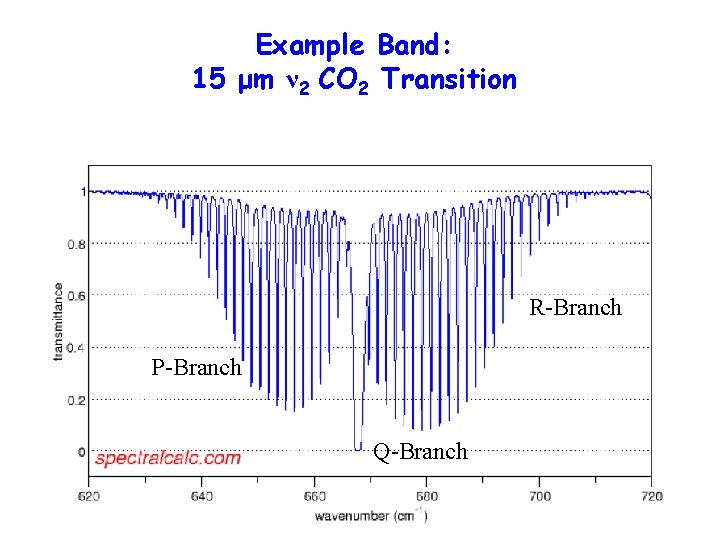
Example Band: 15 μm ν 2 CO 2 Transition R-Branch P-Branch Q-Branch
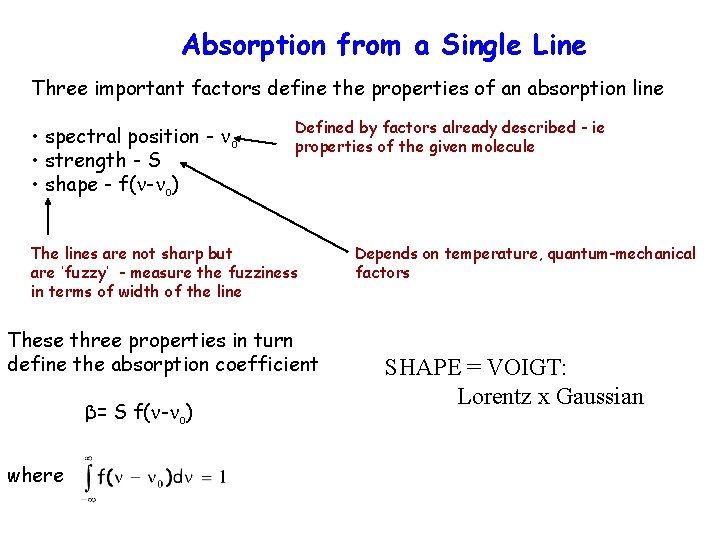
Absorption from a Single Line Three important factors define the properties of an absorption line • spectral position - o • strength - S • shape - f( - o) Defined by factors already described - ie properties of the given molecule The lines are not sharp but are ‘fuzzy’ - measure the fuzziness in terms of width of the line These three properties in turn define the absorption coefficient β= S f( - o) where Depends on temperature, quantum-mechanical factors SHAPE = VOIGT: Lorentz x Gaussian
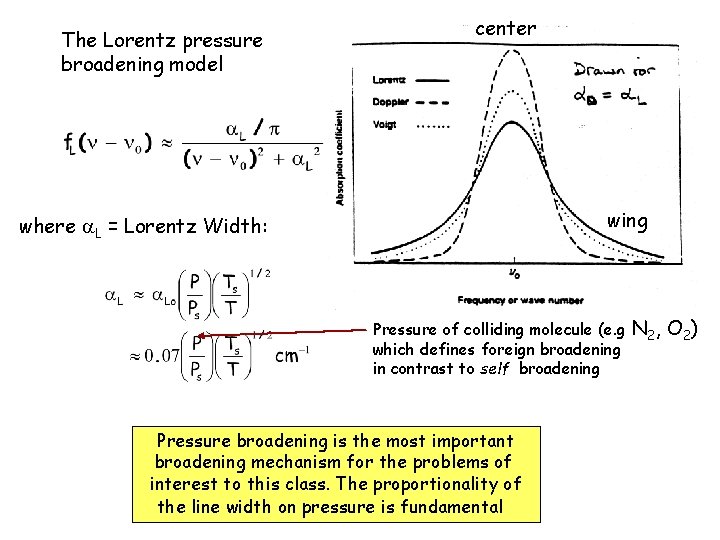
The Lorentz pressure broadening model center wing where L = Lorentz Width: Pressure of colliding molecule (e. g which defines foreign broadening in contrast to self broadening Pressure broadening is the most important broadening mechanism for the problems of interest to this class. The proportionality of the line width on pressure is fundamental N 2, O 2)
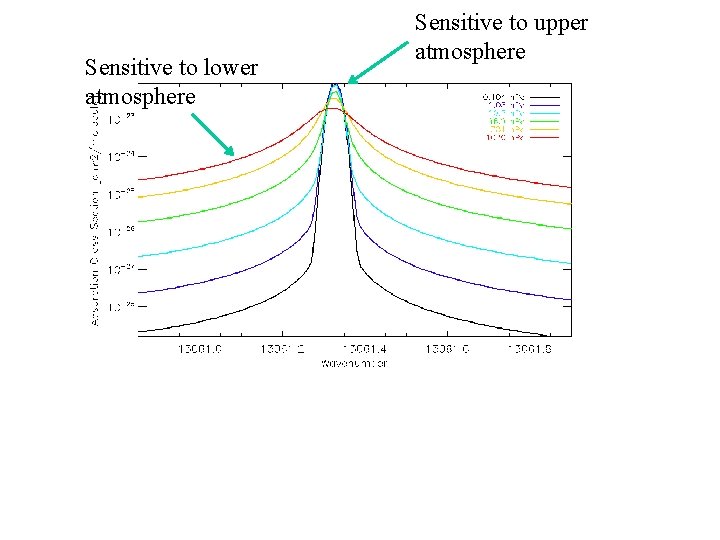
Sensitive to lower atmosphere Sensitive to upper atmosphere
Applications • Gas measurements. o Thermal IR emission measurements provide ways to “see” gas concentrations at different atmospheric layers, assuming a known temperature profile. (ie, temperature variations must be known much better than gas concentrations) o Vis/NIR reflected sunlight measurements. Only really sensitive to total column, but don’t need to know temperature nearly as well. Generally need to know surface pressure. OR • Temperature profile measurements o Using a gas of known concentration, can measure a temperature profile via thermal emission. (must know gas concentration much better than small temperature variations, and gas should be well-mixed). Generally this is O 2, but CO 2 is sometimes also used.
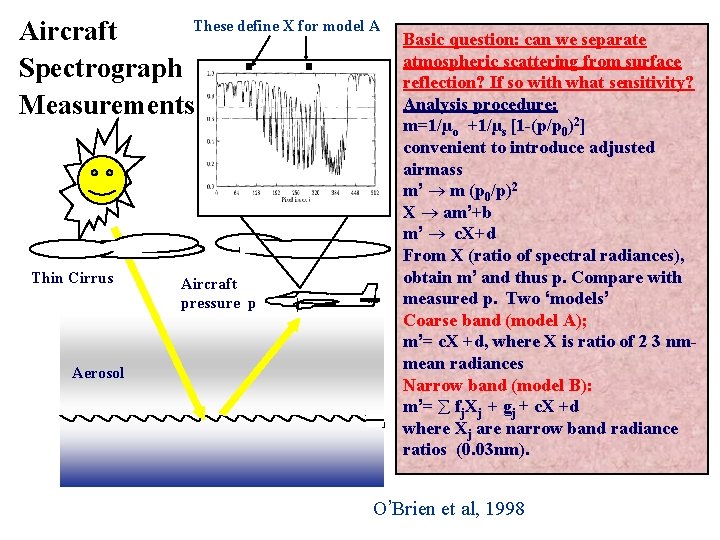
These define X for model A Aircraft Spectrograph Measurements Thin Cirrus Aerosol Aircraft pressure p Basic question: can we separate atmospheric scattering from surface reflection? If so with what sensitivity? Analysis procedure: m=1/µo +1/µs [1 -(p/p 0)2] convenient to introduce adjusted airmass m’ m (p 0/p)2 X am’+b m’ c. X+d From X (ratio of spectral radiances), obtain m’ and thus p. Compare with measured p. Two ‘models’ Coarse band (model A); m’= c. X +d, where X is ratio of 2 3 nmmean radiances Narrow band (model B): m’= fj. Xj + gj + c. X +d where Xj are narrow band radiance ratios (0. 03 nm). O’Brien et al, 1998
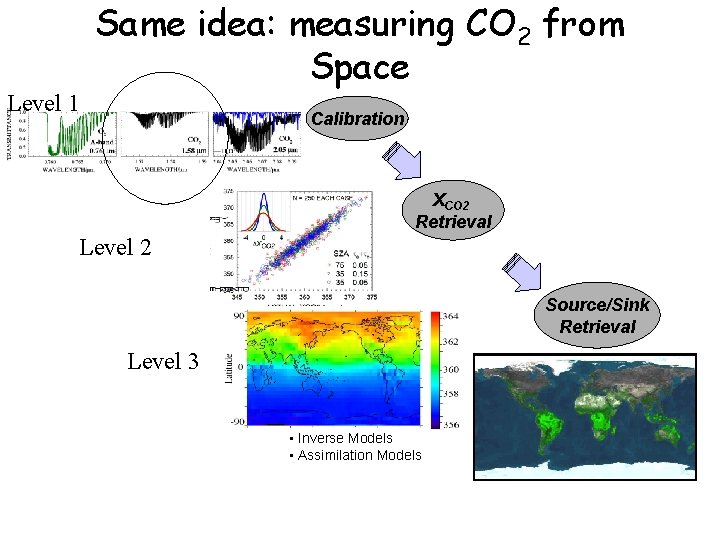
Level 1 Same idea: measuring CO 2 from Space Calibration XCO 2 Retrieval Level 2 Source/Sink Retrieval Level 3 • Inverse Models • Assimilation Models
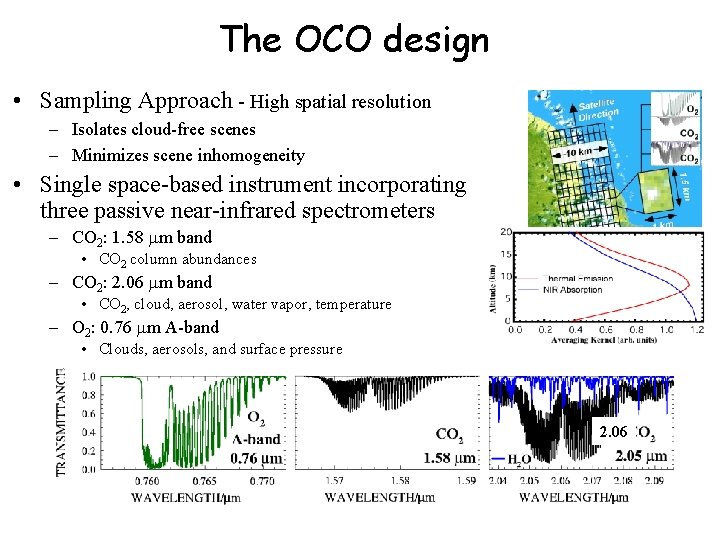
The OCO design • Sampling Approach - High spatial resolution – Isolates cloud-free scenes – Minimizes scene inhomogeneity • Single space-based instrument incorporating three passive near-infrared spectrometers – CO 2: 1. 58 m band • CO 2 column abundances – CO 2: 2. 06 m band • CO 2, cloud, aerosol, water vapor, temperature – O 2: 0. 76 m A-band • Clouds, aerosols, and surface pressure 2. 06
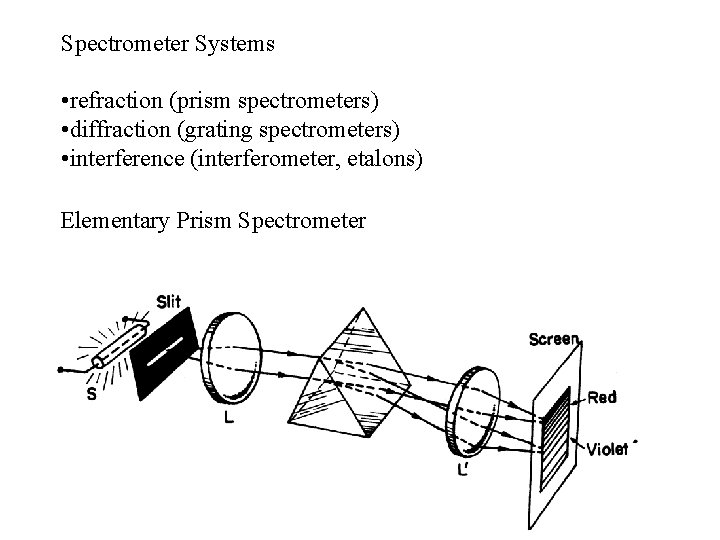
Spectrometer Systems • refraction (prism spectrometers) • diffraction (grating spectrometers) • interference (interferometer, etalons) Elementary Prism Spectrometer
- Slides: 22