
Review of Linear Algebra Cont SVD Full Representation
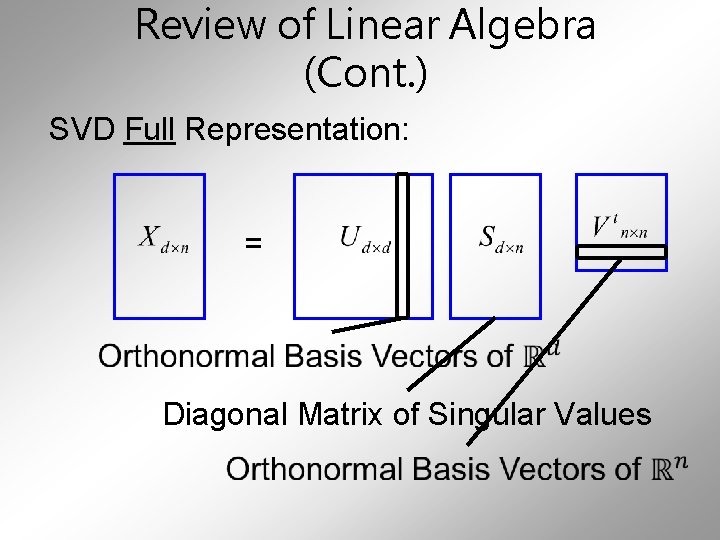
Review of Linear Algebra (Cont. ) SVD Full Representation: = Diagonal Matrix of Singular Values
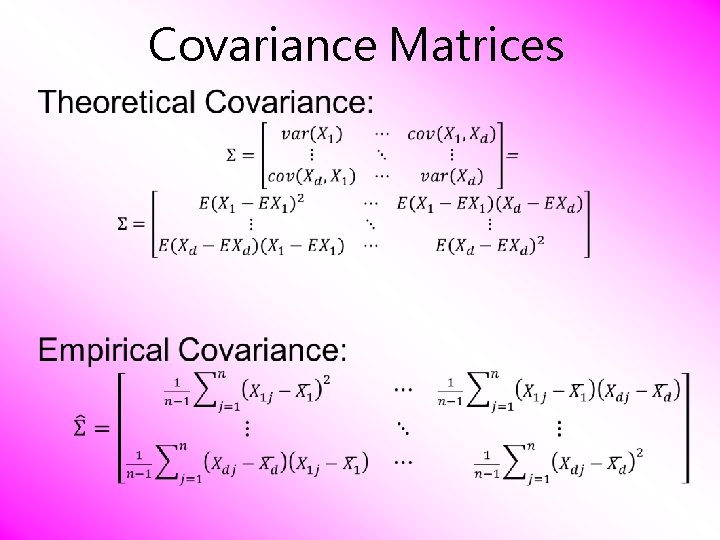
Covariance Matrices
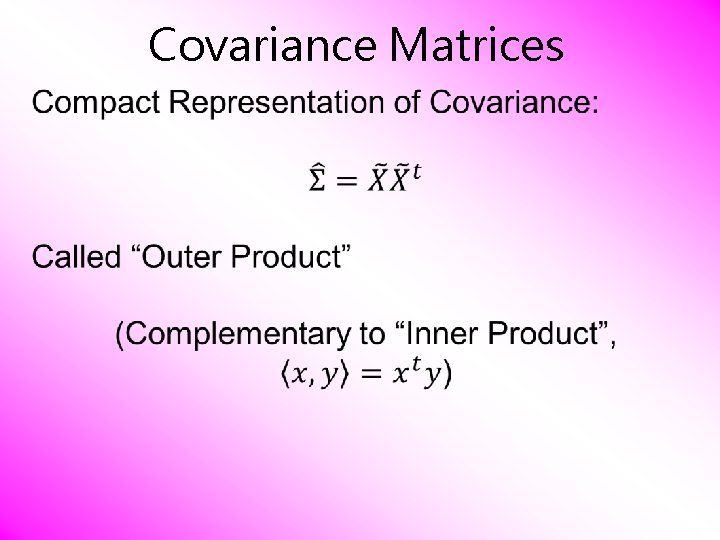
Covariance Matrices
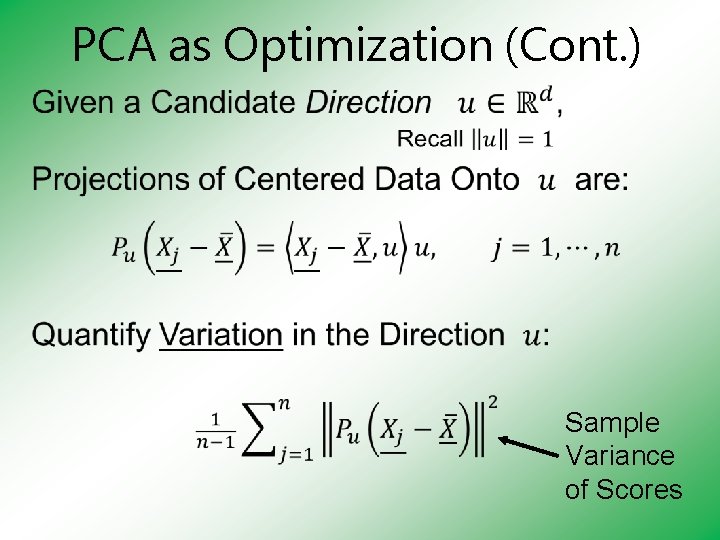
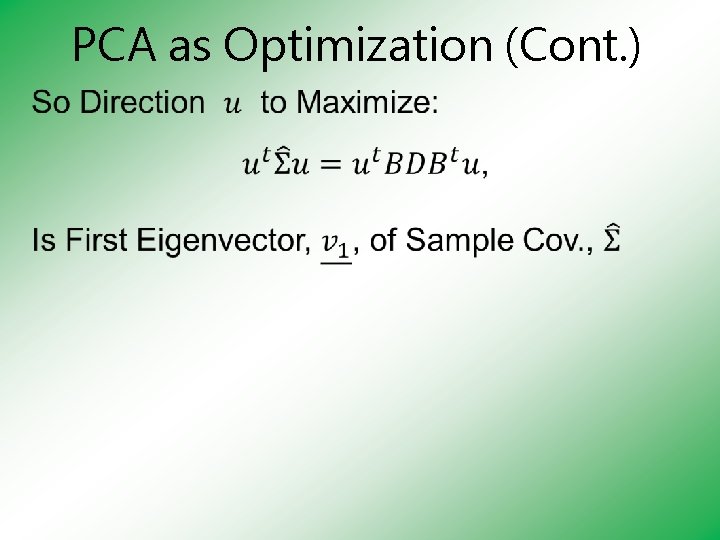
PCA as Optimization (Cont. ) Sample Variance of Scores
PCA as Optimization (Cont. )
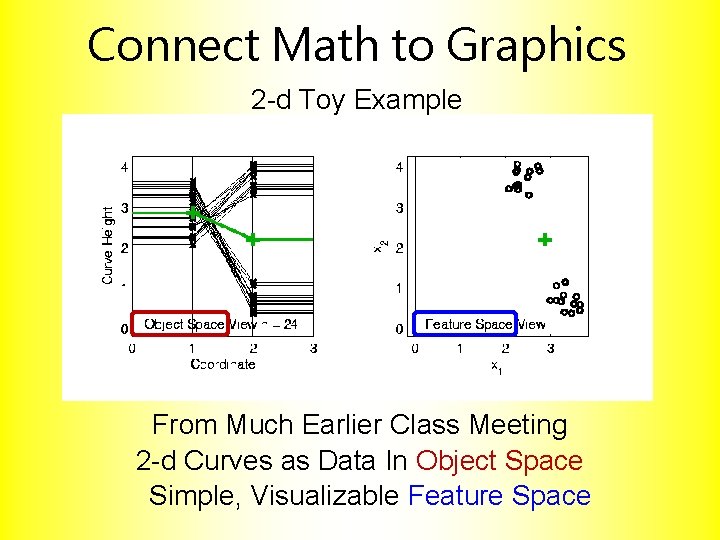
Connect Math to Graphics 2 -d Toy Example From Much Earlier Class Meeting 2 -d Curves as Data In Object Space Simple, Visualizable Feature Space
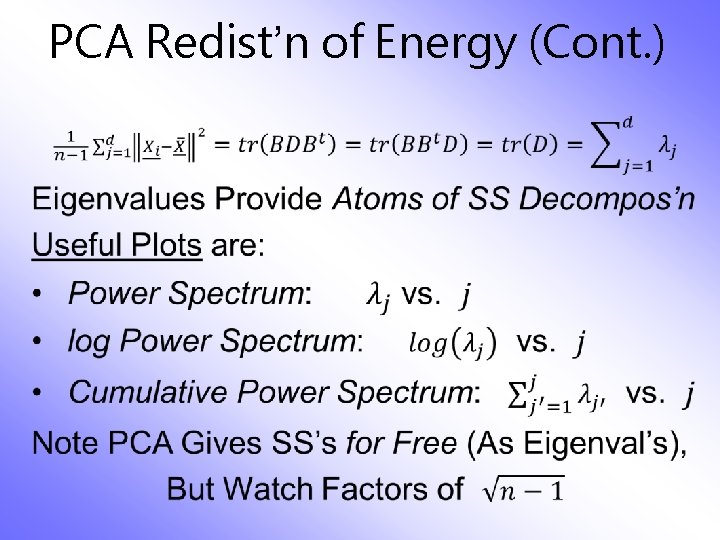
PCA Redist’n of Energy (Cont. )
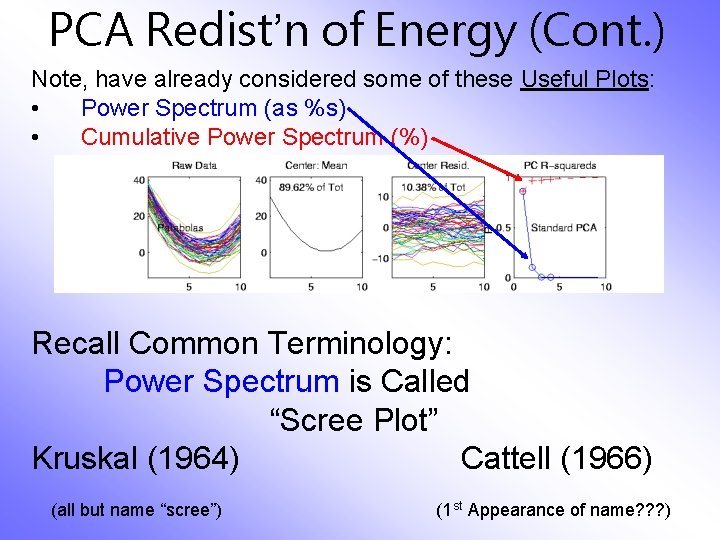
PCA Redist’n of Energy (Cont. ) Note, have already considered some of these Useful Plots: • Power Spectrum (as %s) • Cumulative Power Spectrum (%) Recall Common Terminology: Power Spectrum is Called “Scree Plot” Kruskal (1964) Cattell (1966) (all but name “scree”) (1 st Appearance of name? ? ? )
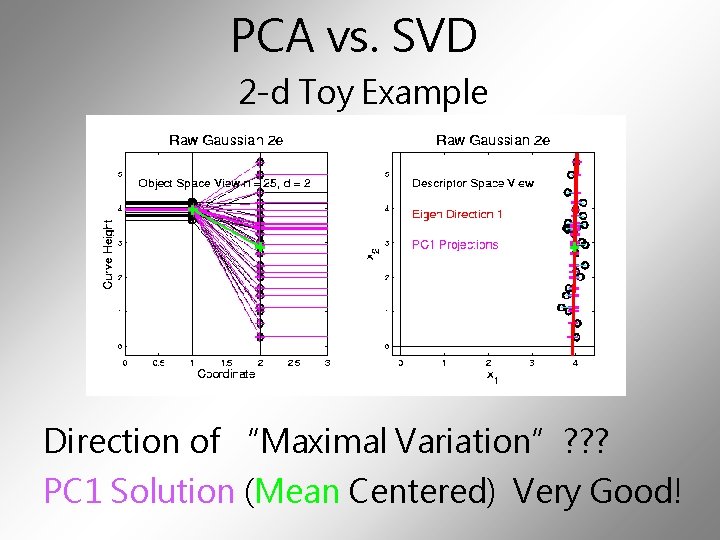
PCA vs. SVD 2 -d Toy Example Direction of “Maximal Variation”? ? ? PC 1 Solution (Mean Centered) Very Good!
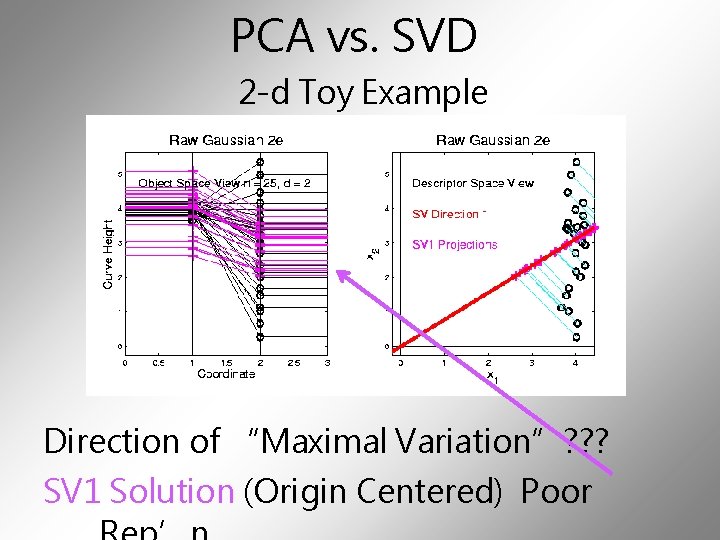
PCA vs. SVD 2 -d Toy Example Direction of “Maximal Variation”? ? ? SV 1 Solution (Origin Centered) Poor
Similar 2 -d PCA vs. SVD Toy Example Now Compare Scores
PCA vs. SVD Consequences Of Centering: PCA Scores Are Mean Centered Not SVD Scores
PCA vs. SVD Consequences Of Centering: PCA Scores Are Uncorrelated Not SVD Scores
PCA vs. SVD Sometimes “SVD Analysis of Data” = Uncentered PCA Investigate with Similar Toy Example: Conclusions: ü PCA Generally Better ü Unless “Origin Is Important” Deeper Look: Zhang et al (2007)
Different Views of PCA Solves several optimization problems: 1. Direction to maximize SS of 1 -d proj’d data 2. Direction to minimize SS of residuals (same, by Pythagorean Theorem) 3. “Best fit line” to data in “orthogonal sense” (vs. regression of Y on X = vertical sense & regression of X on Y = horizontal sense) Use one that makes sense…
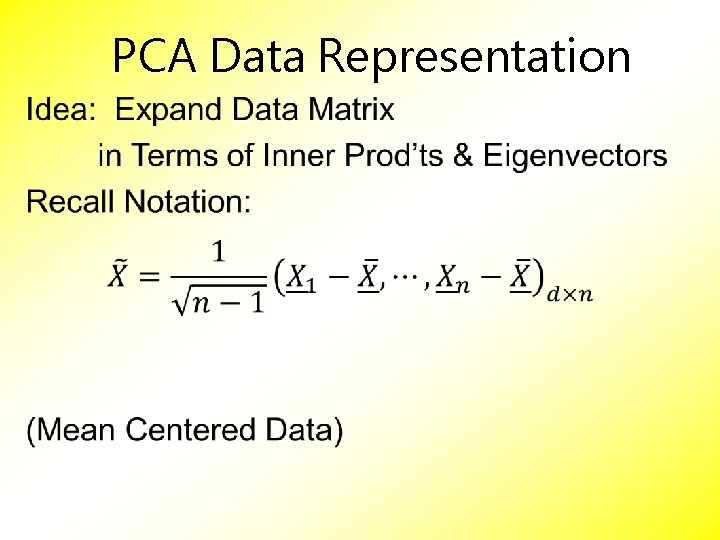
PCA Data Representation
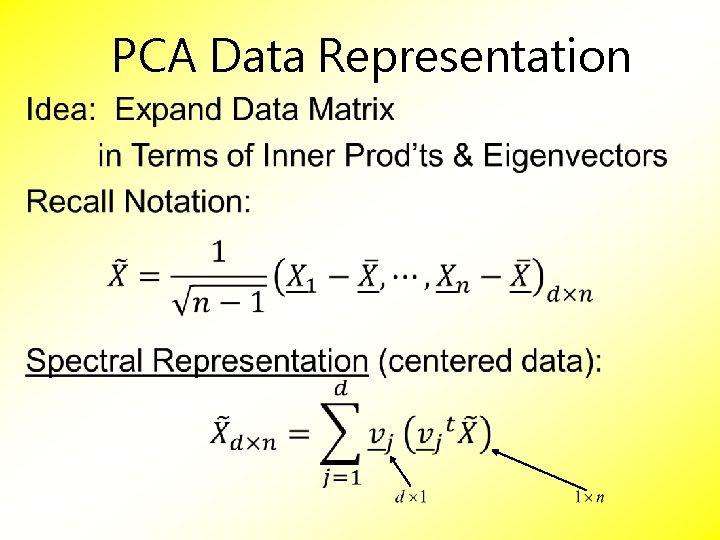
PCA Data Representation
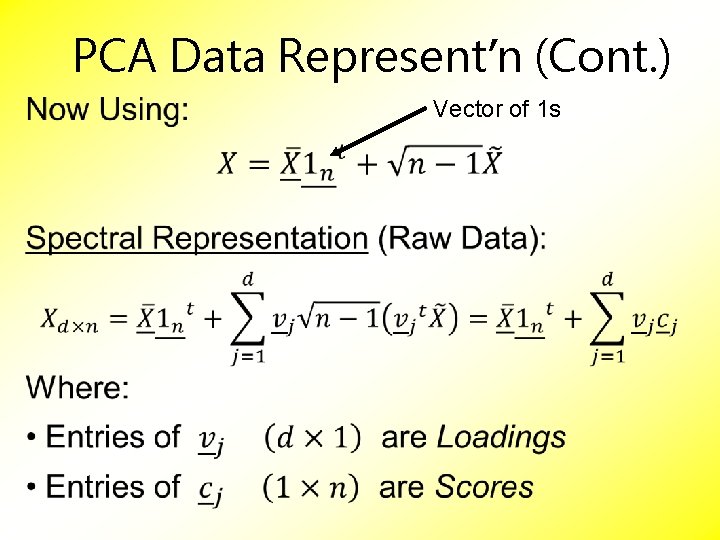
PCA Data Represent’n (Cont. ) Vector of 1 s
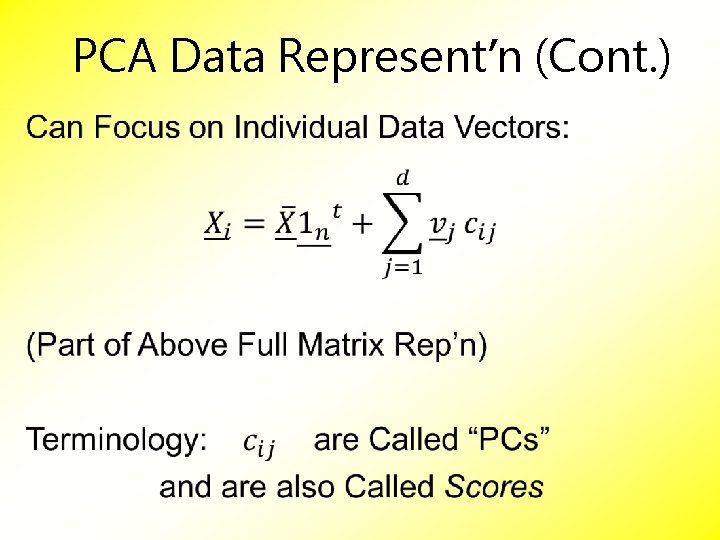
PCA Data Represent’n (Cont. )
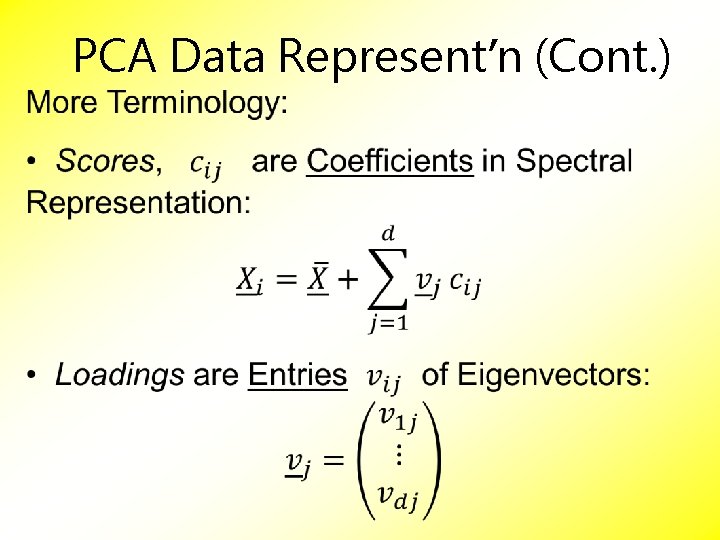
PCA Data Represent’n (Cont. )
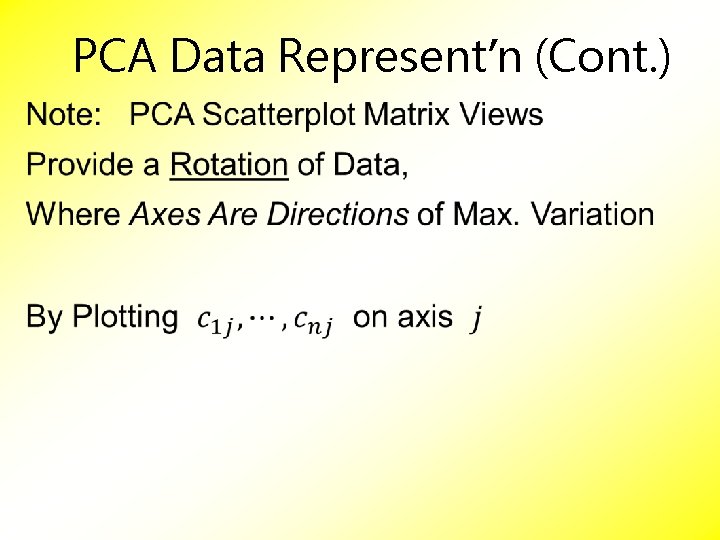
PCA Data Represent’n (Cont. )
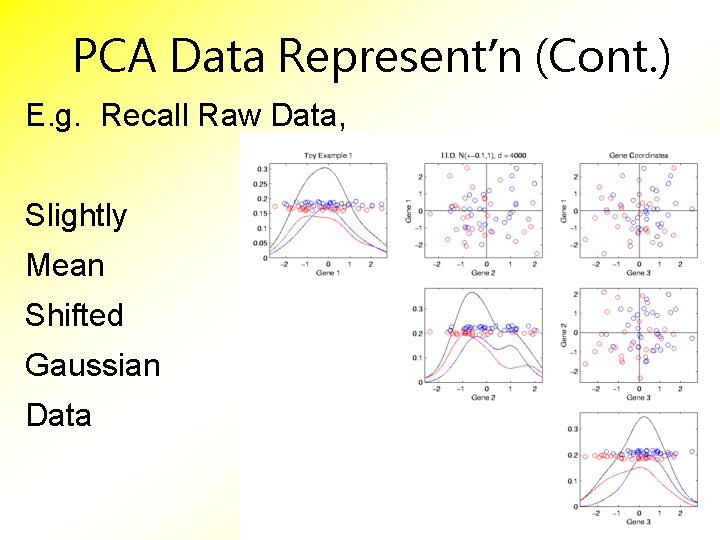
PCA Data Represent’n (Cont. ) E. g. Recall Raw Data, Slightly Mean Shifted Gaussian Data
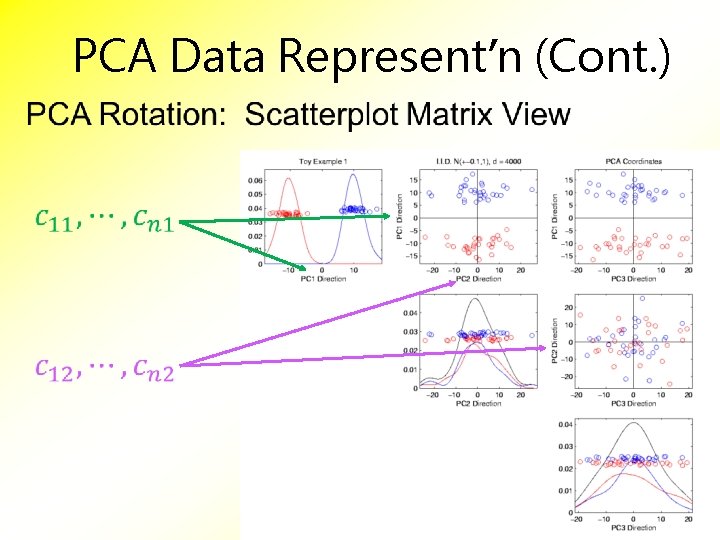
PCA Data Represent’n (Cont. )
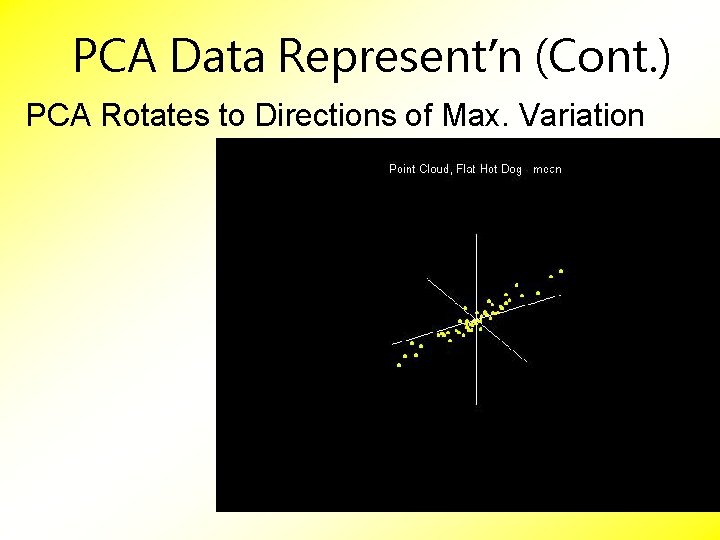
PCA Data Represent’n (Cont. ) PCA Rotates to Directions of Max. Variation
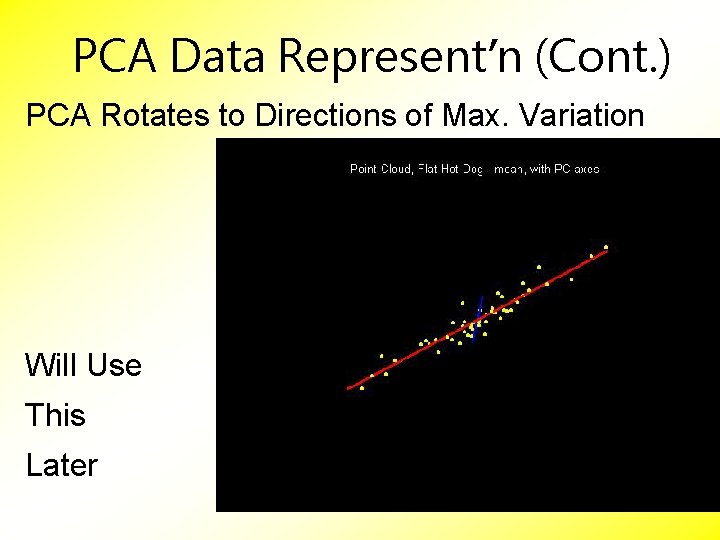
PCA Data Represent’n (Cont. ) PCA Rotates to Directions of Max. Variation Will Use This Later
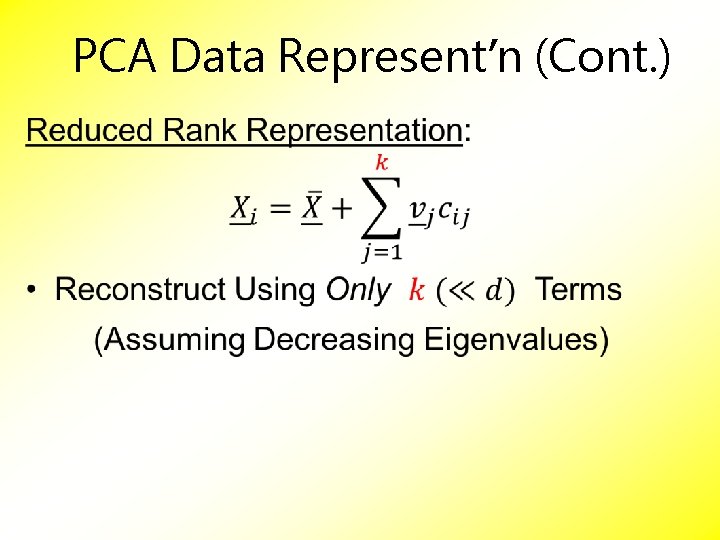
PCA Data Represent’n (Cont. )
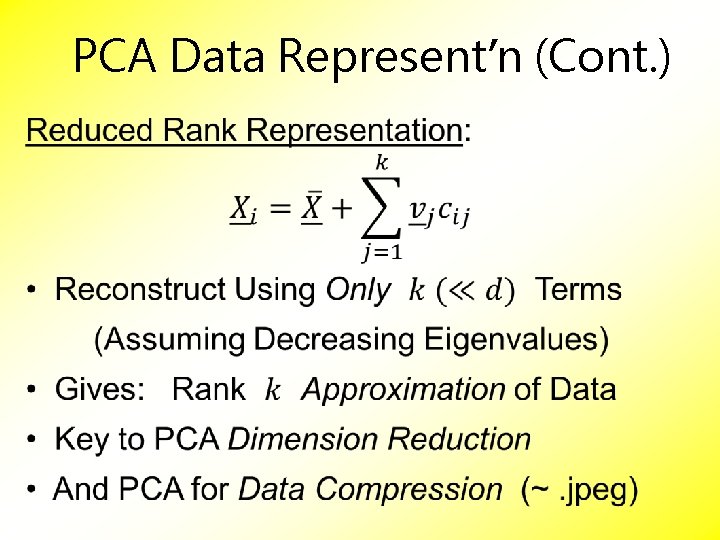
PCA Data Represent’n (Cont. )
PCA Data Represent’n (Cont. ) Choice of in Reduced Rank Represent’n: • Generally Very Slippery Problem Not Recommended: o Arbitrary Choice o E. g. % Variation Explained 90%? 95%?
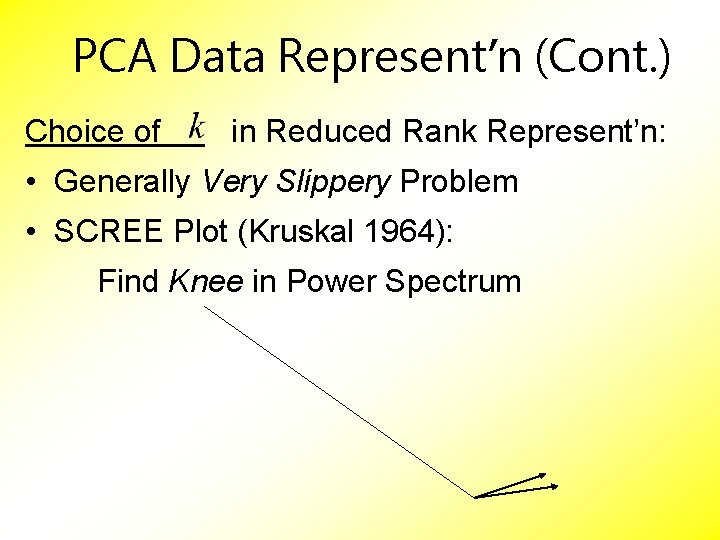
PCA Data Represent’n (Cont. ) Choice of in Reduced Rank Represent’n: • Generally Very Slippery Problem • SCREE Plot (Kruskal 1964): Find Knee in Power Spectrum
PCA Data Represent’n (Cont. ) SCREE Plot Drawbacks: • What is a Knee? • What if There are Several? • Knees Depend on Scaling (Power? log? ) Personal Suggestions: ü Find Auxiliary Cutoffs (Inter-Rater Variation) ü Use the Full Range
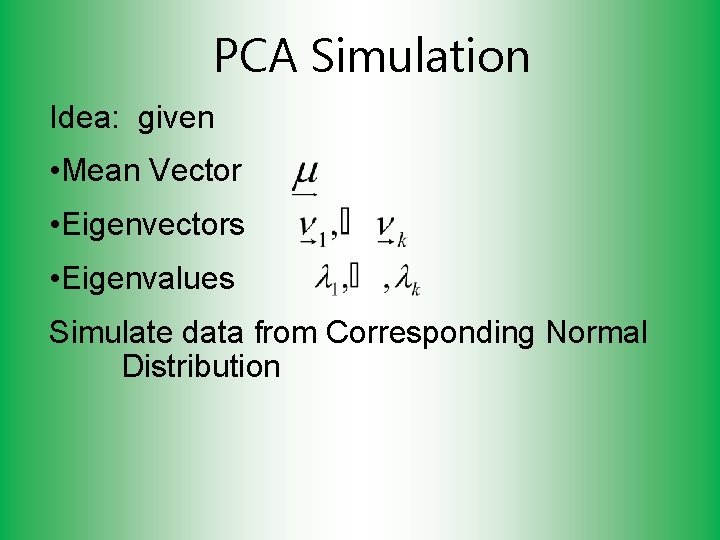
PCA Simulation Idea: given • Mean Vector • Eigenvectors • Eigenvalues Simulate data from Corresponding Normal Distribution
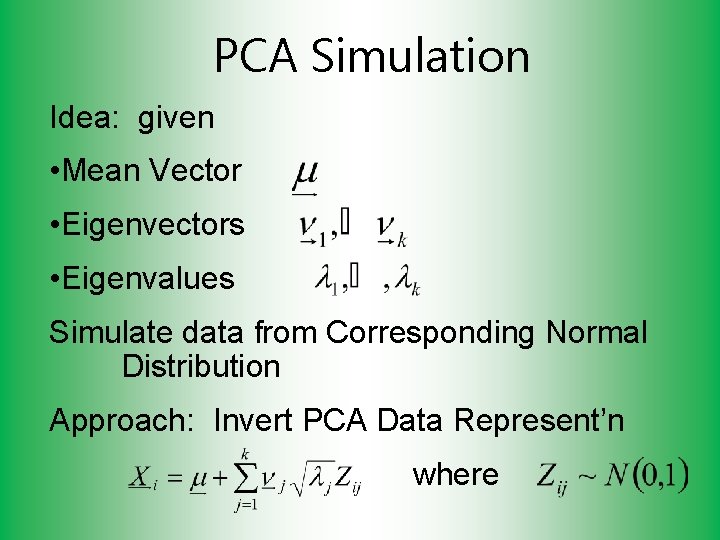
PCA Simulation Idea: given • Mean Vector • Eigenvectors • Eigenvalues Simulate data from Corresponding Normal Distribution Approach: Invert PCA Data Represent’n where
PCA & Graphical Displays Small caution on PC directions & plotting: • PCA directions (may) have sign flip • Mathematically no difference • Numerically caused artifact of round off • Can have large graphical impact
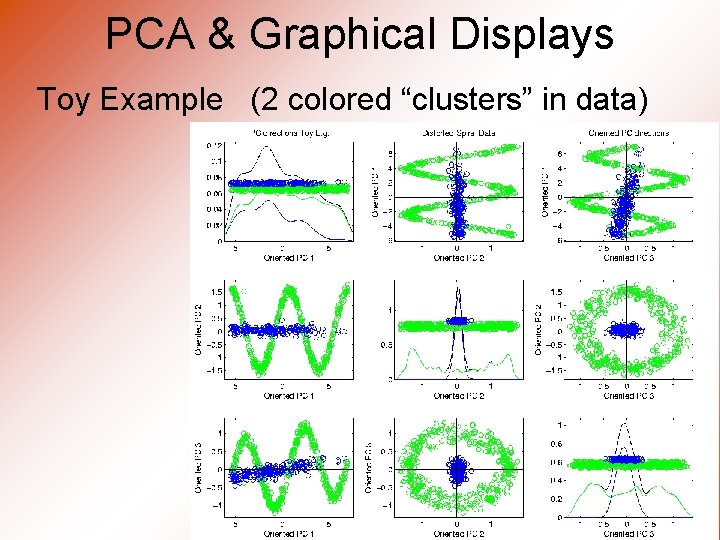
PCA & Graphical Displays Toy Example (2 colored “clusters” in data)
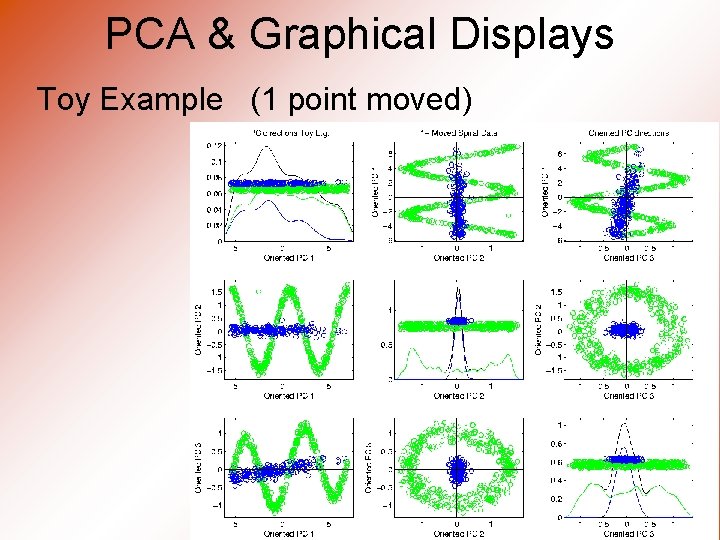
PCA & Graphical Displays Toy Example (1 point moved)
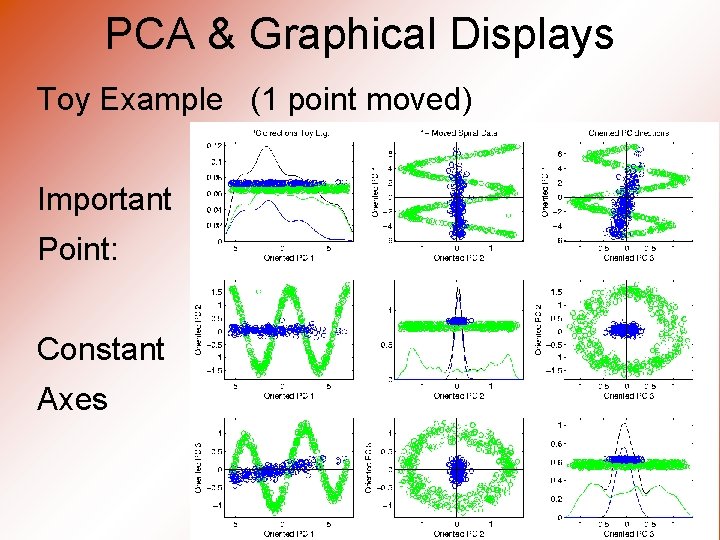
PCA & Graphical Displays Toy Example (1 point moved) Important Point: Constant Axes
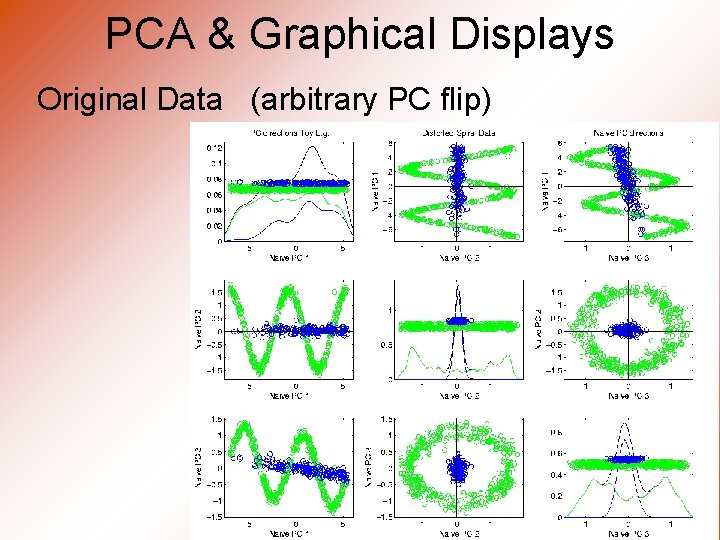
PCA & Graphical Displays Original Data (arbitrary PC flip)
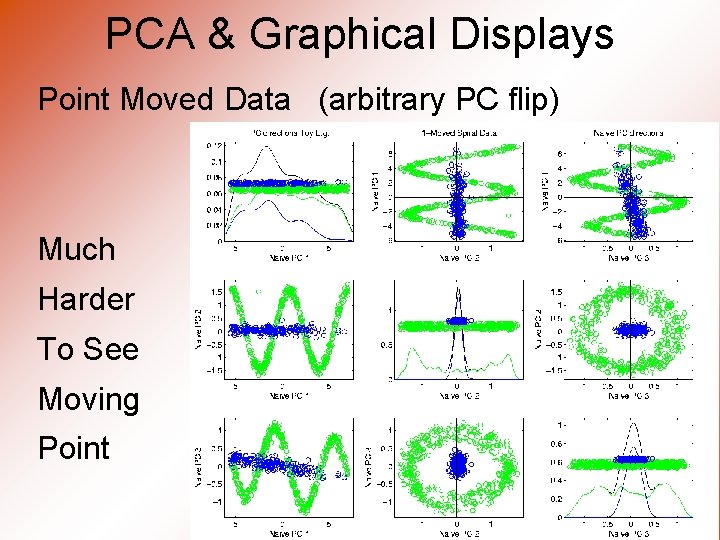
PCA & Graphical Displays Point Moved Data (arbitrary PC flip) Much Harder To See Moving Point
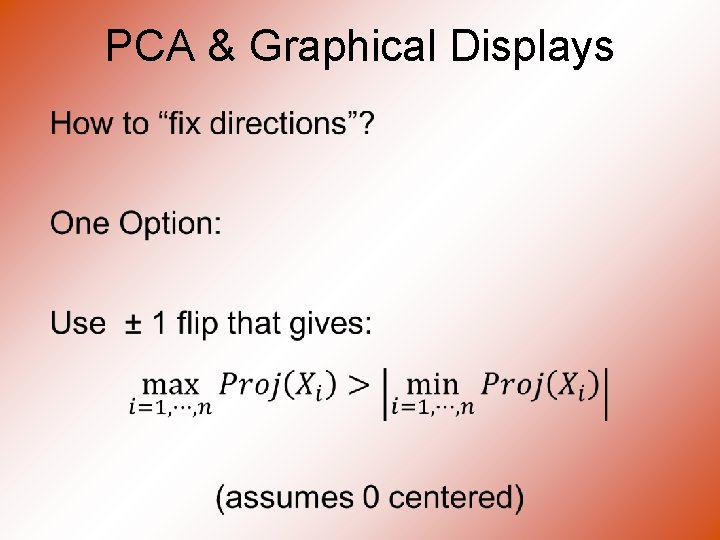
PCA & Graphical Displays
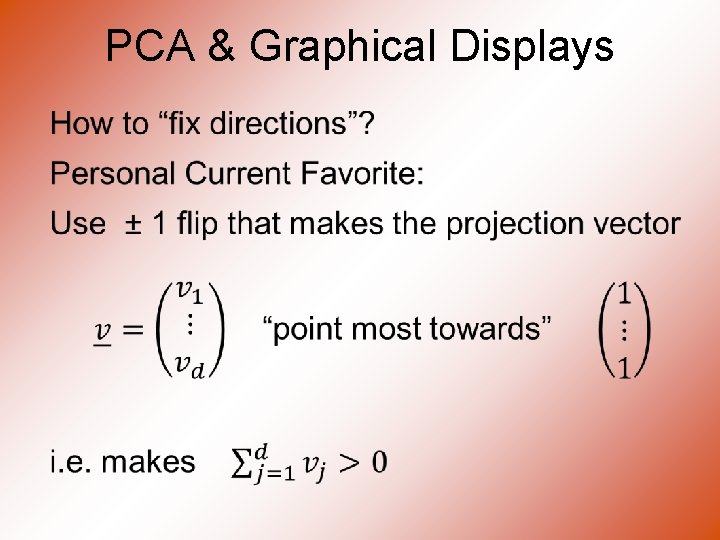
PCA & Graphical Displays
Return to Big Picture Main statistical goals of OODA: • Understanding population structure – Low dim’al Projections, PCA … • Classification (i. e. Discrimination) – Understanding 2+ populations • Time Series of Data Objects – Chemical Spectra, Mortality Data • “Vertical Integration” of Data Types
Classification - Discrimination Background: Two Class (Binary) version: Using “training data” from Class +1 and Class -1 Develop a “rule” for assigning new data to a Class Canonical Example: Disease Diagnosis • New Patients are “Healthy” or “Ill” • Determine based on measurements
Classification - Discrimination Important Distinction: Classification vs. Clustering Classification: Class labels are known, Goal: understand differences Clustering: Goal: Find class labels (to be similar) Both are about clumps of similar data, but much different goals
Classification - Discrimination Important Distinction: Classification vs. Clustering Useful terminology: Classification: Clustering: supervised learning unsupervised learning
Classification - Discrimination Terminology: For statisticians, these are synonyms
Classification - Discrimination Terminology: For statisticians, these are synonyms For biologists, classification means: • Constructing taxonomies • And sorting organisms into them (maybe this is why discrimination was used, until politically incorrect…)
Classification (i. e. discrimination) There a number of: • Approaches • Philosophies • Schools of Thought Too often cast as: Statistics vs. EE - CS
Classification (i. e. discrimination) EE – CS variations: • Pattern Recognition • Artificial Intelligence • Neural Networks (Deep Learning) • Data Mining • Machine Learning
Classification (i. e. discrimination) Differing Viewpoints: Statistics • Model Classes with Probability Distribut’ns • Use to study class diff’s & find rules EE – CS • Data are just Sets of Numbers • Optimize Separation Rules • Current thought: combine these
Classification (i. e. discrimination) Important Overview Reference: Duda, Hart and Stork (2001) • Too much about neural nets? ? ? • Pizer disagrees… • Update of Duda & Hart (1973)
Classification (i. e. discrimination) For a more classical statistical view: Mc. Lachlan (2004). • Gaussian Likelihood theory, etc. • Not well tuned to HDLSS data
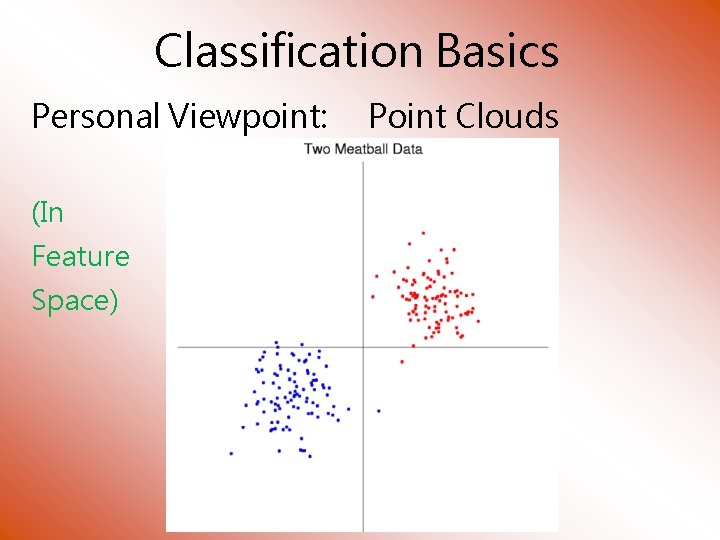
Classification Basics Personal Viewpoint: (In Feature Space) Point Clouds
Classification Basics Simple and Natural Approach: Mean Difference a. k. a. Centroid Method Find “skewer through two meatballs”
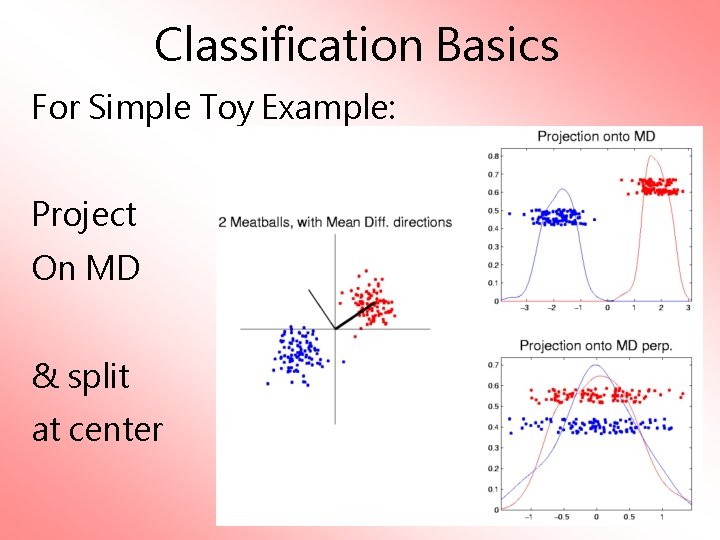
Classification Basics For Simple Toy Example: Project On MD & split at center
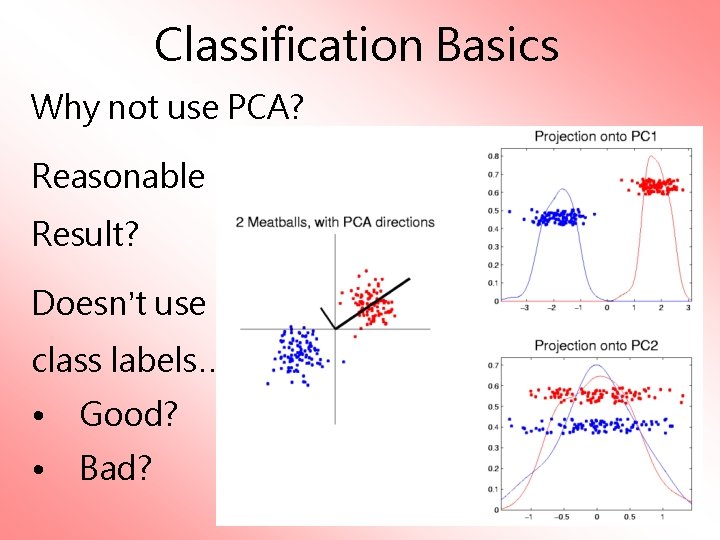
Classification Basics Why not use PCA? Reasonable Result? Doesn’t use class labels… • Good? • Bad?
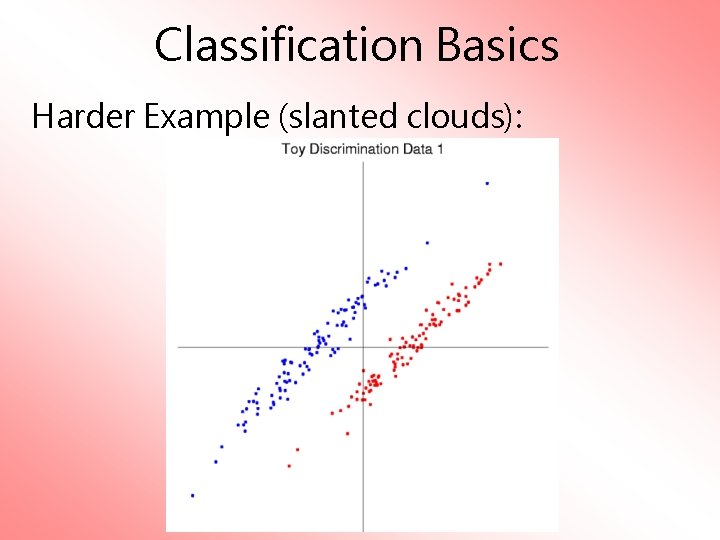
Classification Basics Harder Example (slanted clouds):
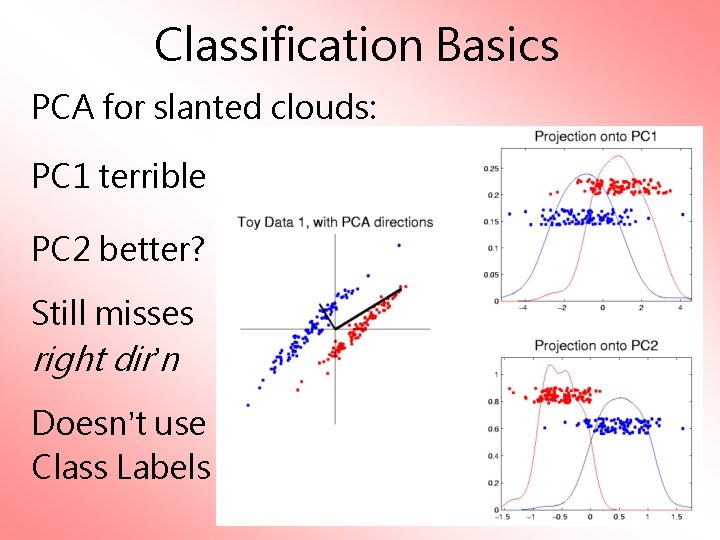
Classification Basics PCA for slanted clouds: PC 1 terrible PC 2 better? Still misses right dir’n Doesn’t use Class Labels
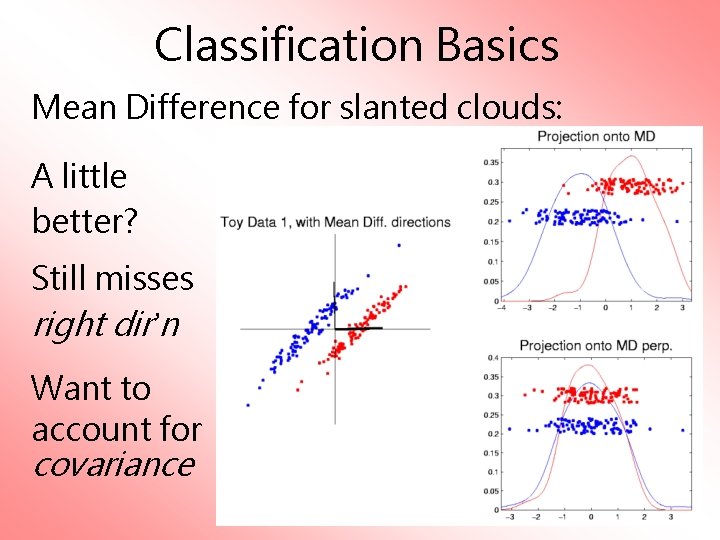
Classification Basics Mean Difference for slanted clouds: A little better? Still misses right dir’n Want to account for covariance
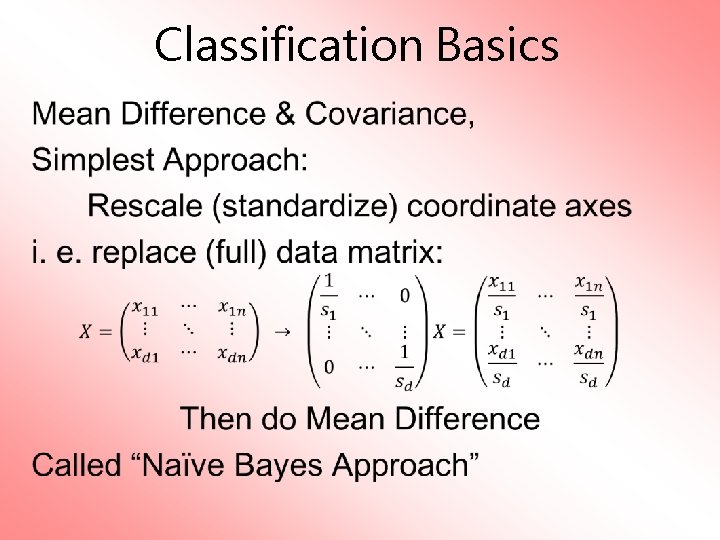
Classification Basics •
Classification Basics Naïve Bayes Reference: Domingos & Pazzani (1997) Most sensible contexts: • Non-comparable data • E. g. different units
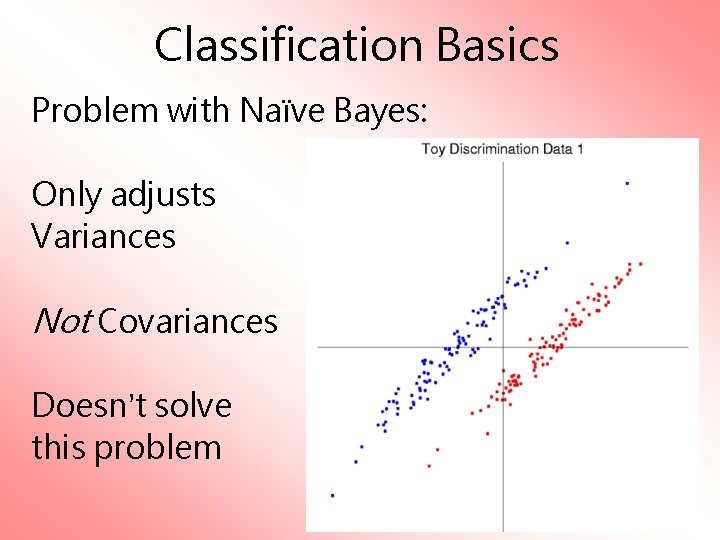
Classification Basics Problem with Naïve Bayes: Only adjusts Variances Not Covariances Doesn’t solve this problem
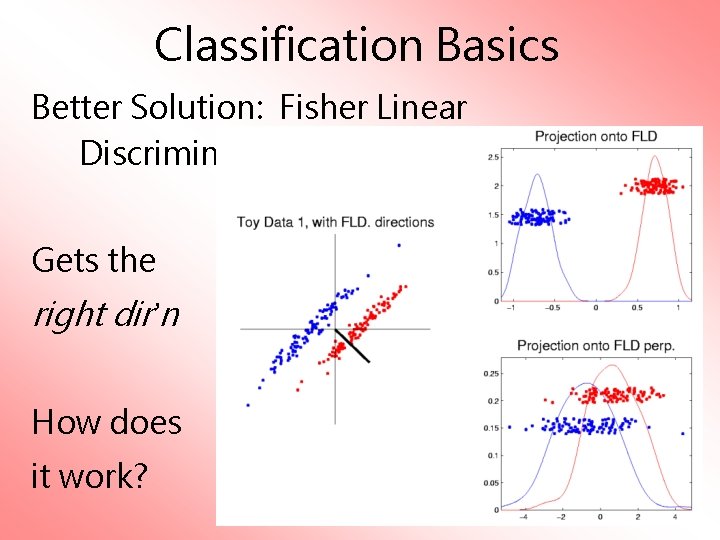
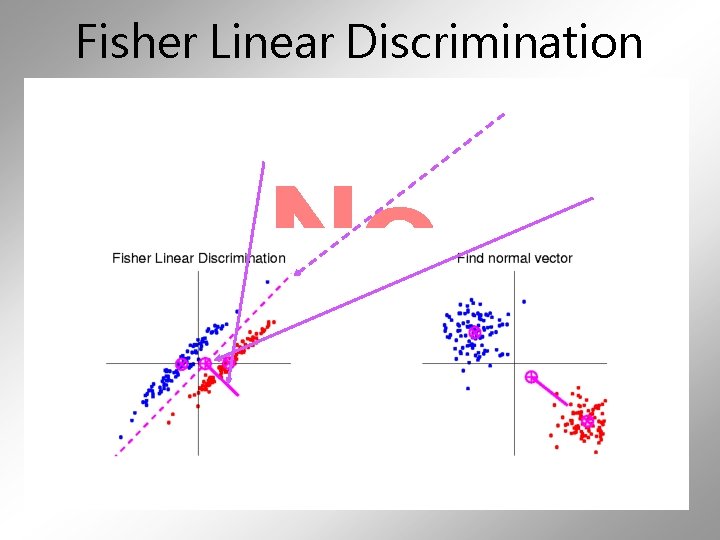
Classification Basics Better Solution: Fisher Linear Discrimination Gets the right dir’n How does it work?
Fisher Linear Discrimination Other common terminology (for FLD): Linear Discriminant Analysis (LDA) Original Paper: Fisher (1936)
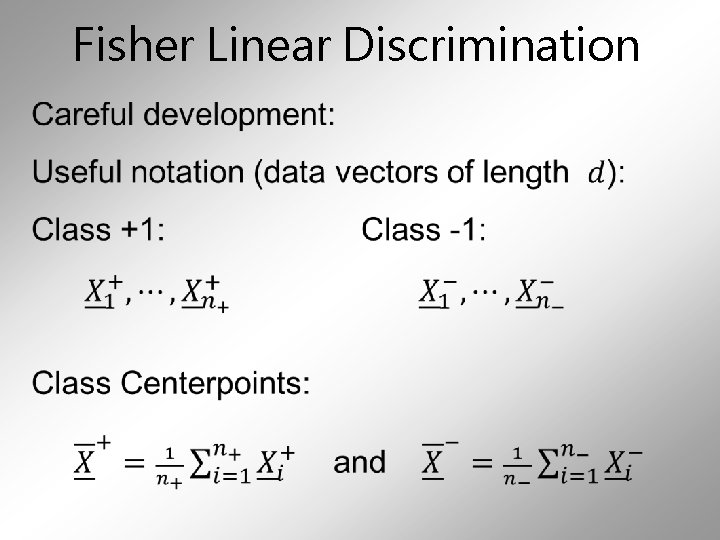
Fisher Linear Discrimination •
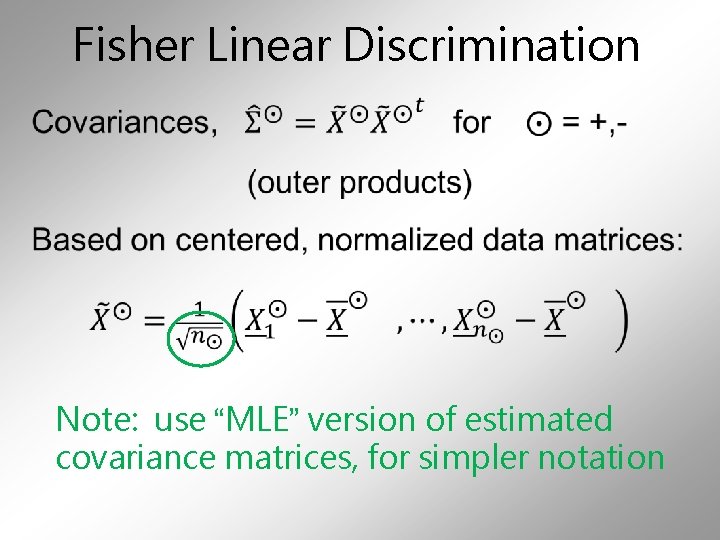
Fisher Linear Discrimination • Note: use “MLE” version of estimated covariance matrices, for simpler notation
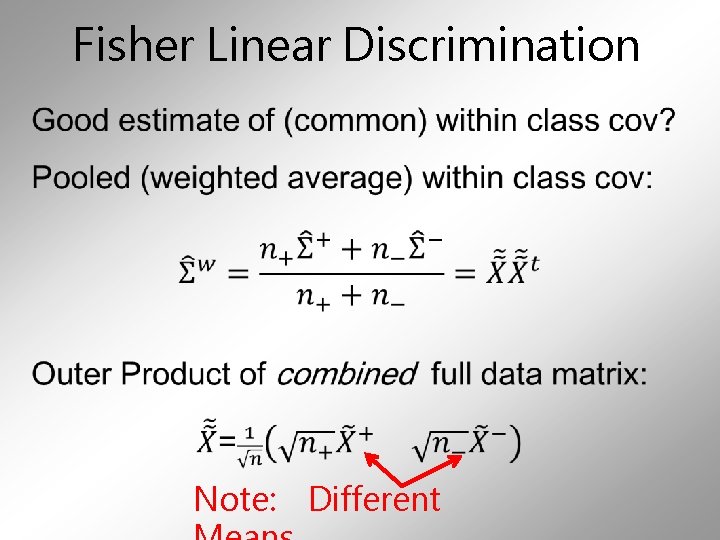
Fisher Linear Discrimination • Note: Different
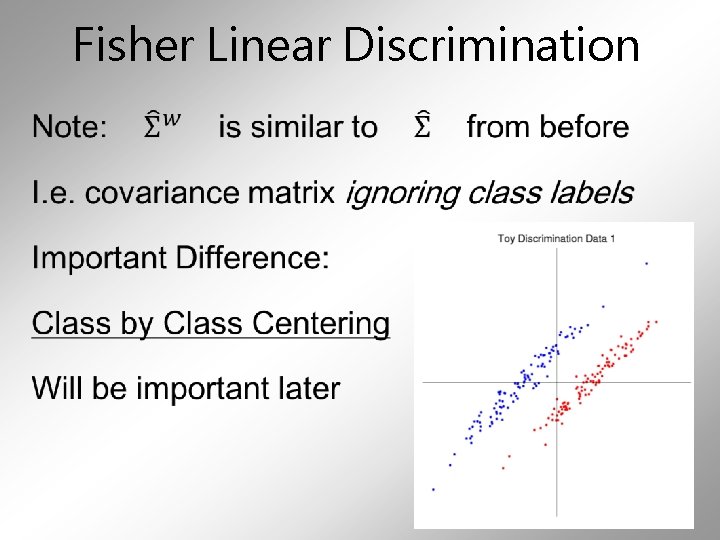
Fisher Linear Discrimination •
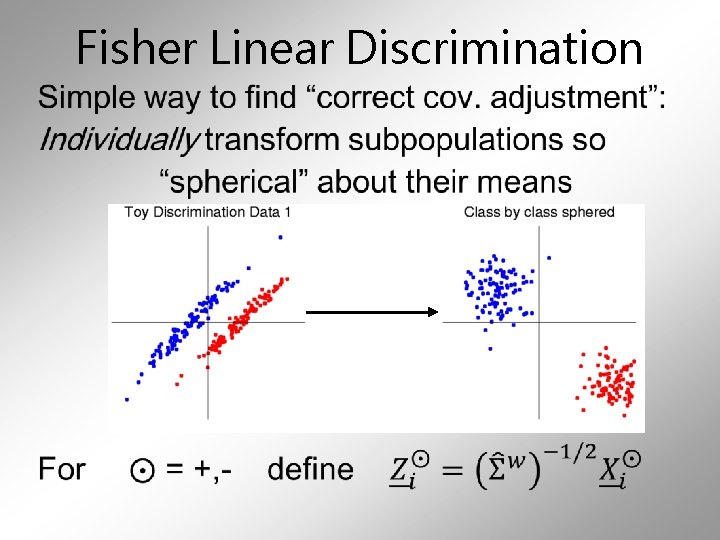
Fisher Linear Discrimination •
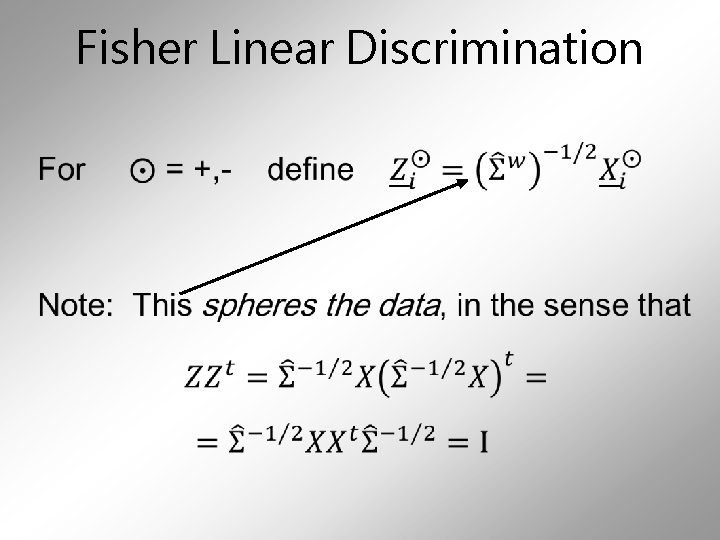
Fisher Linear Discrimination •
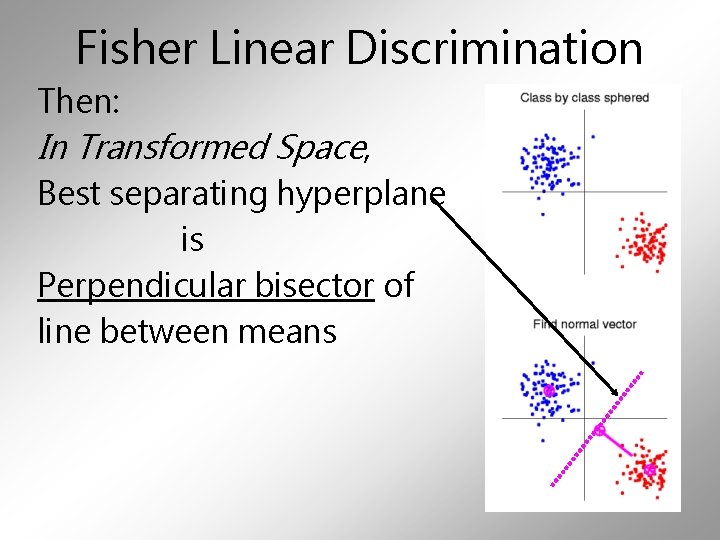
Fisher Linear Discrimination Then: In Transformed Space, Best separating hyperplane is Perpendicular bisector of line between means
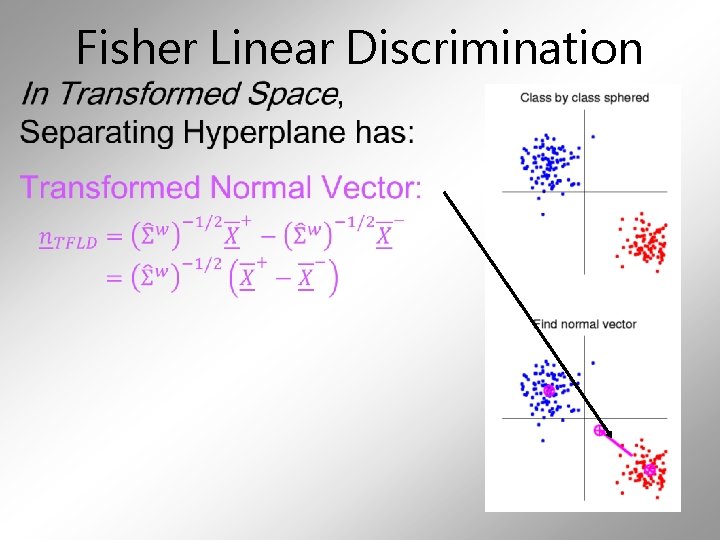
Fisher Linear Discrimination •
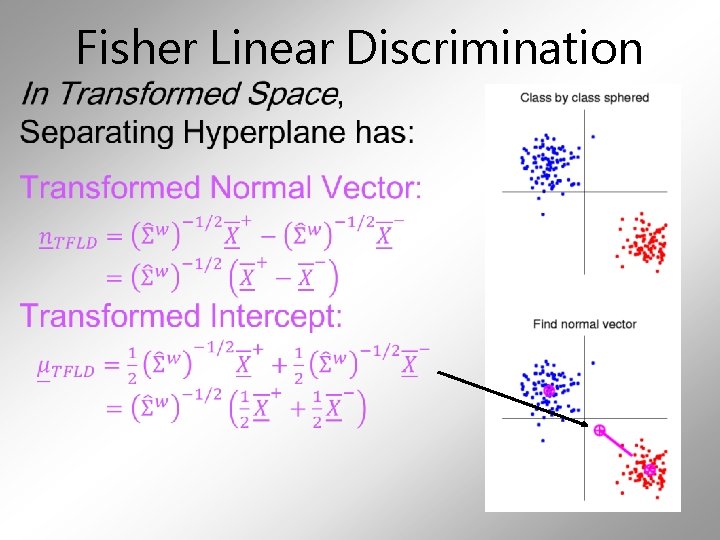
Fisher Linear Discrimination •
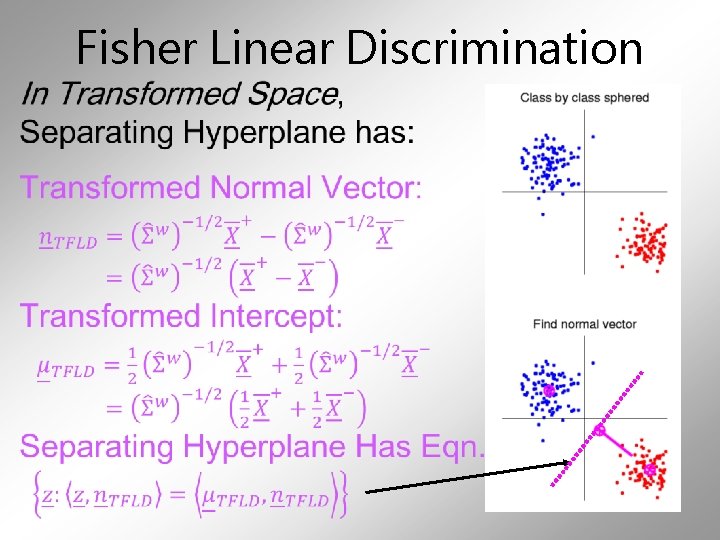
Fisher Linear Discrimination •
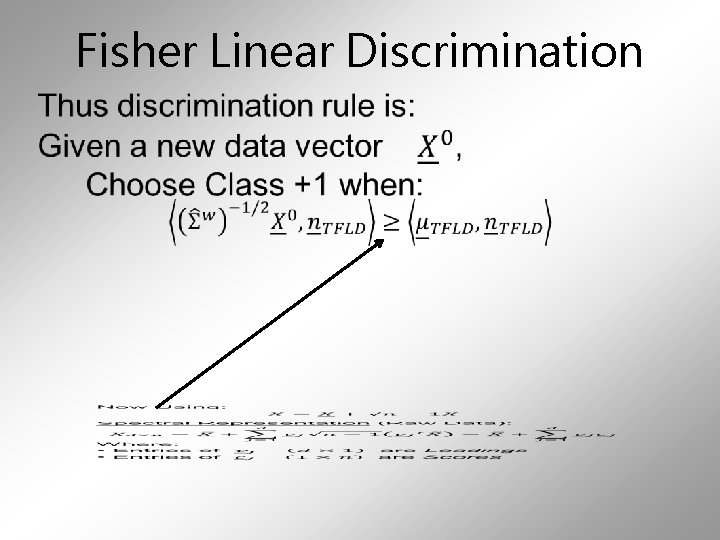
Fisher Linear Discrimination •
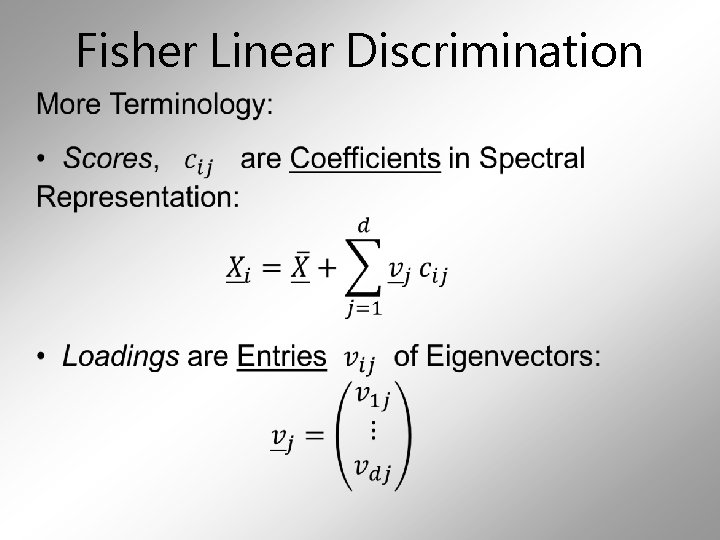
Fisher Linear Discrimination •
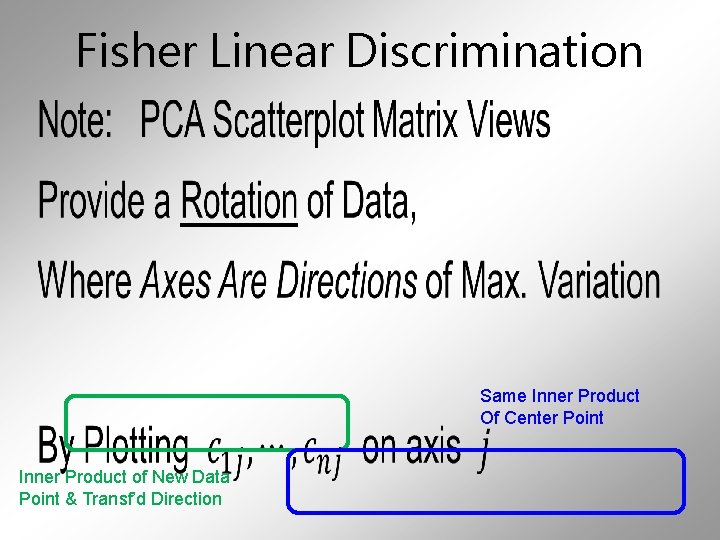
Fisher Linear Discrimination • Same Inner Product Of Center Point Inner Product of New Data Point & Transf’d Direction
Fisher Linear Discrimination •
Fisher Linear Discrimination •
Fisher Linear Discrimination •
- Slides: 79