
REVIEW OF HISTORIC PROPERTY IDENTIFICATION SURVEYS AND STRATEGIES
- Slides: 16
REVIEW OF HISTORIC PROPERTY IDENTIFICATION SURVEYS AND STRATEGIES FOR MANAGING POST-WORLD WAR II HOUSING IN TRANSPORTATION PROJECTS National Cooperative Highway Research Program 25 -25, Task 110
Acknowledgments This study was conducted for the AASHTO Committee on the Environment and Sustainability, with funding provided through the National Cooperative Highway Research Program (NCHRP) Project 25 -25, Task 110, National Synthesis of Successful Strategies for Managing Post-World War II Resources in Historic Property Identification Surveys. The opinions and conclusions expressed or implied are those of the research agency that performed the research and are not necessarily those of the Transportation Research Board (TRB) or its sponsoring agencies. This report has not been reviewed or accepted by the TRB Board Executive Committee or the Governing Board of the National Research Council. The project was managed by Ann Hartell, NCHRP Senior Program Officer. NCHRP Panel Members: • • Tony Opperman, Virginia DOT Chris Bell, Oregon DOT Jody Brown, California DOT Roy Jackson, Florida DOT Jacob Woodcock, Iowa DOT Kristen Zschomler, Minnesota DOT Emily Pettis, Mead & Hunt David Clarke, Federal Preservation Officer, FHWA Liaison Project Team • Camilla Deiber, Louis Berger • Steven Bedford, Louis Berger
NCHRP 25 -25, Task 110 Research Objective Synthesize specific approaches DOTs have implemented to identify and evaluate the historic significance of post. World War housing since the 2012 release of NCHRP Report 723, A Model for Identifying and Evaluating the Historic Significance of Post-World War II Housing. • Have agencies used the model in NCHRP Report 723? • How do we know what’s working? • What successes have DOTs and SHPOs had regarding post-World War II housing survey and evaluation?
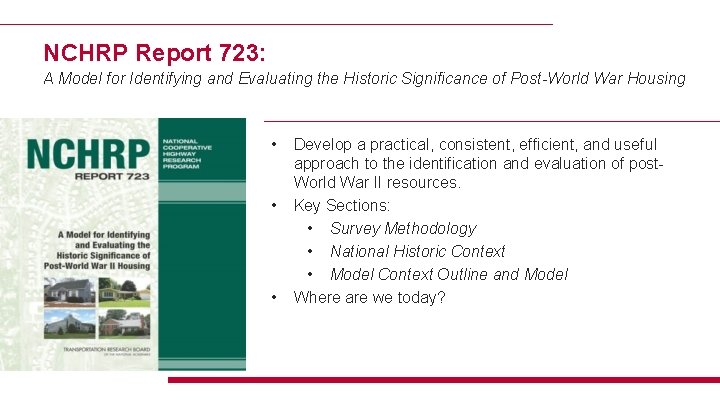
NCHRP Report 723: A Model for Identifying and Evaluating the Historic Significance of Post-World War Housing • • • Develop a practical, consistent, efficient, and useful approach to the identification and evaluation of post. World War II resources. Key Sections: • Survey Methodology • National Historic Context • Model Context Outline and Model Where are we today?
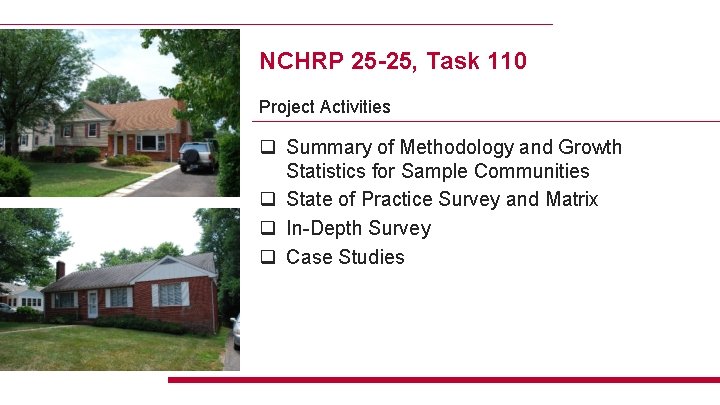
NCHRP 25 -25, Task 110 Project Activities q Summary of Methodology and Growth Statistics for Sample Communities q State of Practice Survey and Matrix q In-Depth Survey q Case Studies
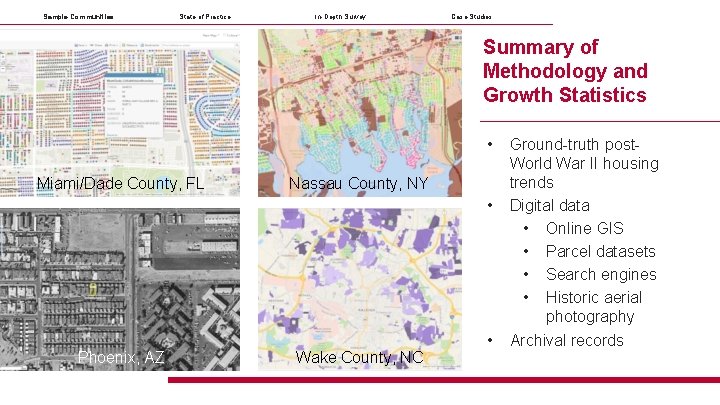
Sample Communities State of Practice In-Depth Survey Case Studies Summary of Methodology and Growth Statistics • Miami/Dade County, FL Nassau County, NY • Phoenix, AZ Wake County, NC • Ground-truth post. World War II housing trends Digital data • Online GIS • Parcel datasets • Search engines • Historic aerial photography Archival records
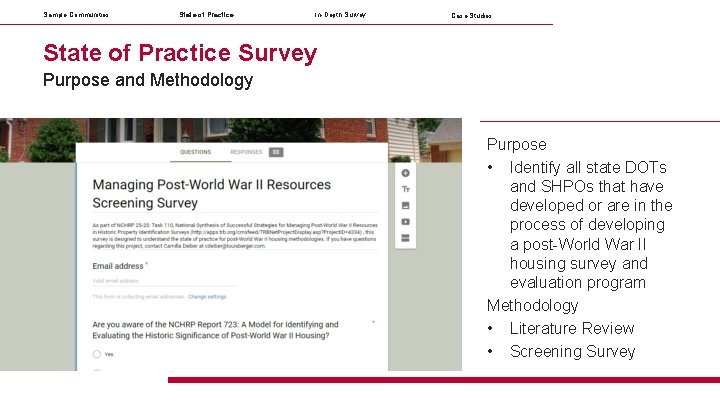
Sample Communities State of Practice In-Depth Survey Case Studies State of Practice Survey Purpose and Methodology Purpose • Identify all state DOTs and SHPOs that have developed or are in the process of developing a post-World War II housing survey and evaluation program Methodology • Literature Review • Screening Survey
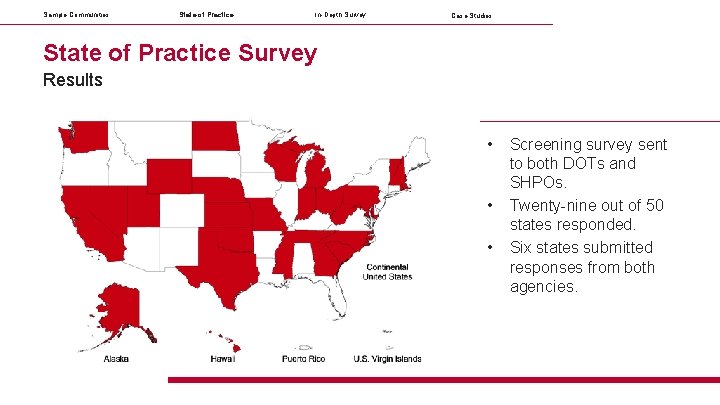
Sample Communities State of Practice In-Depth Survey Case Studies State of Practice Survey Results • • • Screening survey sent to both DOTs and SHPOs. Twenty-nine out of 50 states responded. Six states submitted responses from both agencies.
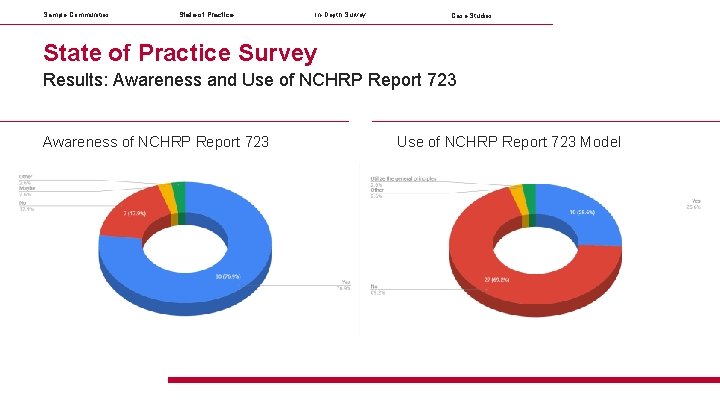
Sample Communities State of Practice In-Depth Survey Case Studies State of Practice Survey Results: Awareness and Use of NCHRP Report 723 Awareness of NCHRP Report 723 Use of NCHRP Report 723 Model
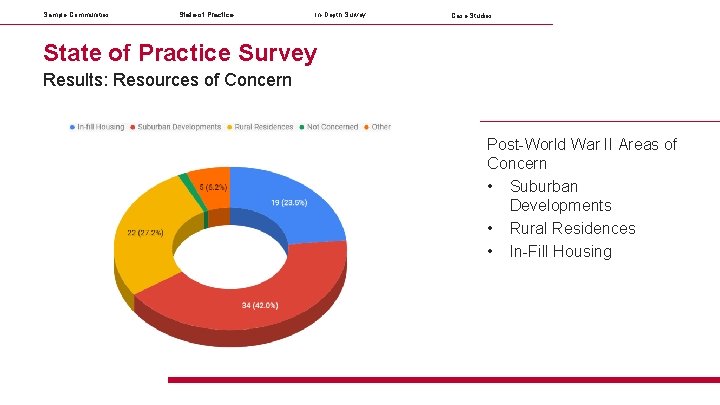
Sample Communities State of Practice In-Depth Survey Case Studies State of Practice Survey Results: Resources of Concern Post-World War II Areas of Concern • Suburban Developments • Rural Residences • In-Fill Housing
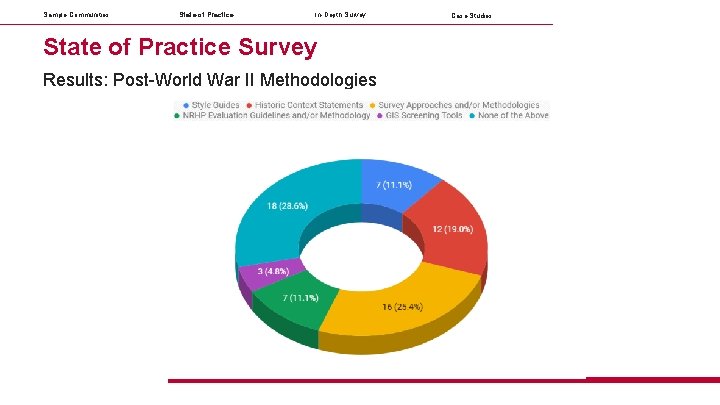
Sample Communities State of Practice In-Depth Survey State of Practice Survey Results: Post-World War II Methodologies Case Studies
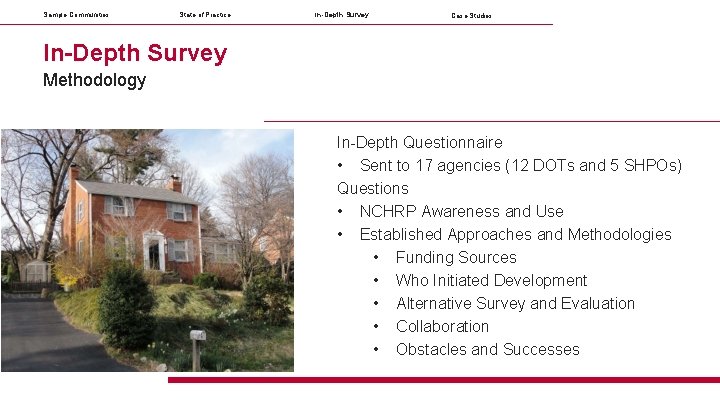
Sample Communities State of Practice In-Depth Survey Case Studies In-Depth Survey Methodology In-Depth Questionnaire • Sent to 17 agencies (12 DOTs and 5 SHPOs) Questions • NCHRP Awareness and Use • Established Approaches and Methodologies • Funding Sources • Who Initiated Development • Alternative Survey and Evaluation • Collaboration • Obstacles and Successes
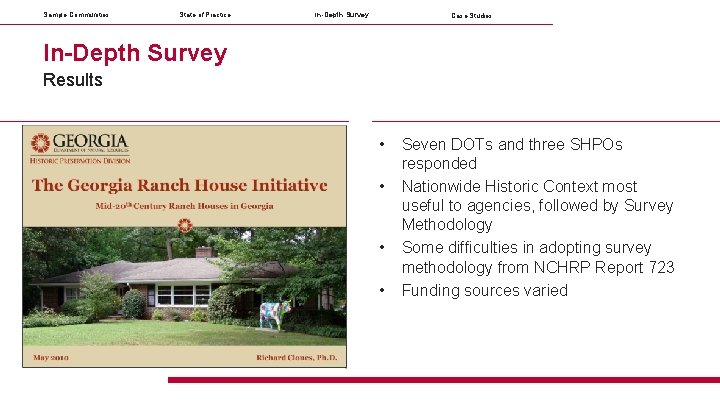
Sample Communities State of Practice In-Depth Survey Case Studies In-Depth Survey Results • • Seven DOTs and three SHPOs responded Nationwide Historic Context most useful to agencies, followed by Survey Methodology Some difficulties in adopting survey methodology from NCHRP Report 723 Funding sources varied
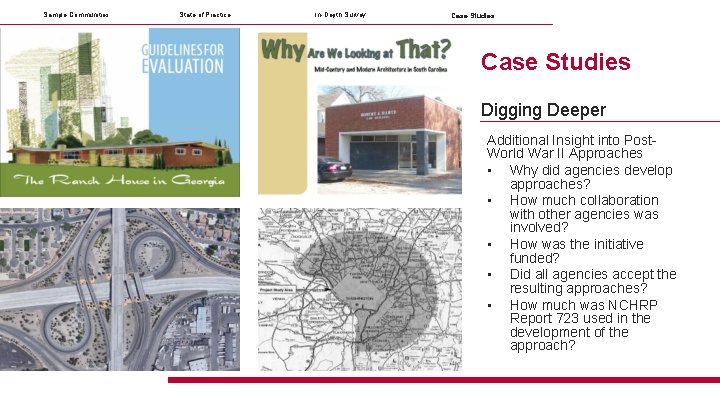
Sample Communities State of Practice In-Depth Survey Case Studies Digging Deeper Additional Insight into Post. World War II Approaches • Why did agencies develop approaches? • How much collaboration with other agencies was involved? • How was the initiative funded? • Did all agencies accept the resulting approaches? • How much was NCHRP Report 723 used in the development of the approach?
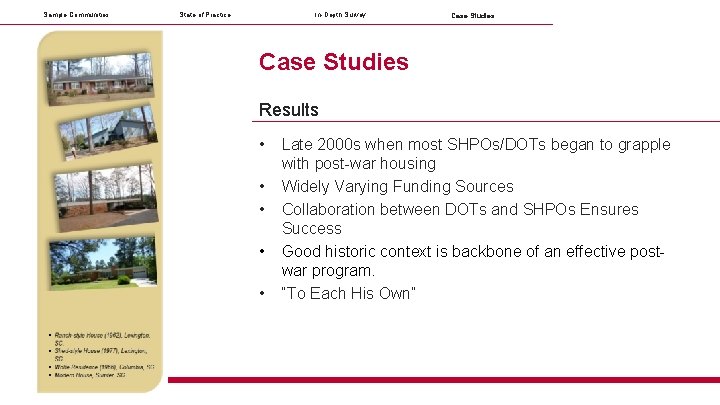
Sample Communities State of Practice In-Depth Survey Case Studies Results • • • Late 2000 s when most SHPOs/DOTs began to grapple with post-war housing Widely Varying Funding Sources Collaboration between DOTs and SHPOs Ensures Success Good historic context is backbone of an effective postwar program. “To Each His Own”
NCHRP 25 -25 Task 110 Conclusion For More Information Visit the Project Website: http: //apps. trb. org/cmsfeed/TR BNet. Project. Display. asp? Proje ct. ID=4334 The National Cooperative Highway Research Program (NCHRP) produces ready-to-implement solutions to the challenges facing transportation professionals. NCHRP is sponsored by the individual state departments of transportation of the American Association of State Highway and Transportation Officials (AASHTO), in cooperation with the Federal Highway Administration (FHWA). NCHRP is administered by the Transportation Research Board (TRB), part of the National Academies of Sciences, Engineering, and Medicine. Any opinions and conclusions expressed or implied in resulting research products are those of the individuals and organizations who performed the research and are not necessarily those of TRB; the National Academies of Sciences, Engineering, and Medicine; or NCHRP sponsors.