
Review of General Chem Scientific Method Metric System






- Slides: 48
Review of General Chem Scientific Method Metric System Uncertainty Dimensional Analysis
l. Significant Digits
Rules for Determining the Proper Number of Sig Figs l There are 4 rules for determining the proper number of sig figs
Rule 1 l Digits other than zero are always significant. l Examples: 98765 1. 56 5 sig. figs. 3 sig. figs.
Rule 2 l Any final zero or zeros used after the decimal point are significant. l Examples: 8. 80 15. 000 3 sig. figs. 5 sig. figs. Note: 100 has 1 sig fig. There is no decimal point.
Rule 3 l Zeros between two other significant digits are always significant. l Examples: 1001 5. 60023 4 sig. figs. 6 sig. figs.
Rule 4 l Zeros used solely for spacing the decimal point are not significant. l Examples: 0. 001 0. 011 0. 111 1 sig. fig. 2 sig. figs. 3 sig. figs.
Addition and Subtraction The number of sig figs allowed depends on the number with the largest uncertainty. l Stated another way … l Addition/subtraction rule: The answer has only as many decimal places as the measurement having the least number of decimal places. l
Multiplication and Division The measurement with the smallest number of sig figs determines how many digits are allowed in the final answer. l Stated another way … l Multiplication/division: The answer has only as many significant digits as the measurement with the least number of significant digits. l
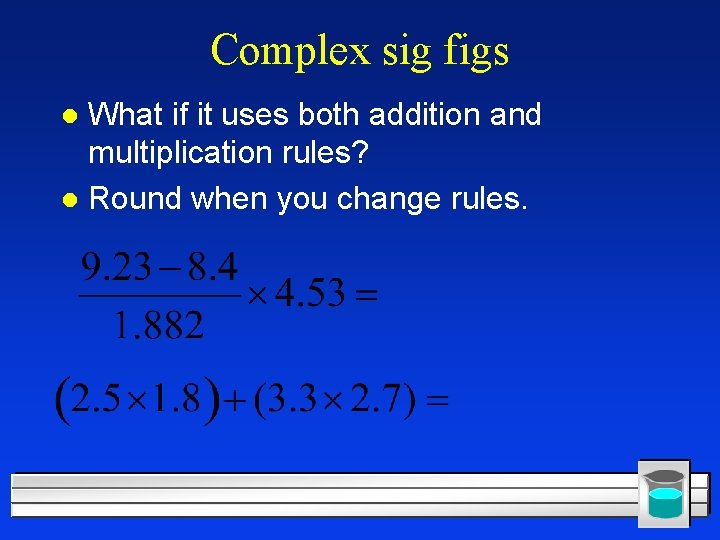
Complex sig figs What if it uses both addition and multiplication rules? l Round when you change rules. l
Sig Figs l You will need to be proficient at using sig figs in calculations for the AP exam.
l. Scientific Method
Scientific method. A way of solving problems l Observation- what is seen or measured l Hypothesis- educated guess of why things behave the way they do. (possible explanation) l Experiment- designed to test hypothesis l leads to new observations, l and the cycle goes on l
Scientific method. After many cycles, a broad, general explanation is developed for why things behave the way they do l Theory l Also regular patterns of how things behave the same in different systems emerges l Laws are summaries of observations l Often mathematical relationship l
Scientific Method Theories have a predictive value. l The true test of a theory is if it can predict new behaviors. l If the prediction is wrong, theory must be changed. l Theory- why l Law – how l Law – equation of how things change l
Observations Hypothesis Theory (Model) Modify Experiment Prediction Law Experiment
Metric System Every measurement has two parts l Number l Scale (unit) l SI system (System International) based on the metric system l Prefix + base unit l Prefix tells you the power of 10 to multiply by - decimal system -easy conversions l
l. Metric System
Metric System Base Units l Mass - kilogram (kg) l Length- meter (m) l Time - second (s) l Temperature- Kelvin (K) l Electric current- ampere (amp, A) l Amount of substance- mole (mol) l
Prefixes gigal mega l kilo l decil centil millil microl nanol G M k d c m m n 1, 000, 000 1, 000 0. 1 0. 001 0. 000000001 109 106 103 10 -1 10 -2 10 -3 10 -6 10 -9
Deriving the Liter 3 l Liter is defined as the volume of 1 dm 3 l gram is the mass of 1 cm l 1 3 cm of water is equivalent to 1 m. L of water
Mass and Weight Mass is a measure of resistance to change in motion l Weight is force of gravity. l Sometimes used interchangeably l Mass can’t change, weight can l
l. Uncertainty Precision and
Uncertainty Basis for significant figures l All measurements are uncertain to some degree l Precision- how repeatable l Accuracy- how correct - closeness to true value. l Random error - equal chance of being high or low- addressed by averaging measurements - expected l
Uncertainty Systematic error- same direction each time l Want to avoid this l Bad equipment or bad technique. l Better precision implies better accuracy l You can have precision without accuracy l You can’t have accuracy without precision (unless you’re really lucky). l
Dimensional Analysis Using the units to solve problems
Dimensional Analysis Use conversion factors to change the units l Conversion factors = 1 l 1 foot = 12 inches (equivalence statement) l 12 in = 1 ft. 12 in l 2 conversion factors l multiply by the one that will give you the correct units in your answer. l
Examples l Because you never learned dimensional analysis, you have been working at a fast food restaurant for the past 35 years wrapping hamburgers. Each hour you wrap 184 hamburgers. You work 8 hours per day. You work 5 days a week. you get paid every 2 weeks with a salary of $840. 34. How many hamburgers will you have to wrap to make your first one million dollars?
l A senior was applying to college and wondered how many applications she needed to send. Her counselor explained that with the excellent grade she received in chemistry she would probably be accepted to one school out of every three to which she applied. She immediately realized that for each application she would have to write 3 essays, and each essay would require 2 hours work. Of course writing essays is no simple matter. For each hour of serious essay writing, she would need to expend 500 calories which she could derive from her mother's apple pies. Every three times she cleaned her bedroom, her mother would made her an apple pie. How many times would she have to clean her room in order to gain acceptance to 10 colleges?
Units to a Power l How many m 3 is 1500 cm 3? 1500 cm 3 1500 1 m 1 m 1 m 100 cm cm 3 1 m 100 cm 3
Units to a Power How many cm 2 is 15 m 2? l 36 cm 3 is how many mm 3? l
Multiple units l The speed limit is 65 mi/hr. What is this in m/s? 1 mile = 1760 yds 1 meter = 1. 094 yds 65 mi hr 1760 yd 1 m 1 hr 1 min 1 mi 1. 094 yd 60 min 60 s
Multiple units l Lead has a density of 11. 4 g/cm 3. What is this in pounds per quart? 454 g = 1 lb 1 L = 1. 094 qt
Temperature and Density
Temperature Scales l. Farhenheit l. Celsius l. Kelvin
l l ºF = 1. 8 ºC + 32 K = ºC + 273
Temperature A measure of the average kinetic energy l Different temperature scales, all are talking about the same height of mercury. l Derive a equation for converting ºF toºC l
0ºC = 32ºF 0ºC 32ºF
100ºC = 212ºF 0ºC = 32ºF 0ºC 32ºF 100ºC 212ºF
How much it changes 100ºC = 212ºF 0ºC = 32ºF 100ºC = 180ºF 0ºC 100ºC 212ºF 32ºF
How much it changes 100ºC = 212ºF 0ºC = 32ºF 100ºC = 180ºF 1ºC = (180/100)ºF 1ºC = 9/5ºF 0ºC 100ºC 212ºF 32ºF
ºF 0ºC is not 0ºF 9 5 ºC
(0, 32)= (C 1, F 1) ºF ºC
(0, 32) = (C 1, F 1) (100, 212) = (C 2, F 2) ºF ºC
Density Ratio of mass to volume l D = m/V l Useful for identifying a compound l Useful for predicting weight l An intrinsic property- does depend on what the material is l
Density Problem l An empty container weighs 121. 3 g. Filled with carbon tetrachloride (density 1. 53 g/cm 3 ) the container weighs 283. 2 g. What is the volume of the container?
Density Problem l A 55. 0 gal drum weighs 75. 0 lbs. when empty. What will the total mass be when filled with ethanol? density 0. 789 g/cm 3 1 gal = 3. 78 L 1 lb = 454 g
l Thanks to Mr. Greene for the use of his Power. Point.