
Review of Causes of Foundation Failures and Their

- Slides: 14
Review of Causes of Foundation Failures and Their Possible Preventive and Remedial Measures by Dr. Amit Srivastava Associate Professor, Department of Civil & Environmental Engineering The North. Cap University, HUDA Sector 23 -A Gurgaon - 122017.
Contents I. Introduction II. Load transfer failures III. Drag down and heave IV. Collapsible soils V. Lateral loads VI. Construction error VII. Unequal support
Contents VIII. Water level fluctuation IX. Earthquake X. Contents Vibration effect XI. Foundation failure due to landslide/ slope instability XII. Foundation failure due to uplift XIII. Conclusion
Introduction § Foundations of engineering constructions are systems that act like interface elements to transmit the loads from superstructure to, and into, the underlying soil or rock over a wider area at reduced pressure. § Engineering structures despite being constructed with adequate strength and safety measures do fail or collapse. § “Failure is an unacceptable difference between expected and observed performance. ” – Council of Forensic Engineering, ASCE
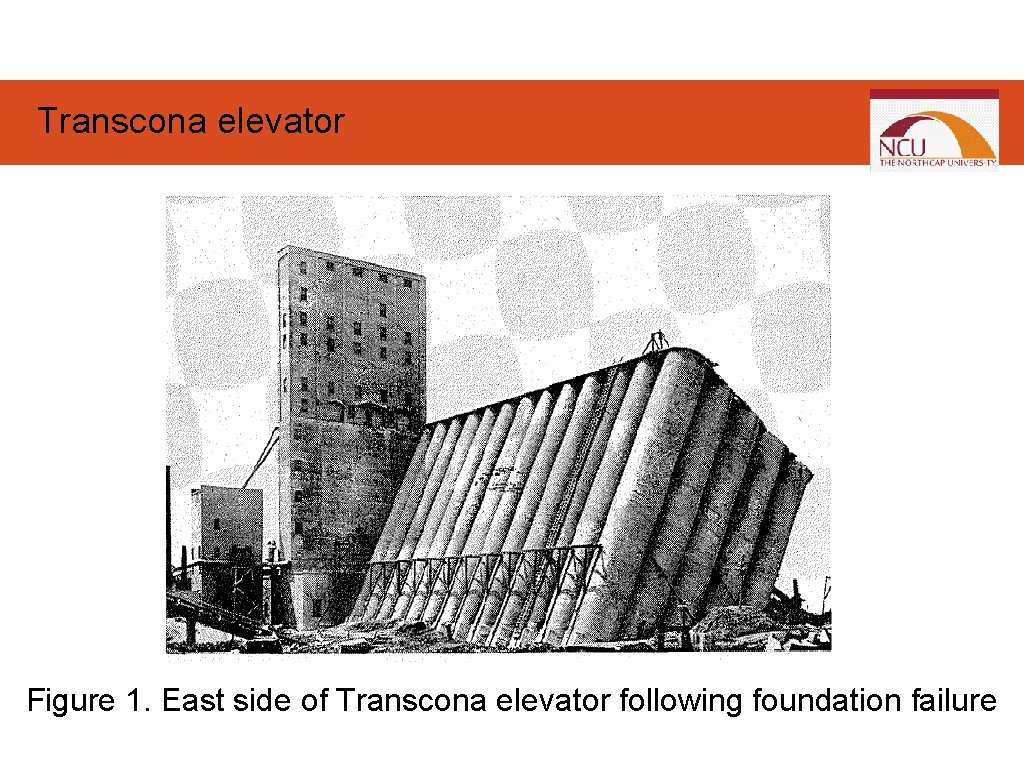
Load transfer failures § The objective of foundation is to transfer the load of superstructure to the foundation soil on a wider area. § The uncertainties for which factor of safety is provided in geotechnical design include (a) the natural heterogeneity or inherent variability (b) measurement error, and (c) model transformation uncertainty. § Classic examples of Bearing capacity failures: Transcona Grain elevator in 1913 and Fargo Grain Elevator in 1955.
Transcona elevator Figure 1. East side of Transcona elevator following foundation failure
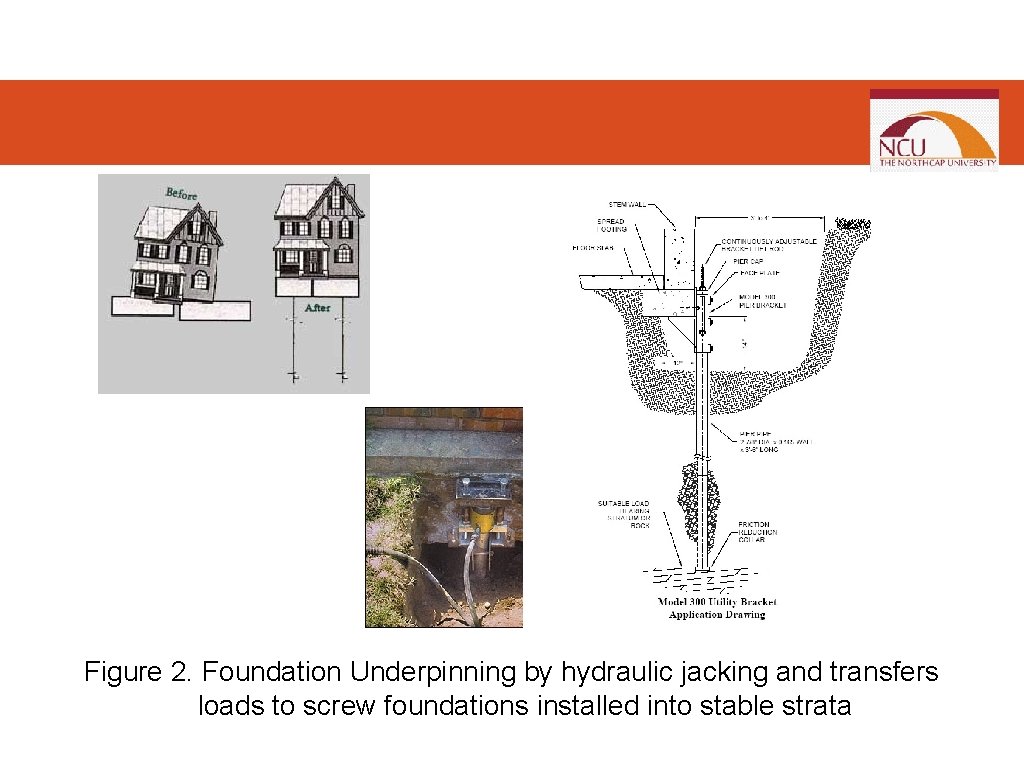
Preventive measures and remedies • Under such circumstances, the most commonly adopted remedial measure to rectify the problem is underpinning. • Underpinning is accomplished by extending the foundation in depth or width so that it either rests on a more supportive soil stratum or distributes its load across a greater area. • Use of steel piers, helical anchors and micro piles are common methods in underpinning.
Figure 2. Foundation Underpinning by hydraulic jacking and transfers loads to screw foundations installed into stable strata
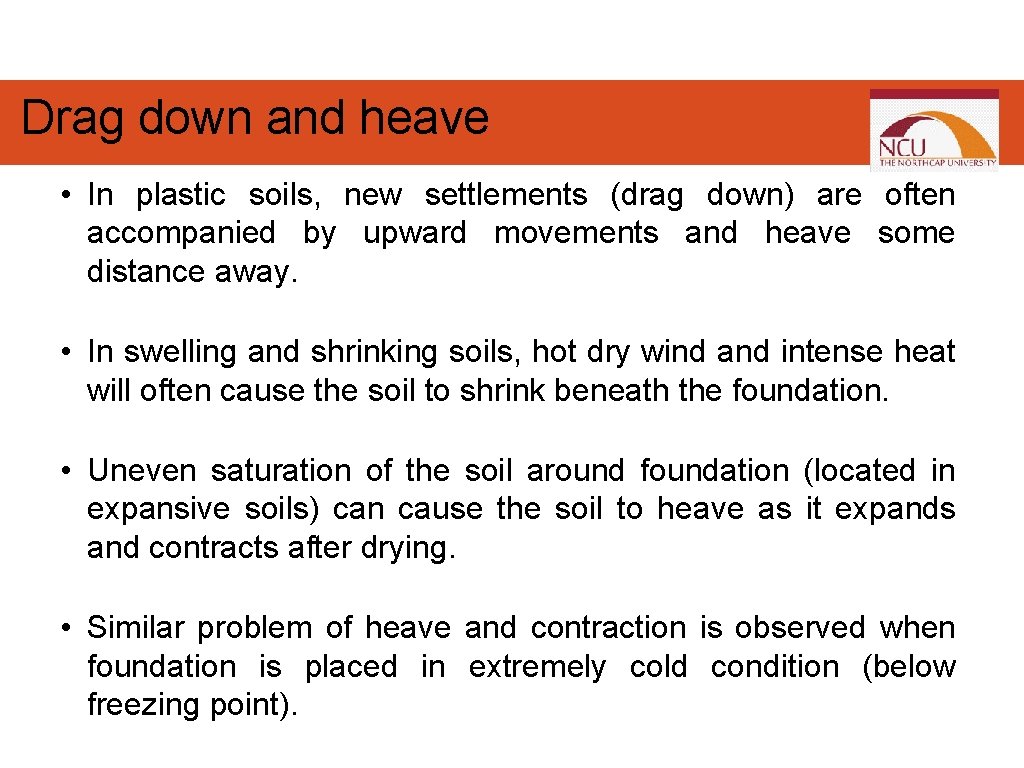
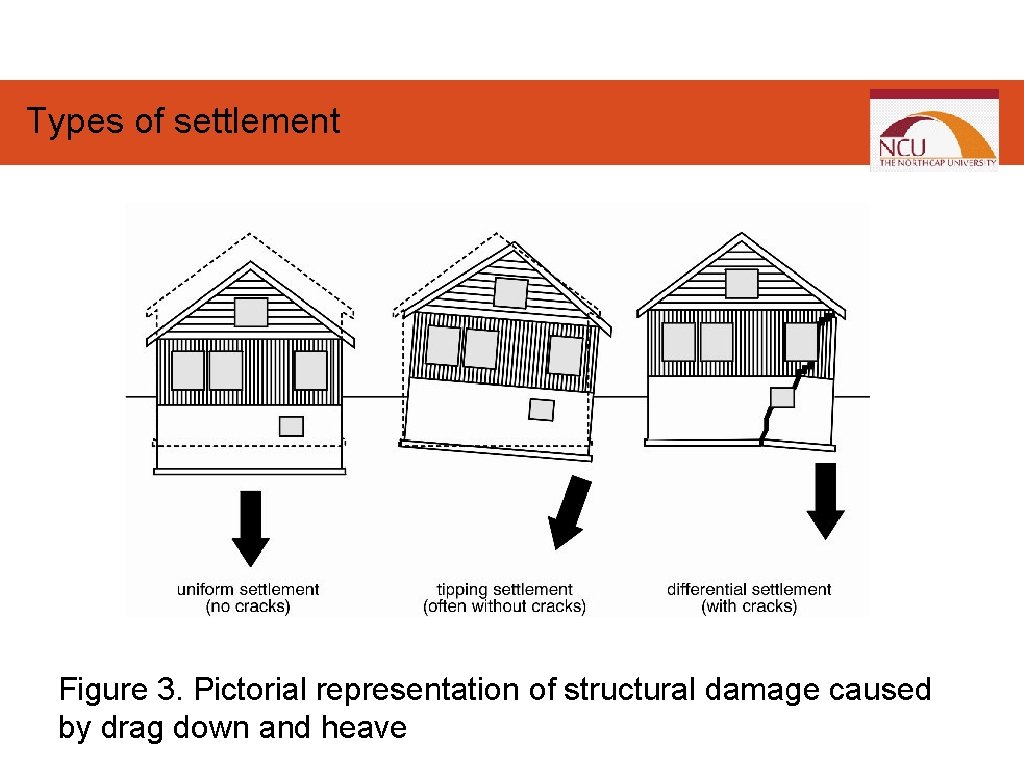
Drag down and heave • In plastic soils, new settlements (drag down) are often accompanied by upward movements and heave some distance away. • In swelling and shrinking soils, hot dry wind and intense heat will often cause the soil to shrink beneath the foundation. • Uneven saturation of the soil around foundation (located in expansive soils) can cause the soil to heave as it expands and contracts after drying. • Similar problem of heave and contraction is observed when foundation is placed in extremely cold condition (below freezing point).
Types of settlement Figure 3. Pictorial representation of structural damage caused by drag down and heave
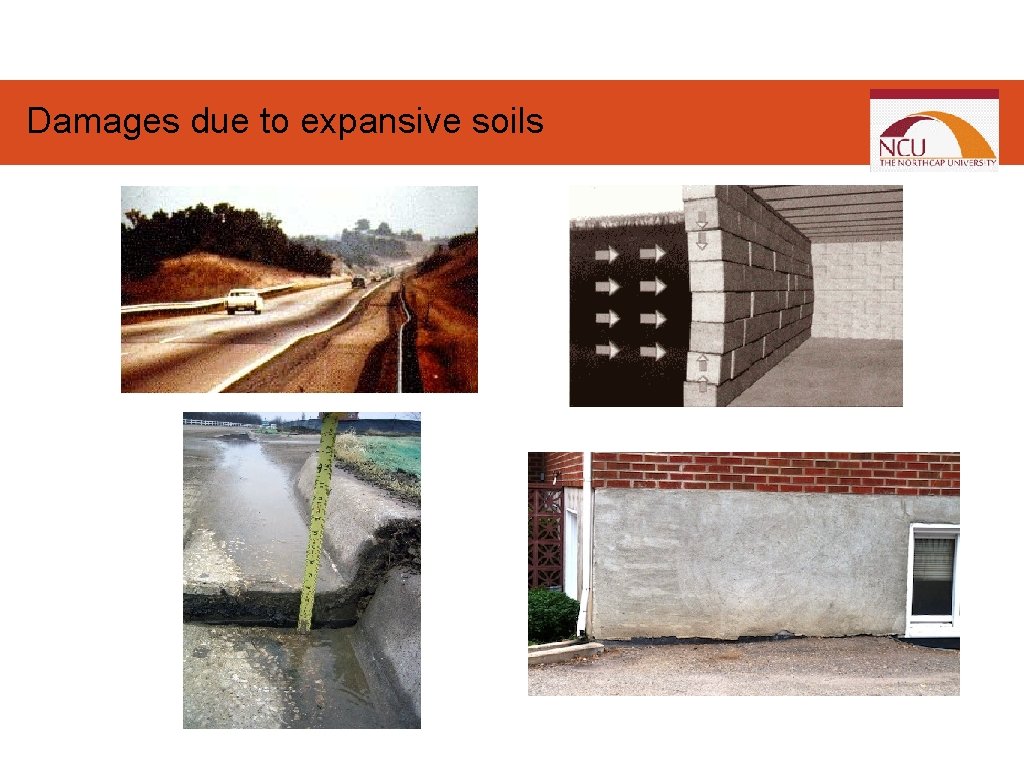
Damages due to expansive soils
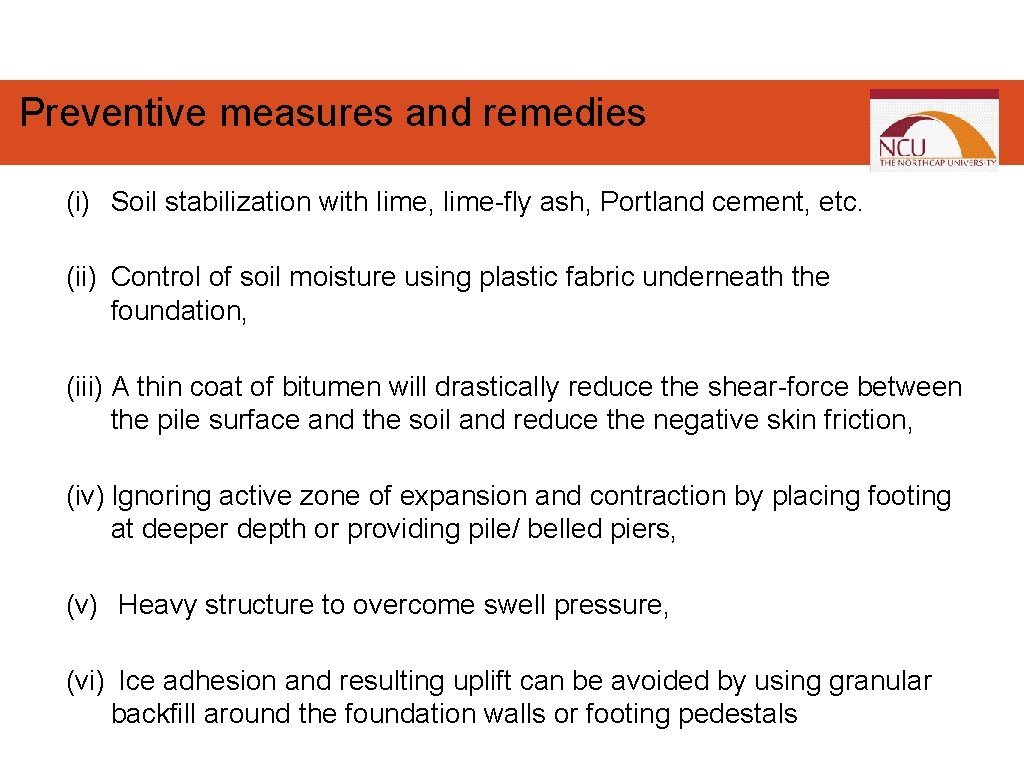
Preventive measures and remedies (i) Soil stabilization with lime, lime-fly ash, Portland cement, etc. (ii) Control of soil moisture using plastic fabric underneath the foundation, (iii) A thin coat of bitumen will drastically reduce the shear-force between the pile surface and the soil and reduce the negative skin friction, (iv) Ignoring active zone of expansion and contraction by placing footing at deeper depth or providing pile/ belled piers, (v) Heavy structure to overcome swell pressure, (vi) Ice adhesion and resulting uplift can be avoided by using granular backfill around the foundation walls or footing pedestals
COLLAPSIBLE SOILS • They are deposits of fine grained particles transported by wind are characterized by constituent parts with an open packing arrangement, which forms a meta-stable state that can collapse to form a closer packed, more stable structure of significantly reduced volume. • Collapse in such deposits can be triggered by either increasing the load on the soil or by wetting it. • A collapse condition can lead to structure failure, landslides (depending on the topography), and tsunamis (if the soil collapses into a body of water).
Interesting, right? This is just a sneak preview of the full presentation. We hope you like it! To see the rest of it, just click here to view it in full on Power. Show. com. Then, if you’d like, you can also log in to Power. Show. com to download the entire presentation for free.