
Review of atmospheric radiative transfer models suitable for
Review of atmospheric radiative transfer models suitable for vicarious calibration 2019 GSICS Data and Research Working Groups Annual Meeting Yves Govaerts & Vincent Leroy Rayference ESRIN, Frascati, 4 – 8 March 2019
Overview Radiative transfer models play a critical role for vicarious calibration; Instruments like S 2/MSI have proven to have a radiometric accuracy close to 2 -3%; What is the expected simulation accuracy with current 1 D RTMs over CEOS calibration sites: 1%, 3% or 5%? • RTM numerical accuracy • Input parameter accuracy
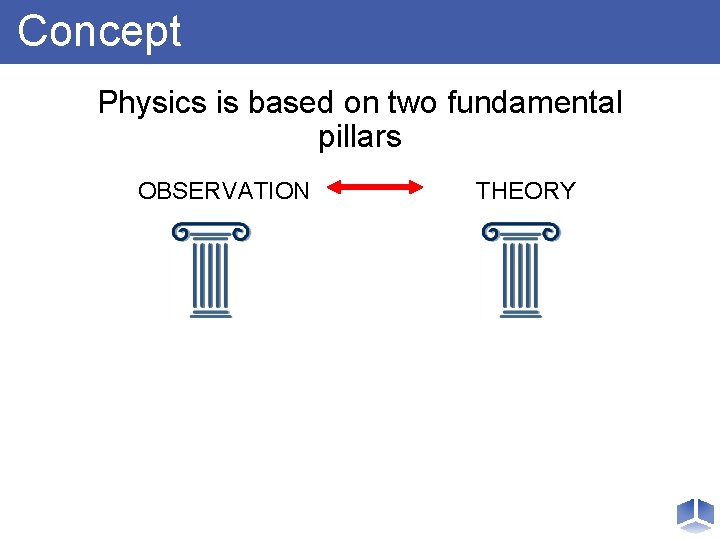
Concept Physics is based on two fundamental pillars OBSERVATION THEORY
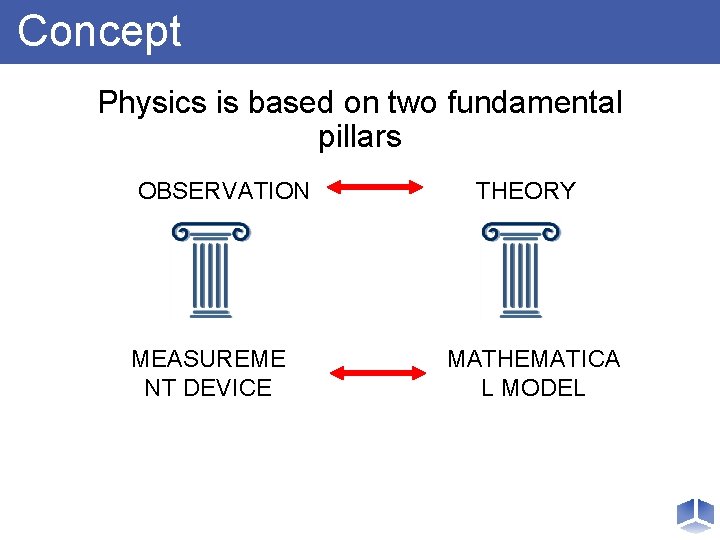
Concept Physics is based on two fundamental pillars OBSERVATION MEASUREME NT DEVICE THEORY MATHEMATICA L MODEL
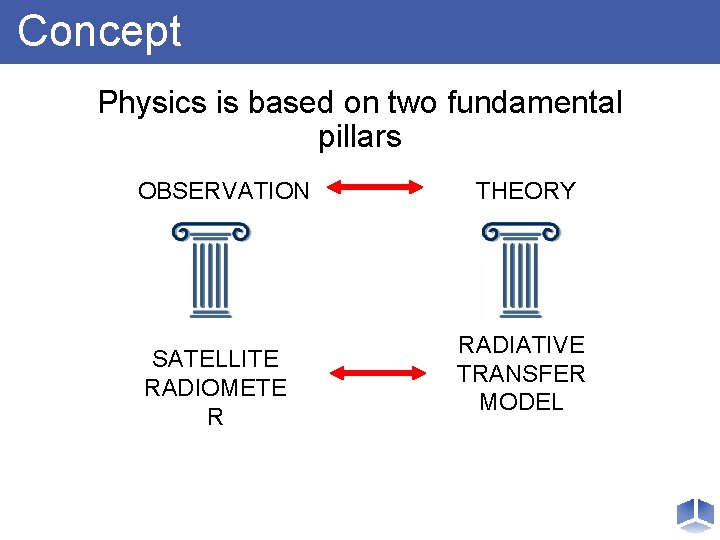
Concept Physics is based on two fundamental pillars OBSERVATION SATELLITE RADIOMETE R THEORY RADIATIVE TRANSFER MODEL
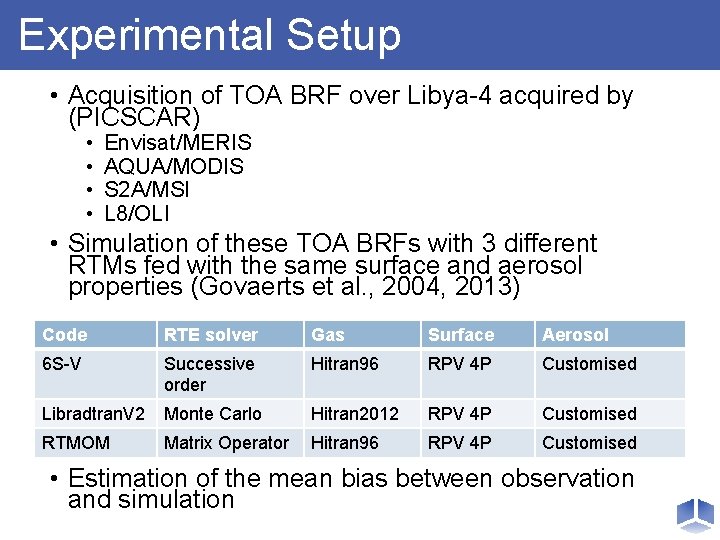
Experimental Setup • Acquisition of TOA BRF over Libya-4 acquired by (PICSCAR) • • Envisat/MERIS AQUA/MODIS S 2 A/MSI L 8/OLI • Simulation of these TOA BRFs with 3 different RTMs fed with the same surface and aerosol properties (Govaerts et al. , 2004, 2013) Code RTE solver Gas Surface Aerosol 6 S-V Successive order Hitran 96 RPV 4 P Customised Libradtran. V 2 Monte Carlo Hitran 2012 RPV 4 P Customised RTMOM Matrix Operator Hitran 96 RPV 4 P Customised • Estimation of the mean bias between observation and simulation
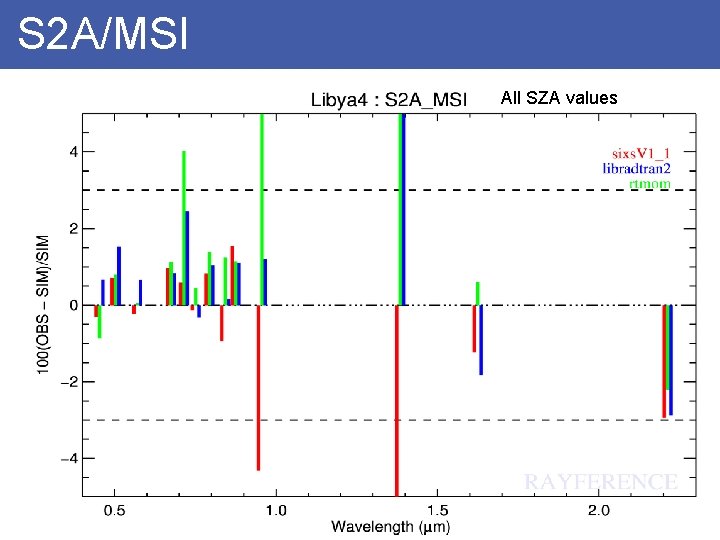
S 2 A/MSI All SZA values
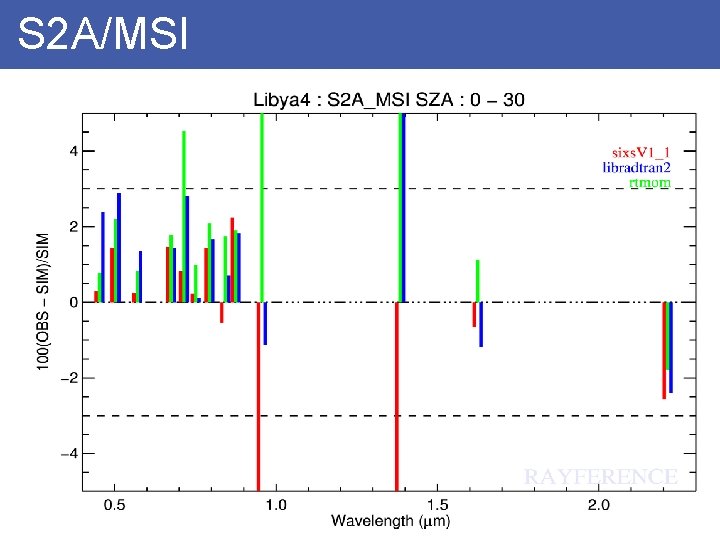
S 2 A/MSI
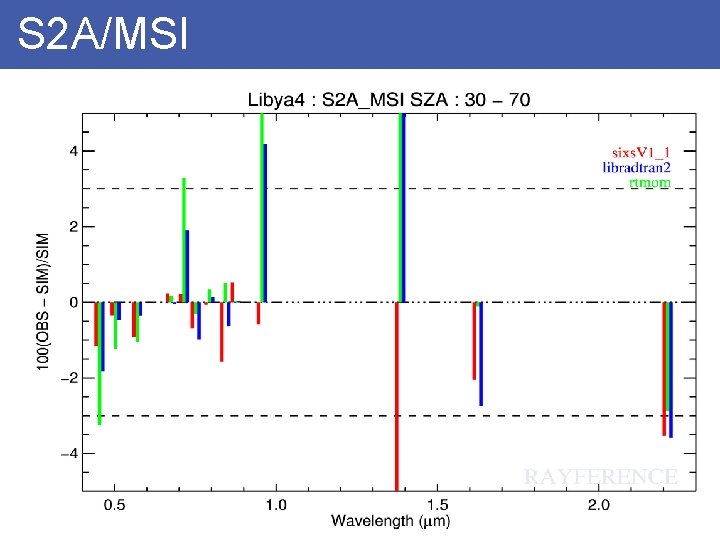
S 2 A/MSI
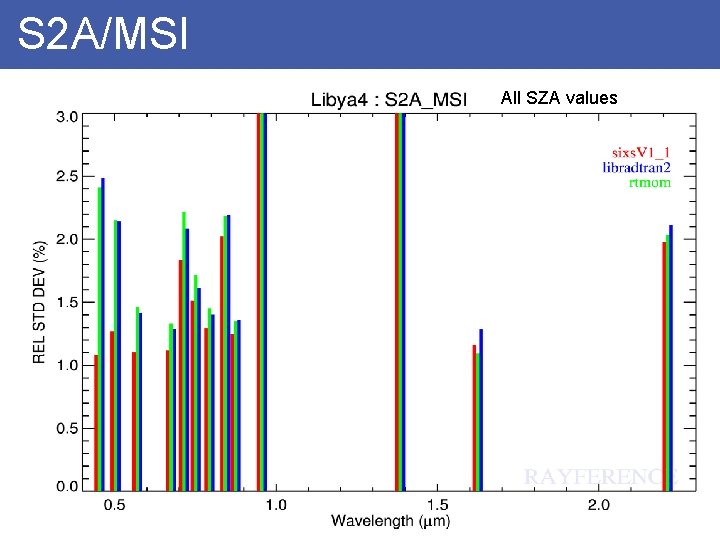
S 2 A/MSI All SZA values
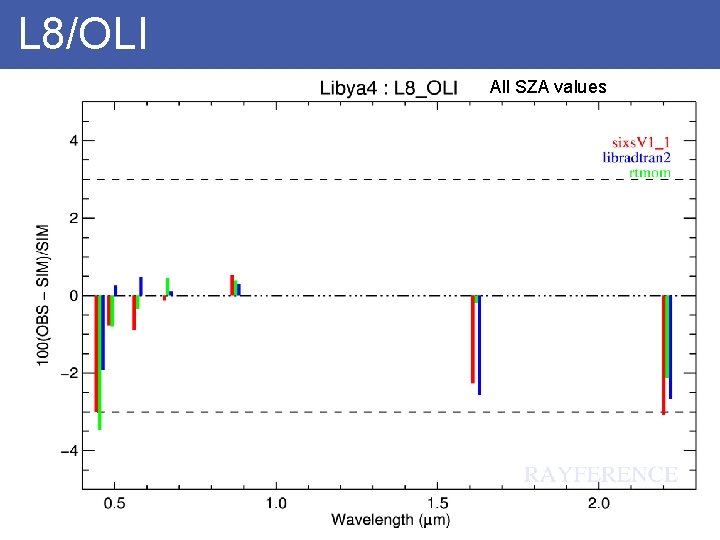
L 8/OLI All SZA values
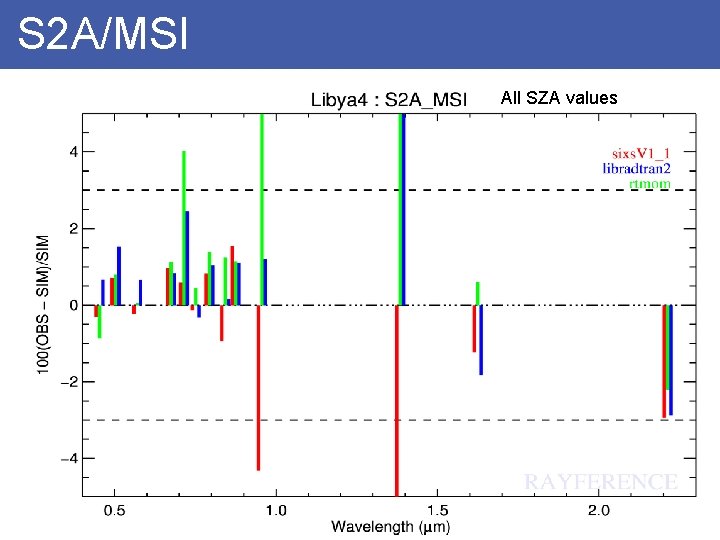
S 2 A/MSI All SZA values
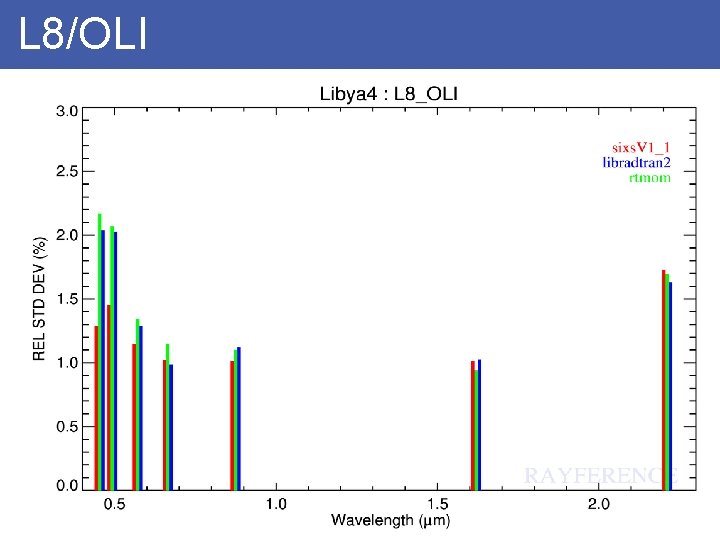
L 8/OLI
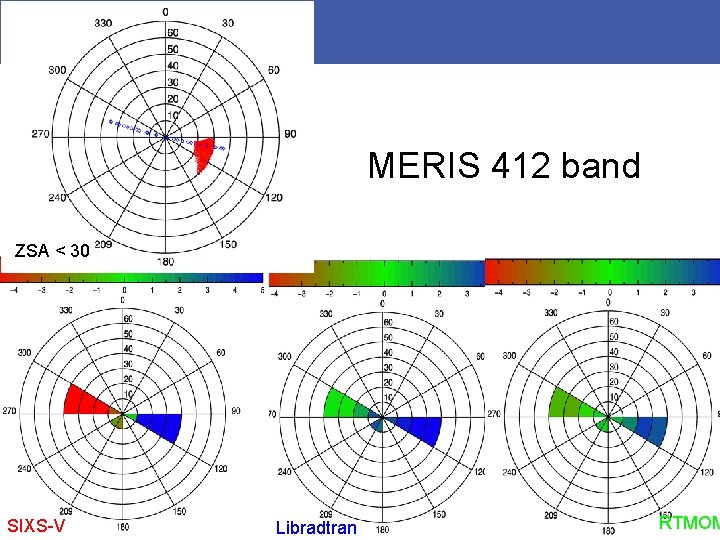
MERIS 412 band ZSA < 30 SIXS-V Libradtran RTMOM
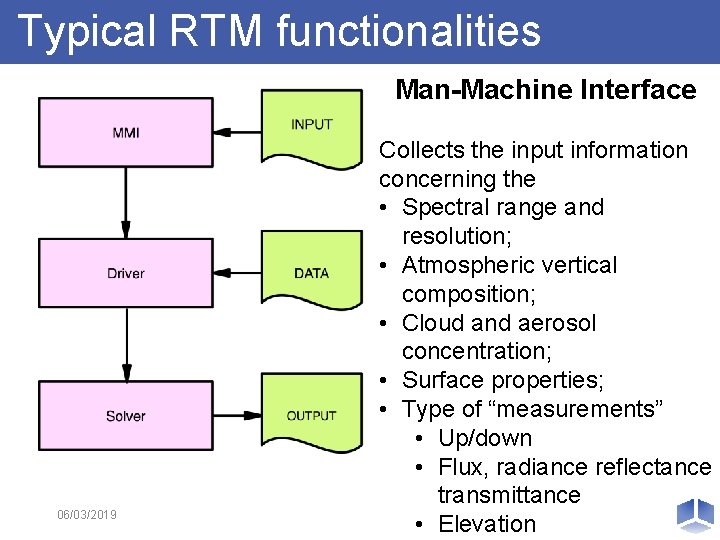
Typical RTM functionalities Man-Machine Interface 06/03/2019 Collects the input information concerning the • Spectral range and resolution; • Atmospheric vertical composition; • Cloud and aerosol concentration; • Surface properties; • Type of “measurements” • Up/down • Flux, radiance reflectance transmittance • Elevation
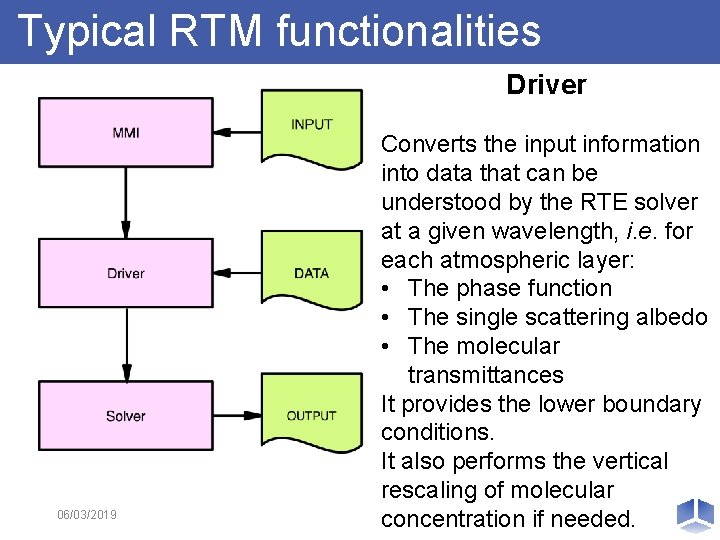
Typical RTM functionalities Driver 06/03/2019 Converts the input information into data that can be understood by the RTE solver at a given wavelength, i. e. for each atmospheric layer: • The phase function • The single scattering albedo • The molecular transmittances It provides the lower boundary conditions. It also performs the vertical rescaling of molecular concentration if needed.
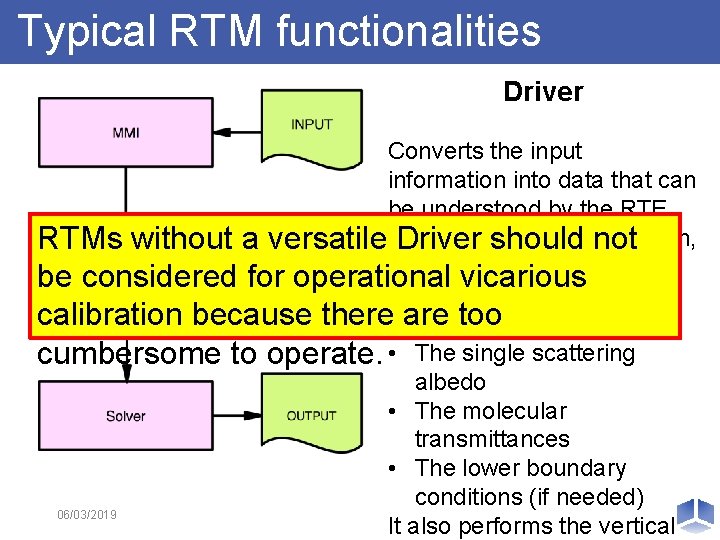
Typical RTM functionalities Driver Converts the input information into data that can be understood by the RTE at ashould given wavelength, RTMs without a versatilesolver Driver not i. e. for each atmospheric be considered for operational vicarious layer: calibration because there • are The too phase function cumbersome to operate. • The single scattering albedo • The molecular transmittances • The lower boundary conditions (if needed) 06/03/2019 It also performs the vertical
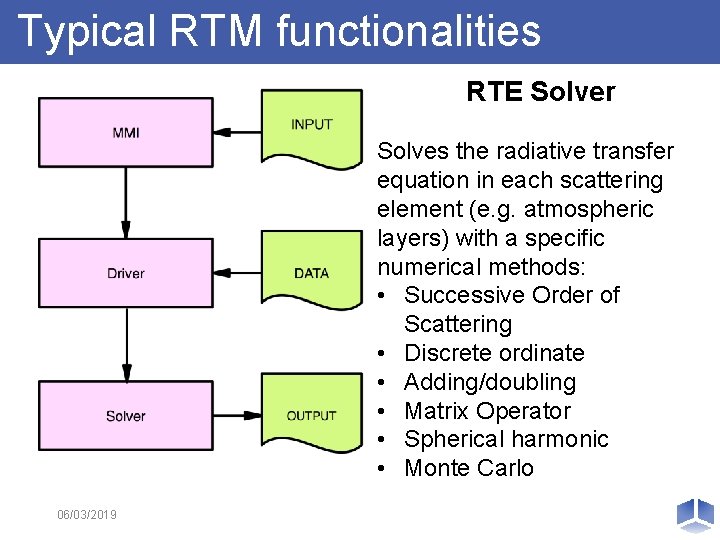
Typical RTM functionalities RTE Solver Solves the radiative transfer equation in each scattering element (e. g. atmospheric layers) with a specific numerical methods: • Successive Order of Scattering • Discrete ordinate • Adding/doubling • Matrix Operator • Spherical harmonic • Monte Carlo 06/03/2019
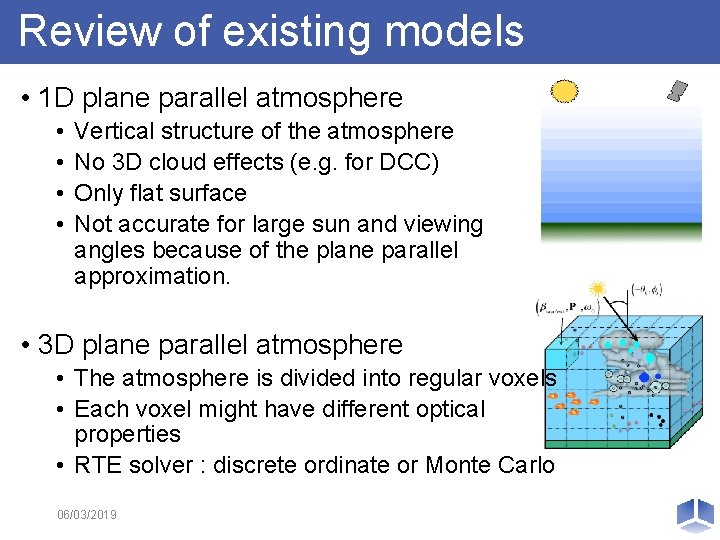
Review of existing models • 1 D plane parallel atmosphere • • Vertical structure of the atmosphere No 3 D cloud effects (e. g. for DCC) Only flat surface Not accurate for large sun and viewing angles because of the plane parallel approximation. • 3 D plane parallel atmosphere • The atmosphere is divided into regular voxels • Each voxel might have different optical properties • RTE solver : discrete ordinate or Monte Carlo 06/03/2019
Toward a 1% RTM accuracy • Surface BRF : accounting for topography (e. g. , oriented sand dunes); • Molecular absorption: account for species like O 4; • Rigorous calculation of the coupling between: • Surface reflectance and atmosphere scattering; • Aerosol scattering and molecular absorption; • Polarization, non flat earth for large zenith angles; • Improvement of the surface and atmospheric 06/03/2019 property characterization;
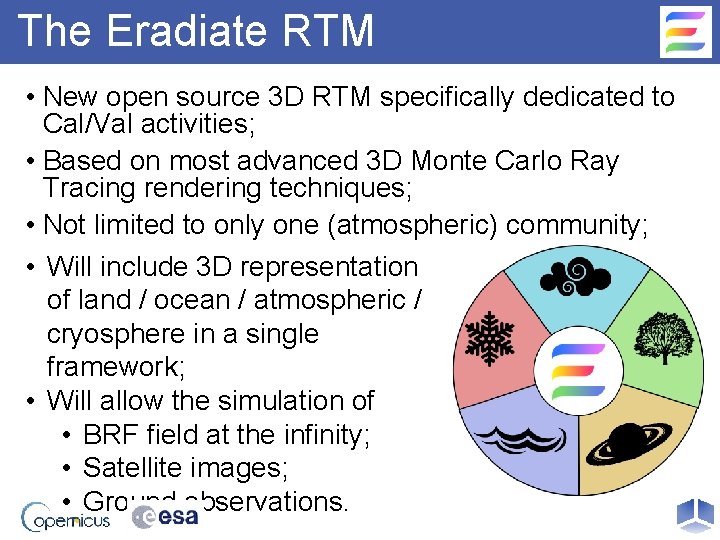
The Eradiate RTM • New open source 3 D RTM specifically dedicated to Cal/Val activities; • Based on most advanced 3 D Monte Carlo Ray Tracing rendering techniques; • Not limited to only one (atmospheric) community; • Will include 3 D representation of land / ocean / atmospheric / cryosphere in a single framework; • Will allow the simulation of • BRF field at the infinity; • Satellite images; • Ground observations.
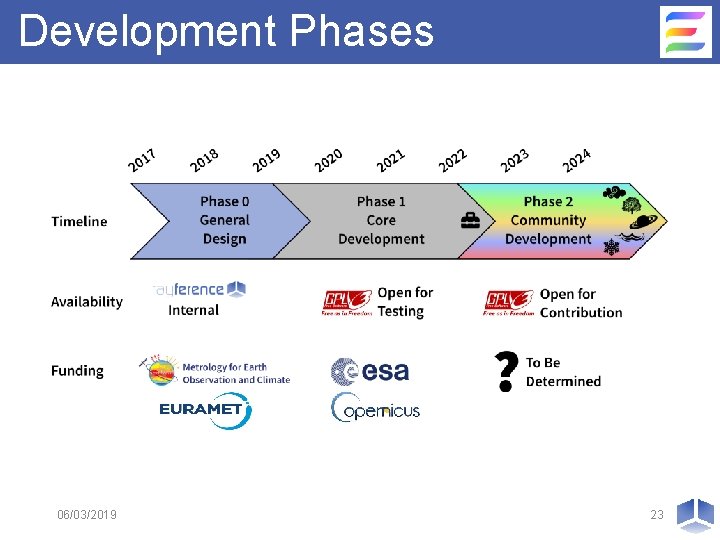
Development Phases 06/03/2019 23
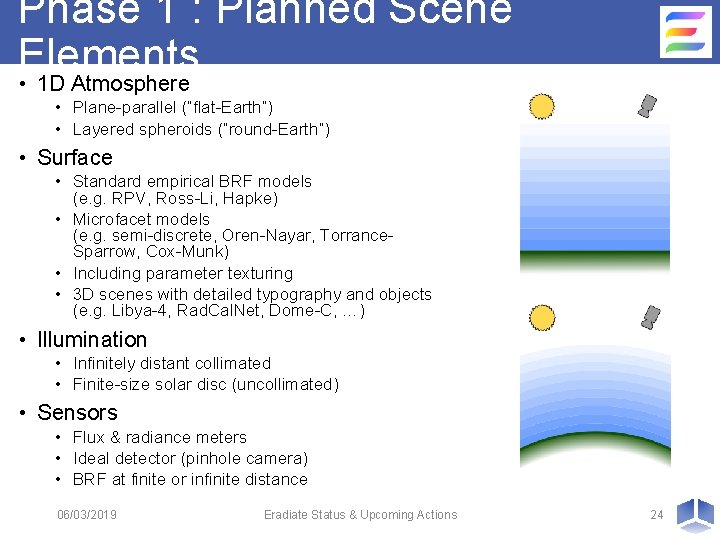
Phase 1 : Planned Scene Elements • 1 D Atmosphere • Plane-parallel (“flat-Earth”) • Layered spheroids (“round-Earth”) • Surface • Standard empirical BRF models (e. g. RPV, Ross-Li, Hapke) • Microfacet models (e. g. semi-discrete, Oren-Nayar, Torrance. Sparrow, Cox-Munk) • Including parameter texturing • 3 D scenes with detailed typography and objects (e. g. Libya-4, Rad. Cal. Net, Dome-C, …) • Illumination • Infinitely distant collimated • Finite-size solar disc (uncollimated) • Sensors • Flux & radiance meters • Ideal detector (pinhole camera) • BRF at finite or infinite distance 06/03/2019 Eradiate Status & Upcoming Actions 24
The Eradiate RTM www. eradiate. eu Please register to the Eradiate newsletter (under contact) to be updated on Eradiate latest developments. Yearly Eradiate workshops are organised at the JRC, Ispra site (IT). The next (third) one will take place on Nov 26 th - 27 th 2019 (save the date!). Our sponsors (for this presentation)
- Slides: 24