
Review Objects and Classes State fields Constructors parameters

Review

• Objects and Classes – State • fields – Constructors • parameters • Initialise the fields – Methods • • • parameters return Values Operate on the fields Class diagrams show if one class refers to another (anywhere in its implementation). Object diagrams show field values (which may refer to specific other objects). Objects First with Java - A Practical Introduction using Blue. J, © David J. Barnes, Michael Kölling
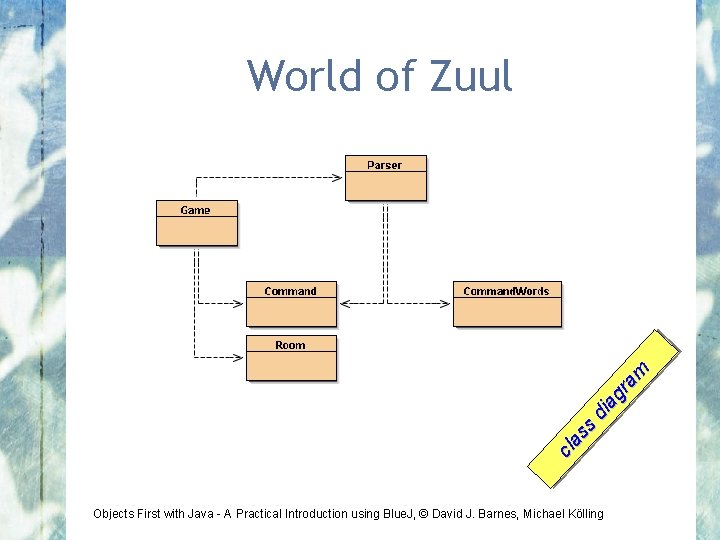
cl a ss di a gr am World of Zuul Objects First with Java - A Practical Introduction using Blue. J, © David J. Barnes, Michael Kölling
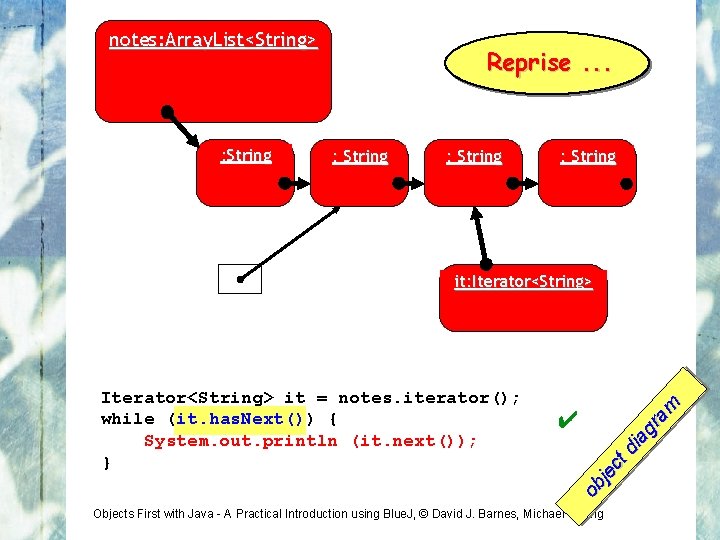
notes: Array. List<String> : String Reprise. . . : String ✔ ob je ct Iterator<String> it = notes. iterator(); while (it. has. Next()) { System. out. println (it. next()); } di ag ra m it: Iterator<String> Objects First with Java - A Practical Introduction using Blue. J, © David J. Barnes, Michael Kölling
• A class is a template from which objects can be constructed. • A class defines the data fields held by its objects, together with logic for constructors of its objects and methods for accessing and operating on their data. • Methods (and constructors) may declare and use their own local variables – these exist only for the duration of their method (or constructor). On the other hand, data fields last for the duration of their object. • Methods and constructors may be passed parameters – these exist only for the duration of the method or constructor. Objects First with Java - A Practical Introduction using Blue. J, © David J. Barnes, Michael Kölling
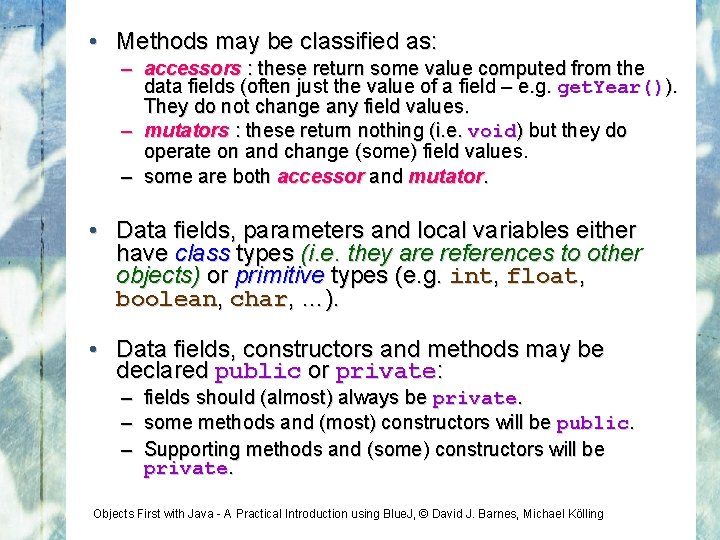
• Methods may be classified as: – accessors : these return some value computed from the data fields (often just the value of a field – e. g. get. Year()). They do not change any field values. – mutators : these return nothing (i. e. void) but they do operate on and change (some) field values. – some are both accessor and mutator. • Data fields, parameters and local variables either have class types (i. e. they are references to other objects) or primitive types (e. g. int, float, boolean, char, …). • Data fields, constructors and methods may be declared public or private: – fields should (almost) always be private. – some methods and (most) constructors will be public. – Supporting methods and (some) constructors will be private. Objects First with Java - A Practical Introduction using Blue. J, © David J. Barnes, Michael Kölling
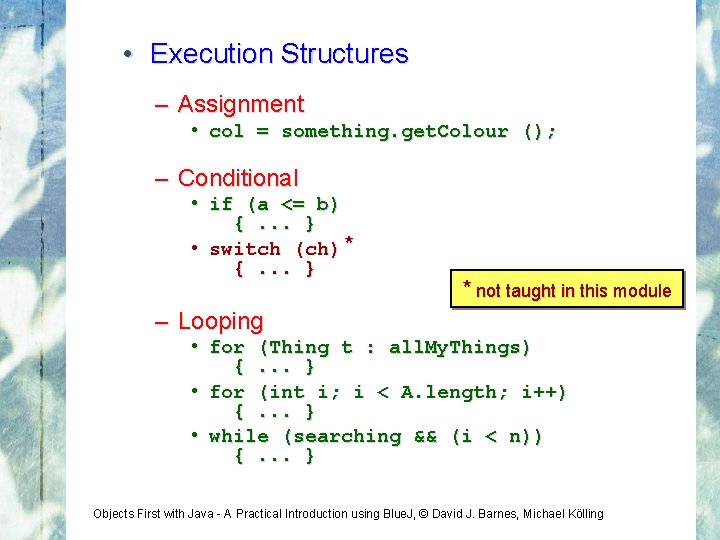
• Execution Structures – Assignment • col = something. get. Colour (); – Conditional • if (a <= b) {. . . } • switch (ch) * {. . . } * not taught in this module – Looping • for (Thing t : all. My. Things) {. . . } • for (int i; i < A. length; i++) {. . . } • while (searching && (i < n)) {. . . } Objects First with Java - A Practical Introduction using Blue. J, © David J. Barnes, Michael Kölling
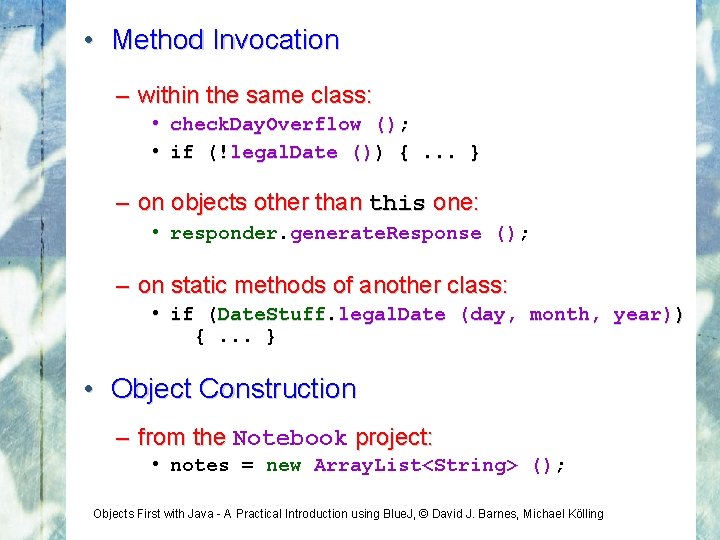
• Method Invocation – within the same class: • check. Day. Overflow (); • if (!legal. Date ()) {. . . } – on objects other than this one: • responder. generate. Response (); – on static methods of another class: • if (Date. Stuff. legal. Date (day, month, year)) {. . . } • Object Construction – from the Notebook project: • notes = new Array. List<String> (); Objects First with Java - A Practical Introduction using Blue. J, © David J. Barnes, Michael Kölling
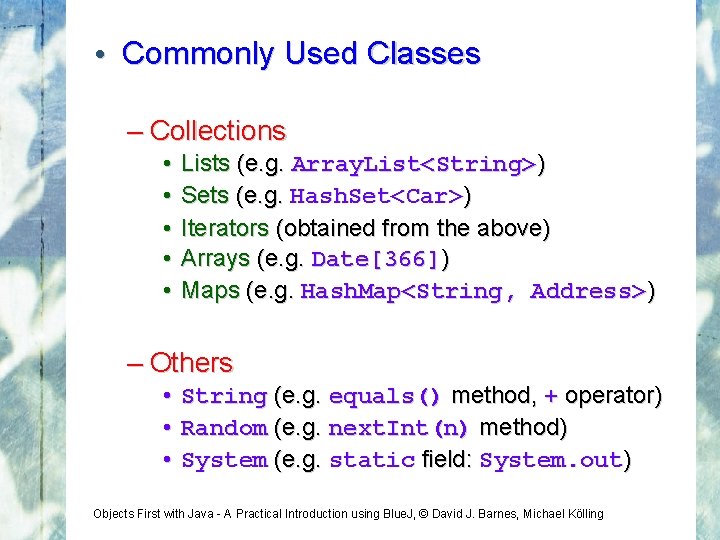
• Commonly Used Classes – Collections • • • Lists (e. g. Array. List<String>) Sets (e. g. Hash. Set<Car>) Iterators (obtained from the above) Arrays (e. g. Date[366]) Maps (e. g. Hash. Map<String, Address>) – Others • String (e. g. equals() method, + operator) • Random (e. g. next. Int(n) method) • System (e. g. static field: System. out) Objects First with Java - A Practical Introduction using Blue. J, © David J. Barnes, Michael Kölling
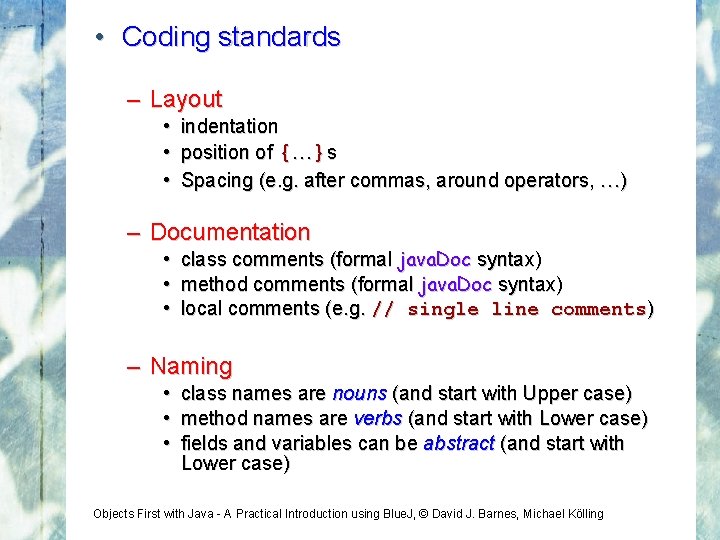
• Coding standards – Layout • • • indentation position of {…}s Spacing (e. g. after commas, around operators, …) – Documentation • • • class comments (formal java. Doc syntax) method comments (formal java. Doc syntax) local comments (e. g. // single line comments) – Naming • class names are nouns (and start with Upper case) • method names are verbs (and start with Lower case) • fields and variables can be abstract (and start with Lower case) Objects First with Java - A Practical Introduction using Blue. J, © David J. Barnes, Michael Kölling
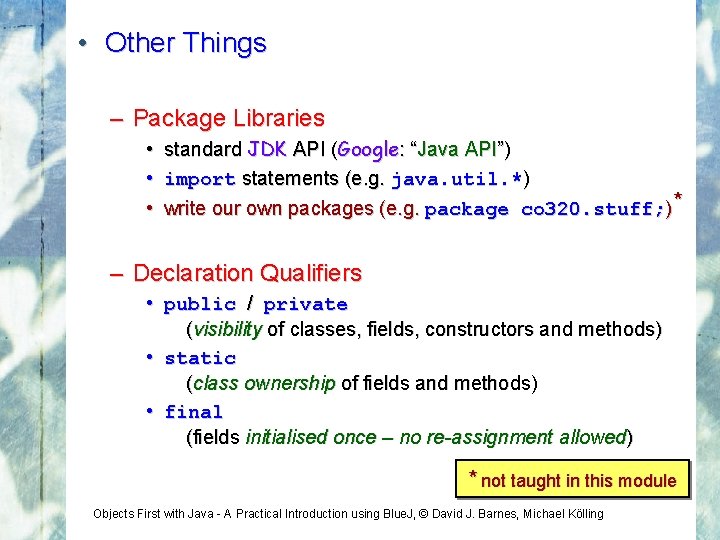
• Other Things – Package Libraries • standard JDK API (Google: “Java API”) • import statements (e. g. java. util. *) • write our own packages (e. g. package co 320. stuff; ) * – Declaration Qualifiers • public / private (visibility of classes, fields, constructors and methods) • static (class ownership of fields and methods) • final (fields initialised once – no re-assignment allowed) * not taught in this module Objects First with Java - A Practical Introduction using Blue. J, © David J. Barnes, Michael Kölling
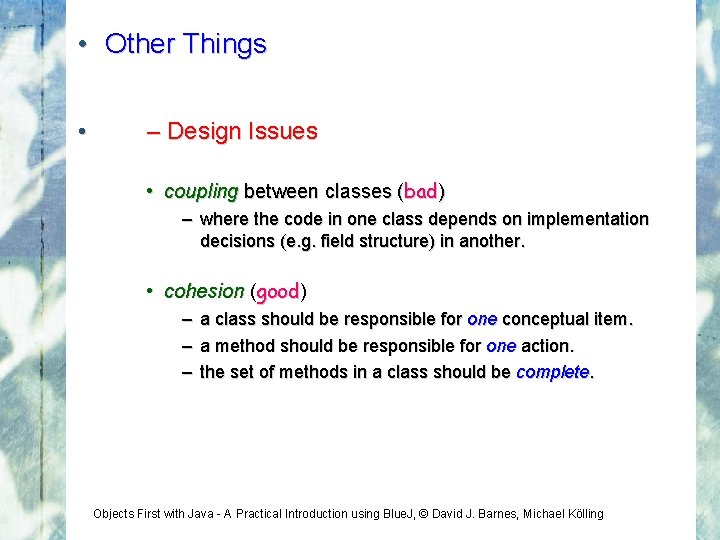
• Other Things • – Design Issues • coupling between classes (bad) – where the code in one class depends on implementation decisions (e. g. field structure) in another. • cohesion (good) – – – a class should be responsible for one conceptual item. a method should be responsible for one action. the set of methods in a class should be complete. Objects First with Java - A Practical Introduction using Blue. J, © David J. Barnes, Michael Kölling
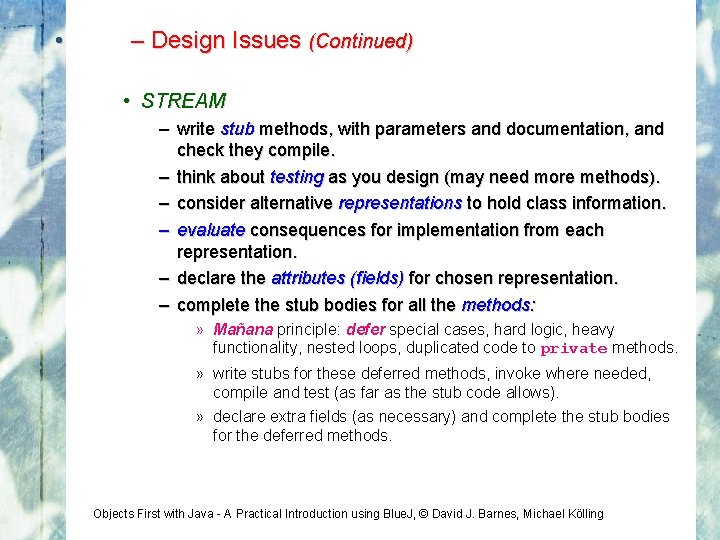
• – Design Issues (Continued) • STREAM – write stub methods, with parameters and documentation, and check they compile. – think about testing as you design (may need more methods). – consider alternative representations to hold class information. – evaluate consequences for implementation from each representation. – declare the attributes (fields) for chosen representation. – complete the stub bodies for all the methods: » Mañana principle: defer special cases, hard logic, heavy functionality, nested loops, duplicated code to private methods. » write stubs for these deferred methods, invoke where needed, compile and test (as far as the stub code allows). » declare extra fields (as necessary) and complete the stub bodies for the deferred methods. Objects First with Java - A Practical Introduction using Blue. J, © David J. Barnes, Michael Kölling
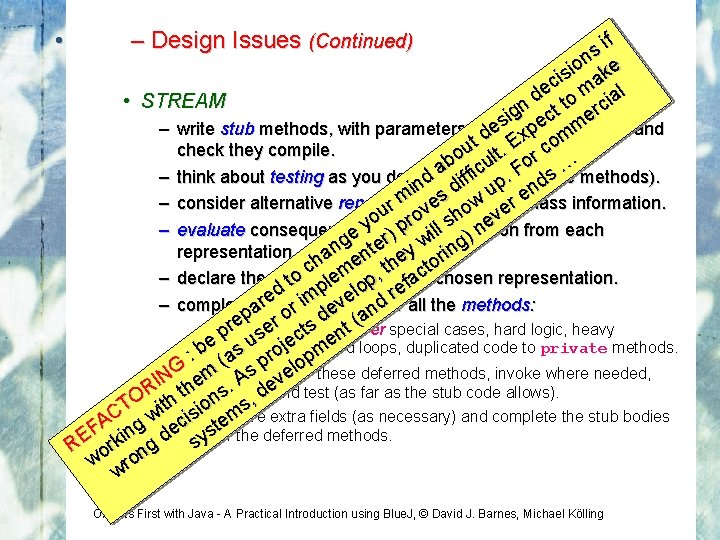
• – Design Issues (Continued) if s n e o i is ak c de to m cial • STREAM ign ect er s – write stub methods, with parameters and e documentation, p mm d x ut lt. E r co check they compile. o b icu Fo … a(may f need s methods). – think about testing as you design. more ind s dif up end – consider alternative representations r class information. r m ve otow hold e u v h o o pr l s e from each yfor n – evaluate consequences implementation l i ) e ) g ter y w ng n representation. a en he ori h c ct chosen representation. , t ffor – declare the attributes a to plem(fields) p d im elo re e r – complete athe stub r dbodies ev andfor all the methods: o p ( special cases, hard logic, heavy e r ts defer t » Mañana pr use principle: c en e efunctionality, j b m loops, duplicated code to private methods. : (as pro onested p l these deferred methods, invoke where needed, sstubs efor NG » emwrite A v I R th compile s. , deand test (as far as the stub code allows). O n h T it sio ms C extra fields (as necessary) and complete the stub bodies w ci » declare e A t g F in de ysfor the deferred methods. E s R ork ng w ro w Objects First with Java - A Practical Introduction using Blue. J, © David J. Barnes, Michael Kölling
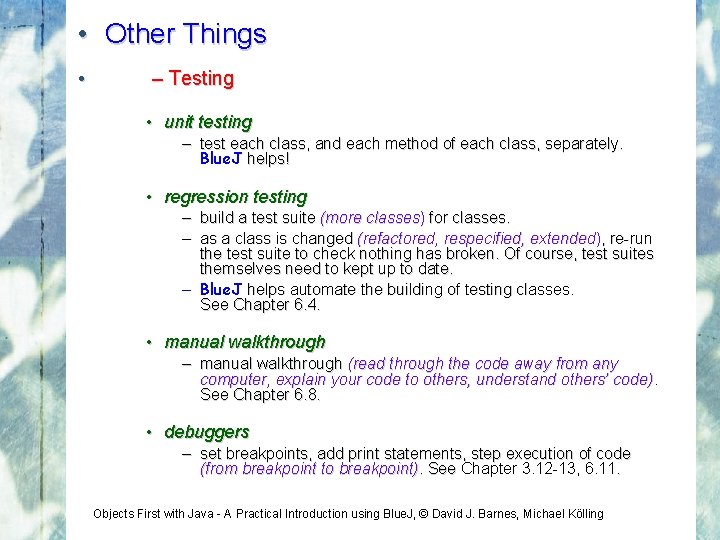
• Other Things • – Testing • unit testing – test each class, and each method of each class, separately. Blue. J helps! • regression testing – – build a test suite (more classes) for classes. as a class is changed (refactored, respecified, extended), re-run the test suite to check nothing has broken. Of course, test suites themselves need to kept up to date. – Blue. J helps automate the building of testing classes. See Chapter 6. 4. • manual walkthrough – manual walkthrough (read through the code away from any computer, explain your code to others, understand others’ code). See Chapter 6. 8. • debuggers – set breakpoints, add print statements, step execution of code (from breakpoint to breakpoint). See Chapter 3. 12 -13, 6. 11. Objects First with Java - A Practical Introduction using Blue. J, © David J. Barnes, Michael Kölling
- Slides: 17