
Review Name the four major eras of church


- Slides: 24
Review • Name the four major eras of church history as I presented it last week. – – The Early Church The Medieval Church The Reformation The Modern Church • Bonus Question: Give the starting date of each of those eras – double bonus if you can tell why that date was chosen. – The Early Church – started: AD 33 – The Death Burial and Resurrection of Christ – The Medieval Church – started: AD 600 – Approximate time of Pope Gregory – The Reformation – started in 1517 – Martin Luther’s 99 thesis – The Modern Church – started in 1648 – The end of the Thirty Year’s War
Review • Name the two major divisions of early church history as I presented it last week. – The Persecuted Church – The Imperial Church • Give the event and approximate year that caused the early church to go from “persecuted” to “imperial”. – Conversion of Constantine – AD 312 – The Edict of Milan – AD 313 • Without looking at your notes, name one person or event from each of the six centuries of the early church.
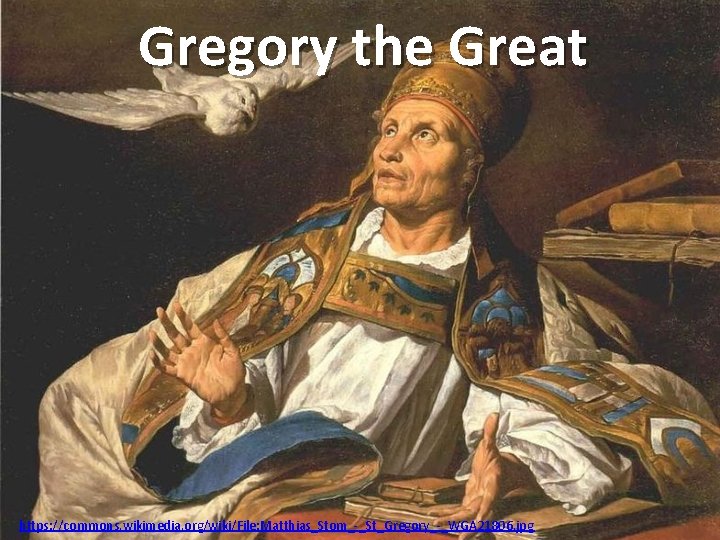
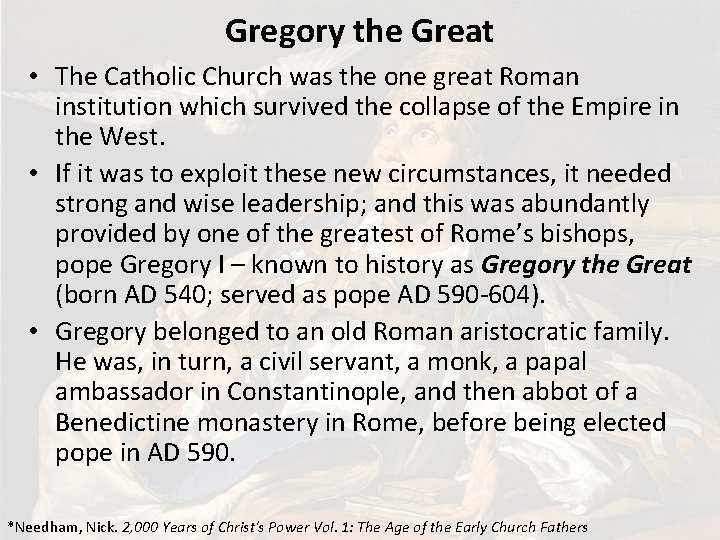
Gregory the Great https: //commons. wikimedia. org/wiki/File: Matthias_Stom_-_St_Gregory_-_WGA 21806. jpg
Gregory the Great • The Vandals in North-West Africa, and the Angles, Saxons and Jutes in Britain, tended to carry out a policy of what we today would call “ethnic cleansing”, often expelling or massacring the native peoples. • The new Germanic masters of mainland Western Europe, however, did not do this. Having conquered, they lived at peace with their Roman subjects. • The Germans were always a minority of the population in their new European territories. • Despite having the military strength to conquer the Western Empire, they lacked the civilization and culture to govern it properly; so they relied heavily on their more educated subjects to supply them with civil servants and political advisors. *Needham, Nick. 2, 000 Years of Christ's Power Vol. 1: The Age of the Early Church Fathers
Gregory the Great • And the Germanic rulers – the Franks and Burgundians in France, the Visigoths in Spain, and the Ostrogoths for most of the time in Italy, then their successors the Lombards – did not persecute Catholics. • So the result of the Germanic conquests in mainland Europe was a new society made up of two elements: – Catholic, Latin speaking, native population who preserved the traditions of Roman life; – Tolerant, Germanic conquerors, mostly Arians, who wanted to adopt, not destroy, the old Roman ways. • Often the Catholic bishops undertook the secular as well as spiritual leadership of the native Latin communities. *Needham, Nick. 2, 000 Years of Christ's Power Vol. 1: The Age of the Early Church Fathers
Gregory the Great • The Catholic Church was the one great Roman institution which survived the collapse of the Empire in the West. • If it was to exploit these new circumstances, it needed strong and wise leadership; and this was abundantly provided by one of the greatest of Rome’s bishops, pope Gregory I – known to history as Gregory the Great (born AD 540; served as pope AD 590 -604). • Gregory belonged to an old Roman aristocratic family. He was, in turn, a civil servant, a monk, a papal ambassador in Constantinople, and then abbot of a Benedictine monastery in Rome, before being elected pope in AD 590. *Needham, Nick. 2, 000 Years of Christ's Power Vol. 1: The Age of the Early Church Fathers
Gregory the Great • After becoming pope, Gregory often longed for the days when he had lived in a monastery. He once told his deacon, Peter: – “My pastoral responsibilities now force me to have dealings with worldly men, and it appears to me, after the unclouded beauty of my former peaceful life, that my mind is defiled with the mud of daily affairs. After I have wasted my time in attending to the worldly business of countless people, even though I retire within myself to meditate on spiritual things, I do so with manifestly less strength than before. So if I compare what I now endure with what I have lost, and when I consider the nature of the loss, my burdens seem heavier than ever. ” *Needham, Nick. 2, 000 Years of Christ's Power Vol. 1: The Age of the Early Church Fathers
Gregory as Political Leader • During Gregory’s fourteen years as spiritual leader of the Western Church, we see the papacy beginning to become the great political, as well as spiritual, power which would dominate Western Europe for 1, 000 years. • When the Arian Lombards invaded Italy, they took control of north and south, thus surrounding Rome in central Italy, where a large strip of land belonged to the papacy. • The papacy was by this time one of the greatest landowners in the Mediterranean, with property in Italy, Sicily, France, North-West Africa and Dalmatia; it had acquired this land from wealthy Catholics, who made such contributions out of a desire to please and honor God. *Needham, Nick. 2, 000 Years of Christ's Power Vol. 1: The Age of the Early Church Fathers
Gregory as Political Leader • Faced with the Lombard threat, and with no prospect of help from the Byzantine Empire, which had now become almost powerless in the West, Italian Catholics turned to the pope for political leadership. • Without consulting the Byzantine emperor Maurice (AD 582 -602), who still had a governor resident in northern Italy, Gregory made treaties of his own with the Lombard invaders, and was thus instrumental in bringing peace to Italy. • No previous pope had ever dared behave with such political independence. *Needham, Nick. 2, 000 Years of Christ's Power Vol. 1: The Age of the Early Church Fathers
Gregory as Political Leader • Gregory also urged the Byzantine Empire to make peace both with the Lombards and the Franks. • He established an important relationship between the papacy and the Frankish monarchy: later popes would come to rely on the Franks instead of the Byzantine emperors for political and military support. • Gregory also used his papal lands to give food and shelter to many who had been made destitute by the Lombards. • In all these ways, Gregory helped to make the papacy into a powerful social and political institution, governing the western-central region of Italy as an independent state. *Needham, Nick. 2, 000 Years of Christ's Power Vol. 1: The Age of the Early Church Fathers
Gregory as Church Leader • Gregory made every effort to use his authority as patriarch of the West to promote Church life and strengthen the papacy’s position. • He oversaw Visigothic Spain’s conversion from Arianism to Catholicism. • He fought hard against Manichaeism in Italy and Donatism in North-West Africa, persuading the civil authorities to punish all non- Catholics (except the Jews, whom Gregory protected). • He had a famous and fierce controversy with patriarch John the Faster of Constantinople (AD 582 -95). • The Byzantine emperor Maurice had officially bestowed on John the title “ecumenical” or “universal” patriarch – the spiritual leader of all Christians. *Needham, Nick. 2, 000 Years of Christ's Power Vol. 1: The Age of the Early Church Fathers
Gregory as Church Leader • Gregory protested passionately that none of the five patriarchs (Rome, Constantinople, Alexandria, Antioch and Jerusalem) could claim such an arrogant title, although Rome held a paramount place of honor among them as “first among equals”, by claiming to have “spiritual descent from Peter, prince of the apostles”. • To the constant embarrassment of later popes, Gregory declared: “Whoever calls himself universal priest, or desires that title, is by his pride the forerunner of Antichrist. ” • Amazingly, despite Gregory’s strong words, the next pope after his successor, pope Boniface III (AD 607), was quite happy to claim the title of “ecumenical bishop”. • Gregory preferred to call himself “the servant of the servants of God”. (Later popes have retained this title too, but not usually in the humble spirit of Gregory. ) *Needham, Nick. 2, 000 Years of Christ's Power Vol. 1: The Age of the Early Church Fathers
Gregory’s Theology • Gregory was a devout disciple of Augustine of Hippo in his theology, but he blended Augustine’s theology with other elements drawn from the popular religious beliefs and practices of his own day. • He taught that all human beings are born sinful, and that Christ alone by His sovereign grace can rescue sinners from their bondage to sin. • This salvation comes through baptism, in which the Holy Spirit causes the sinner (including the new-born baby) to be spiritually reborn. • However, the Christian must make up for sins committed after baptism through works of love. *Needham, Nick. 2, 000 Years of Christ's Power Vol. 1: The Age of the Early Church Fathers
Gregory’s Theology • The Augustinian doctrines of predestination and irresistible grace were set aside by Gregory, who was more concerned with the question of how we are to offer satisfaction to God for sins committed. 1 • Gregory believed this was done through penance, which consists of contrition and confession. To these must be added priestly absolution, which confirms the forgiveness granted by God. 1 • Gregory also taught that, for believers, “holy communion” had the power to wash away postbaptismal sin, and that if at death a Christian had any sins left which had not been dealt with, he must pay for them by sufferings in purgatory, a place of purifying fire midway between heaven and hell. 2 1 Gonzalez, Justo L. . The Story of Christianity: Volume 1: The Early Church to the Dawn of the Reformation (p. 288) Nick. 2, 000 Years of Christ's Power Vol. 1: The Age of the Early Church Fathers 2 Needham,
Gregory’s Theology • Augustine had suggested the possibility that there was a place of purification for those who died in sin, where they would spend some time before going to heaven. • On the basis of these speculations of Augustine, Gregory dogmatically affirmed the existence of such a place, and helped to make it a definite doctrine in the West (although not in the East, which has never accepted the idea). • Based on this belief in purgatory, Gregory introduced the practice of celebrating special communion services for the dead; such services, Gregory thought, were effective for remitting the sins of departed souls and thus hastening their passage from purgatory to heaven. • By Gregory’s time, people in the West were calling holy communion “the mass”, from the closing words of the Latin communion liturgy – ite, missa est (“go, the congregation is dismissed”) – which the bishop or presbyter spoke at the end of communion. • On the other hand, in contrast to modern Roman Catholic teaching, Gregory stated that the Apocryphal Book of First Maccabees was not canonical. Thus, we have an early pope denying the canonicity of the Apocrypha. (James White’s 2016 Church History series) *Needham, Nick. 2, 000 Years of Christ's Power Vol. 1: The Age of the Early Church Fathers
The Influence of Gregory on Church Worship • Gregory contributed richly to the development of Western worship. • He opposed the superstitious veneration of images or icons of Christ, the Virgin Mary and the saints, but approved of using them to adorn churches as teaching aids for those who could not read. • Gregory’s influence in this area helped to promote some division of opinion between East and West during the great iconoclastic controversy of the 8 th and 9 th centuries. • He introduced some changes in the liturgy for holy communion, including a new collection of hymns to be sung alternately by presbyter and congregation or choir. *Needham, Nick. 2, 000 Years of Christ's Power Vol. 1: The Age of the Early Church Fathers
The Influence of Gregory on Church Worship • “Gregorian chant” is also named after Gregory. • Scholars think that he wrote a series of chants for use on each of the festivals of the Christian year, and that we now call Gregorian chant arose out of this. • However, since the chants were not actually written down until the 9 th and 10 th centuries, we cannot be certain about the precise extent of Gregory’s own contribution. • The style of Gregorian chant seems to have been a return to the simpler form of chanting which had been common in the West before the liturgical reforms of Ambrose of Milan in the 4 th century. • The hallmarks of Gregorian chant are its musical simplicity, solemnity, unearthly beauty, and “unison” (all the voices sing the same lines and notes at the same time). No musical instruments are used. *Needham, Nick. 2, 000 Years of Christ's Power Vol. 1: The Age of the Early Church Fathers
Gregory’s Writings • Theologians read Gregory’s writings very widely in the Middle Ages. They include: – Gregory’s Letters. Some 838 of his letters have survived. They are addressed to bishops, missionaries and secular rulers in all parts of Europe, and tell us a lot about Gregory and the times he lived in. – Gregory’s Dialogues. These contain the lives of various Western saints, such as Benedict of Nursia (our chief source of information about him). Gregory’s lives of Benedict and other believers are full of stories of supernatural dreams, visions and miracles, which shows us what people of that age thought the life of an outstanding saint should be like. From Gregory’s Dialogues, the Eastern Church calls him “Gregory the Dialogist”. *Needham, Nick. 2, 000 Years of Christ's Power Vol. 1: The Age of the Early Church Fathers
Gregory’s Writings • Theologians read Gregory’s writings very widely in the Middle Ages. They include: – Works of biblical exposition. Gregory wrote a long commentary on Job, using Origen’s threefold method of interpretation – literal, moral and spiritual. The all-important “spiritual” interpretation was highly allegorical in nature. This emphasis on the allegorical meaning of the text became the normal way of expounding the Bible among Western theologians in the Middle Ages. Gregory also wrote homilies on Ezekiel and the Gospels. – The Pastoral Care. This is a book in which Gregory set forth his ideals of the Christian ministry. He said that a pastor must set a personal example by the way he lives, be a servant not a ruler, meditate daily on the Word of God, love truth more than popularity, and give a high place to preaching (Gregory himself was a great preacher). The Pastoral Care became the standard textbook on the ministry throughout the Middle Ages in the West, and is generally reckoned to be a classic work on the subject. *Needham, Nick. 2, 000 Years of Christ's Power Vol. 1: The Age of the Early Church Fathers
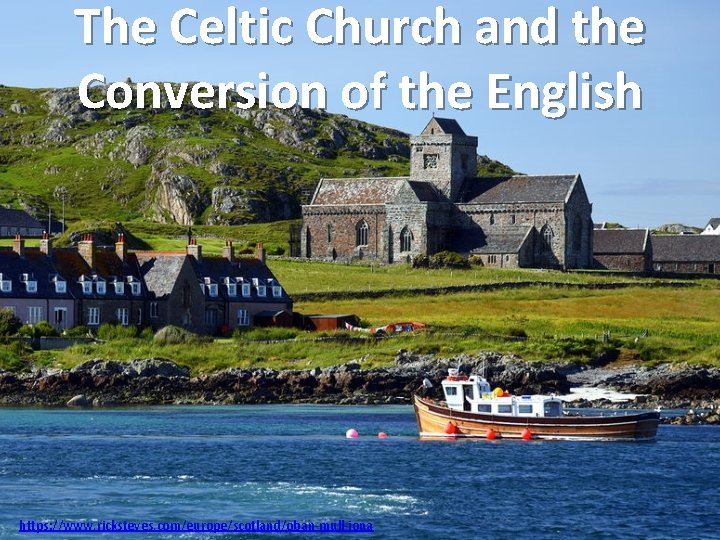
The Celtic Church and the Conversion of the English https: //www. ricksteves. com/europe/scotland/oban-mull-iona
https: //www. hopehelps. org/volunteer-appreciation-week-2018/
Class Discussion Time https: //www. weareteachers. com/moving-beyond-classroom-discussions/
*Class Discussion Time • Gregory, like many in his day, loved the monastic life. They felt closer to God when, in their monasteries, they were able to withdraw from “the mud of daily affairs”. They felt that “attending to the worldly business of countless people” was a waste of time, preferring to spend their days in isolation so as to “meditate on spiritual things” without unnecessary distraction. • While there is, no doubt, benefit to be found in spending time alone in meditation and prayer, do you believe that the time we spend in the sometimes messy work of ministering to other people is wasted time and detrimental to our spiritual well being? • We can see from the time of Gregory how the large complex of false beliefs held by Roman Catholics today began through a series of small, gradual deviations from scripture. • Does seeing this help you to have a greater appreciation for building your theology on scripture alone? • Do you have a topic or question that you would like to see us to discuss?