
Review Lifecourse Framework Review Sampson and Laub Terrie
Review Lifecourse Framework Review Sampson and Laub Terrie Moffitt’s Theory

Lifecourse Theory I • Must explain why there is stability (continuity) in antisocial behavior • Must explain childhood precursors to offending (childhood antisocial behavior) – Severe (age inappropriate) temper tantrums – Deviant/criminal behavior • Must explain desistence, or “change” – Antisocial children, but not adults – Adults that “age out”

Lifecourse Theory II • Types of Lifecourse Theories (From Cullen and Agnew) 1. Continuity Theories (Trait—G&H) 2. Continuity and Change Theories (Sampson and Laub, Patterson) 3. Continuity or Change Theories (Moffitt)
Sampson and Laub • Important/Popular book: Crime in the Making: Pathways and Turning Points Through Life – First to fully outline “lifecourse” criminology – Put forth a lifecourse theory – Use “Glueck data” to test theory
Pathways and Turning Points • Pathways = stability • Turning Points = opportunity for change
Sampson and Laub’s “Age Graded Theory of Informal Social Control” • In what sense is theory “age graded? ” • What does “Informal Social Control” mean?
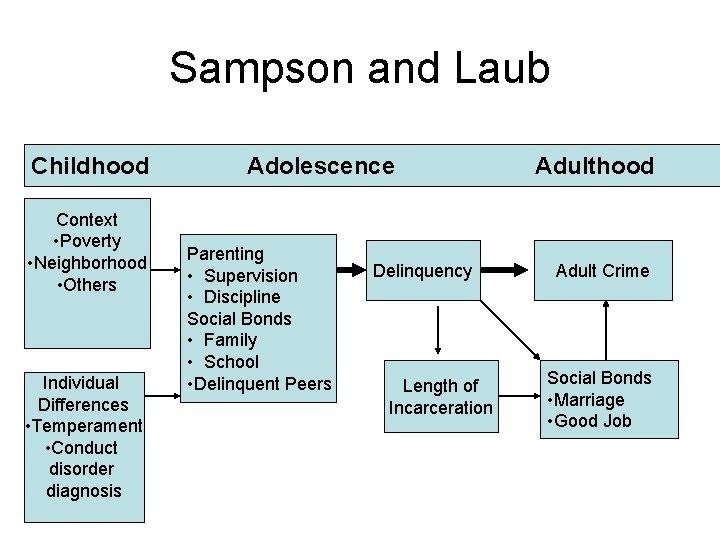
Sampson and Laub Childhood Context • Poverty • Neighborhood • Others Individual Differences • Temperament • Conduct disorder diagnosis Adolescence Parenting • Supervision • Discipline Social Bonds • Family • School • Delinquent Peers Delinquency Length of Incarceration Adulthood Adult Crime Social Bonds • Marriage • Good Job
Continuity • Stability of Trajectory – Individual differences (traits) possible – Cumulative Continuity • Delinquency/crime has effect on “adult social bonds” • Delinquency/crime can lead to incarceration, which also has effect on adult social bonds • These bonds, in turn, have effect on future crime
Change • Turning Points = Adult Social Bonds – Quality Marriage – Quality Employment • Why would these things reduce crime? – S&L: they increase informal control (bind individuals to society, give them something to lose) – Other explanations (spend less time with criminal friends, etc. )
Sampson and Laub II • New Book/Articles based on follow-up data from Gleuck sample – Followed until age 70 • Similar to original theory – Employment, marriage, military service • More complex-why a “turning point? ” – Knife off past from the present/future – Supervision/monitoring (control) but also opportunities for social support/growth – Change to structure/routine activities – Opportunity for identity transformation
How do people desist? • Desistence by Default – No conscious decision to “stop offending” • Rather, roles, structure, social context changes • Human Agency – Vague concept that implies people have some say in the matter. • Not same as “rational choice” nor is it a “trait” – Interaction = land a good job but still must want to keep – Theoretical Importance • Lives do not “unfold” in predictable sequences • Desistence more difficult to explain than onset or persistence
Terrie Moffitt • A Stability or Change Theory • Argument: – There are 2 different “kinds” of offenders in the world – These types can be characterized by their unique “offending trajectories” • Failure of Mainstream Criminology? – During adolescence, these two groups look rather similar
Moffitt’s 2 Groups of Offenders • LCP’s – Early Start, Stable over lifecourse, 5% of general population (small group) – Therefore… • Why start so early? Why so stable? • AL’s – Late starters, desist in adulthood, very prevalent in population – Therefore…. • Why start so late? Why desist right away?
Explaining the LCP trajectory • Presence of “Neuropsychological Deficits” – Where do they come from? – Why do they matter? INTERACTING WITH • Ineffective Parenting – Monitoring, supervision, etc. • This “dual hazard” puts them on bad path…however…
Cumulative Continuity for LCP’s • What in the environment is affected? – Peer Rejection – School Failure – Parenting • THEREFORE – Cumulative continuity – Contemporary continuity (still have N. P. Deficit, personality traits)
Explaining the AL’s • Maturity Gap – Knifing off Bonds as “rewarding” • Mimic • Why do AL’s desist? • However, some may exhibit continuity – “Snares” as another example of cumulative continuity
Key Moffitt Questions • Why do we need 2 theories? • How does she account for stability and change? • Specific explanations of LCP and AL offending
- Slides: 17