
Review Guide Aerobic Cell Respiration The process by

Review Guide
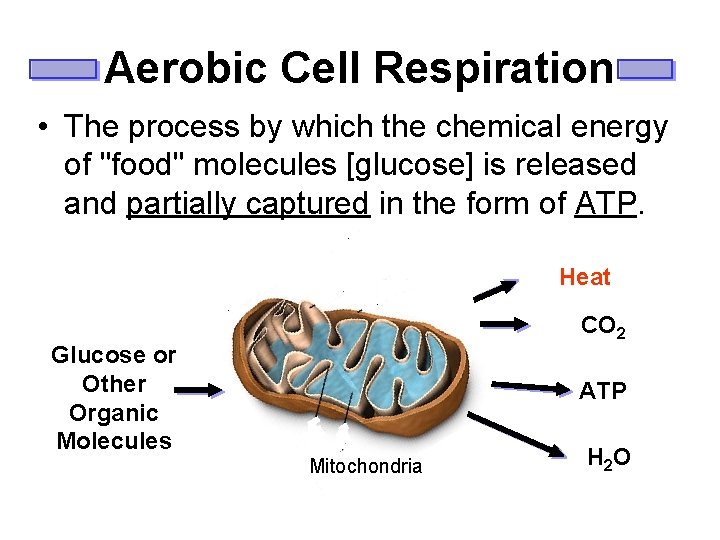
Aerobic Cell Respiration • The process by which the chemical energy of "food" molecules [glucose] is released and partially captured in the form of ATP. Heat CO 2 Glucose or Other Organic Molecules ATP Mitochondria H 2 O
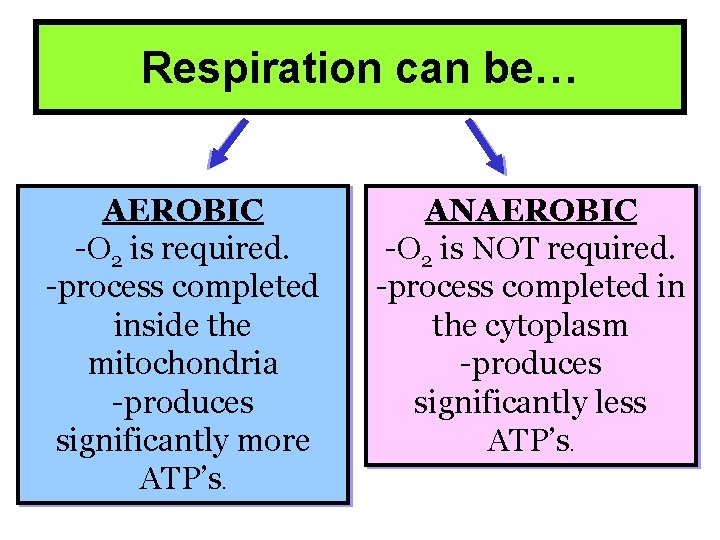
Respiration can be… AEROBIC -O 2 is required. -process completed inside the mitochondria -produces significantly more ATP’s. ANAEROBIC -O 2 is NOT required. -process completed in the cytoplasm -produces significantly less ATP’s.
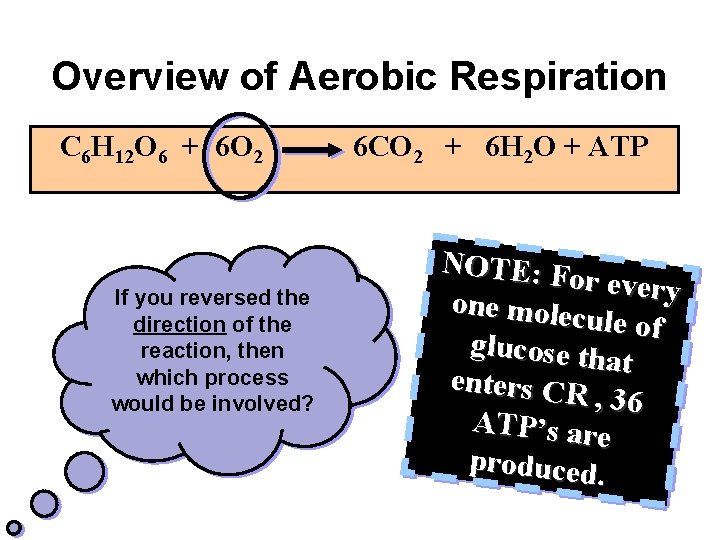
Overview of Aerobic Respiration C 6 H 12 O 6 + 6 O 2 If you reversed the direction of the reaction, then which process would be involved? 6 CO 2 + 6 H 2 O + ATP NOTE: F or every one molec ule of glucose th at enters CR , 36 ATP’s are produced.
![Three stages make up Cell Respiration [Aerobic Pathway]: I. Glycolysis -occurs in the cytoplasm](http://slidetodoc.com/presentation_image_h2/18e7bd5de675184f9941a55b5c46d671/image-5.jpg "Three stages make up Cell Respiration [Aerobic Pathway]: I. Glycolysis -occurs in the cytoplasm")
Three stages make up Cell Respiration [Aerobic Pathway]: I. Glycolysis -occurs in the cytoplasm -does not require O 2 III. Electron Transport Chain -occurs in the mitochondria • Requires oxygen -most number of ATP’s produced II. Krebs Cycle -occurs in the mitochondrion • Requires oxygen -C in glucose is released as CO 2 -high-energy electrons produced via the molecule NADH and FADH 2
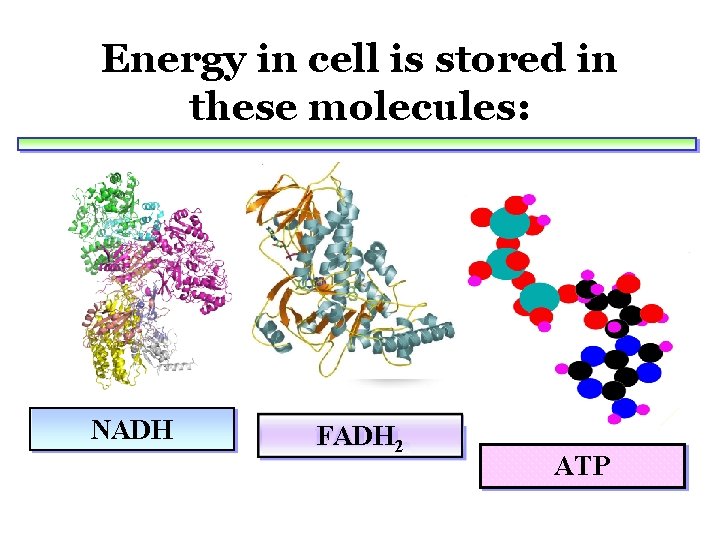
Energy in cell is stored in these molecules: NADH FADH 2 ATP
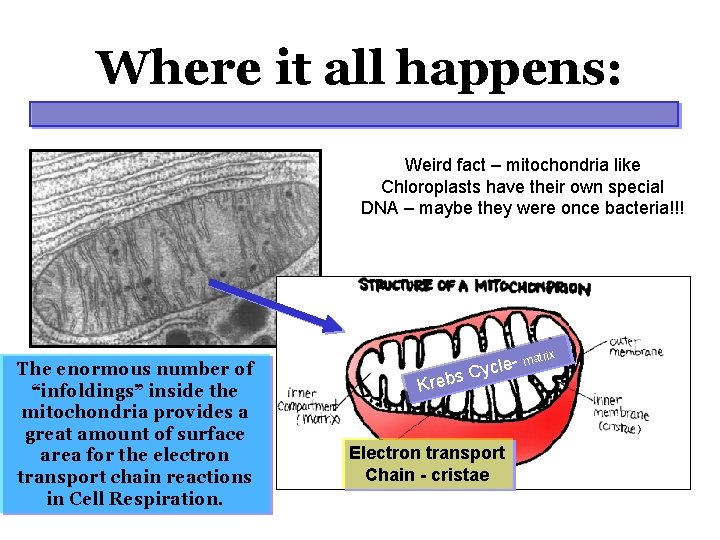
Where it all happens: Weird fact – mitochondria like Chloroplasts have their own special DNA – maybe they were once bacteria!!! The enormous number of “infoldings” inside the mitochondria provides a great amount of surface area for the electron transport chain reactions in Cell Respiration. Kreb s ma e l c Cy Electron transport Chain - cristae trix
What kinds of Cells have lots of mitochondria: • Cells that have a high metabolism – lots of chemical reactions: – Liver cells – Muscle cells – Intestinal cells – Eye cells – Heart cells
Cells types that have and don’t have Mitochondria Eukaryotes – Cells that have a nucleus and membrane bound organelles have mitochondria Cells that are eukaryotes include: • Animal cells So the answer is……. • Plant cells • Fungus cells • Protist cells like algae Cells that are not eukaryotes are called Prokaryotes and these include bacteria.
Practice Questions All of the following are organic molecules (carbon containing) except: a) Lipids b) DNA c) Glucose d) Water
Practice Questions Energy conversion within an eukaryotic cell would be limited by the removal of the cell’s a) Nucleus b) Lysosome c) Mitochondria d) Plastids
![What is the effect of adding more and more sugar [glucose] to the rate](http://slidetodoc.com/presentation_image_h2/18e7bd5de675184f9941a55b5c46d671/image-12.jpg "What is the effect of adding more and more sugar [glucose] to the rate")
What is the effect of adding more and more sugar [glucose] to the rate of cell respiration? The amount of ATP produced is directly proportional to the _____? _____.
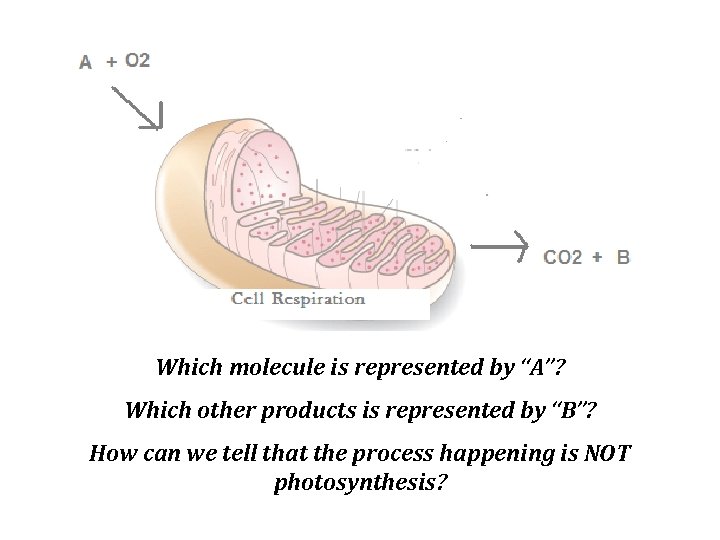
Which molecule is represented by “A”? Which other products is represented by “B”? How can we tell that the process happening is NOT photosynthesis?
- Slides: 13