
Review for Unit 7 Chapter 4 Energy Chapter


- Slides: 37
Review for: Unit 7 Chapter 4 – Energy Chapter 6 – Thermal Energy
#1 The type of energy which describes the motion of an object is ______ energy. A. B. C. D. Potential Kinetic Thermal Chemical
#2 An object can increase its kinetic energy by increasing its ______. A. B. C. D. Speed Size Height Specific heat
#3 The type of energy that is associated with an object’s position is called ___ energy. A. B. C. D. Potential Kinetic Thermal Chemical
#4 A rock sitting on a desk has ______ energy. A. B. C. D. Potential Kinetic Thermal Chemical
#5 Any type of energy that is stored is considered ______ energy. A. B. C. D. Potential Kinetic Thermal Chemical
#6 What is the correct unit for energy? A. B. C. D. Watts Newtons Joules kilograms
#7 The type of energy in an object that can stretch or compress is ____ energy A. B. C. D. Gravitational potential Chemical potential Elastic potential Kinetic
#8 A book and a feather sitting next to each other on a shelf have _____ potential energies. A. the same B. Different
#9 According to the Law of Conservation of Energy, energy _______. A. can be created or destroyed. B. can change forms but cannot be created or destroyed. C. in the universe is constant. D. Answers B and C are correct.
#10 _____ energy is the total kinetic and potential energies in a system. A. B. C. D. Thermal Mechanical Chemical Chuck Norris
#11 A clothes iron changes electrical energy into thermal energy. A. True B. False
#12 When a baseball is thrown from the outfield to home plate, its kinetic energy is least ______. A. B. C. D. At the peak of its flight When it leaves the player’s hand When it lands in the catcher’s mit Right after it leaves the player’s hand
#13 When a baseball is thrown from the outfield to home plate, its potential energy is greatest ______. A. B. C. D. At the peak of its flight When it leaves the player’s hand When it lands in the catcher’s mit Right after it leaves the player’s hand
#14 If an object has energy then that object has the ability to _______. A. B. C. D. Make sandwiches Beat Chuck Norris Cause a change Get an “A” in Mr. Schlueter’s class
#15 The potential energy of a swing is 200 J at its highest point and 50 J at its lowest point. If mechanical energy is conserved, what is the kinetic energy of the swing at its lowest point? A. B. C. D. E. 250 J 200 J 150 J
#16 What is the potential energy of a truck with a mass of 3, 000 kg at the top of a 75 m hill? A. B. C. D. 3, 075 J 225 k. J 2. 21 MJ 2. 25 MJ
#17 What is the kinetic energy of a truck with a mass of 3, 000 kg moving at 50 m/s? A. B. C. D. 3, 050 J 75 k. J 150 k. J 3. 75 MJ
#18 _____ is the average kinetic energy of the particles of a material. A. B. C. D. Total kinetic energy Temperature Thermal energy Heat
#19 The sum of the kinetic and potential energies of all the particles of a material is the _______. A. B. C. D. Mechanical Energy Temperature Thermal energy Heat
#20 ____ is thermal energy that flows from an object at a higher temperature to an object at a lower temperature. A. B. C. D. Specific Heat Temperature Thermal energy Heat
#21 The amount of heat required to raise the temperature of 1 kg of a material by 1°C is called ____. A. B. C. D. Specific Heat Temperature Thermal energy Heat
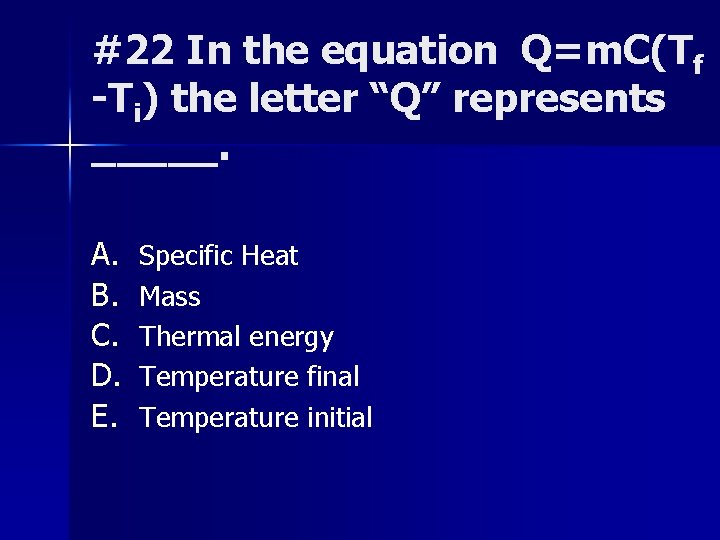
#22 In the equation Q=m. C(Tf -Ti) the letter “Q” represents _____. A. B. C. D. E. Specific Heat Mass Thermal energy Temperature final Temperature initial
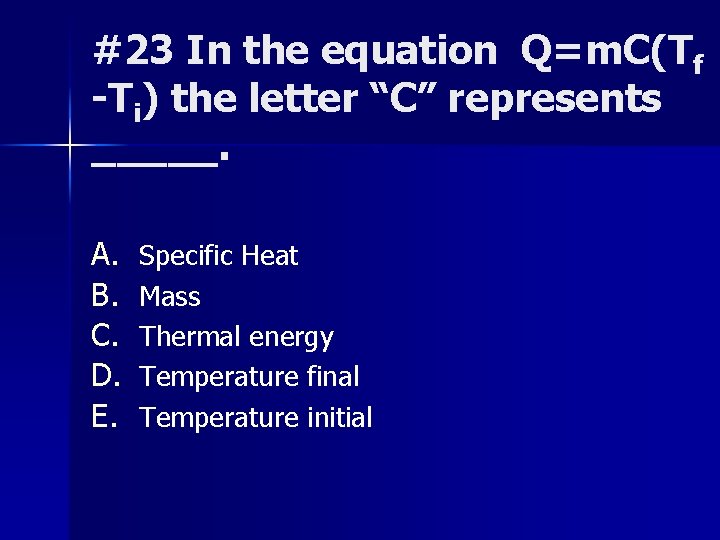
#23 In the equation Q=m. C(Tf -Ti) the letter “C” represents _____. A. B. C. D. E. Specific Heat Mass Thermal energy Temperature final Temperature initial
#24 _____ is the transfer of thermal energy by collisions between particles in matter. A. B. C. D. Conduction Convection Radiation Heat
#25 _____ is the transfer of thermal energy in a fluid by the movement of warmer and cooler fluid. A. B. C. D. Conduction Convection Radiation Heat
#26 ____ is the transfer of thermal energy by electromagnetic waves. A. B. C. D. Conduction Convection Radiation Heat
#27 _____ and _____ require matter in order to transfer thermal energy. A. Conduction and radiation B. Convection and radiation C. Conduction and Convection
#28 A material in which heat flows slowly is a(n) ______. A. B. C. D. Conductor Insulator Convector Radiator
#29 Why are gases usually better insulators than solids and liquids? A. The particles in gases are closer together which doesn’t allow heat to travel through very easily. B. The particles in gases are farther apart, not allowing the energy to be transferred by the collisions between the particles. C. Gases are not better insulators than solids and liquids. D. Because that’s what Chuck Norris decided.
#30 Of these materials which is the best insulator? A. B. C. D. Air Copper Iron Aluminum
#31 Gasoline and diesel engines are _____. A. B. C. D. Heat pumps External combustion engines Internal combustion engines Heat movers
#32 A device that heats your home by removing thermal energy from one location and transferring it to another location at a different temperature is a(n) ____. A. B. C. D. Heat mover Radiator Conductor Heat engine
#33 Solar collectors are parts of ____. A. B. C. D. Passive solar heating systems Active solar heating systems Internal combustion engines External combustion engines
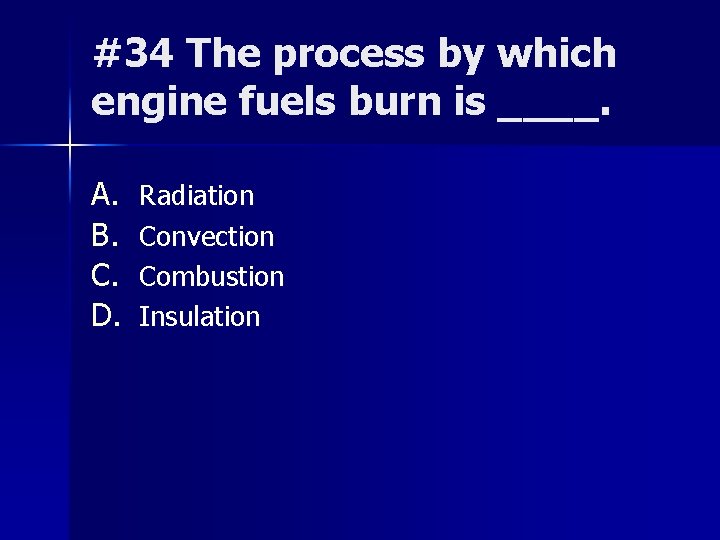
#34 The process by which engine fuels burn is ____. A. B. C. D. Radiation Convection Combustion Insulation
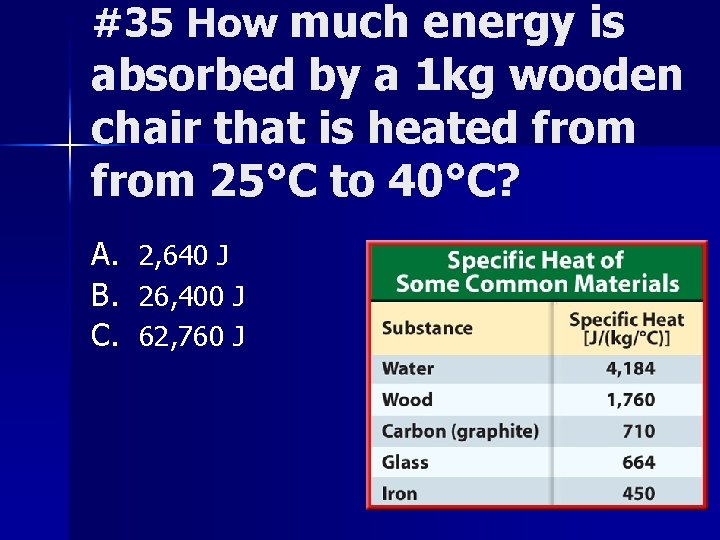
#35 How much energy is absorbed by a 1 kg wooden chair that is heated from 25°C to 40°C? A. 2, 640 J B. 26, 400 J C. 62, 760 J
QUESTIONS!? ? ? !! Are there any problems you want me to work through? Any questions you want to ask? The test covers CHAPTERS 4 & 6! Study!