
Review for CS 1050 Review Questions Without using

- Slides: 18
Review for CS 1050
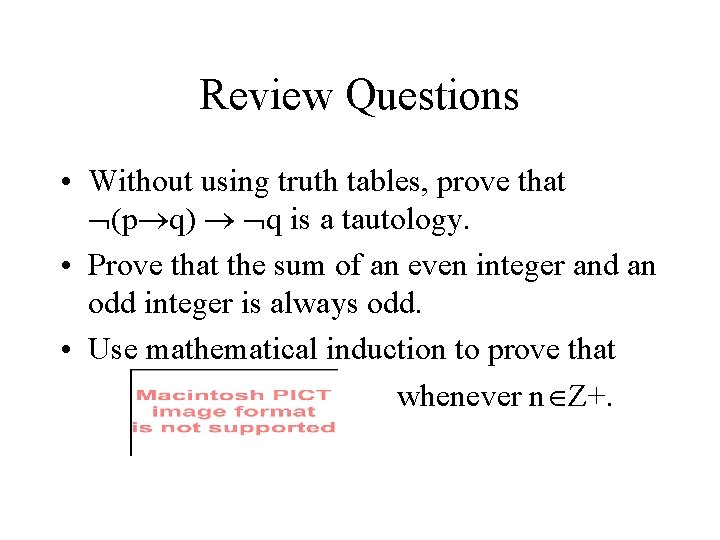
Review Questions • Without using truth tables, prove that (p q) q is a tautology. • Prove that the sum of an even integer and an odd integer is always odd. • Use mathematical induction to prove that whenever n Z+.
Review Questions • Prove that fn+1 fn-1 – fn 2 = (-1)n whenever n is a positive integer. • Without using set membership tables, prove or disprove that if A, B and C are sets, then A – (B C) = (A-B) (A-C). • Using the definition of “Big Oh” prove that n! is O(nn). • Prove that (3, 5, 7) is the only “prime triple”, i. e. , the only set of three consecutive odd integers > 1 that are all prime.
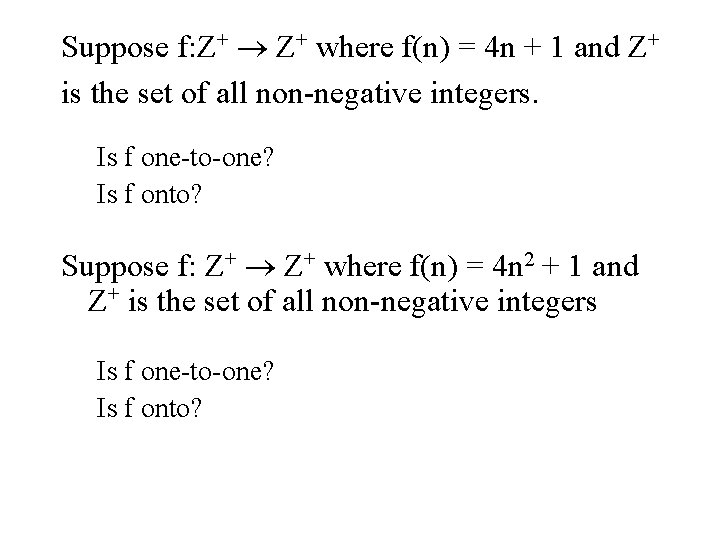
Review Questions • Suppose f: Z+ where f(n) = 4 n + 1 and Z+ is the set of all non-negative integers. – Is f one-to-one? – Is f onto? • Suppose f: Z+ where f(n) = 4 n 2 + 1 and Z+ is the set of all non-negative integers – Is f one-to-one? – Is f onto?
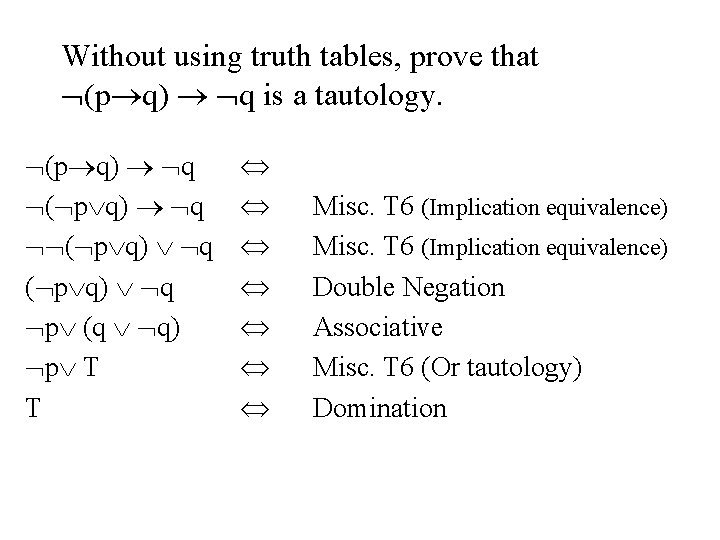
Without using truth tables, prove that (p q) q is a tautology. (p q) q ( p q) q p (q q) p T T Misc. T 6 (Implication equivalence) Double Negation Associative Misc. T 6 (Or tautology) Domination
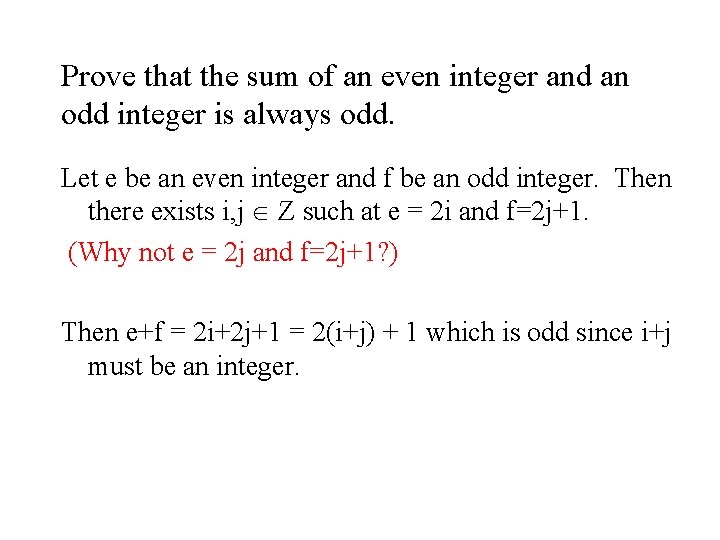
Prove that the sum of an even integer and an odd integer is always odd. Let e be an even integer and f be an odd integer. Then there exists i, j Z such at e = 2 i and f=2 j+1. (Why not e = 2 j and f=2 j+1? ) Then e+f = 2 i+2 j+1 = 2(i+j) + 1 which is odd since i+j must be an integer.
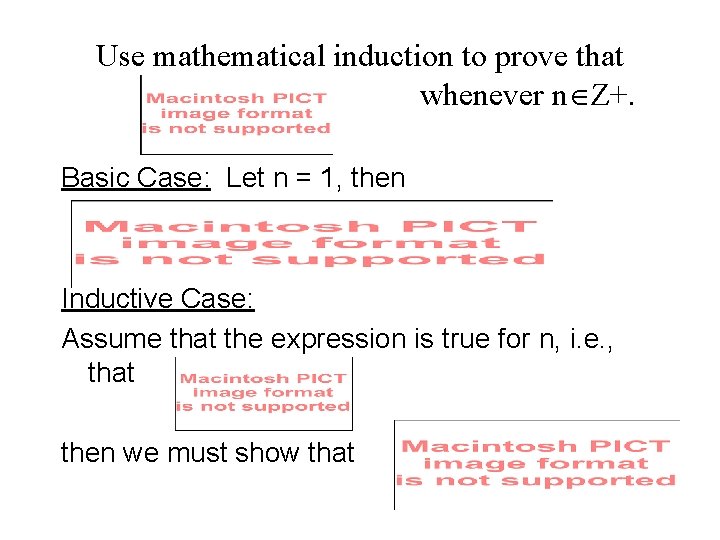
Use mathematical induction to prove that whenever n Z+. Basic Case: Let n = 1, then Inductive Case: Assume that the expression is true for n, i. e. , that then we must show that
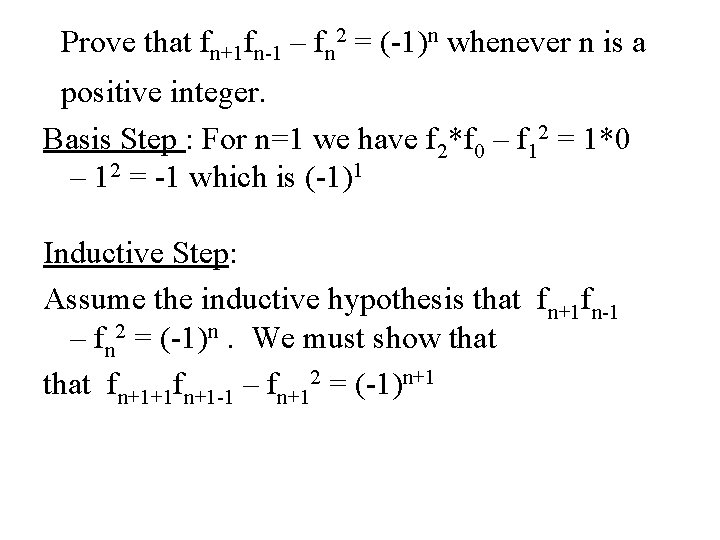
Prove that fn+1 fn-1 – fn 2 = (-1)n whenever n is a positive integer. Basis Step : For n=1 we have f 2*f 0 – f 12 = 1*0 – 12 = -1 which is (-1)1 Inductive Step: Assume the inductive hypothesis that fn+1 fn-1 – fn 2 = (-1)n. We must show that fn+1+1 fn+1 -1 – fn+12 = (-1)n+1
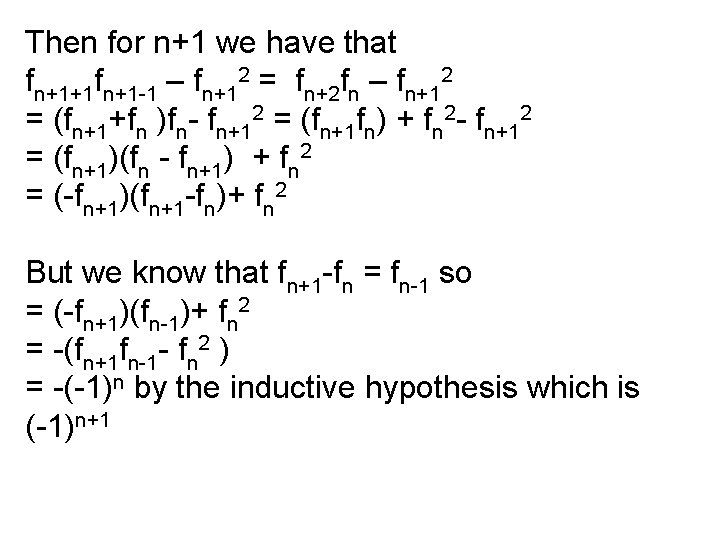
Then for n+1 we have that fn+1+1 fn+1 -1 – fn+12 = fn+2 fn – fn+12 = (fn+1+fn )fn- fn+12 = (fn+1 fn) + fn 2 - fn+12 = (fn+1)(fn - fn+1) + fn 2 = (-fn+1)(fn+1 -fn)+ fn 2 But we know that fn+1 -fn = fn-1 so = (-fn+1)(fn-1)+ fn 2 = -(fn+1 fn-1 - fn 2 ) = -(-1)n by the inductive hypothesis which is (-1)n+1
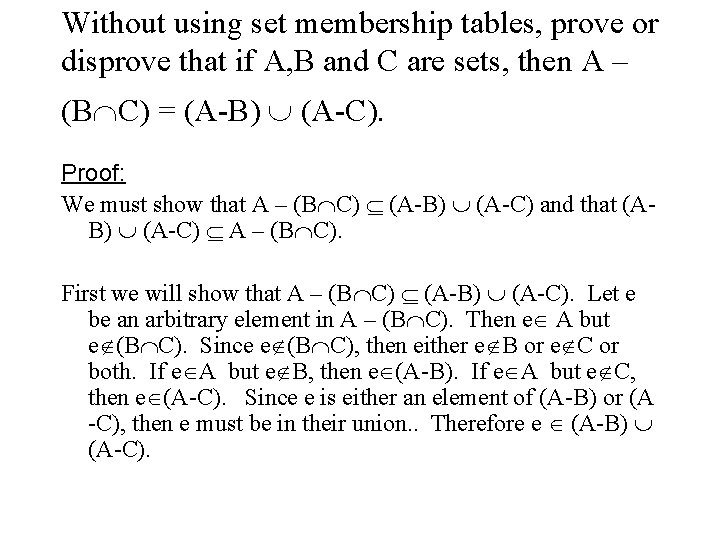
Without using set membership tables, prove or disprove that if A, B and C are sets, then A – (B C) = (A-B) (A-C). Proof: We must show that A – (B C) (A-B) (A-C) and that (AB) (A-C) A – (B C). First we will show that A – (B C) (A-B) (A-C). Let e be an arbitrary element in A – (B C). Then e A but e (B C). Since e (B C), then either e B or e C or both. If e A but e B, then e (A-B). If e A but e C, then e (A-C). Since e is either an element of (A-B) or (A -C), then e must be in their union. . Therefore e (A-B) (A-C).
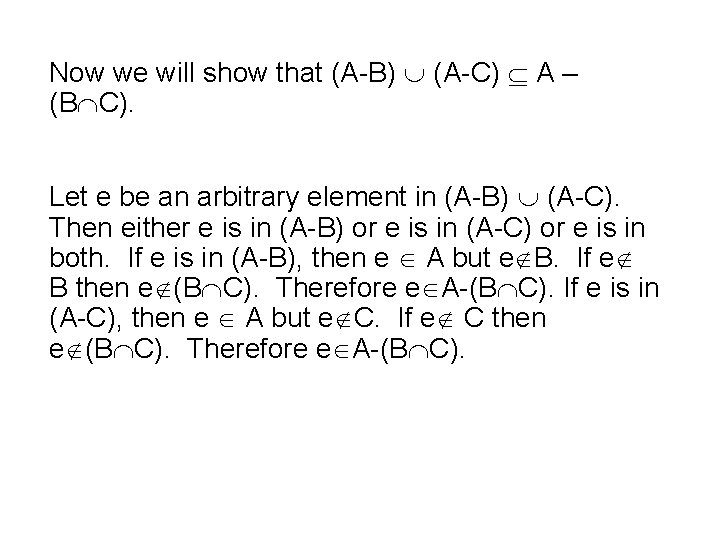
Now we will show that (A-B) (A-C) A – (B C). Let e be an arbitrary element in (A-B) (A-C). Then either e is in (A-B) or e is in (A-C) or e is in both. If e is in (A-B), then e A but e B. If e B then e (B C). Therefore e A-(B C). If e is in (A-C), then e A but e C. If e C then e (B C). Therefore e A-(B C).
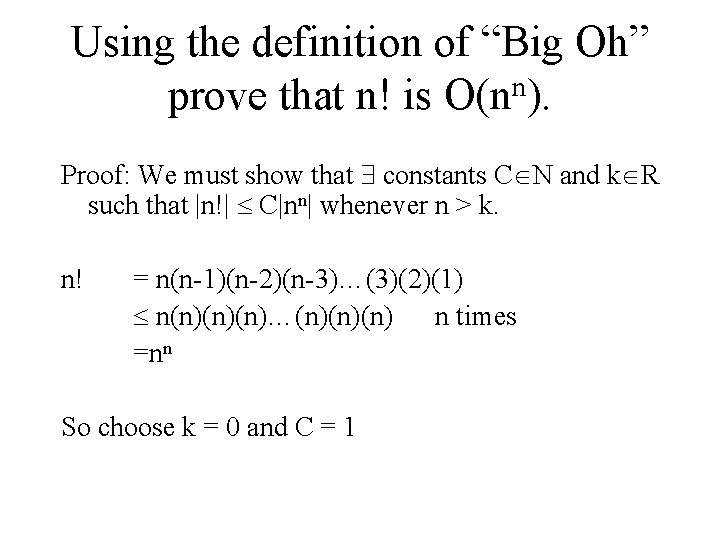
Using the definition of “Big Oh” n prove that n! is O(n ). Proof: We must show that constants C N and k R such that |n!| C|nn| whenever n > k. n! = n(n-1)(n-2)(n-3)…(3)(2)(1) n(n)(n)(n)…(n)(n)(n) n times =nn So choose k = 0 and C = 1
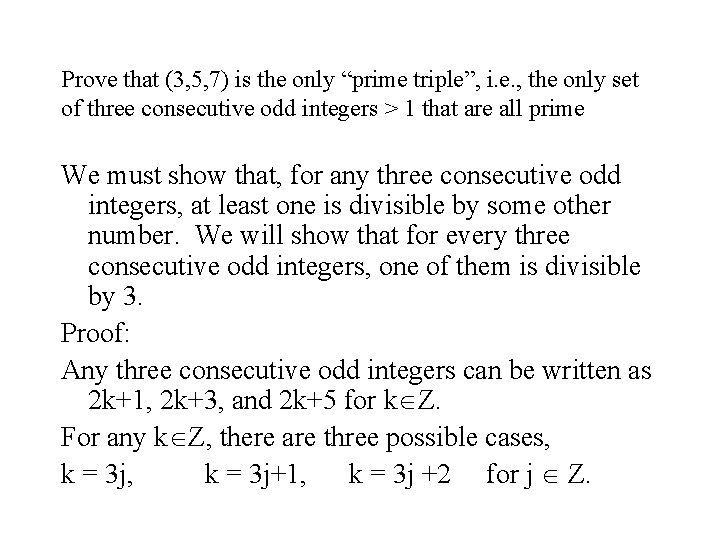
Prove that (3, 5, 7) is the only “prime triple”, i. e. , the only set of three consecutive odd integers > 1 that are all prime We must show that, for any three consecutive odd integers, at least one is divisible by some other number. We will show that for every three consecutive odd integers, one of them is divisible by 3. Proof: Any three consecutive odd integers can be written as 2 k+1, 2 k+3, and 2 k+5 for k Z. For any k Z, there are three possible cases, k = 3 j+1, k = 3 j +2 for j Z.
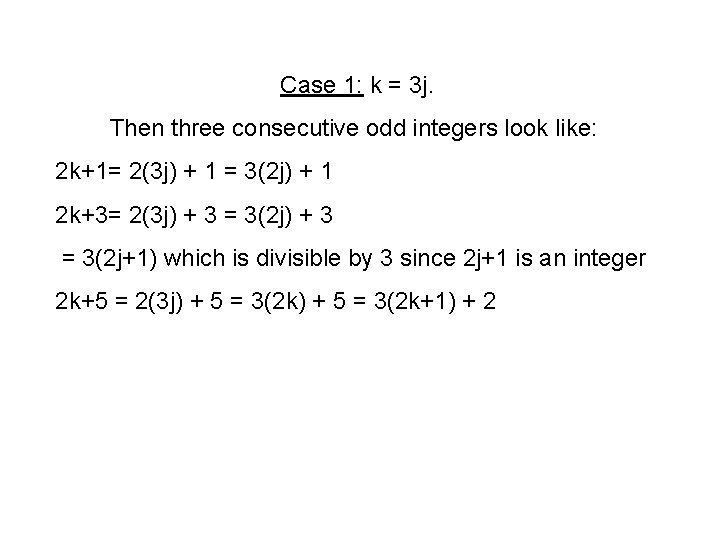
Case 1: k = 3 j. Then three consecutive odd integers look like: 2 k+1= 2(3 j) + 1 = 3(2 j) + 1 2 k+3= 2(3 j) + 3 = 3(2 j+1) which is divisible by 3 since 2 j+1 is an integer 2 k+5 = 2(3 j) + 5 = 3(2 k+1) + 2
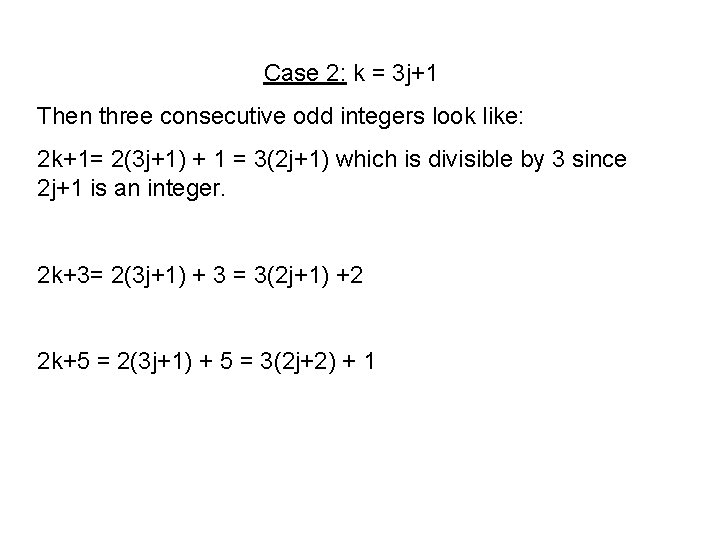
Case 2: k = 3 j+1 Then three consecutive odd integers look like: 2 k+1= 2(3 j+1) + 1 = 3(2 j+1) which is divisible by 3 since 2 j+1 is an integer. 2 k+3= 2(3 j+1) + 3 = 3(2 j+1) +2 2 k+5 = 2(3 j+1) + 5 = 3(2 j+2) + 1
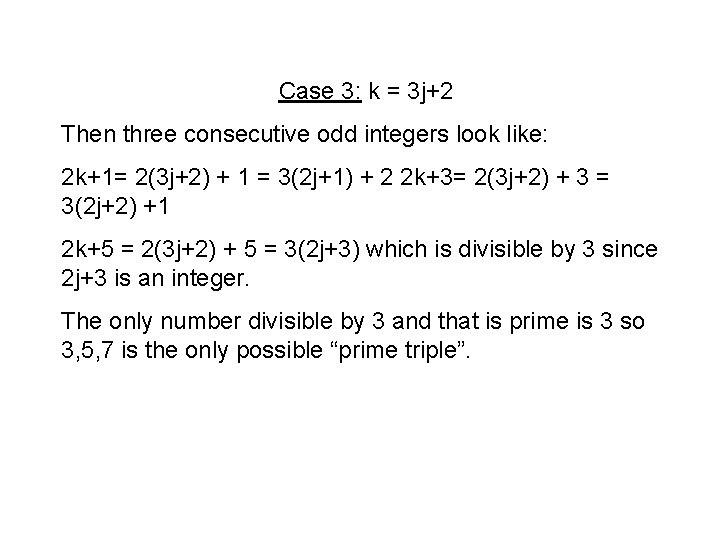
Case 3: k = 3 j+2 Then three consecutive odd integers look like: 2 k+1= 2(3 j+2) + 1 = 3(2 j+1) + 2 2 k+3= 2(3 j+2) + 3 = 3(2 j+2) +1 2 k+5 = 2(3 j+2) + 5 = 3(2 j+3) which is divisible by 3 since 2 j+3 is an integer. The only number divisible by 3 and that is prime is 3 so 3, 5, 7 is the only possible “prime triple”.
Suppose f: Z+ where f(n) = 4 n + 1 and Z+ is the set of all non-negative integers. Is f one-to-one? Is f onto? Suppose f: Z+ where f(n) = 4 n 2 + 1 and Z+ is the set of all non-negative integers Is f one-to-one? Is f onto?