
REVIEW FINAL FLUID PROPERTIES CE 30460 FLUID MECHANICS


- Slides: 26
REVIEW FINAL – FLUID PROPERTIES CE 30460 - FLUID MECHANICS DIOGO BOLSTER
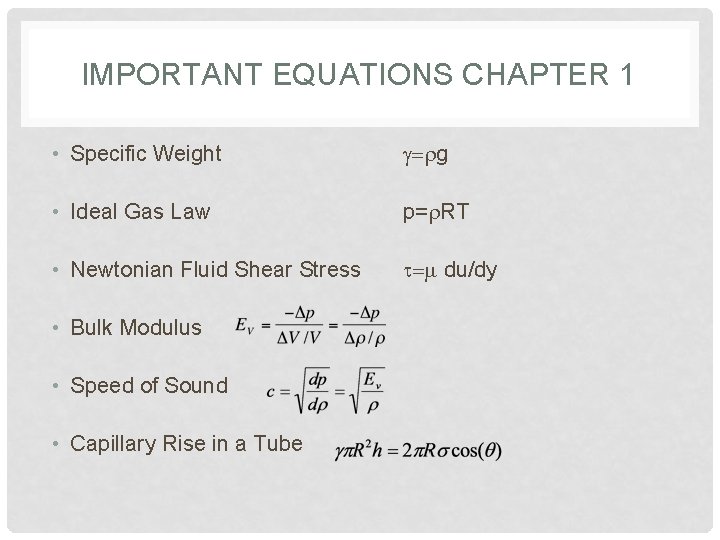
IMPORTANT EQUATIONS CHAPTER 1 • Specific Weight g=rg • Ideal Gas Law p=r. RT • Newtonian Fluid Shear Stress t=m du/dy • Bulk Modulus • Speed of Sound • Capillary Rise in a Tube
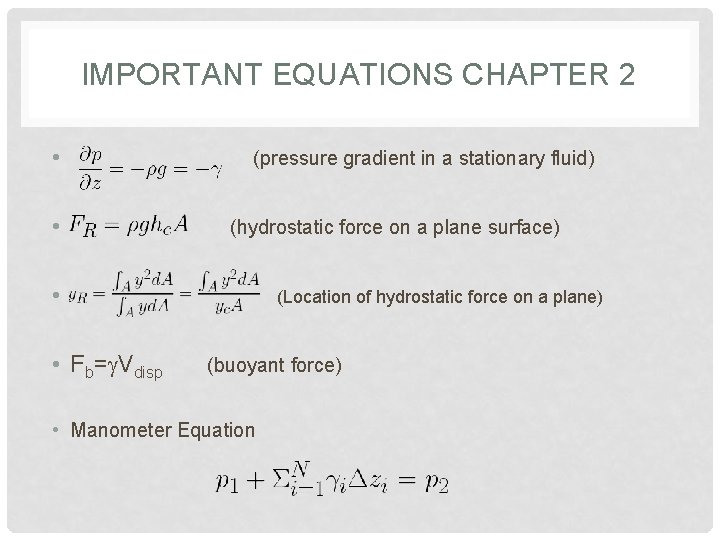
IMPORTANT EQUATIONS CHAPTER 2 • • (pressure gradient in a stationary fluid) (hydrostatic force on a plane surface) • • Fb=g. Vdisp (Location of hydrostatic force on a plane) (buoyant force) • Manometer Equation
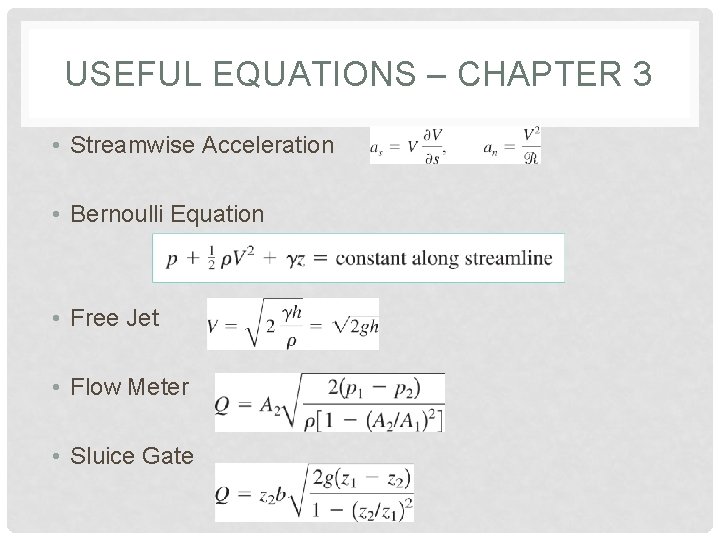
USEFUL EQUATIONS – CHAPTER 3 • Streamwise Acceleration • Bernoulli Equation • Free Jet • Flow Meter • Sluice Gate
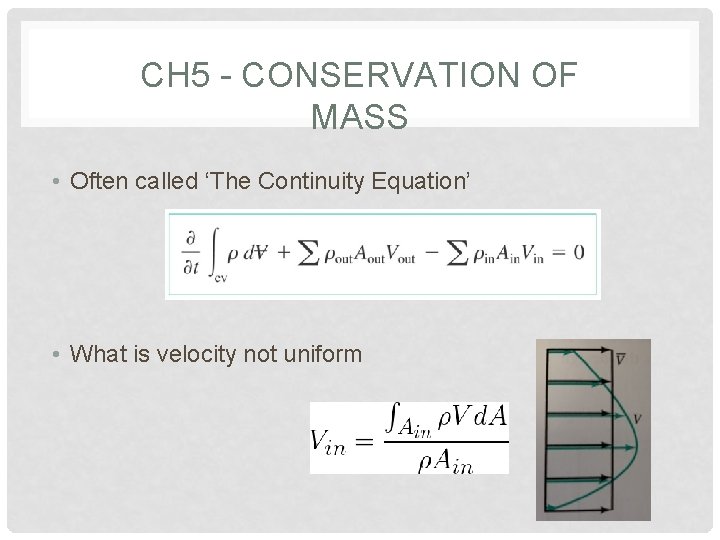
CH 5 - CONSERVATION OF MASS • Often called ‘The Continuity Equation’ • What is velocity not uniform
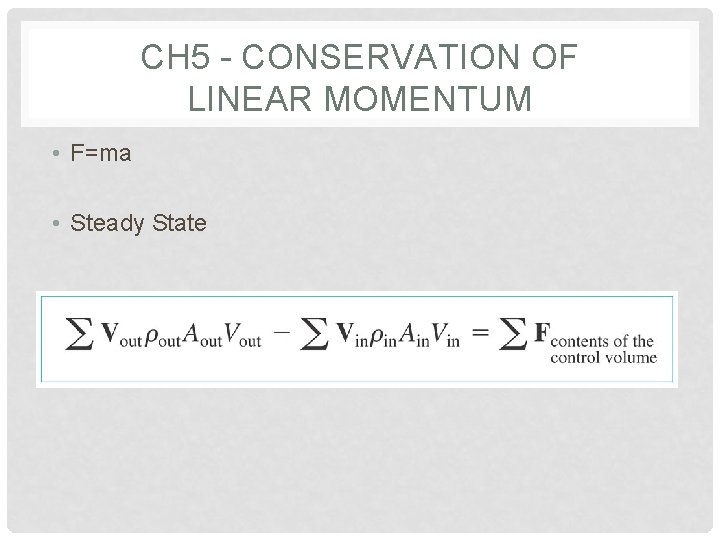
CH 5 - CONSERVATION OF LINEAR MOMENTUM • F=ma • Steady State
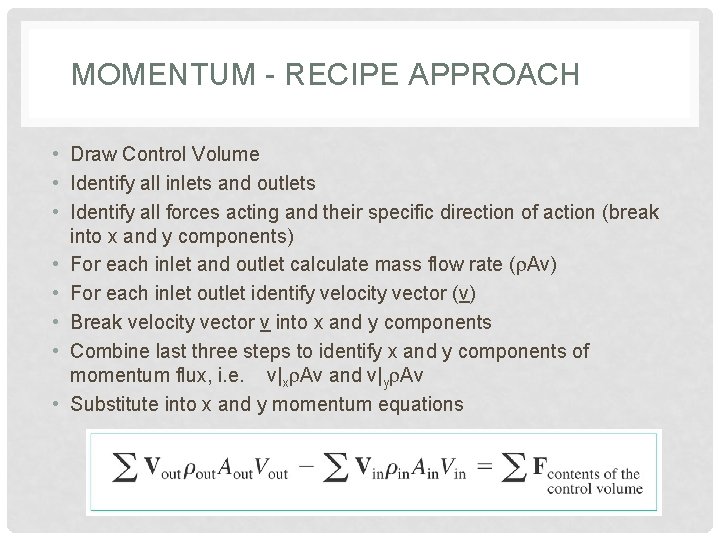
MOMENTUM - RECIPE APPROACH • Draw Control Volume • Identify all inlets and outlets • Identify all forces acting and their specific direction of action (break into x and y components) • For each inlet and outlet calculate mass flow rate (r. Av) • For each inlet outlet identify velocity vector (v) • Break velocity vector v into x and y components • Combine last three steps to identify x and y components of momentum flux, i. e. v|xr. Av and v|yr. Av • Substitute into x and y momentum equations
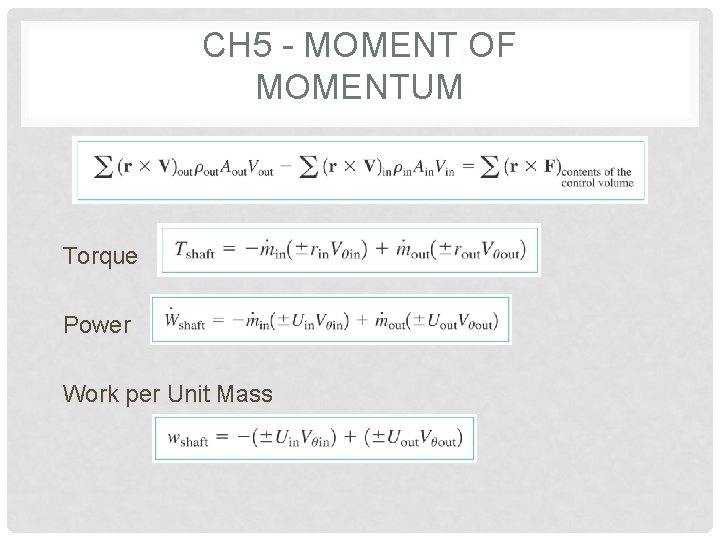
CH 5 - MOMENT OF MOMENTUM Torque Power Work per Unit Mass
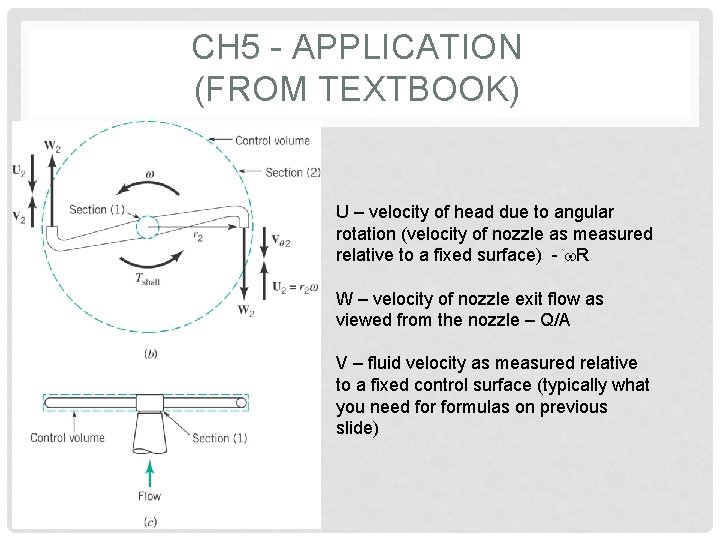
CH 5 - APPLICATION (FROM TEXTBOOK) U – velocity of head due to angular rotation (velocity of nozzle as measured relative to a fixed surface) - w. R W – velocity of nozzle exit flow as viewed from the nozzle – Q/A V – fluid velocity as measured relative to a fixed control surface (typically what you need formulas on previous slide)
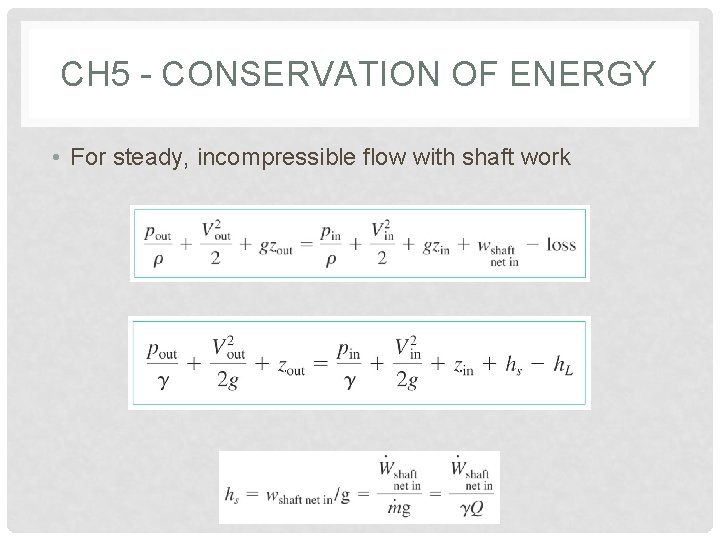
CH 5 - CONSERVATION OF ENERGY • For steady, incompressible flow with shaft work
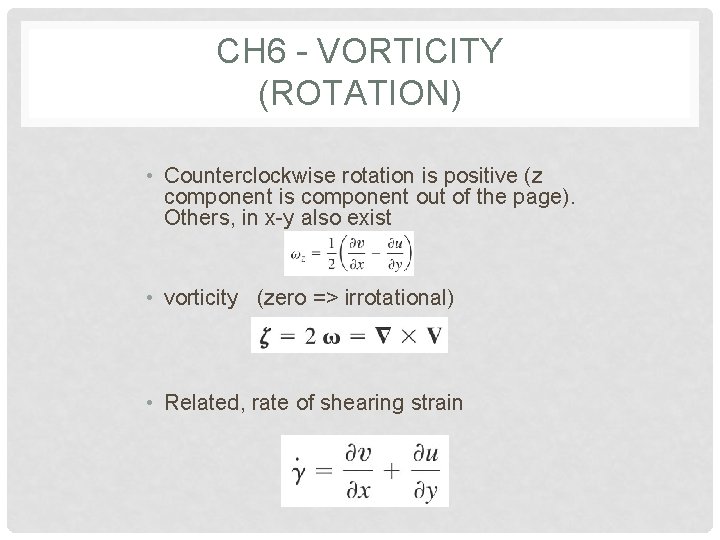
CH 6 - VORTICITY (ROTATION) • Counterclockwise rotation is positive (z component is component out of the page). Others, in x-y also exist • vorticity (zero => irrotational) • Related, rate of shearing strain
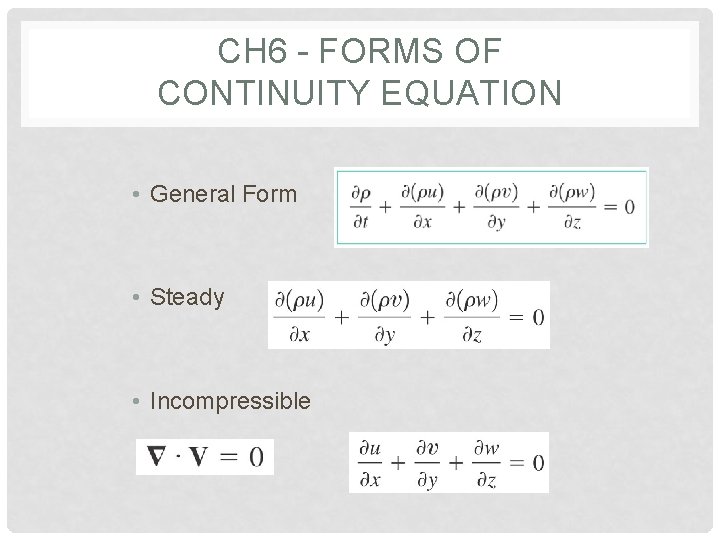
CH 6 - FORMS OF CONTINUITY EQUATION • General Form • Steady • Incompressible
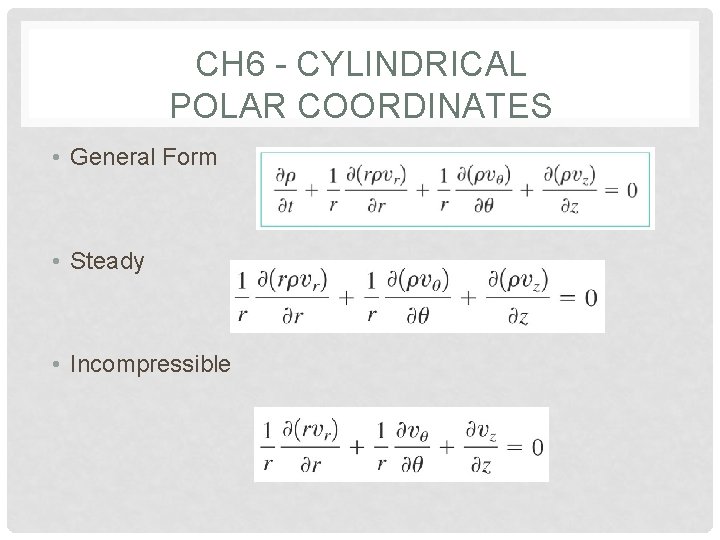
CH 6 - CYLINDRICAL POLAR COORDINATES • General Form • Steady • Incompressible
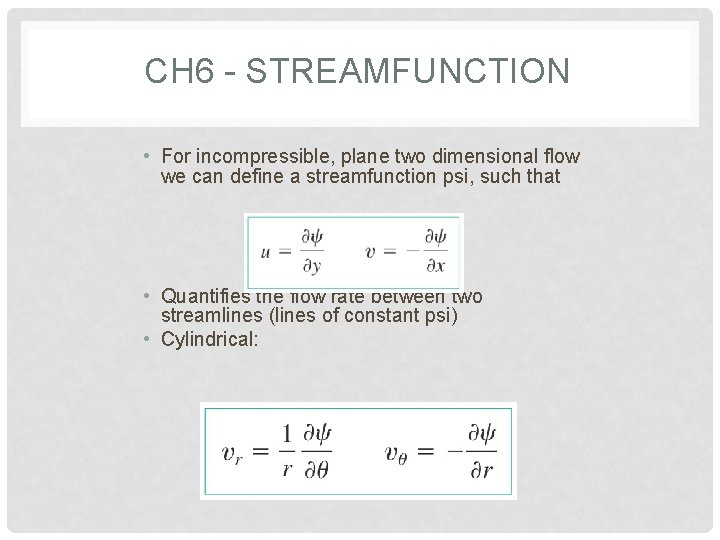
CH 6 - STREAMFUNCTION • For incompressible, plane two dimensional flow we can define a streamfunction psi, such that • Quantifies the flow rate between two streamlines (lines of constant psi) • Cylindrical:
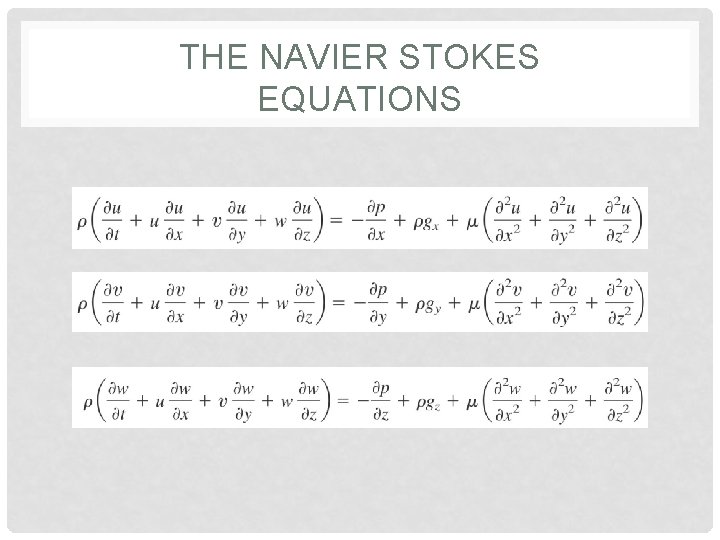
THE NAVIER STOKES EQUATIONS
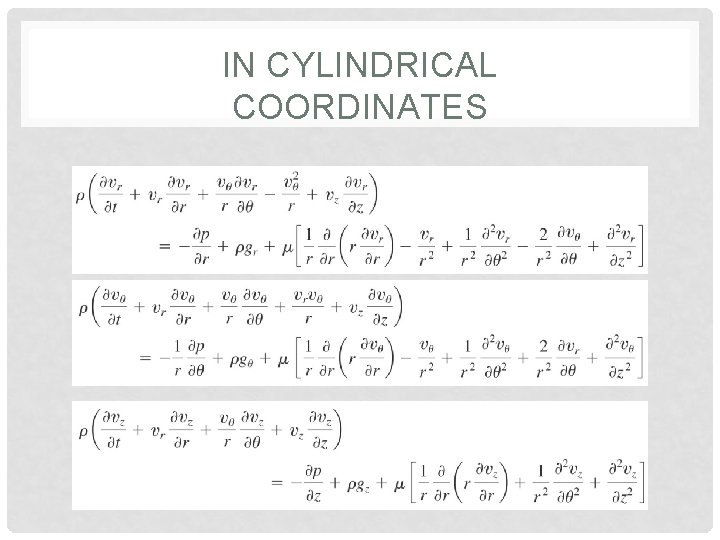
IN CYLINDRICAL COORDINATES
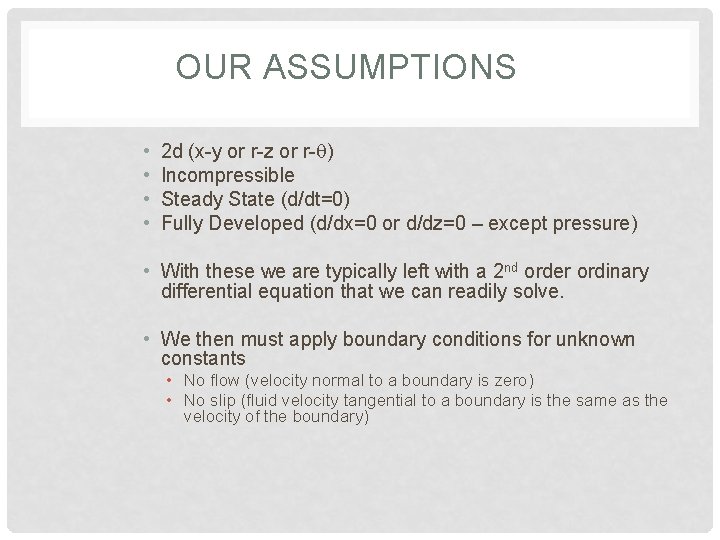
OUR ASSUMPTIONS • • 2 d (x-y or r-z or r-q) Incompressible Steady State (d/dt=0) Fully Developed (d/dx=0 or d/dz=0 – except pressure) • With these we are typically left with a 2 nd order ordinary differential equation that we can readily solve. • We then must apply boundary conditions for unknown constants • No flow (velocity normal to a boundary is zero) • No slip (fluid velocity tangential to a boundary is the same as the velocity of the boundary)
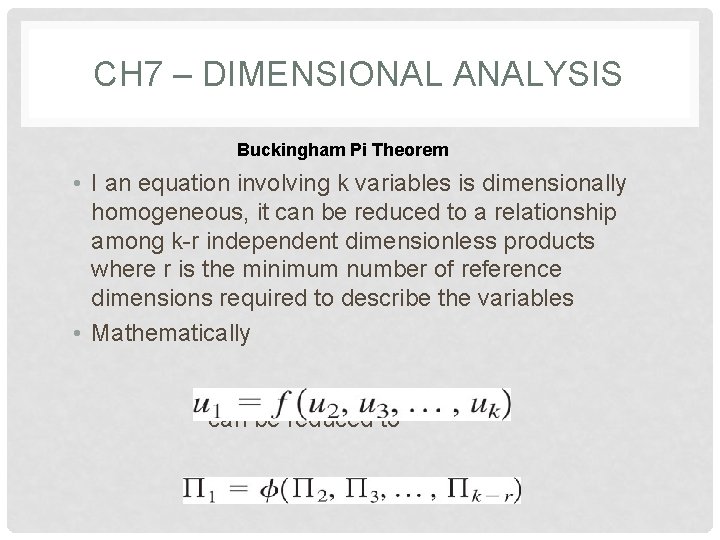
CH 7 – DIMENSIONAL ANALYSIS Buckingham Pi Theorem • I an equation involving k variables is dimensionally homogeneous, it can be reduced to a relationship among k-r independent dimensionless products where r is the minimum number of reference dimensions required to describe the variables • Mathematically can be reduced to
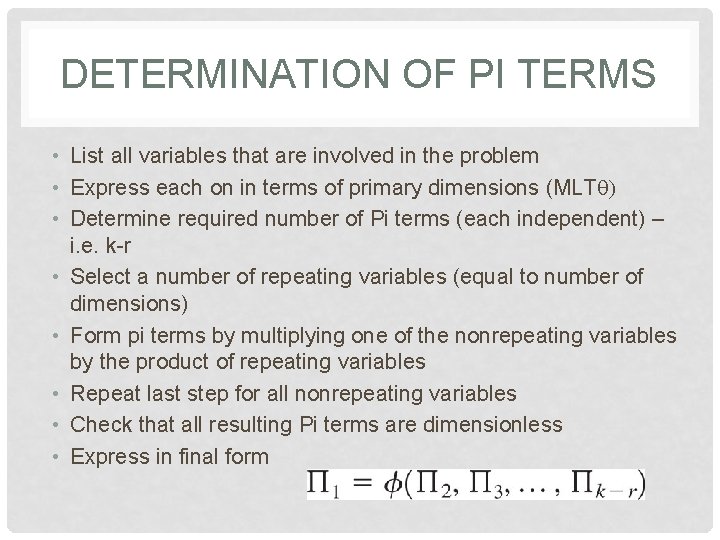
DETERMINATION OF PI TERMS • List all variables that are involved in the problem • Express each on in terms of primary dimensions (MLTq) • Determine required number of Pi terms (each independent) – i. e. k-r • Select a number of repeating variables (equal to number of dimensions) • Form pi terms by multiplying one of the nonrepeating variables by the product of repeating variables • Repeat last step for all nonrepeating variables • Check that all resulting Pi terms are dimensionless • Express in final form
DATA • Problems with One Pi Term : If only one term exists then according to the Pi Theorem we can say: P 1=C • For two terms P 1=f(P 2) • Means when you have data you should plot P 1 against P 2 to deduce relationships or at least make best fits that can be used predicatively.
TYPES OF SIMILARITY • • Geometric (ratio of length scales the same) Kinematic (velocity structures are the same) Dynamic (ratio forces the same) The best situation is: Get all dimensionless variables (Pi groups) the same between model and prototype. Then all similarities are preserved…. . • If N-1 dimensionless groups between model and prototype are the same then the last one must be also.
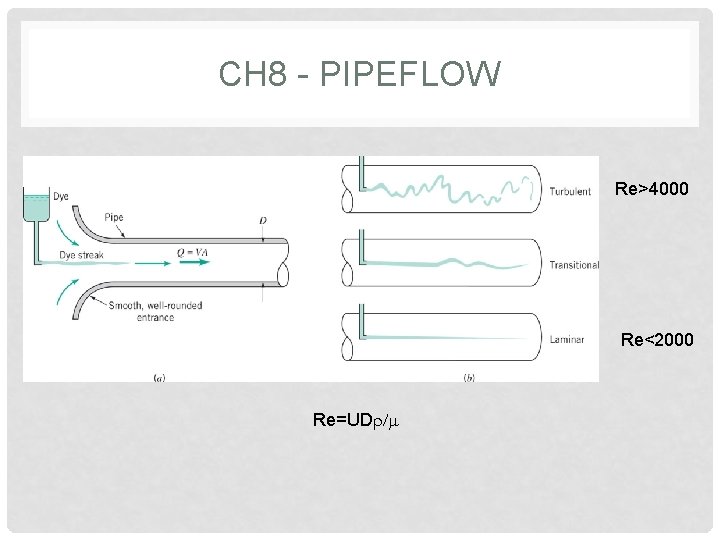
CH 8 - PIPEFLOW Re>4000 Re<2000 Re=UDr/m
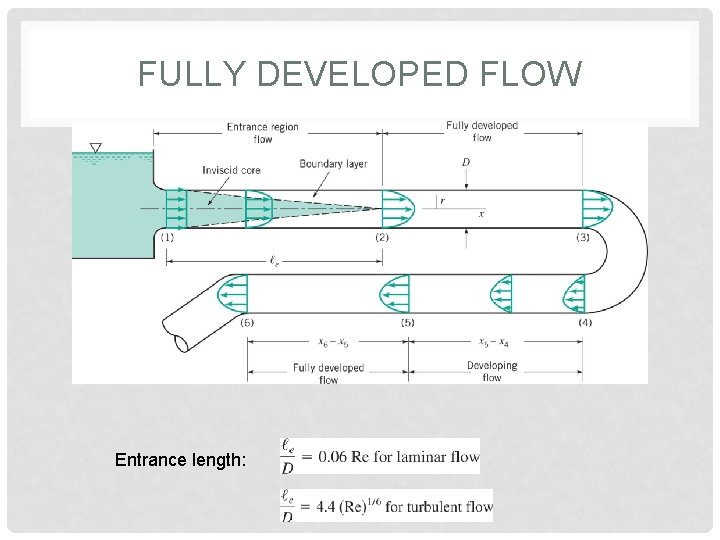
FULLY DEVELOPED FLOW Entrance length:
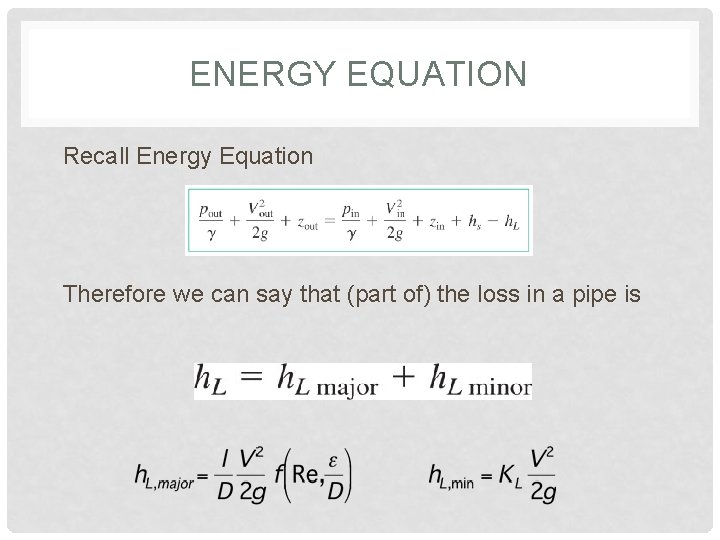
ENERGY EQUATION Recall Energy Equation Therefore we can say that (part of) the loss in a pipe is
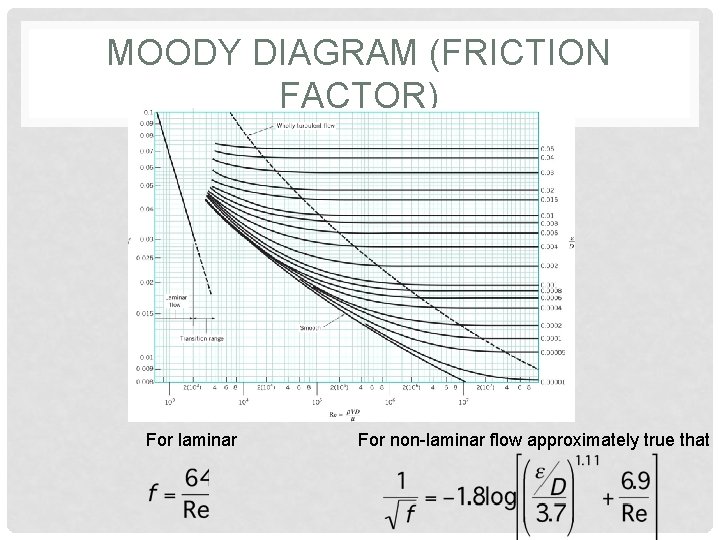
MOODY DIAGRAM (FRICTION FACTOR) For laminar For non-laminar flow approximately true that
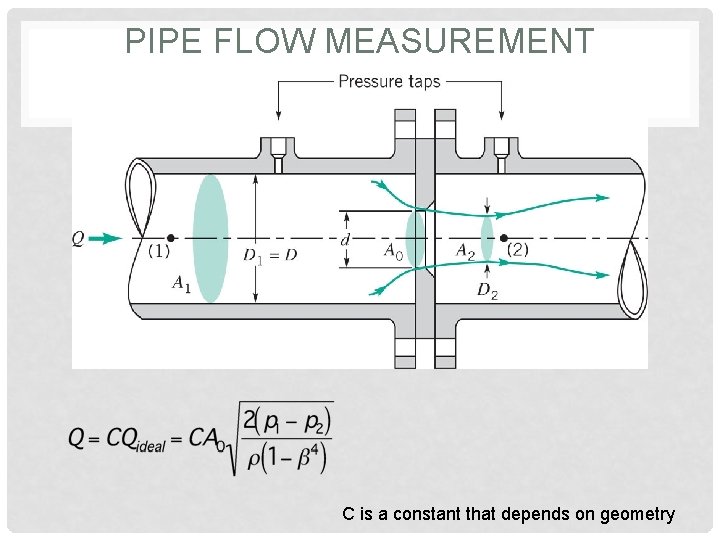
PIPE FLOW MEASUREMENT C is a constant that depends on geometry