
Review Evaluation Please complete evaluation form and email

- Slides: 11
Review & Evaluation • Please complete evaluation form and email it back to me • I’ve added some links to youtube clips and sites that might be interesting • Recap uses pf plants
Interesting Sites How Plants Work The Trembling Giant – Pando Carnegie Airborne Observatory Is being Vegetarian better for the environment? How do trees help us breathe? Extraction of plant oils
USEFUL PRODUCTS FROM PLANTS FOOD About 7 000 plant species have been used as food for humans domestic and wild animals. Leaves, roots, stems, seeds, fruits and flowers can all provide sources of nutrients. Foods obtained from plants include berries, nuts, tubers, grains, herbs and edible oils. Plants have also undergone breeding programs to develop new crop varieties resistant to diseases and can adapt to adverse climates or be grown in new areas.
USEFUL PRODUCTS FROM PLANTS FUEL Plants are an important sources of renewable biofuels that can be used for cooking, boiling water, transport, heating homes and buildings. Wood as fuel supplies over half the energy used in developing countries. FIBERS Plants use elongated woody cells in stems, leaves, bark and seeds for support and transport. These form fibers which can be used to make ropes, textiles and paper • Fiber cells in the leaves of sisal (Agave sisalana) are used to make string and rope. • Cotton (Gossypium species) made from hairs that grow on the surface of the seeds is the most important textile. • Hemp: Linen • Bamboo: material for clothes • Pineapple: leather • Wood pulp and a wide variety of other fiber sources are used to make paper
USEFUL PRODUCTS FROM PLANTS MEDICINES In developed countries, about 25% of all prescriptions contain materials isolated from plants. Others, like aspirin, are synthesised copies of naturally occurring chemicals or modified from the original plant product. Only about a fifth of the known plant species have been investigated for their medicinal potential. Recently, the Madagascan rose periwinkle (Catharanthus roseus) has been used as the source of two drugs to treat cancer and alkaloids used to treat childhood leukaemia and Hodgkin's disease. Many medicinal plants are taken from the wild and are at risk of extinction.
USEFUL PRODUCTS FROM PLANTS DYES A wide range of colours can be obtained from renewable plant sources, including red from madder (Rubia tinctoria), yellow from chamomile (Anthemis tinctoria) and blue from indigo (Indigofera tinctoria). Many synthetic dyes are based on petroleum compounds – a finite source. PERFUMES Plants have been used as a source of essential oils and aroma compounds throughout history. They provide the largest source of fragrant compounds used in perfume manufacture. Many of these compounds can also be used as insect repellents, antiseptics or disinfectants.
USEFUL PRODUCTS FROM PLANTS GUMS & RESINS Gums form when the cellulose in plant cell walls breaks down. Originally used as adhesives, today they have many other uses. For example, gum Arabic harvested from Acacia trees is used as an adhesive on postage stamps, and to thicken medicines and inks and other resins are used in paints. Certain plants secrete resins from specialised cells. Aromatic and flammable, they have long been used in medicines, embalming, incense and torches.
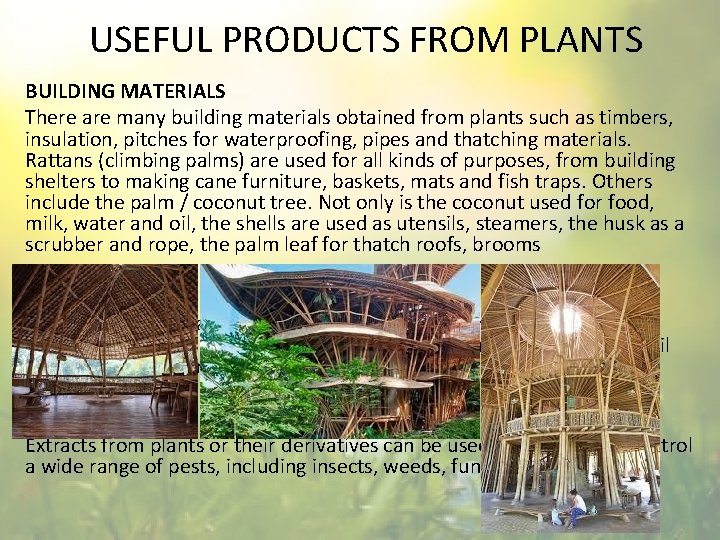
USEFUL PRODUCTS FROM PLANTS BUILDING MATERIALS There are many building materials obtained from plants such as timbers, insulation, pitches for waterproofing, pipes and thatching materials. Rattans (climbing palms) are used for all kinds of purposes, from building shelters to making cane furniture, baskets, mats and fish traps. Others include the palm / coconut tree. Not only is the coconut used for food, milk, water and oil, the shells are used as utensils, steamers, the husk as a scrubber and rope, the palm leaf for thatch roofs, brooms COMPOST All plants and animals decay when they die, recycling nutrients. Rotted plant materials can be used to form compost which can be used as a soil conditioner and to return nutrients to the soil after cropping. PESTICIDES Extracts from plants or their derivatives can be used successfully to control a wide range of pests, including insects, weeds, fungi and rodents.
Importance of Plants in nature. The environment and the climate are largely interlinked with plants. Rainfall, humidity, and temperature are influenced by the presence of plants. Cutting down plants also imbalance the environment which will indirectly affect human life. In every food chain, the plants occupy the first position and lead the chain as a source of food.