
Review Conversion Data Dual Credit Students Who Go


- Slides: 13
Review - Conversion Data Dual Credit Students Who Go On To College Institutional Research Offices at Colleges can contribute to the SCWI initiative by contributing time and resources to tracking students. With proper set-up, data models can be refined such that the time commitment is reasonable. Fleming has shared this model with Durham, Sheridan, and George Brown Colleges. Proper tracking of DC courses and students allow for data analysis related to DC course enrolment, conversion, progression, etc.
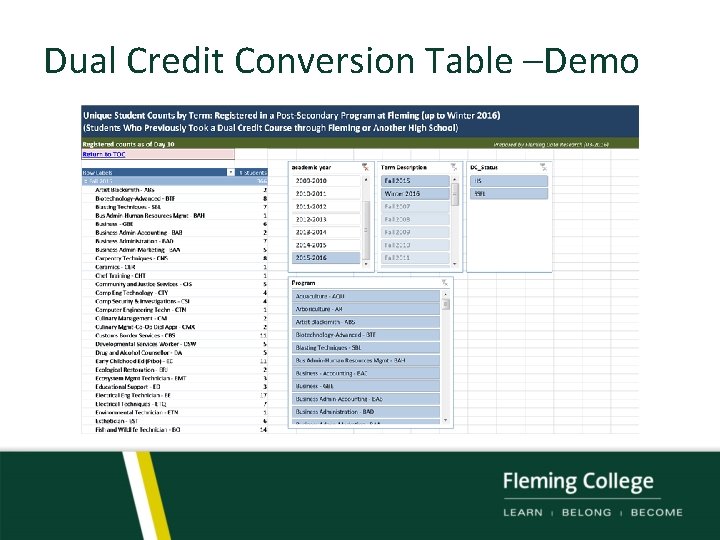
Dual Credit Conversion Table –Demo
Dual Credit Conversion Rates UNIQUE STUDENT COUNTS BY ACADEMIC YEAR Sum of Count of DC_Status 900 800 196 700 600 171 177 182 183 500 133 400 300 129 470 200 100 0 614 261 2011 -2012 502 472 527 337 2012 -2013 -2014 -2015 -2016 -2017 -2018
Dual Credit Footprint – Semester 1 550 500 450 400 350 300 250 200 337 150 100 50 500 470 354 308 219 469 305 162 146 164 2013 -14 (11%*) 2014 -15 (11%*) 2015 -16 (11%*) 118 0 2012 -13 (8%*) Former Fleming DC students Former Other DC students Total DC Students Enrolled at Fleming
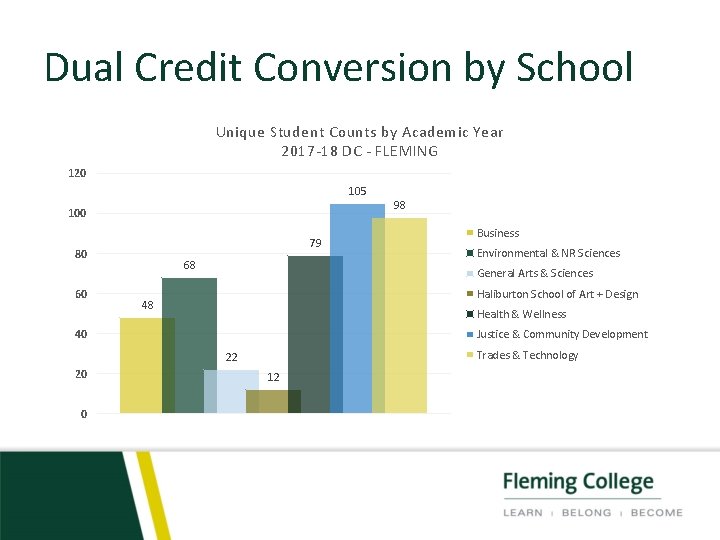
Dual Credit Conversion by School Unique Student Counts by Academic Year 2017 -18 DC - FLEMING 120 105 100 79 80 60 68 Environmental & NR Sciences Haliburton School of Art + Design 48 Health & Wellness Justice & Community Development Trades & Technology 22 0 Business General Arts & Sciences 40 20 98 12
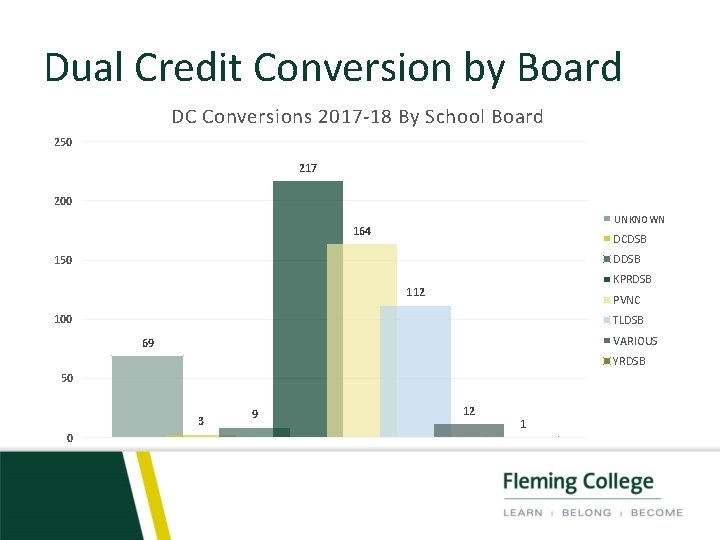
Dual Credit Conversion by Board DC Conversions 2017 -18 By School Board 250 217 200 UNKNOWN 164 DCDSB DDSB 150 KPRDSB 112 PVNC 100 TLDSB VARIOUS 69 YRDSB 50 3 0 9 12 1
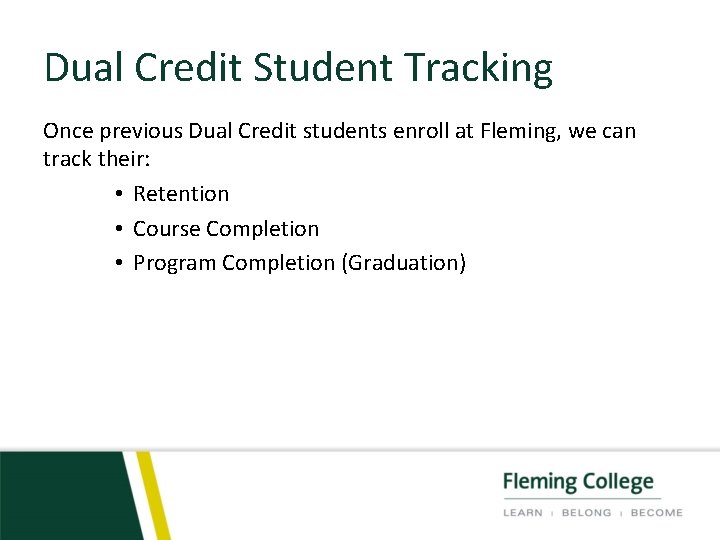
Dual Credit Student Tracking Once previous Dual Credit students enroll at Fleming, we can track their: • Retention • Course Completion • Program Completion (Graduation)
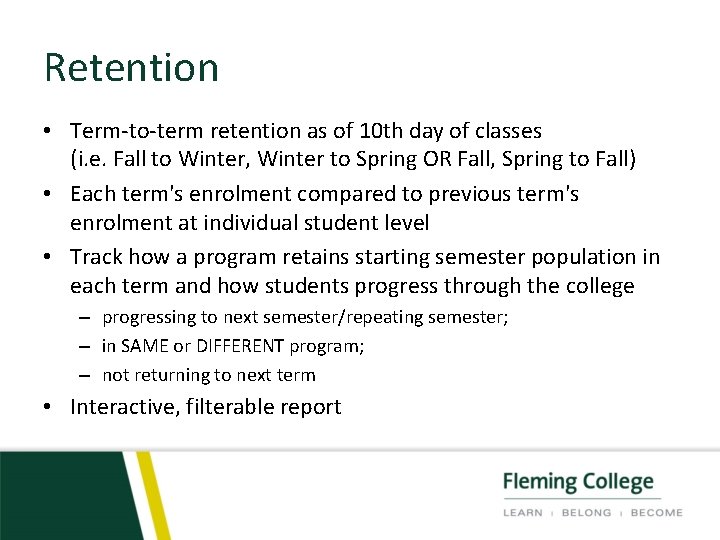
Retention • Term-to-term retention as of 10 th day of classes (i. e. Fall to Winter, Winter to Spring OR Fall, Spring to Fall) • Each term's enrolment compared to previous term's enrolment at individual student level • Track how a program retains starting semester population in each term and how students progress through the college – progressing to next semester/repeating semester; – in SAME or DIFFERENT program; – not returning to next term • Interactive, filterable report
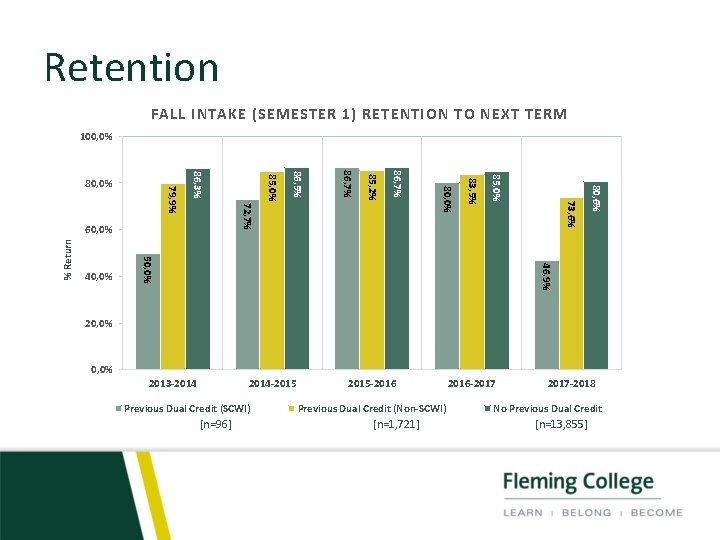
Retention FALL INTAKE (SEMESTER 1) RETENTION TO NEXT TERM 100, 0% 46, 9% 50, 0% % Return 80, 6% 73, 6% 85, 0% 83, 5% 80, 0% 86, 7% 85, 2% 86, 7% 86, 5% 72, 7% 60, 0% 40, 0% 85, 0% 86, 3% 79, 9% 80, 0% 20, 0% 2013 -2014 -2015 Previous Dual Credit (SCWI) [n=96] 2015 -2016 Previous Dual Credit (Non-SCWI) [n=1, 721] 2016 -2017 -2018 No Previous Dual Credit [n=13, 855]
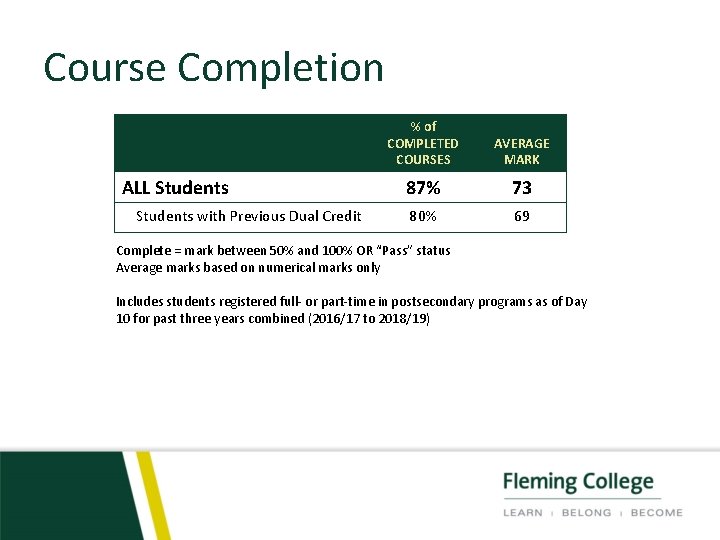
Course Completion ALL Students with Previous Dual Credit % of COMPLETED COURSES AVERAGE MARK 87% 73 80% 69 Complete = mark between 50% and 100% OR “Pass” status Average marks based on numerical marks only Includes students registered full- or part-time in postsecondary programs as of Day 10 for past three years combined (2016/17 to 2018/19)
Program Completion (Graduation) • How long does it take Previous Dual Credit students to complete their postsecondary program? • Based on first postsecondary term at Fleming (after Dual Credit course(s)) • Rough comparison to Overall College KPI Graduation (200% completion timeframe)
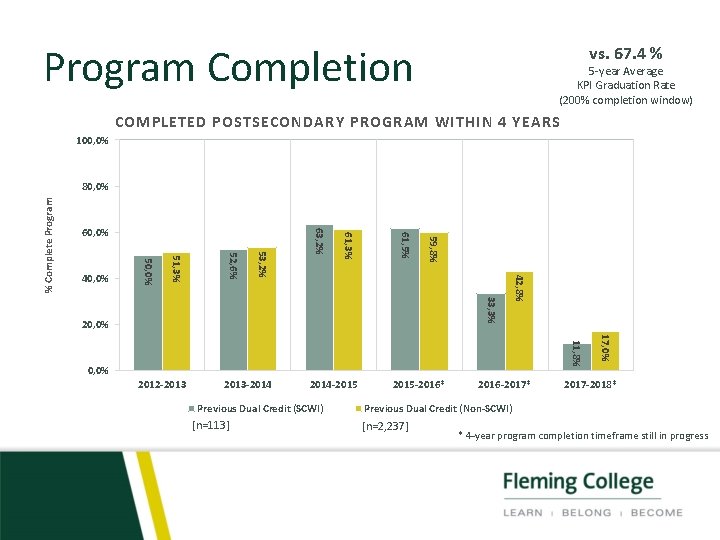
Program Completion vs. 67. 4 % 5 -year Average KPI Graduation Rate (200% completion window) COMPLETED POSTSECONDARY PROGRAM WITHIN 4 YEARS 100, 0% 59, 8% 61, 5% 61, 3% 33, 3% 20, 0% 42, 8% 53, 2% 52, 6% 51, 3% 40, 0% 63, 2% 60, 0% 50, 0% % Complete Program 80, 0% 2012 -2013 -2014 -2015 Previous Dual Credit (SCWI) [n=113] 2015 -2016* 2016 -2017* 17, 0% 11, 8% 0, 0% 2017 -2018* Previous Dual Credit (Non-SCWI) [n=2, 237] * 4 -year program completion timeframe still in progress
Eastern Lakeshore Regional Planning Team