
Review COMPOSITE SANDWICH PANEL UNDER BUCKLING BEHAVIOUR Joko

Review COMPOSITE SANDWICH PANEL UNDER BUCKLING BEHAVIOUR Joko Sedyono Supervisor: Dr Homa Hadavinia Department of Mechanical Engineering, Kingston University London, Roehampton Vale Friars Avenue London SW 15 3 DW
Content • Introduction – Metal-Matrix Composites (MMC) – Ceramic-Matrix Composites (CMC) – Polymer-Matrix Composites (PMC) • Buckling Under Monotonic Loading • Buckling Under Impact Loading • Method of Measurement of Out-of-Plane Deflection Point and Full Field • Post Buckling

Introduction
Composite Material Two inherently different materials that when combined together (macroscopic scale) produce a material with properties that exceed the constituent material (Shafer, 2010)
COMPOSITES Composites can be classified by their matrix material: -Metal matrix composites (MMC’s) -Ceramic matrix composites (CMC’s) -Polymer matrix composites (PMC’s)
MMC - Metal Matrix Composites -The matrix is relatively soft and flexible. -The reinforcement must have high strength and stiffness -Since the load must be transferred from the matrix to the reinforcement, the reinforcement-matrix bond must be strong. MMC use: -Two types of particulates ( dispersion strengthened alloys and regular particulate composites) -Or long fiber reinforcements Keulen, 2010

CMC – Ceramic Matrix Composites -The matrix is relatively hard and brittle -The reinforcement must have high tensile strength to arrest crack growth -The reinforcement must be free to pull out as a crack extends, so the reinforcement-matrix bond must be relatively weak Polymer Matrix Composites -The matrix is relatively soft and flexible -The reinforcement must have high strength and stiffness -Since the load must be transferred from matrix to reinforcement, the reinforcement-matrix bond must be strong (Keulen, 2010)
Polymer-Matrix Composites (PMC)
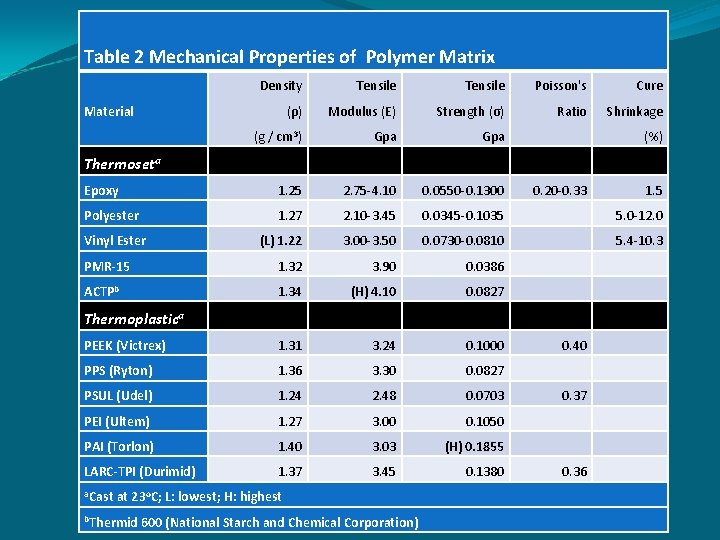
Table 2 Mechanical Properties of Polymer Matrix Density Tensile Poisson's Cure (ρ) Modulus (E) Strength (σ) Ratio Shrinkage (g / cm 3) Gpa Epoxy 1. 25 2. 75 -4. 10 0. 0550 -0. 1300 Polyester 1. 27 2. 10 -3. 45 0. 0345 -0. 1035 5. 0 -12. 0 (L) 1. 22 3. 00 -3. 50 0. 0730 -0. 0810 5. 4 -10. 3 PMR-15 1. 32 3. 90 0. 0386 ACTPb 1. 34 (H) 4. 10 0. 0827 PEEK (Victrex) 1. 31 3. 24 0. 1000 PPS (Ryton) 1. 36 3. 30 0. 0827 PSUL (Udel) 1. 24 2. 48 0. 0703 PEI (Ultem) 1. 27 3. 00 0. 1050 PAI (Torlon) 1. 40 3. 03 (H) 0. 1855 LARC-TPI (Durimid) 1. 37 3. 45 0. 1380 Material (%) Thermoseta Vinyl Ester 0. 20 -0. 33 Thermoplastica a. Cast at 23 o. C; L: lowest; H: highest b. Thermid 600 (National Starch and Chemical Corporation) 0. 40 0. 37 0. 36 1. 5

Fibre
Natural fibres


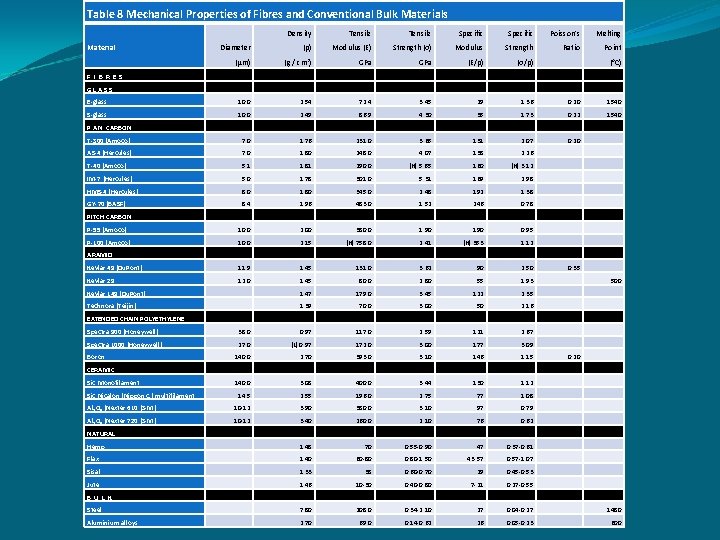
Table 8 Mechanical Properties of Fibres and Conventional Bulk Materials Material Density Tensile Specific Poisson's Melting Diameter (ρ) Modulus (E) Strength (σ) Modulus Strength Ratio Point (µm) cm 3) GPa (E/ρ) (σ/ρ) (g / (o. C) F I B R E S GLASS E-glass 10. 0 2. 54 72. 4 3. 45 29 1. 36 0. 20 1540 S-glass 10. 0 2. 49 86. 9 4. 30 35 1. 73 0. 22 1540 T-300 (Amoco) 7. 0 1. 76 231. 0 3. 65 131 2. 07 0. 20 AS-4 (Hercules) 7. 0 1. 80 248. 0 4. 07 138 2. 26 T-40 (Amoco) 5. 1 1. 81 290. 0 (H) 5. 65 160 (H) 3. 12 IM-7 (Hercules) 5. 0 1. 78 301. 0 5. 31 169 2. 98 HMS-4 (Hercules) 8. 0 1. 80 345. 0 2. 48 192 1. 38 GY-70 (BASF) 8. 4 1. 96 483. 0 1. 52 246 0. 78 P-55 (Amoco) 10. 0 2. 00 380. 0 1. 90 190 0. 95 P-100 (Amoco) 10. 0 2. 15 (H) 758. 0 2. 41 (H) 353 1. 12 Kevlar 49 (Du. Pont) 11. 9 1. 45 131. 0 3. 62 90 2. 50 Kevlar 29 12. 0 1. 45 80. 0 2. 80 55 1. 93 Kevlar 149 (Du. Pont) 1. 47 179. 0 3. 45 122 2. 35 Technora (Teijin) 1. 39 70. 0 3. 00 50 2. 16 P A N CARBON PITCH CARBON ARAMID 0. 35 500 EXTENDED CHAIN POLYETHYLENE Spectra 900 (Honeywell) 38. 0 0. 97 117. 0 2. 59 121 2. 67 Spectra 1000 (Honeywell) 27. 0 (L) 0. 97 172. 0 3. 00 177 3. 09 140. 0 2. 70 393. 0 3. 10 146 1. 15 140. 0 3. 08 400. 0 3. 44 130 1. 12 14. 5 2. 55 196. 0 2. 75 77 1. 08 Al 2 O 3 (Nexter 610 (3 -M) 10 -12 3. 90 380. 0 3. 10 97 0. 79 Al 2 O 3 (Nexter 720 (3 -M) 10 -12 3. 40 260. 0 2. 10 76 0. 62 Boron 0. 20 CERAMIC Si. C Monofilament Si. C Nicalon (Nippon c. ) multifilament NATURAL Hemp 1. 48 70 0. 55 -0. 90 47 0. 37 -0. 61 Flax 1. 40 60 -80 0. 80 -1. 50 43 -57 0. 57 -1. 07 Sisal 1. 33 38 0. 60 -0. 70 29 0. 45 -0. 53 Jute 1. 46 10 -30 0. 40 -0. 80 7 -21 0. 27 -0. 55 Steel 7. 80 208. 0 0. 34 -2. 10 27 0. 04 -0. 27 1480 Aluminium alloys 2. 70 69. 0 0. 14 -0. 62 26 0. 05 -0. 23 600 B U L K
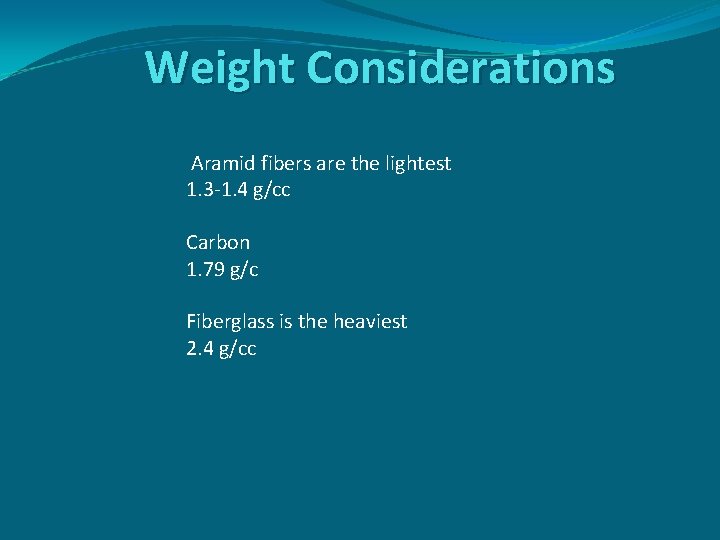
Weight Considerations Aramid fibers are the lightest 1. 3 -1. 4 g/cc Carbon 1. 79 g/c Fiberglass is the heaviest 2. 4 g/cc
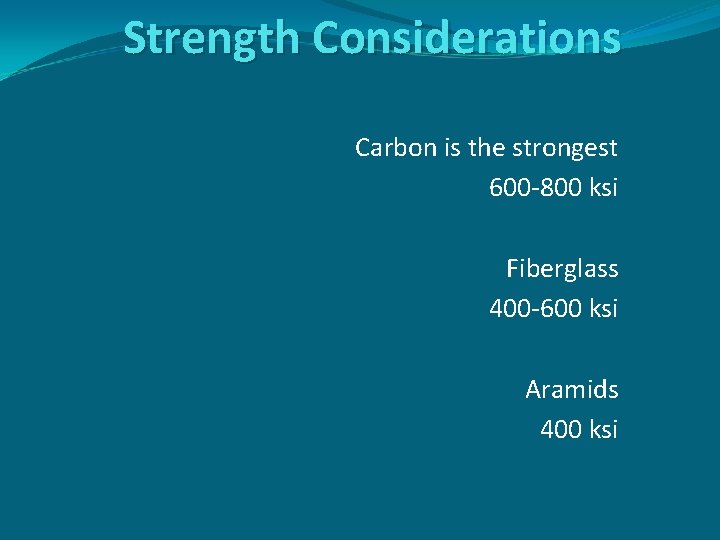
Strength Considerations Carbon is the strongest 600 -800 ksi Fiberglass 400 -600 ksi Aramids 400 ksi
Impact Resistance Kevlar is the toughest Fiberglass Carbon
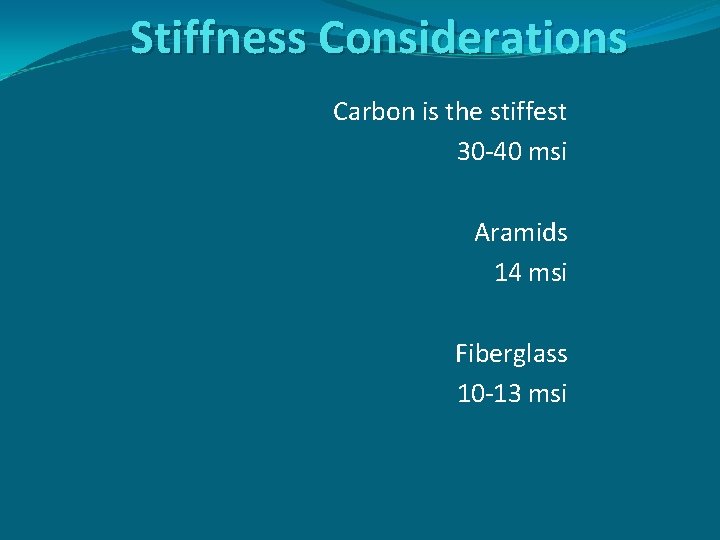
Stiffness Considerations Carbon is the stiffest 30 -40 msi Aramids 14 msi Fiberglass 10 -13 msi
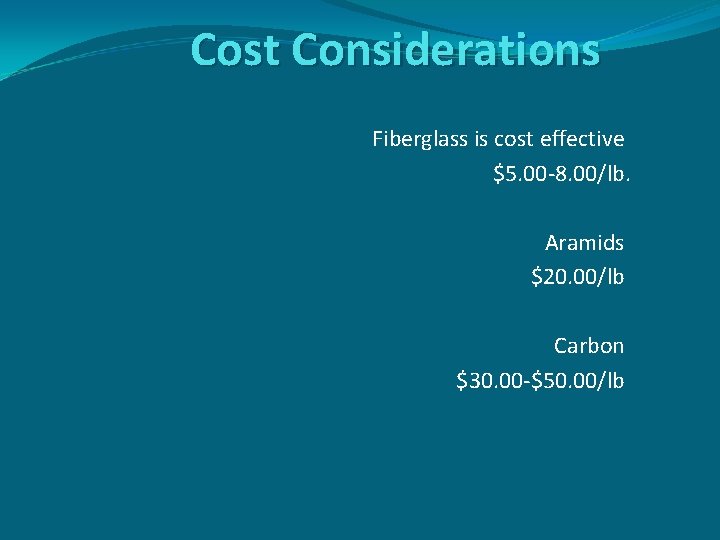
Cost Considerations Fiberglass is cost effective $5. 00 -8. 00/lb. Aramids $20. 00/lb Carbon $30. 00 -$50. 00/lb
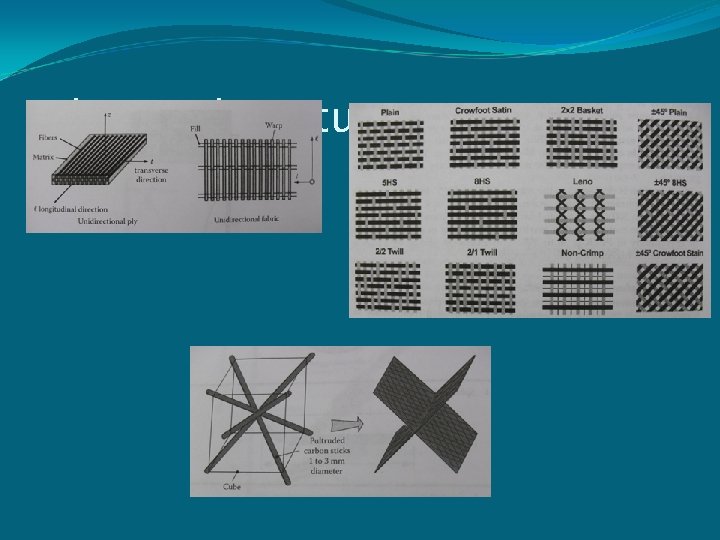
Fibre architecture
![Table 9 Mechanical Properties of Various Prepreg Materials [7] Fibre Volume Tensile Fraction Modulus](http://slidetodoc.com/presentation_image_h2/9cada912823f6d47a443b1a2a6eb41a1/image-21.jpg "Table 9 Mechanical Properties of Various Prepreg Materials [7] Fibre Volume Tensile Fraction Modulus")
Table 9 Mechanical Properties of Various Prepreg Materials [7] Fibre Volume Tensile Fraction Modulus Strength (%) (GPa) Carbon (AS 4, T-300)/epoxy 55 -65 103 -151. 8 1. 242 -2. 208 Carbon (IM 7)/epoxy 55 -60 138 -172. 5 2. 208 -3. 036 (Highest) S-2 glass/epoxy 55 -63 41. 4 -55. 2 0. 828 -1. 587 Kevlar/epoxy 55 -60 69 0. 966 Carbon (AS 4)/bismaleimide 55 -62 103. 5 -151. 8 1. 38 -2. 208 Carbon (IM 7)/bismaleimide 60 -66 138 -172. 5 2. 622 -2. 76 Carbon (IM 7)/cyanate ester 55 -63 138 -172. 5 0. 69 -2. 7255 S-2 glass/cyanate ester 55 -60 48. 3 1. 242 Carbon (IM 7)/PEEK 57 -63 179. 4 (highest) 2. 829 Carbon (G 34/700)/Nylon 6 55 -62 110. 4 1. 4904 Aramid/Nylon 12 52 46. 92 1. 4145 Carbon (AS 4)/PPS 64 120. 75 1. 9665 Carbon (IM 7)/polyimide 62 172. 5 2. 622 Carbon (AS 4)/epoxy 57 -63 55. 2 -62. 1 0. 5175 -0. 8556 S-2 glass/epoxy 55 34. 5 0. 552 58 -62 69 -124. 2 0. 897 -1. 0695 Prepreg Material Unidirectional thermoset Unidirectional thermoplastic Fabric (plain weave) thermoset Fabric (plain weave) thermoplastic tape Carbon HM (T 650 -35)/polyimide
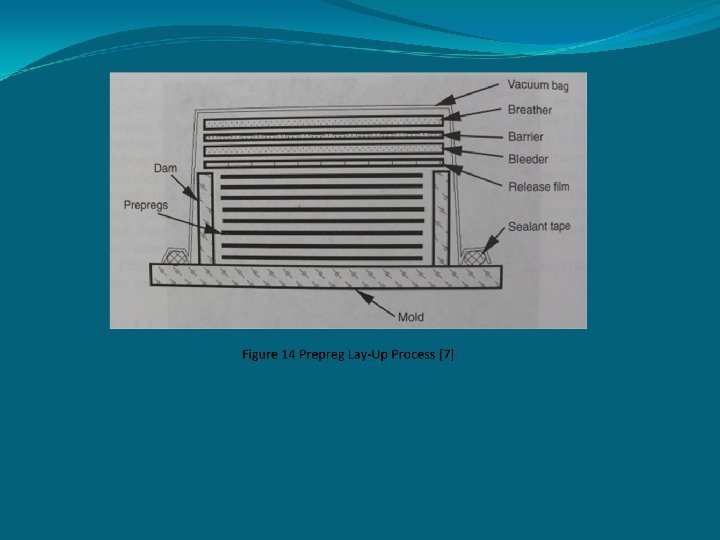
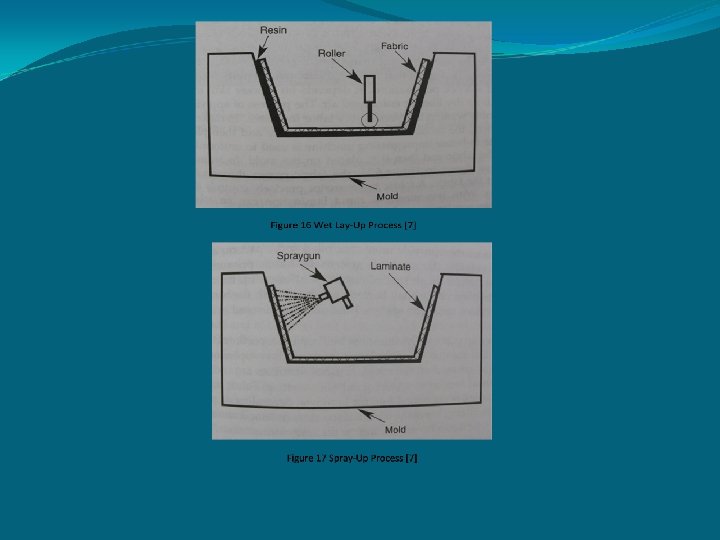
![Figure 30 Photos and Schematic Drawing of A Micro-Braided Yarn [8]](http://slidetodoc.com/presentation_image_h2/9cada912823f6d47a443b1a2a6eb41a1/image-30.jpg "Figure 30 Photos and Schematic Drawing of A Micro-Braided Yarn [8]")
Figure 30 Photos and Schematic Drawing of A Micro-Braided Yarn [8]

- Slides: 31