
Review CLASSIFYING EXPLORING LIFE MATCHING A 1 Having





- Slides: 11
Review CLASSIFYING & EXPLORING LIFE
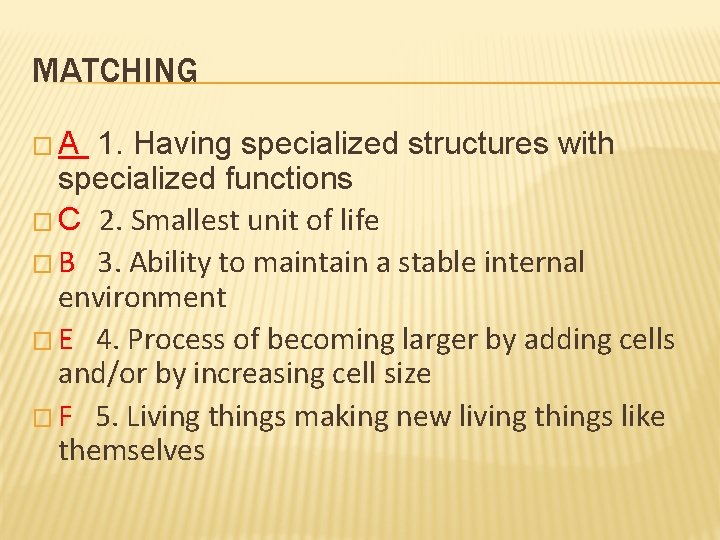
MATCHING �A 1. Having specialized structures with specialized functions � C 2. Smallest unit of life � B 3. Ability to maintain a stable internal environment � E 4. Process of becoming larger by adding cells and/or by increasing cell size � F 5. Living things making new living things like themselves
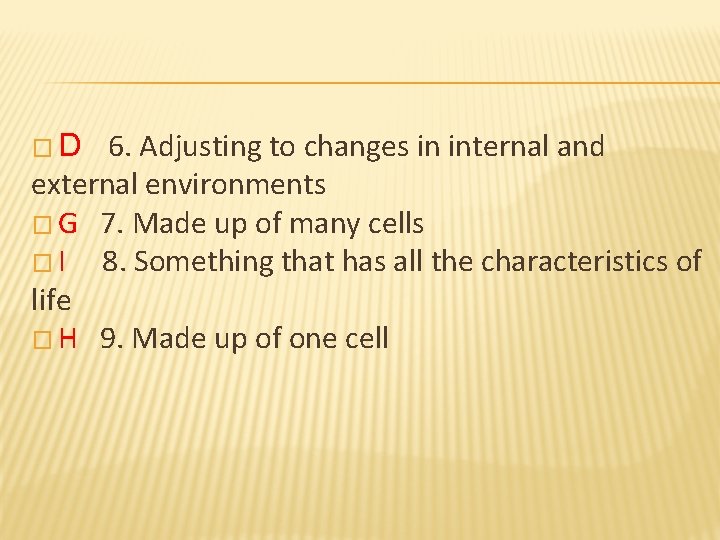
6. Adjusting to changes in internal and external environments � G 7. Made up of many cells �I 8. Something that has all the characteristics of life � H 9. Made up of one cell �D
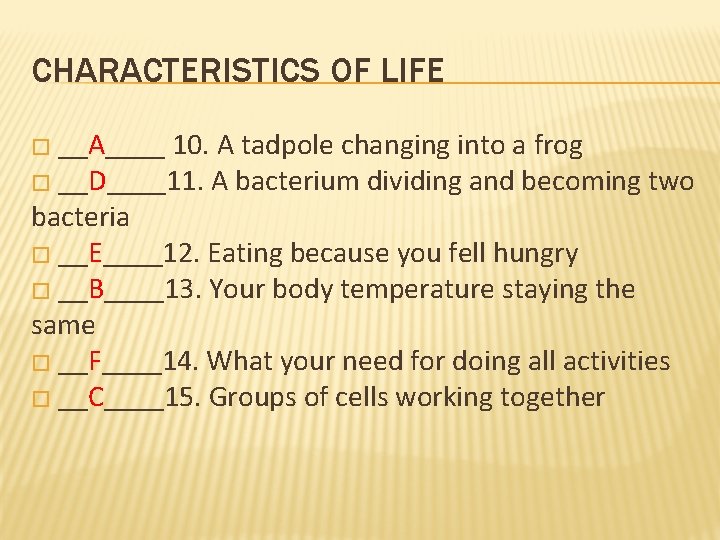
CHARACTERISTICS OF LIFE � __A____ 10. A tadpole changing into a frog � __D____11. A bacterium dividing and becoming two bacteria � __E____12. Eating because you fell hungry � __B____13. Your body temperature staying the same � __F____14. What your need for doing all activities � __C____15. Groups of cells working together
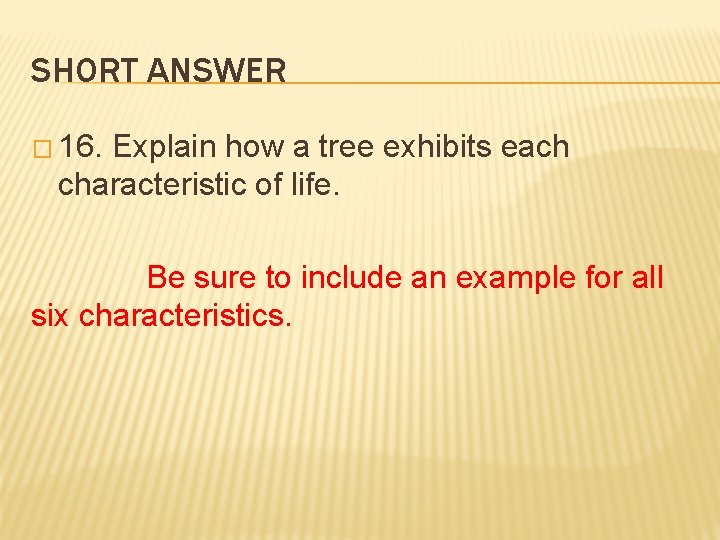
SHORT ANSWER � 16. Explain how a tree exhibits each characteristic of life. Be sure to include an example for all six characteristics.
� 17. Explain the difference between a unicellular organism and a multicellular organism. A unicellular organism is made up of one cell. A multicellular organism is made up of two or more cells.
CONCEPT MAP � 18. Organization � 19. Growth and Development � 20. Uses energy � 21. Homeostasis � 22. Reproduction � 23. Response to stimuli
DICHOTOMOUS KEY � 1. � 2. � 3. � 4. � 5. � 6. � 7. � 8. Norno beverlus Norno dallus Norno rajus Norno kentuckyus Norno californius Norno wala Norno dakotus Norno yorkio
� 32. The two main types of microscopes are the compound microscope and the light microscope. � 33. A(n) electron microscope uses a magnetic field to focus a beam of electrons through an object or onto an object’s surface.
PRACTICE � 34. If the ocular lens of a microscope has 10 x magnification and the objective lens has 40 x magnification, what is the total magnification? 10 x 40 = 400
� 35. A student observes a sample of onion root cells under a microscope with a 10 x ocular lens and a 50 x objective lens. How much larger do the cells appear under the microscope? 10 x 50 = 500